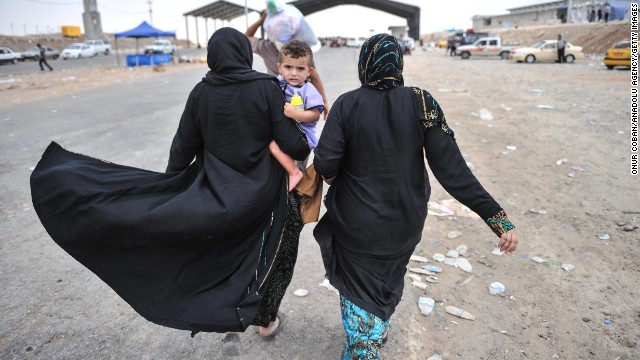
News Focus
News Focus
icon url

fuagf

06/26/14 11:52 PM

#224394 RE: fuagf #224392

Precarious Relationship Between The Islamic State of Iraq And The Baathist Naqshibandi

Wednesday, June 25, 2014


Jaysh Rijal al-Tariq al-Naqshibandi (JRTN) is the Baathist insurgent group led by Izzat Ibrahim al-Douri, Saddam Hussein’s former number two. After the Islamic State of Iraq and the Levant (ISIS) the Baathists are one of the largest insurgent groups in the country. Those two organizations have had a very rough relationship. For years the two have cooperated in carrying out attacks in Iraq with one usually providing the money and planning, while the other launches the operation. Now however ISIS is demanding that JRTN units pledge allegiance to it, which has been resisted.

---
[ INSERT: sounds a territorial war, as ISIS ran into trouble with in Syria ..

"Syria should have been ISIS’s greatest moment, but things didn’t work out for it there. Not because it was “extreme,” but because it tried too hard to dominate the market against savvy local competition. Syria was a wide-open market for jihadi organizers, free to operate openly over most of the country after decades of effective repression. Money was pouring in from fat armchair jihadis .. http://pando.com/2013/12/19/the-war-nerd-saudis-syria-and-blowback/ .. in Saudi, Kuwait, and the Emirates—enough to pay jihadis a first-world salary of $1,500/mo .. http://www.al-monitor.com/pulse/fr/contents/articles/security/2013/09/turkish-fighters-syria-opposition.html# . If you had a good line of patter and a few Quranic passages memorized, you could score some investment money. And military entrepreneurs poured in to take advantage of the opportunity; so many that by 2013, there were 1,200 different jihadi groups operating in Syria."
http://investorshub.advfn.com/boards/read_msg.aspx?message_id=103403857
---

That has led to several clashes between the two in Kirkuk, Ninewa, and Diyala provinces. These cracks in the insurgency have continued in the midst of their uprising against Baghdad, and are likely to grow in the future.


The Baathist Naqshibandi have had a difficult relationship with ISIS over the last few months leading to
constant clashes between the two (Wikipedia)

Starting this spring there have been continued reports of clashes between the JRTN and ISIS. The latest lasted several days in Kirkuk province. The fighting started in Riyad on June 20 .. http://english.shafaaq.com/index.php/security/10251-isil-kidnap-naqshbandi-leader-in-kirkuk-due-to-influence-conflict .. when ISIS allegedly confiscated the weapons of a Naqshibandi unit and kidnapped one of its leaders, and told it that it had to pledge allegiance to the Islamic State. When the JRTN refused there was a gunfight that left 9 Naqshibandi and 8 ISIS fighters dead. An alternative story .. http://news.yahoo.com/sunni-militant-infighting-kills-17-iraqs-kirkuk-082536502.html .. emerged that the two might have been fighting over money that would come from a number of fuel tankers that JRTN was using. Two days later shooting broke out again .. http://www.reuters.com/article/2014/06/22/us-iraq-security-idUSKBN0EX0BJ20140622 .. in the same area leaving 10 dead, and the next day an IED was set off .. http://www.ninanews.com/english/News_Details.asp?ar95_VQ=HFDMED .. against an ISIS convoy killing one and wounding two. These were just the most recent incidents between the two. On June 16 .. http://alrayy.com/113671.htm .. for example, 12 insurgents died in Mosul after the JRTN’s Military Council criticized the Islamic State’s code of conduct for the city. Control over the money .. http://burathanews.com/news/239355.html .. seized in Mosul might have been an issue as well. Those all occurred after the current uprising started, but the two had been arguing over the same issues for months beforehand. On May 28 .. http://www.alrafidayn.com/arabic/index.php/responsive/1971-2014-06-03-08-25-11 .. ISIS killed 8 Naqshibandi fighters in Baiji, Salahaddin because the Islamic State told them they had to follow its lead. JRTN retaliated by setting up an ambush for an ISIS leader and two of his aides in the Hamrin area of Diyala. Earlier on May 2 .. http://tiny.cc/o5f3hx .. there was a news report that the Baathists had authorized the killing of ISIS members in Diyala after it had killed six of its leaders since January 2014. For instance, the Islamic State murdered a Naqshibandi commander and his son in Hamrin on April 7 .. http://burathanews.com/news/233828.html . A member of the Diyala provincial council claimed .. http://burathanews.com/news/238056.html .. that the conflict between the two cost ISIS up to 70 fighters a not insignificant number. Publicly the Baathists have denied .. http://tiny.cc/x9f3hx .. that there are any problems between it and the Islamic State. That shows the basic inequality between the insurgent organizations. ISIS is by far the most well armed and organized militant group in Iraq. The JRTN is in effect living in its shadow willing to cooperate with it, but not give its loyalty since the two have diametrically opposed worldviews. ISIS wants to create an Islamic State across the Muslim world, while the Naqshibandi want to restore Baathist rule in Iraq. These differences will persist in the future, and likely grow in intensity as the insurgency spreads to new areas of the country.

As ISIS takes more territory and attempts to administer it more examples of these conflicts with not only JRTN but other insurgent groups will emerge. ISIS and its predecessor Al Qaeda in Iraq have a long history of trying to impose itself upon others. That’s especially true of the Islamic State who sees itself as a vanguard in the jihadist movement, which all others should follow. Already in Syria it has fought not only the Assad government, but various other opponents of the regime. The Americans were able to play upon these divisions with the insurgency with the Anbar Awakening and Sons of Iraq that were instrumental in turning the tide during the civil war years. Now it is nearly impossible to imagine Prime Minister Nouri al-Maliki or any other Shiite premier making a deal with Baathists or other Islamist groups to turn on ISIS since all are seen as existential threats to the state and Shiite rule. The results are a lost opportunity to turn the militants upon themselves, which will mean more fighting in the long run.

SOURCES

http://musingsoniraq.blogspot.com.au/2014/06/precarious-relationship-between-islamic.html

.. seems in that one there is more good reason for Americans not to rush into bombing in Iraq, and not to cull the terrorists either, 70 ISIS killed with no? civilian causalities, is tough to beat .. it's damn hard, but concentration on containment while letting the locals look after it feels the best way to go .. and working on easing the sectarian stuff which Maliki says basically doesn't exist .. hmm, could always draft the most violent American militias, and the most radical Sovereign Citizens and send them over .. they could choose which side they wanted to fight on ..

See also:

The War Nerd: Here’s everything you need to know about “too extreme for Al Qaeda” I.S.I.S.
http://investorshub.advfn.com/boards/read_msg.aspx?message_id=103403857 .. insert above also ..

Some Mid-East stuff .. Sunni-Shiite unity meeting seeks to defuse tensions in Iraq
http://investorshub.advfn.com/boards/read_msg.aspx?message_id=103449298

Iran Is Deploying Drones in Iraq. Wait, What? Iran Has Drones?
http://investorshub.advfn.com/boards/read_msg.aspx?message_id=103763267

In Rare Consensus, Sunnis and Shiites Tell Cheney to Shut Up
http://investorshub.advfn.com/boards/read_msg.aspx?message_id=103740257

This is One of the Craziest Fox News Rants Ever, and It’s Not Hannity or O’Reilly
http://investorshub.advfn.com/boards/read_msg.aspx?message_id=103764984

Judge Jeanine Pirro who/what/where!!! .. sheesh, lol, comedian Russell Brand's video, in the one that one replies to, is worth a watch.


icon url

fuagf

07/28/14 1:50 AM

#226243 RE: fuagf #224392

The Bend of Power

How the U.S. military can overcome the challenges of complexity in a rapidly changing world.

BY Martin E. Dempsey
JULY 25, 2014


When my father was drafted into the Army during World War II, the challenges were immense, but the military end states were clear. Germany had invaded its neighbors and Japan had attacked the United States. Diplomacy and sanctions had failed. Force was the only option left. Together with our allies, the U.S. armed forces did what militaries have done for generations: used lethal force to compel an enemy to surrender.

After 1945, the U.S. military became smaller, but the burdens of global leadership caused our obligations to grow. We increased our capabilities and reorganized our national-security apparatus to contain the communist powers. The United States led the way in replacing the old system of European colonies with a more stable order of shared norms, multilateral institutions, and interdependent markets.

This new order did not sustain itself on its own. It required constant care, attention, and defense, much of which was done by the U.S. military. In its new role as guarantor of the international order, the U.S. armed forces became the hard-power foundation of global security -- which protected and promoted our interests, our friends, and the norms that bound us together.

In the past half-century, we've enjoyed some notable successes. Our European partners grew into a strong and capable alliance and many former colonies evolved into stable, democratic states. East Asia embraced free markets and emerged more prosperous than ever before. The Soviet Union collapsed under the weight of its own contradictions. The values we fought for in World War II and the Cold War began to coalesce into widely shared norms.

But a new century brought new dangers. In each region of the world, we face serious -- but very different -- security challenges, from rising state-to-state tensions in Asia and Europe to escalating sub-state violence in the Middle East and North Africa. Moreover, technologies and capabilities once confined to states are moving beyond their control. The result is an international order under duress with as many things working to pull the world apart as to pull it together.

Just like after 1945, we now confront a situation in which the U.S. military is shrinking as calls for our leadership around the globe are expanding. With the opportunity cost of each of our actions increasing, we must be judicious in the application of military force and seize innovative ways to use it to best effect.

The U.S. military is up to this challenge. We are becoming more agile in how we manage our forces, employing our assets around the globe in dynamic and purposeful ways. We are updating our efforts to build the capacity of our partners, emphasizing regional and multilateral approaches. We are better integrating military efforts with those of the other instruments of national power, including diplomacy and economics. Ultimately, the United States must continue to underwrite the international order.

Shifting Power

The scholar and former Foreign Policy editor Moisés Naím argues in The End of Power that technology and demographics are changing the ways people interact and compete around the world. I agree. Traditional power structures are losing their monopolies on authority in many areas of human affairs. In politics, disparate protest movements are challenging governments by coordinating their efforts over the Internet and through social media. In business, blue-chip corporations are losing ground to start-ups, hedge funds, and independent innovators.

---
"Everywhere, individuals have more access to power than ever before -- large
hierarchical organizations are losing out to newer, better-networked actors.
"
---

Everywhere, individuals have more access to power than ever before -- large hierarchical organizations are losing out to newer, better-networked actors.

Some aspects of this diffusion of power are certainly good. But in the realm of security, it raises serious concerns. There are some tools that only responsible governments should possess -- no one wants a world in which rogue regimes and nonstate actors field nuclear weapons, for example. There are also some tools that only responsible governments do possess; when major crises occur, whether natural or man-made, it is only these states that have the infrastructure and resources to respond effectively. In short, more participation and more competition are not necessarily desirable in the security realm. Strong states and institutions bring stability. Weak ones breed confrontation and chaos.

It would be difficult enough if all we had to grapple with was what Naím calls the "decay of power." But the way power relationships are changing varies greatly from region to region across the globe.

In Asia, states are rapidly expanding their militaries while territorial disputes heighten the risk of miscalculation. The U.S. security umbrella and decades of diplomatic and military efforts have helped facilitate Asia's historic rise, but renewed rivalries threaten to reverse the region's progress. Traditional power-on-power relationships will shape Asia's future and ultimately determine whether it becomes the economic engine of the 21st century or a zone of interstate conflict.

In the Middle East and North Africa, centuries-old religious, ethnic, and tribal tensions challenge state authority and fuel violence. As the region wobbles along a fault line extending from Beirut to Damascus to Baghdad, there are no easy solutions for steadying it. In this environment, the traditional use of military power rarely yields expected results.

In Europe, threats from Russia on the eastern flank and extremist groups on the southern flank are growing as countries trend toward parochialism at home. Russia's activities in Ukraine are giving the world a disturbing image of the hybrid nature of military aggression in the 21st century. Europe is approaching an inflection point at which decisions to favor narrow interests or greater unity will transform the region.

Even in our own hemisphere, organized criminal networks to our south pose a looming security threat close to home.

The United States -- and those partners with whom we share common values -- confronts a dizzying assortment of challenges. There's certainly not a one-size-fits-all solution. But there are some common best practices that we should follow. First, wherever possible, we should view problems through a regional lens -- not one country, one group, and one crisis at a time. Second, we should carefully integrate all our instruments of power, making sure that our policies leverage each instrument to its best use.

Played out in real time in the media, the myriad challenges we face can be paralyzing -- unless we have a set of guideposts against which to measure our choices and their consequences.

Historians have argued since the dawn of the written word about whether it is possible for a nation to craft grand strategy. Some suggest that grand strategy is too difficult -- that the grand strategies of the past were only discernible in hindsight, not the result of careful forethought and planning.

Despite cynics' arguments that grand strategy is a thing of the past, it is critical today -- when calls for U.S. leadership and military power shift from crisis to crisis. We need a well-articulated grand strategy that clearly prioritizes what is most important -- one that leverages traditional and new regional partnerships and fully integrates all of the instruments of national power.

Striking the Right Balance

To deal with our most pressing security challenges, the U.S. military will not be the only tool we use, nor should it be the principal one in most circumstances. Often the military is best used in a supporting role -- especially if we want to achieve meaningful and enduring results. And we should "go it alone" only in the rarest of circumstances.

The problems of the Middle East, for example, require much more than hard power. Our experiences there have demonstrated that good governance, economic development, and strong and equitable institutions are prerequisites for sustainable peace. The challenges confronting the Middle East will take a generation or more to resolve, and the people and leaders of the region must lead the way. In such circumstances, patience and perseverance will be necessary -- the changes will not come overnight.

Most problems around the world today do not have quick military fixes. The key is to be selective in how we use military power and to combine it more effectively with diplomatic and economic levers. In the rough-and-tumble world of international politics, force and diplomacy must work hand in hand -- it is the credible threat of violence that gives nonviolent alternatives their strongest appeal. The same is true of economic levers: Sanctions, for example, are most effective when coordinated with other lines of effort. These tools do not operate independently; their full potential is realized through integration.

Over the past 13 years, the U.S. military has rightly revamped our practices to confront the challenges we faced in Iraq and Afghanistan. But as we look ahead to the emerging security environment, it is time for us to bring our military instrument of power back into balance.

"As the U.S. military rebalances, our first consideration is our most traditional
role -- the direct application of force in defense of the nation and its interests.
"

As the U.S. military rebalances, our first consideration is our most traditional role -- the direct application of force in defense of the nation and its interests. America's armed forces keep the United States immune from coercion. This is our foremost charge and it will always be the primary driver of how we structure, train, and equip the force.

To this end, the U.S. military is adapting the way we distribute the force and manage readiness -- a process we call Global Force Management -- to become more predictable for our allies and more confusing to our potential adversaries. We are adjusting our processes so that we can aggregate and disaggregate forces rapidly to shape, deter, and, if necessary, strike. Our force will be smaller, so it must be more agile, more lethal, and postured to project power wherever needed.

Of course, agility has its limits. The size of the military matters. Our nation's elected leaders must ensure the armed forces have the resources they need to protect and promote the nation's security interests.

The emerging security environment also demands that we update our approach to building partner capacity. Armored divisions and bomber wings can blunt our enemies, but they cannot single-handedly preserve the peace. To do that, we need to construct stronger security partnerships with like-minded nations, so that all can contribute to the collective defense.

Building partner capacity has long been a hallmark of America's defense policy. It begins with small-scale efforts: student exchanges, technical training, and conferences. With more established partners, capacity building includes attendance at U.S. service academies and war colleges, multilateral exercises, and foreign military sales. All of these things make our partners more effective and improve our collective ability to respond to real-world crises. They also help build professional military forces that respect civilian control and the rule of law. They yield the benefits of security while sharing the burdens of providing it.

We will continue to focus on building partner capacity, but we must reform our approach to account for the realities of the current security environment. We need to move beyond bilateral capacity building and adopt regional and multilateral approaches. Regional players almost always understand their neighborhood's security challenges better than we do. To make capacity building more effective, we must leverage these countries' unique skills and knowledge to our collective advantage. At the same time, an important lesson of our recent wars is that successful capacity building requires time -- often decades -- and credible partners.

Committing to Leadership

The U.S. military today is one of the most flexible and adaptable tools in America's toolbox. We shape behavior simply by our presence. We strengthen our friends' capabilities in peacetime and enable their operations in combat. We protect the sea-lanes that facilitate global commerce. We defend the norms and institutions that make up the international order.

Our responsibility now is to sharpen that tool and deploy it more effectively -- in a world in which the international order is strained but still intact.

After World War II, the United States accounted for half of global GDP and stood at the apex of its power. Instead of leveraging this power to serve narrow national interests, we helped rebuild the world and laid the foundations of the international order we all enjoy today.

Everyone has a stake in keeping this system functioning. We must continue to lead -- and that requires an agile, modern, and smartly postured force. We cannot continue to put off much-needed maintenance and modernization.

The security environment today is more complex than it has been at any other time in my 40-year Army career. But the U.S. military remains as committed as ever to underwriting peace and stability around the world. We will not shrink from the challenges of complexity. We will adapt ourselves to overcome them.

TAUSEEF MUSTAFA/AFP/Getty Images

http://www.foreignpolicy.com/articles/2014/07/25/the_bend_of_power_us_leadership_military_martin_dempsey

===

Dempsey: Russian Attacks Change Europe’s Security Landscape

By Claudette Roulo
DoD News, Defense Media Activity

ASPEN, Colo., July 25, 2014 – Russia’s decision to fire artillery from within Russia onto Ukrainian military positions transforms
the security environment throughout Eastern Europe, the chairman of the Joint Chiefs of Staff said here yesterday.


Army Gen. Martin E. Dempsey, chairman of the Joint Chiefs of Staff, addresses the Aspen Security Forum in Aspen, Colo., July 24, 2014. DoD photo by Army Staff Sgt. Sean K. Harp
(Click photo for screen-resolution image);high-resolution image available.

“You’ve got a Russian government that has made the conscious decision to use its military force inside of another sovereign nation to achieve its objectives -- first time, I think, probably, since 1939 or so that that’s been the case,” Army Gen. Martin E. Dempsey said at the Aspen Security Forum.

Russian leader Josef Stalin invaded Poland on Sept. 17, 1939, claiming to be protecting ethnic minorities living there.

The military actions in Ukraine mark a change in the relationship between Europe and Russia, and between the United States and Russia, Dempsey said, though the true meaning of the change isn’t yet defined.

Since 2008, the Russian military has increased its capability, its proficiency, and the level of its long-range aviation and air-launch cruise missile testing activities, the chairman said.

“They clearly are on a path to assert themselves differently, not just in Eastern Europe, but in Europe in the main and toward the United States,” he said.

The next thing that must happen is to define what these changes mean for NATO, Dempsey said, noting that NATO was created to increase stability and offset Soviet aggression at the time while maintaining a stable Europe.

“And we’ve been successful at it for 60 years,” he added.

Suggestions that the U.S. withdrawals from Iraq and Afghanistan caused the nation to appear weak or unwilling to use force and created an opening for the Russian military actions in Ukraine are without merit, the chairman said.

“I think this is very clearly [Russian President Vladimir] Putin, the man himself, with a vision for Europe, as he sees it, to what he considers to be an effort to redress grievances that were burdened upon Russia after the fall of the Soviet Union, and also to appeal to ethnic Russian enclaves across Eastern Europe with … a foreign policy objective, but also a domestic policy objective,” Dempsey said. “And he’s very aggressive about it, and he’s got a playbook that has worked for him now two or three times. And he will continue to [use it].”

Russia’s violations of Ukraine’s sovereignty have triggered a rise in nationalism around Europe, the chairman said. “If I have a fear about this,” he added, “it’s that Putin may actually light a fire that he loses control of.”

Dempsey said he believes in keeping an open line of communication with his Russian counterpart, Army Gen. Valery Gerasimov, the chief of the General Staff.

“I think that the Russian military is probably reluctant -- -- you know, this is risky for me to say this, and 10 of them could end up in a gulag tomorrow -- but I think that the Russian military and its leaders that I know are probably somewhat reluctant participants in this form of warfare,” he said.

His real concern, the chairman said, is that having this fire in an isolated part of Eastern Europe may not stay in Eastern Europe.

“And I think that’s a real risk,” he added. “So I am maintaining an open line of communication with my counterpart, and so far, he’s doing the same with me.”

The United States isn’t sitting idly by as these events unfold, the nation’s top military officer said. An active process is going on to determine what support can be provided to Ukraine, he said, and the United States is working with its NATO allies to build capability and readiness.

In addition, he said, “we’re looking inside of our own readiness models to look at things we haven’t had to look at for 20 years, frankly, about basing and lines of communication and sea lanes.”

(Follow Claudette Roulo on Twitter: @roulododnews)

http://www.defense.gov/news/newsarticle.aspx?id=122751

.. lol, in posting the first one i had to push aside a touch of 'military apologist'
feeling .. but it's reality isn't it, and at a glance it read a fair look at the situation ..

the other day in a Ukraine mention moment i was moved to remind a guy of the shooting down of ..

Iran Air Flight 655 was an Iran Air civilian passenger flight from Tehran to Dubai that was shot down by the United States Navy guided missile cruiser USS Vincennes on 3 July 1988. The incident took place in Iranian airspace, over Iran's territorial waters in the Persian Gulf, and on the flight's usual flight path. The aircraft, an Airbus A300 B2-203, was destroyed by SM-2MR surface-to-air missiles fired from the Vincennes. .. http://en.wikipedia.org/wiki/Iran_Air_Flight_655

See also:

'Iran Awakening,' by Shirin Ebadi ..
http://investorshub.advfn.com/boards/read_msg.aspx?message_id=66034916

icon url

fuagf

08/08/14 7:57 PM

#226753 RE: fuagf #224392

Bush deBaathification, al-Malicki Shiafication, lie as the root of the success of the Sunni Islamic state. Sunni groups who might have opposed IS have joined it because they are excluded from the Iraq government. The Sadrists are in favor of al-Maliki's Shiafication so "ending de-Baathification" is "unlikely to come about." Obama's repeated calls for an inclusive government have been aimed at the core "but" [even] "it is no panacea for the deep structural problems facing Iraq."


icon url

fuagf

08/09/14 8:47 AM

#226761 RE: fuagf #224392

Who's to blame for Iraq crisis

By Derek Harvey and Michael Pregent
June 12, 2014 -- Updated 1812 GMT (0212 HKT)


Iraqi civilians from Mosul escape to a refugee camp near Erbil, Iraq, on Thursday, June 12.
More than 500,000 people fled in fear after extremist militants overran Mosul, Iraq's
second-largest city, on June 10, the International Organization for Migration said.

[15 images]


STORY HIGHLIGHTS

* Writers: Troop collapse in Mosul predictable since Iraq's politicization of security forces
* Prime Minister marginalized Sunnis, Kurds, replaced them with Shiite loyalists, they say
* Writers: He's dismantled Sunni "Awakening" forces that helped rout al Qaeda in Iraq
* Nuri al-Maliki should seek security forces he's shunned, but he's unlikely to, they say

Editor's note: Derek Harvey is a former senior intelligence official who worked on Iraq from 2003-2009, including numerous assignments in Baghdad. Michael Pregent is a former U.S. Army officer and former senior intelligence analyst who worked on Iraq from 2003-2011, including in Mosul 2005-2006 and Baghdad in 2007-2010. The opinions expressed in this commentary are solely those of the authors.

(CNN) -- Observers around the world are stunned by the speed and scope of this week's assaults on every major city in the upper Tigris River Valley -- including Mosul, Iraq's second-largest city -- by the Islamic State of Iraq and Syria, or ISIS. But they shouldn't be. The collapse of the Iraqi government's troops in Mosul and other northern cities in the face of Sunni militant resistance has been the predictable culmination of a long deterioration, brought on by the government's politicization of its security forces.

The politicization of the Iraqi military

For more than five years, Prime Minister Nuri al-Maliki and his ministers have presided over the packing of the Iraqi military and police with Shiite loyalists .. http://www.understandingwar.org/sites/default/files/Malikis-Authoritarian-Regime-Web.pdf -- in both the general officer ranks and the rank and file -- while sidelining many effective commanders who led Iraqi troops in the battlefield gains of 2007-2010, a period during which al Qaeda in Iraq (the forerunner of the Islamic State of Iraq and Syria) was brought to the brink of extinction.

Al-Maliki's "Shiafication" of the Iraqi security forces has been less about the security of Iraq than the security of Baghdad and his regime. Even before the end of the U.S.-led "surge" in 2008 .. http://www.cnn.com/2008/WORLD/meast/06/23/iraq.security/ , al-Maliki began a concerted effort to replace effective Sunni and Kurdish commanders and intelligence officers in the key mixed-sect areas of Baghdad, Diyala and Salaheddin provinces to ensure that Iraqi units focused on fighting Sunni insurgents while leaving loyal Shiite militias alone -- and to alleviate al-Maliki's irrational fears of a military coup against his government.

[VIDEOS]
Militants press forward in Iraq
How militants are achieving their goal
More fighting ahead in Iraq?
Cities under siege in Iraq

In 2008, al-Maliki began replacing effective Kurdish commanders and soldiers in Mosul and Tal Afar with Shiite loyalists from Baghdad and the Prime Minister's Dawa Party, and even Shiite militia members from the south. A number of nonloyalist commanders were forced to resign in the face of trumped up charges or reassigned to desk jobs and replaced with al-Maliki loyalists. The moves were made to marginalize Sunnis and Kurds in the north and entrench al-Maliki's regime and the Dawa Party ahead of provincial and national elections in 2009, 2010 and 2013.

The dismantling of the 'Awakening'

It's no accident that there exists today virtually no Sunni popular resistance to ISIS, but rather the result of a conscious al-Maliki government policy to marginalize the Sunni tribal "Awakening .. http://www.nytimes.com/2010/05/04/world/middleeast/04awakening.html?module=Search&mabReward=relbias%3Ar " that deployed more than 90,000 Sunni fighters against al Qaeda in 2007-2008.

These 90,000 "Sons of Iraq" made a significant contribution to the reported 90% drop in sectarian violence in 2007-2008, assisting the Iraqi security forces and the United States in securing territory from Mosul to the Sunni enclaves of Baghdad and the surrounding Baghdad "belts." As the situation stabilized, the Iraqi government agreed to a plan to integrate vetted Sunni members of the Sons of Iraq into the Iraqi army and police to make those forces more representative of the overall Iraqi population.

But this integration never happened. Al-Maliki was comfortable touting his support for the Sons of Iraq in non-Shiite areas such as Anbar and Nineveh provinces, but he refused to absorb Sunnis into the ranks of the security forces along Shiite-Sunni fault lines in central Iraq.

In areas with (or near) Shiite populations, al-Maliki saw the U.S.-backed Sons of Iraq as a threat, and he systematically set out to .. http://www.mepc.org/journal/middle-east-policy-archives/iraqs-tribal-sahwa-its-rise-and-fall?print .. dismantle the program over the next four years. As this process played out, we saw its effects firsthand in our interactions with Iraqi government officials and tribal leaders in Baghdad, where it was clear the Sons of Iraq were under increasing pressure from both the government and al Qaeda. By 2013, the Sons of Iraq were virtually nonexistent, with thousands of their sidelined former members either neutral or aligned with the Islamic State of Iraq and Syria in its war against the Iraqi government.

The disappearance of the Sons of Iraq meant that few Sunnis in western and northern Iraq had a stake in the defense of their own communities. The vast system of security forces and Sunni tribal auxiliaries that had made the Sunni provinces of Iraq hostile territory for al Qaeda was dismantled.

The militant gains in Mosul and other cities of the north and Anbar are the direct result of the removal of the Iraqi security forces commanders and local Sons of Iraq leaders who had turned the tide against al Qaeda in 2007-2008. Those commanders who had a reason to secure and hold territory in the north were replaced with al-Maliki loyalists from Baghdad who, when the bullets began to fly, had no interest in dying for Sunni and Kurdish territory. And when the commanders left the battlefield this week, their troops melted away as well.

What can be done?

The problem will only get worse in the coming months. Now that the Iraqi government's weakness in Sunni territories has been exposed, other Sunni extremist groups are joining forces with the Islamic State of Iraq and Syria to exploit the opening. The Baathist-affiliated Naqshbandi Army and the Salafist Ansar al-Sunna Army are reportedly taking part in the offensive .. http://www.itv.com/news/2014-06-11/how-did-hundreds-of-islamist-militants-beat-thousands-of-us-trained-iraqi-army-soldiers-in-mosul .. as well, and they are drawing support from a Sunni population that believes itself persecuted and disenfranchised by al-Maliki's government and threatened by Shiite militias that are his political allies.

For six months, Shiite militants have been allowed or encouraged by the government .. http://iswiraq.blogspot.com/2014/04/overt-shia-militia-mobilization-in.html .. to conduct sectarian cleansing in mixed areas around Baghdad, particularly in Diyala province between Baghdad and the Iranian border. These events contributed to the motivation of Sunnis who have taken up arms or acquiesced in the Islamic State of Iraq and Syria's offensive.

Even as the ISIS tide rolls southward down the Tigris, there is probably little danger of Baghdad and other Shiite areas falling into Sunni insurgent hands. The Shiite troops unwilling to fight to hold onto Mosul will be far more motivated to fight to protect Shiite territories in central and southern Iraq and to defend the sectarian fault line. This is their home territory, where they have the advantage of local knowledge, and where they have successfully fought the Sunni insurgency for years.

In the north, however, al-Maliki now has two military options. He can reconsolidate his shattered forces along sectarian fault lines to defend Shiite territories in central Iraq, ceding Sunni areas to the insurgency, or he can regroup his security forces at their bases north of Baghdad and mount expeditions to conduct "cordon and search" operations in Sunni areas lost to the Islamic State of Iraq and Syria.

If al-Maliki chooses to regroup and move on Sunni population centers controlled by the ISIS, we are likely to see Shiite troops unfamiliar with Sunni neighborhoods employing heavy-handed tactics, bluntly targeting Sunni military-age males (12-60) not affiliated with the insurgency and further inflaming sectarian tensions as they do so -- reminiscent of the situation in many parts of Iraq in 2005-2006.

The problem at its core is not just a matter of security, but politics. The Islamic State of Iraq and Syria and its allies would not have had the opportunity to seize ground in the Sunni Arab-dominated provinces of Salaheddin, Nineveh and Anbar if there had been more inclusive and sincere political outreach to the mainstream Sunni Arab community.

In the end, the solution to the ISIS threat is a fundamental change in Iraq's political discourse, which has become dominated by one sect and one man, and the inclusion of mainstream Sunni Arabs and Kurds as full partners in the state.

If al-Maliki truly wishes to restore government control to the Sunni provinces, he must reach out to Sunni and Kurdish leaders and ask for their help, and he must re-enlist former Sons of Iraq leaders, purged military commanders and Kurdish Peshmerga to help regain the territory they once helped the Iraqi government defend.

But these are steps a-Maliki has shown himself unwilling and unlikely to take. At this point, al-Maliki does not have what it takes to address Iraq's problem -- because he is the problem.

http://edition.cnn.com/2014/06/12/opinion/pregent-harvey-northern-iraq-collapse/

See also:

Tapes by C.I.A. Lived and Died to Save Image
http://investorshub.advfn.com/boards/read_msg.aspx?message_id=25629680

Pakistan Totters as Bush's "Gift" to bin Laden Bears Fruit
http://investorshub.advfn.com/boards/read_msg.aspx?message_id=25625514

Bush's Falling Dominoes
http://investorshub.advfn.com/boards/read_msg.aspx?message_id=25576066

Bush Uses Troops In Iraq As Domestic Political Pawns
http://investorshub.advfn.com/boards/read_msg.aspx?message_id=32407871

Blackwater Said to Pursue Bribes to Iraq After 17 Died
http://investorshub.advfn.com/boards/read_msg.aspx?message_id=43479356

I do wish that the US could impose our Christian morals on the world as that would put an end to much of the fighting.
http://investorshub.advfn.com/boards/read_msg.aspx?message_id=57978072

"Mission Accomplished" - U.S. Iraq setback: Allawi pulls out of talks on coalition
http://investorshub.advfn.com/boards/read_msg.aspx?message_id=53462396

The Prime Minister and the Sunnis
http://investorshub.advfn.com/boards/read_msg.aspx?message_id=68724267

Maliki in Russia for huge arms deal, Syria agreement
http://investorshub.advfn.com/boards/read_msg.aspx?message_id=80333159

Deadly Turn in Protests Against Iraqi Leadership
http://investorshub.advfn.com/boards/read_msg.aspx?message_id=83834003

By Ceding Northeastern Syria to the Kurds, Assad Puts Turkey in a Bind
http://investorshub.advfn.com/boards/read_msg.aspx?message_id=88546268

This is One of the Craziest Fox News Rants Ever, and It’s Not Hannity or O’Reilly
http://investorshub.advfn.com/boards/read_msg.aspx?message_id=103764984

General Petraeus hangs McCain out to dry...
http://investorshub.advfn.com/boards/read_msg.aspx?message_id=103547299