War Games: Chinese troops on Georgian border closing in on Iran, not to mention the Chechen Republic, Caspian Sea, Black Sea, South Ossetia and many other Western linked trouble spots.
With Peace Mission 2005 behind them, Russia and China are planning for new military exercises, this time to take place in southern Russia. Russian Interior Minister Rashid Nurgaliyev stated on March 2 that Russia and China have "made plans to conduct exercises in spring 2007 in [Russia's] Southern Federal District". According to Nurgaliyev, the joint exercises will include special forces from China's Public Security Ministry, in addition to special forces and regular troops from Russia's Interior Ministry. The exercises, described by Nurgaliyev as large-scale, will "develop skills for cooperation in accomplishing objectives to counter the threat of terrorism".#msg-10248118
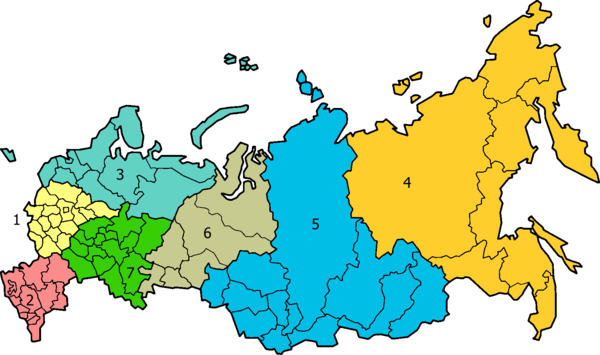
1. Central Federal District 2. Southern Federal District 3. Northwestern Federal District 4. Far Eastern Federal District 5. Siberian Federal District 6. Urals Federal District 7. Privolzhsky (Volga) Federal
Southern Federal District
Includes: Republic of Adygea Astrakhan Oblast Chechen Republic Republic of Dagestan Republic of Ingushetia Kabardino-Balkar Republic Republic of Kalmykia Republic of Karachay-Cherkessia Krasnodar Krai North Ossetia-Alania Republic Stavropol Krai Rostov Oblast Volgograd Oblast
There have been numerous articles this week on Russian-Chinese diplomacy and new trade deals. MSNBC's "Fear and Loathing in Siberia", written by Owen Matthews and Anna Nemtsova, is the best of the latest feature articles in the U.S. media.
While Cold War thinking still dominates much of the coverage of Russia and China, the truth is starting to come out: Russia is not forging an alliance with China against the USA but is accomodating itself to the superpower next door.
Nowhere is China's growing dominance more evident than in Siberia, a vast land far larger than China itself but inhabited by a mere 30 million Russians. Chinese goods are everywhere. In Novosibirsk, the owner of a new hotel can't think of a single thing in the place that isn't from China, from the electric sockets to the beds and furniture. The town's citizens will soon ride to work on Chinese buses; in the markets of Khabarovsk bargain-hungry Russian babushkas even know the Chinese names for the vegetables they buy from Chinese traders. "Everything we have comes from China—our dishes, leather goods, even the meat we eat is from China," complains Vyacheslav Ilyukhin, head of the Building Department at Novosobirsk's city hall. "Siberia is becoming Chinese."
Just in case there was any more doubt about the balance of power in the Russian-Chinese relationship, below are some more facts concerning China's moves to tap Siberia's vast reserves of hydropower and hydrocarbon energy sources. In the long term, Siberia's water may be just as important as the oil and gas. Lake Baikal, with 1/4th of the world's entire fresh water supply, is the real Siberian prize.
Siberia is more than just a market for Chinese goods. Its vast oil and gas reserves make it the ideal gas tank to power China's growth. Earlier this month Putin ordered officials to speed up plans for an $11.5 billion, 4,100km crude-oil pipeline from eastern Siberia to the Pacific Ocean that will eventually carry 1.6 million barrels per day to China and Japan. And Russia's state energy utility, Unified Energy Systems, plans to spend $8.2 billion to build four giant hydropower complexes on the Aldan, Uchur and Timpton rivers in eastern Siberia to help meet China's annual demand for 40 billion kilowatt-hours of power.
China's soaring energy needs would seem to put Russia in the catbird seat. But in fact, it works the other way. There's no denying China's need for Russian natural resources. By some estimates, China will look to Russia to supply 20 percent of its energy imports by 2011. Ditto for other resources like lumber and aluminum. But China is developing other sources of supply as well, like Iran and Kazakhstan for oil. Chinese companies have been buying iron-ore mines in Australia, as well as Canada's largest nickel and zinc mining company, Noranda. China isn't about to become critically dependent on Russia, while Russia is becoming dependent on China—which will account for half of Russia's energy exports by 2015, according to some estimates.
It seems that Chinese, and not American or European firms, will finally make Moscow bend, if not break, the rules that Khodorkovsky went to jail for violating: do not sell hard assets to foreigners. Sitting in his solitary confinement cell close to the Chinese border, Khordokovsky can at least console himself that Yukos was part of this process. American energy CEOs should also be happy about this news, at least for now. China is beating down the door into the largest untapped energy producer in the world - but will the Americans be ready to compete against state-backed firms prepared to pay well above current market prices for future raw materials?
Russia cannot say no to the demands of the new big kid on the block. See the pictures below:
Photos from "Peace Mission 2005", China's joint military exercise with Russia.


 Market Data
  Markets


 AI
AI