



 AI
AI







Friday, April 01, 2011 5:53:46 AM
Japan Nuclear Agency: Questions Over Tepco's Radioactivity Analysis
APRIL 1, 2011, 12:40 A.M. ET
TOKYO (Dow Jones)--Japan's nuclear power regulator cast doubt Friday on Tokyo Electric Power Co.'s (9501.TO) measurements of different types of radioactive materials at the stricken Fukushima Daiichi nuclear plant.
The Nuclear and Industrial Safety Agency said that settings for the computer programs Tepco has been using to measure a number of radioactive materials, or "nuclear species," were likely wrong.
"The data on overall radiation levels remains valid, but we now have to investigate all the data (from Tepco) on specific radioactive materials," said agency spokesman Hiroshi Sakamoto.
The agency said it doesn't yet know which measurements for what parts of the plant and surrounding areas so far released by Tepco may have been affected by the program settings. The company has given levels for water in building basements, trenches and nearby seawater. The agency also said it doesn't know whether the measurements based on the programs would result in readings that are too high or too low.
The agency began to have doubts about the measurements because the combinations of some of the numbers shown in Tepco's measurements of specific radioactive materials were scientifically impossible, suggesting that program settings used to analyze the presence of the materials were flawed, the agency spokesman said.
-By Juro Osawa, Dow Jones Newswires; 813 6269 2794; juro.osawa@dowjones.com
Copyright ©2011 Dow Jones & Company, Inc.
http://online.wsj.com/article/BT-CO-20110331-720649.html
===
Hong Kong Radiation Exceeds Tokyo Even After Japan Crisis
Apr 1, 2011 2:14 AM CT
http://www.bloomberg.com/news/2011-04-01/hong-kong-radiation-exceeds-tokyo-even-after-japan-crisis.html
===
As Radioactive Contamination Spreads, Japanese Government Attempts to Downplay Fears
Mar. 31 2011 - 11:21 pm
http://blogs.forbes.com/oshadavidson/2011/03/31/as-radioactive-contamination-spreads-japanese-government-attempts-to-downplay-fears/ [with comment]
===
Hundreds of corpses believed irradiated, inaccessible
Kyodo News
Friday, April 1, 2011
Radiation is preventing the retrieval of hundreds of bodies from inside the 20-km evacuation zone around the Fukushima No. 1 nuclear power plant, police sources said Thursday.
Based on initial reports after the March 11 catastrophe, the number of bodies is estimated at between a few hundred and 1,000, one of the sources said, adding that high radiation is now hampering full-scale searches.
That view was supported by the Sunday find of high radiation levels on a body found in Okuma, Fukushima Prefecture, 5 km from the plant.
The rescuers are now in a bind. Even if they retrieve the bodies, anyone who comes into contact with them risks being irradiated, too, whether they're in the evacuation zone or not.
And if the bodies are cremated, the smoke could spread radioactive materials as well, the sources said. Even burial poses a problem. When the bodies decompose, they might contaminate the soil with radioactive materials.
Authorities are considering decontaminating and inspecting the bodies where they are found, but the sources said cleansing the decomposing bodies could damage them further.
Copyright 2011 The Japan Times Ltd.
http://search.japantimes.co.jp/cgi-bin/nn20110401a2.html
===
Cattle Struggling to Survive in Fukushima as Radiation Taints Soil, Water
Apr 1, 2011 12:59 AM CT
Cattle in Japan’s Fukushima prefecture are struggling to survive as the health ministry said radiation exceeding the legal limit was found in local beef and tainted soil and water forced farmers to flee.
“Farmers must make a very tough decision -- running away from their farms to protect themselves or staying there to take care of their livestock,” Kenzo Sasaki, 70, who raises 25 cattle in Irisabara village in Fukushima, said in an interview. “Animals in the evacuation zone are probably dying without food and water as growers in the area have no option but to flee.”
Cattle futures surged to a record in Chicago yesterday on speculation demand for U.S. beef would increase in Japan after radiation from the stricken nuclear plant contaminated food supplies. Tyson Foods Inc., the top U.S. meat processor, said the country may increase imports.
Hazardous radiation levels have been detected in areas outside an evacuation radius around the Fukushima Dai-Ichi power plant, site of the worst nuclear disaster since Chernobyl. The United Nations’ nuclear watchdog agency said that a potential uncontrolled chain reaction at the plant could cause further radiation leaks and increase the risk to human health.
Sasaki’s farm is near Iitate village, about 40 kilometers (25 miles) from the plant, where the government discovered 163,000 becquerel per kilogram of radioactive cesium and 1.17 million becquerel of radioactive iodine in soil. Iitate is outside the 20-kilometer evacuation zone.
Iitate Village
Iitate is a farming region in Fukushima for wagyu cattle -- a breed genetically predisposed to intense marbling, producing a high percentage of oleaginous unsaturated fat. Sasaki’s herd does not include wagyu.
Fukushima is the 10th biggest producer of beef cattle in Japan, representing 2.7 percent of the total. Japan exported 677 metric tons of beef, including wagyu, in the year to March 31, 2010, government data show. Vietnam was the top buyer with 433 tons, then Hong Kong with 119 tons and the U.S. with 81 tons.
Beef from Tenei village, about 70 kilometers from the Fukushima plant, had a combined 510 becquerel per kilogram of cesium-134 and cesium-137, exceeding the limit of 500 becquerel, according to the health ministry. The beef is being stored and will be checked again today, the statement said. The health ministry couldn’t say whether the beef was wagyu.
[...]
http://www.bloomberg.com/news/2011-04-01/cattle-struggling-to-survive-in-fukushima-as-radiation-taints-soil-water.html
===
Official: Tens of thousands of evacuees can't head home for months
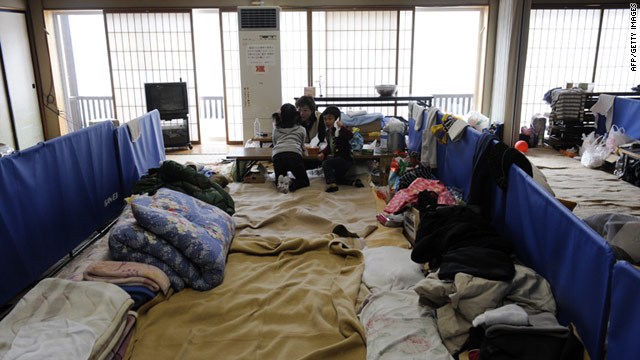
A family group from Fukushima at a makeshift shelter in Yokote city, Akita prefecture
By the CNN Wire Staff
April 1, 2011 -- Updated 0837 GMT (1637 HKT)
Tokyo (CNN) -- Tens of thousands evacuated from around the stricken Fukushima Daiichi power plant may not be allowed home for months, a Japanese minister said Friday, with no end in sight for the nuclear crisis as fresh concerns mount about alarming radiation levels in beef, seawater and groundwater.
While he didn't set a firm timetable, Chief Cabinet Secretary Yukio Edano said people who'd lived within 20 kilometers (12 miles) of the nuclear facility would not return home permanently in "a matter of days or weeks. It will be longer than that."
"The evacuation period is going to be longer than we wanted it to be," Edano said. "We first need to regain control of the nuclear power plant."
About 78,000 people lived in the evacuation zone in northeast Japan, with another 62,000 in the 20-to-30 kilometer (12-to-19 mile) radius -- the so-called exclusion zone, where people have been told to stay indoors and encouraged to leave -- an official from Prime Minister Naoto Kan's office said.
The evacuees' plight is one of many storylines still playing out in relation to the crisis. Many are rooted to workers, soldiers and others efforts rush to prevent a worsening disaster at the plant situated 240 kilometers (150 miles) north of Tokyo, while further afoot farmers, citizens and officials are dealing with the effects of already released radiation.
That includes news Friday, from Edano, that more tests would be conducted on radiation levels in beef, as well as chicken and pork that came from the most affected areas.
Japan's health ministry reported the previous day thatradiation higher than the regulatory limit has been found in beef from Fukushima prefecture, the same province as the embattled nuclear plant. Radiation likely would enter a cow -- or, similarly, a pig or chicken -- indirectly, after it eats grass and other feed that itself has been contaminated.
The radiation levels, detected in a single cow, were slightly above the guidelines set by Japan's Nuclear Safety Commission -- 510 becquerels (a measurement of radioactivity by weight), compared to the official limit of 500 becquerels.
The meat will not be sold and will be retested, the ministry said.
This radiation finding is the first one involving beef, although authorities have banned the sale and transport of numerous vegetables grown in the area after tests detected radiation.
Cesium 134 loses half its radiation every 2.1 years, notes the Argonne National Laboratory in Argonne, Illinois. Cesium 137, experts have said, has a half life of 30 years.
Cesium 137 levels have also spiked in ocean waters off the nuclear plant, according to the nation's nuclear and industrial safety agency. A Wednesday afternoon sample showed levels of 527 times the standard.
Because of its long half life, experts have said its presence is worrisome.
"That's the one I am worried about," said Michael Friedlander, a U.S.-based nuclear engineer, explaining cesium might linger much longer in the ecosystem. "Plankton absorbs the cesium, the fish eat the plankton, the bigger fish eat smaller fish -- so every step you go up the food chain, the concentration of cesium gets higher."
Questions remain about how the cesium reached the sea, as did radioactive iodine-131 isotope samples taken Wednesday 330 meters (361 yards) into the Pacific Ocean that showed levels 4,385 times above the regulatory limit. This exceeded the previous day's reading of 3,355 times over the standard -- and was an exponential spike over the 104-times increase seen just last Friday.
Officials have downplayed the potential perils posed by this isotope, since it loses half of its radiation every eight days. All fishing is banned within 20 kilometers (12 miles) of the plant, and Hidehiko Nishiyama of Japan's nuclear safety agency adds that such waterborne radiation should dilute over time.
As efforts continued Friday to cool nuclear fuel in reactors and spent fuel pools -- using concrete pumping trucks and a new supply of fresh water from a U.S. Navy barge that docked in waters outside the plant Thursday -- concerns remained about other water sources that have shown high levels of radiation.
This includes water in exposed maintenance tunnels leading in and out of the Nos. 1, 2, 3 and 4 reactor buildings, one of which earlier had radiation levels 100,000 above the norm.
Authorities have been working in recent days to drain these tunnels, to prevent them from spilling over and sending tainted water into the ground. By Friday, an official with the Tokyo Electric Power Company -- which operates the plant and heads the recovery effort -- said water levels had dropped one or more meters, and that the issue was no longer urgent.
What has become more of a priority is testing, and finding the source of, an apparent spike in radiation in groundwater near the plant.
Just after midnight Friday, a Tokyo Electric official said that iodine-131 levels in ground water from a pipe near the No. 1 reactor had 10,000 times the standard limit. But the utility later backtracked, promising to get more clarity later.
Edano addressed this confusion in a press conference later Friday, noting that a "constant amount of radiation" appeared to be getting into the groundwater while noting that further tests are forthcoming.
"The numbers released ... looked strange, and that led to the recalculation," he said. "In either case, underground water seems to contain some level of radioactive substances, and this leads to an understanding that the ... soil in the vicinity needs to be monitored closely."
All this contamination -- both into the ground and, eventually, the sea -- is the result of a leak or some other sort of ground seepage from one of the nuclear plant's four most embattled reactors, a Tokyo Electric official said Thursday. The official noted that the high levels suggest the release of radiation into the atmosphere alone couldn't be the lone source.
CNN's Kyung Lah, Yoko Wakatsuki, Junko Ogura, Larry Shaughnessy and Paul Ferguson contributed to this report.
© 2011 Cable News Network. Turner Broadcasting System, Inc.
http://edition.cnn.com/2011/WORLD/asiapcf/04/01/japan.nuclear.reactors/ [with comments]
===
Japan nuclear evacuation 'will be long-term'
1 April 2011 Last updated at 02:50 ET
The evacuation of residents near Japan's quake-hit Fukushima nuclear plant will be long-term, officials say.
Many of the tens of thousands of people evacuated from the area around the plant are living in temporary shelters.
The announcement came as high levels of radiation were detected for the first time in groundwater near one of the facility's six reactors.
Meanwhile, a massive search has begun to find the remains of those missing since the devastating tsunami hit.
Three weeks after the 9.0-magnitude earthquake and subsequent tsunami, the true number of those who died is still not known.
More than 11,500 people are confirmed dead but nearly 16,500 remain unaccounted for.
More than 100 Japanese and US military planes and 65 ships are scouring the country's north-eastern coast to locate any remaining bodies that could be recovered.
Employing some 24,000 military personnel, the intensive air and sea operation will focus on shores that were largely submerged or remain under water, as well as the mouths of major rivers.
Many coastal areas remain inaccessible to rescuers trying enter by road or foot, blocked by the mangled remains of houses, ships, cars and trains.
Food contamination
More than 70,000 people have been evacuated from a 20km (12-mile) evacuation zone around the Fukushima Daiichi plant.
Another 136,000 people who live in a 10km zone beyond that have been encouraged by the authorities to leave or to stay indoors.
Chief Cabinet Secretary Yukio Edano said the evacuation would be a "long-term" operation.
"So therefore, we are giving instructions on how to proceed with the continuation of children's' education, and the employment of people who are unable to work because of the evacuation order," he said.
Highly radioactive water continues to leak at the plant; for the first time it has been found in groundwater 15m below reactor 1.
Although it does not appear to have caused an immediate problem, there is a possibility it could eventually affect drinking water if concentrations were high enough.
Radiation detected in the sea near the plant rose steeply on Thursday, with radioactive iodine levels reaching 4,385 times the limit.
The radiation, which has halted shipments of certain vegetables, dairy produce and other foodstuffs from four nearby prefectures, has been widened to include beef, the health ministry said.
However, the government insists that no water or food contamination has reached levels that would be harmful to people's health.
The authorities are resisting calls from the UN's atomic agency to expand the exclusion zone around the plant, after it found safe radiation limits had been exceeded at the village of Iitate, 40km away.
Radioactive material may be leaking from the damaged plant continuously, the country's nuclear and industrial safety agency (Nisa) said.
Workers are continuing to try to stabilise four reactors by using water to cool fuel rods. They also face the problem of how to deal with highly radioactive run-off water that has accumulated in a tunnel.
Kyodo reported that the radiation level in a tunnel outside reactor 2 was more than 10,000 times above normal levels.
The plant's operator, Tepco, says low-priority tasks at Fukushima will now have to be postponed, after it emerged there was a shortage of radiation monitors for workers.
*
Fukushima update (1 April)
Reactor 1: Damage to the core from cooling problems. Building holed by gas explosion. Radioactive water detected in reactor and basement, and groundwater
Reactor 2: Damage to the core from cooling problems. Building holed by gas blast; containment damage suspected. Highly radioactive water detected in reactor and adjoining tunnel
Reactor 3: Damage to the core from cooling problems. Building holed by gas blast; containment damage possible. Spent fuel pond partly refilled with water after running low. Radioactive water detected in reactor and basement
Reactor 4: Reactor shut down prior to quake. Fires and explosion in spent fuel pond; water level partly restored
Reactors 5 & 6: Reactors shut down. Temperature of spent fuel pools now lowered after rising high
*
BBC © MMXI
http://www.bbc.co.uk/news/world-asia-pacific-12930949
===
Radioactivity surges again at Japan nuclear plant

An aerial photo taken by a small drone shows damage at Fukushima Daiichi nuclear reactors.
(Associated Press / Air Photo Service / March 24, 2011)
Work on containing the crisis at the Fukushima Daiichi complex is hampered because the level of radioactive iodine found in water inside exceeds 10,000 times the safety standard, officials say.
By Julie Makinen and Thomas H. Maugh II, Los Angeles Times
April 1, 2011
Reporting from Tokyo and Los Angeles— Radiation levels increased sharply inside and outside the Fukushima Daiichi nuclear power plant Thursday, slowing work on the devastated facility again and once more throwing into doubt the integrity of the containment vessels that hold the fuel rods.
Tokyo Electric Power Co. officials said the level of radioactive iodine in water at the plant hit levels 10,000 times the permissible limit, preventing workers from getting near the water, which accumulated during early efforts to prevent a full-fledged meltdown by flooding the plant.
Engineers have been pumping water out of basement tunnels in the reactor buildings and into holding areas in an attempt to give workers access so they can try to restore electricity to the cooling pumps that could ultimately bring the crisis under control. But they cannot do so when radiation levels are that high.
The iodine is the primary gaseous byproduct of fission of uranium in the fuel rods that produce the power from the plant. Its presence in water suggests that, at the very least, the encasing around the uranium fuel pellets has cracked, permitting the gas to escape. The good news is that radioactive forms of iodine have a half-life of about an hour for one isotope, and eight days for the other, so the radioactivity should quickly decay if no further release occurs.
Engineers speculated that the radiation surges may be coming from a partial meltdown of the fuel core of reactor No. 1. It appears that small segments of the melted fuel rods in that reactor are undergoing what is known as "localized criticality," emitting brief flashes of heat and radiation.
The level of radioactive iodine in seawater off the coast at the plant has also risen, according to Japan's nuclear safety agency. The Nuclear and Industrial Safety Agency said Thursday that the amount of the isotope in water about 350 yards off the coast had increased to 4,385 times the permissible level, up about a third from the previous day's level.
The agency said the seawater level of cesium-137, a much more dangerous isotope because its half-life is more than 30 years, was about 527 times the permissible level. Environmental experts fear that the cesium could get into plankton and then into fish, where it could make its way along the food chain to humans.
Fishing is not allowed within 12 miles of the plant, and radioactive isotopes are expected to become diluted quickly in the vastness of the Pacific.
For the first time, Japanese officials said Thursday that they had detected radiation in beef from Fukushima prefecture — 510 becquerels per kilogram of meat, just over the national guideline of 500 becquerels per kilogram. The meat will be retested and will not be sold, authorities said.
Even as radiation levels are rising at the nuclear plant, public broadcaster NHK said Thursday that many workers at the facility do not have radiation monitoring badges. Tokyo Electric Power Co., known as Tepco, which owns the plant, confirmed the report, noting that most of the devices were destroyed in the magnitude 9 earthquake and subsequent tsunami that left 27,500 people dead or missing.
Company officials said only 320 monitors remained out of the 5,000 devices the company had before the disaster. But they said the leaders of each team of workers have a badge and that workers without badges are assigned to areas with low radiation risk. Tepco added that it may postpone low-priority work to minimize employees being on site without a monitor.
Concern over radiation may also be hampering recovery of bodies in the immediate area around the nuclear facility. Fukushima prefecture still has 4,760 people missing, and media reports suggest that authorities are hesitant to look for them for fear of radiation exposure.
Japan's chief Cabinet secretary, Yukio Edano, said Thursday that the evacuation of residents near the stricken plant would be "long-term."
The U.S. Department of Energy has sent about 40 people to Japan to help with the crisis, according to Peter Lyons, the department's acting assistant secretary for nuclear energy. The French nuclear group Areva has sent five experts in decontaminating water.
On Wednesday, a 155-person Initial Response Force specially trained in handling nuclear emergencies was dispatched to Japan from the U.S. Naval Support Facility in Indian Head, Md.
julie.makinen@latimes.com
thomas.maugh@latimes.com
Makinen reported from Tokyo and Maugh reported from Los Angeles.
Copyright © 2011, Los Angeles Times
http://www.latimes.com/news/science/la-sci-japan-reactor-damage-20110331,0,5950026.story [with comments]
===
Crews 'facing 100-year battle' at Fukushima
Updated April 1, 2011 09:33:00
A nuclear expert has warned that it might be 100 years before melting fuel rods can be safely removed from Japan's Fukushima nuclear plant.
The warning came as levels of radioactive iodine flushed into the sea near the plant spiked to a new high and the Wall Street Journal said it had obtained disaster response blueprints which said the plant's operators were woefully unprepared for the scale of the disaster.
Water is still being poured into the damaged reactors to cool melting fuel rods.
But one expert says the radiation leaks will be ongoing and it could take 50 to 100 years before the nuclear fuel rods have completely cooled and been removed.
"As the water leaks out, you keep on pouring water in, so this leak will go on for ever," said Dr John Price, a former member of the Safety Policy Unit at the UK's National Nuclear Corporation.
"There has to be some way of dealing with it. The water is connecting [sic - 'collecting'] in tunnels and concrete-lined pits at the moment and the question is whether they can pump it back.
"The final thing is that the reactors will have to be closed and the fuel removed, and that is 50 to 100 years away.
"It means that the workers and the site will have to be intensely controlled for a very long period of time."
But Laurence Williams, Professor of Nuclear Safety at England's University of Central Lancashire and the former head nuclear regulator for the UK, is relatively comfortable with the situation.
"I have been monitoring it for the last couple of weeks and [the] three reactors seem to be more or less unchanged from initially when they got into the seawater flowing into them," he said.
"We don't know exactly the state of the fuel in those reactors but looking at the data, the pressures and temperatures look fairly stable over the last couple of weeks.
"My view is that as there hasn't been any sort of major catastrophic release of radioactivity, if they can continue to get the fresh water into the reactors and cool them, the decay heat is now fairly stabilising.
"It will take some time before it disappears but so far, so good. But it will take some time to bring under control."
Both experts agree capping the damaged reactors with concrete is not an option.
[...]
http://www.abc.net.au/news/stories/2011/04/01/3179487.htm
===
A Chernobyl Lesson for Fukushima

Gleb Garanich/Reuters/Corbis

The Russian nuclear plant is undergoing a state-of-the-art containment that could provide lessons for the Japanese plant
By Steve Featherstone
March 31, 2011, 5:00PM EST
The challenges for Japanese authorities at the Fukushima Dai-Ichi nuclear power station remain grave. With potentially fatal radioactive material leaking from the stricken plants, it will take weeks or months for workers to stabilize the facility and know how much nuclear fuel is damaged in the reactors and spent fuel pools. Only then can the cleanup begin.
"It isn't a week endeavor or a month endeavor, it's a years endeavor to do this work," says Kurt Kehler, vice-president of CH2M Hill, a company that decommissions and demolishes nuclear power plants around the world. CH2M Hill is mothballing the Hanford facility in Washington State, which produced plutonium for the Manhattan Project. The company was also among the bidders to build a steel hangar to contain radiation from Chernobyl, a project now being built by Novarka, a consortium of French contractors.
"There's two different things you're concerned with in the nuclear cleanup business," Kehler adds. "One is contamination and one is radiation, and they're completely different." Nuclear fuel rods emanate radiation; particles of fallout create radioactive contamination of land or objects.
Fukushima is unlikely to reach Chernobyl levels in either category, but the problems faced there still hold lessons. When the Chernobyl reactor blew, deadly radiation emanating from its smoldering core and radioactive fallout blanketed the site, thwarting attempts to seal it off. In a desperate measure, the Soviets entombed the reactor within a concrete shell, or sarcophagus, while they figured out a better way to dispose of the molten nuclear fuel deep inside. The sarcophagus was designed to last 10 years. That was 25 years ago. Now it's dangerously unstable.
"It was never a really well-put-together structure," says Laurin Dodd, a manager at the Chernobyl plant for the last five years. "There's large openings in it the size of picture windows with small mammals going in and out, and birds going in and out." As the managing director for the Shelter Implementation Plan, Dodd works for the Ukrainian government overseeing Novarka's construction of the New Safe Confinement (NSC), a 345-foot-high steel hangar that, when completed in 2015, will cover the crumbling sarcophagus. Radiation levels directly over the sarcophagus are too high for the arch to be built in place. Instead, it will be erected piecemeal in a nearby "assembly zone" and slid over the sarcophagus on rails.
While radiation levels are lower in the assembly zone, the ground around the plant is a radioactive minefield that sometimes brings work to a halt. Crews digging holes for concrete and steel pilings to anchor the rails have struck highly contaminated equipment buried by the Soviets. "Caterpillars, cranes, trucks, just about anything you can imagine," Dodd says. "Occasionally there are pieces of fuel that were blown out of the reactor during the accident."
With excavation work nearly finished, crews will soon begin pouring concrete platforms to hold the cranes that will eventually lift the arch segments into place. Blueprints for the arch have yet to be approved by Ukrainian regulators, and designing it "has been a bit painful, because it's the first of its kind, and it's unique and huge," says Sean Evans, operation leader for the €1.5 billion Chernobyl Shelter Fund at the European Bank for Reconstruction and Development (EBRD), the NSC plan's administrator. It's not only the massive size of the arch that makes it unique, or the fact that it's being assembled in one of the most contaminated places on the planet, but rather its purpose. It's much more complicated than an oversized steel barn. "Confinement is but one of its jobs," Evans says. "It's really an integrated decommissioning facility."
When EBRD eventually hands over the NSC's keys to Ukrainian authorities, workers will begin the monumental task of decommissioning Chernobyl. Remote-operated cranes attached to the underside of the arch will dismantle the leaky sarcophagus, block by block, revealing the scorched wreckage of the reactor building. At the time of the accident, about 200 tons of nuclear fuel melted straight through the building and flowed into the basement, forming blob-like configurations that Chernobyl technicians have given colorful names, such as "the elephant's foot." Ultimately the entire reactor building will be demolished, the elephant's foot chiseled away, and the whole radioactive mess carted off and buried. For the duration of this delicate operation, which could take decades, humidity inside the hangar must be maintained at a low 40 percent to prevent corrosion of its steel frame. The Ukrainians will have plenty of time to get the job done, since the container is designed to last 100 years.
Once the Japanese get the reactors at Fukushima under control, they will face many of the same challenges: keeping workers safe in a highly radioactive environment and preventing radioactive material from leaking into the water or atmosphere. Some problems will be unique to Fukushima. For instance, how will damaged fuel rods be extracted from the reactor vessels and spent fuel pools?
Kehler of CH2M Hill speculates that the Japanese won't require anything quite so big or complicated as Chernobyl's to shelter the reactor buildings while they're pulling the fuel out of them. "They would build another secondary containment," says Kehler, "a light steel shelter around the buildings." In other words, the reactor buildings may end up looking much the way they did almost three weeks ago, before the name Fukushima became synonymous with the phrase "nuclear disaster."
The bottom line: The ongoing containment challenges faced at Chernobyl may hold lessons for Japan's damaged Fukushima nuclear plant.
Featherstone is a Bloomberg Businessweek contributor.
©2011 Bloomberg L.P.
http://www.businessweek.com/magazine/content/11_15/b4223057775248.htm [with comments]
===
Bird's-Eye View Of Japan's Stricken Nuclear Plant Shows Vast Damage
March 31, 2011
11:46 am

A hydrogen explosion rocked reactor 3 on March 14. Helicopters and fire trucks have tried dousing the reactor building with water. This photo was taken March 24.
Air Photo Service/AP

This photo, from March 20, shows the damaged buildings of reactor 4 (left) and reactor 3. Reactor 4 was shut down for routine maintenance at the time of the earthquake and tsunami, but two fires broke out on March 15 and 16, caused by the buildup of hydrogen gas.
Air Photo Service/AP

From right to left, reactors 1, 2 and 3, as seen on March 20. Workers started pumping seawater into the reactor cores to help cool them down; the corrosive salt water permanently disabled the reactors.
Air Photo Service/AP

Prior to the quake, reactor 4's nuclear fuel rods had been transferred from the core to a spent fuel pool at the top of the building. Water cannons and concrete pumping trucks have been used in an attempt to keep the still-hot spent fuel rods submerged so they don't dangerously overheat.
Air Photo Service/AP

Reactors 1, 2, 3 and 4 (right to left) and the turbine buildings (foreground), seen on March 20.
Air Photo Service/AP
[more at] http://www.npr.org/blogs/pictureshow/2011/03/31/135008956/utter-destruction-japans-nuclear-plant-seen-from-the-air [with comments]
===
Inside Japan's destroyed nuclear reactor [video]
1 April 2011 Last updated at 02:46 ET
New images of the interior of Japan's stricken nuclear power plant have been released, showing the extent of the damage to reactor 4.
The operator of the Fukushima Daiichi complex, the Tokyo Electric Power Company (Tepco) captured the devastation using a camera attached to a crane on March 24.
Steam and smoke could still be seen billowing out of the reactor while water was sprayed onto the building in a bid to keep it cool.
http://www.bbc.co.uk/news/world-asia-pacific-12931413
===
Fukushima shines light on U.S. problem: 63,000 tons of spent fuel
March 31, 2011 -- Updated 0527 GMT (1327 HKT)
http://edition.cnn.com/2011/US/03/30/spent.nuclear.fuel/ [with comments]
APRIL 1, 2011, 12:40 A.M. ET
TOKYO (Dow Jones)--Japan's nuclear power regulator cast doubt Friday on Tokyo Electric Power Co.'s (9501.TO) measurements of different types of radioactive materials at the stricken Fukushima Daiichi nuclear plant.
The Nuclear and Industrial Safety Agency said that settings for the computer programs Tepco has been using to measure a number of radioactive materials, or "nuclear species," were likely wrong.
"The data on overall radiation levels remains valid, but we now have to investigate all the data (from Tepco) on specific radioactive materials," said agency spokesman Hiroshi Sakamoto.
The agency said it doesn't yet know which measurements for what parts of the plant and surrounding areas so far released by Tepco may have been affected by the program settings. The company has given levels for water in building basements, trenches and nearby seawater. The agency also said it doesn't know whether the measurements based on the programs would result in readings that are too high or too low.
The agency began to have doubts about the measurements because the combinations of some of the numbers shown in Tepco's measurements of specific radioactive materials were scientifically impossible, suggesting that program settings used to analyze the presence of the materials were flawed, the agency spokesman said.
-By Juro Osawa, Dow Jones Newswires; 813 6269 2794; juro.osawa@dowjones.com
Copyright ©2011 Dow Jones & Company, Inc.
http://online.wsj.com/article/BT-CO-20110331-720649.html
===
Hong Kong Radiation Exceeds Tokyo Even After Japan Crisis
Apr 1, 2011 2:14 AM CT
http://www.bloomberg.com/news/2011-04-01/hong-kong-radiation-exceeds-tokyo-even-after-japan-crisis.html
===
As Radioactive Contamination Spreads, Japanese Government Attempts to Downplay Fears
Mar. 31 2011 - 11:21 pm
http://blogs.forbes.com/oshadavidson/2011/03/31/as-radioactive-contamination-spreads-japanese-government-attempts-to-downplay-fears/ [with comment]
===
Hundreds of corpses believed irradiated, inaccessible
Kyodo News
Friday, April 1, 2011
Radiation is preventing the retrieval of hundreds of bodies from inside the 20-km evacuation zone around the Fukushima No. 1 nuclear power plant, police sources said Thursday.
Based on initial reports after the March 11 catastrophe, the number of bodies is estimated at between a few hundred and 1,000, one of the sources said, adding that high radiation is now hampering full-scale searches.
That view was supported by the Sunday find of high radiation levels on a body found in Okuma, Fukushima Prefecture, 5 km from the plant.
The rescuers are now in a bind. Even if they retrieve the bodies, anyone who comes into contact with them risks being irradiated, too, whether they're in the evacuation zone or not.
And if the bodies are cremated, the smoke could spread radioactive materials as well, the sources said. Even burial poses a problem. When the bodies decompose, they might contaminate the soil with radioactive materials.
Authorities are considering decontaminating and inspecting the bodies where they are found, but the sources said cleansing the decomposing bodies could damage them further.
Copyright 2011 The Japan Times Ltd.
http://search.japantimes.co.jp/cgi-bin/nn20110401a2.html
===
Cattle Struggling to Survive in Fukushima as Radiation Taints Soil, Water
Apr 1, 2011 12:59 AM CT
Cattle in Japan’s Fukushima prefecture are struggling to survive as the health ministry said radiation exceeding the legal limit was found in local beef and tainted soil and water forced farmers to flee.
“Farmers must make a very tough decision -- running away from their farms to protect themselves or staying there to take care of their livestock,” Kenzo Sasaki, 70, who raises 25 cattle in Irisabara village in Fukushima, said in an interview. “Animals in the evacuation zone are probably dying without food and water as growers in the area have no option but to flee.”
Cattle futures surged to a record in Chicago yesterday on speculation demand for U.S. beef would increase in Japan after radiation from the stricken nuclear plant contaminated food supplies. Tyson Foods Inc., the top U.S. meat processor, said the country may increase imports.
Hazardous radiation levels have been detected in areas outside an evacuation radius around the Fukushima Dai-Ichi power plant, site of the worst nuclear disaster since Chernobyl. The United Nations’ nuclear watchdog agency said that a potential uncontrolled chain reaction at the plant could cause further radiation leaks and increase the risk to human health.
Sasaki’s farm is near Iitate village, about 40 kilometers (25 miles) from the plant, where the government discovered 163,000 becquerel per kilogram of radioactive cesium and 1.17 million becquerel of radioactive iodine in soil. Iitate is outside the 20-kilometer evacuation zone.
Iitate Village
Iitate is a farming region in Fukushima for wagyu cattle -- a breed genetically predisposed to intense marbling, producing a high percentage of oleaginous unsaturated fat. Sasaki’s herd does not include wagyu.
Fukushima is the 10th biggest producer of beef cattle in Japan, representing 2.7 percent of the total. Japan exported 677 metric tons of beef, including wagyu, in the year to March 31, 2010, government data show. Vietnam was the top buyer with 433 tons, then Hong Kong with 119 tons and the U.S. with 81 tons.
Beef from Tenei village, about 70 kilometers from the Fukushima plant, had a combined 510 becquerel per kilogram of cesium-134 and cesium-137, exceeding the limit of 500 becquerel, according to the health ministry. The beef is being stored and will be checked again today, the statement said. The health ministry couldn’t say whether the beef was wagyu.
[...]
http://www.bloomberg.com/news/2011-04-01/cattle-struggling-to-survive-in-fukushima-as-radiation-taints-soil-water.html
===
Official: Tens of thousands of evacuees can't head home for months
A family group from Fukushima at a makeshift shelter in Yokote city, Akita prefecture
By the CNN Wire Staff
April 1, 2011 -- Updated 0837 GMT (1637 HKT)
Tokyo (CNN) -- Tens of thousands evacuated from around the stricken Fukushima Daiichi power plant may not be allowed home for months, a Japanese minister said Friday, with no end in sight for the nuclear crisis as fresh concerns mount about alarming radiation levels in beef, seawater and groundwater.
While he didn't set a firm timetable, Chief Cabinet Secretary Yukio Edano said people who'd lived within 20 kilometers (12 miles) of the nuclear facility would not return home permanently in "a matter of days or weeks. It will be longer than that."
"The evacuation period is going to be longer than we wanted it to be," Edano said. "We first need to regain control of the nuclear power plant."
About 78,000 people lived in the evacuation zone in northeast Japan, with another 62,000 in the 20-to-30 kilometer (12-to-19 mile) radius -- the so-called exclusion zone, where people have been told to stay indoors and encouraged to leave -- an official from Prime Minister Naoto Kan's office said.
The evacuees' plight is one of many storylines still playing out in relation to the crisis. Many are rooted to workers, soldiers and others efforts rush to prevent a worsening disaster at the plant situated 240 kilometers (150 miles) north of Tokyo, while further afoot farmers, citizens and officials are dealing with the effects of already released radiation.
That includes news Friday, from Edano, that more tests would be conducted on radiation levels in beef, as well as chicken and pork that came from the most affected areas.
Japan's health ministry reported the previous day thatradiation higher than the regulatory limit has been found in beef from Fukushima prefecture, the same province as the embattled nuclear plant. Radiation likely would enter a cow -- or, similarly, a pig or chicken -- indirectly, after it eats grass and other feed that itself has been contaminated.
The radiation levels, detected in a single cow, were slightly above the guidelines set by Japan's Nuclear Safety Commission -- 510 becquerels (a measurement of radioactivity by weight), compared to the official limit of 500 becquerels.
The meat will not be sold and will be retested, the ministry said.
This radiation finding is the first one involving beef, although authorities have banned the sale and transport of numerous vegetables grown in the area after tests detected radiation.
Cesium 134 loses half its radiation every 2.1 years, notes the Argonne National Laboratory in Argonne, Illinois. Cesium 137, experts have said, has a half life of 30 years.
Cesium 137 levels have also spiked in ocean waters off the nuclear plant, according to the nation's nuclear and industrial safety agency. A Wednesday afternoon sample showed levels of 527 times the standard.
Because of its long half life, experts have said its presence is worrisome.
"That's the one I am worried about," said Michael Friedlander, a U.S.-based nuclear engineer, explaining cesium might linger much longer in the ecosystem. "Plankton absorbs the cesium, the fish eat the plankton, the bigger fish eat smaller fish -- so every step you go up the food chain, the concentration of cesium gets higher."
Questions remain about how the cesium reached the sea, as did radioactive iodine-131 isotope samples taken Wednesday 330 meters (361 yards) into the Pacific Ocean that showed levels 4,385 times above the regulatory limit. This exceeded the previous day's reading of 3,355 times over the standard -- and was an exponential spike over the 104-times increase seen just last Friday.
Officials have downplayed the potential perils posed by this isotope, since it loses half of its radiation every eight days. All fishing is banned within 20 kilometers (12 miles) of the plant, and Hidehiko Nishiyama of Japan's nuclear safety agency adds that such waterborne radiation should dilute over time.
As efforts continued Friday to cool nuclear fuel in reactors and spent fuel pools -- using concrete pumping trucks and a new supply of fresh water from a U.S. Navy barge that docked in waters outside the plant Thursday -- concerns remained about other water sources that have shown high levels of radiation.
This includes water in exposed maintenance tunnels leading in and out of the Nos. 1, 2, 3 and 4 reactor buildings, one of which earlier had radiation levels 100,000 above the norm.
Authorities have been working in recent days to drain these tunnels, to prevent them from spilling over and sending tainted water into the ground. By Friday, an official with the Tokyo Electric Power Company -- which operates the plant and heads the recovery effort -- said water levels had dropped one or more meters, and that the issue was no longer urgent.
What has become more of a priority is testing, and finding the source of, an apparent spike in radiation in groundwater near the plant.
Just after midnight Friday, a Tokyo Electric official said that iodine-131 levels in ground water from a pipe near the No. 1 reactor had 10,000 times the standard limit. But the utility later backtracked, promising to get more clarity later.
Edano addressed this confusion in a press conference later Friday, noting that a "constant amount of radiation" appeared to be getting into the groundwater while noting that further tests are forthcoming.
"The numbers released ... looked strange, and that led to the recalculation," he said. "In either case, underground water seems to contain some level of radioactive substances, and this leads to an understanding that the ... soil in the vicinity needs to be monitored closely."
All this contamination -- both into the ground and, eventually, the sea -- is the result of a leak or some other sort of ground seepage from one of the nuclear plant's four most embattled reactors, a Tokyo Electric official said Thursday. The official noted that the high levels suggest the release of radiation into the atmosphere alone couldn't be the lone source.
CNN's Kyung Lah, Yoko Wakatsuki, Junko Ogura, Larry Shaughnessy and Paul Ferguson contributed to this report.
© 2011 Cable News Network. Turner Broadcasting System, Inc.
http://edition.cnn.com/2011/WORLD/asiapcf/04/01/japan.nuclear.reactors/ [with comments]
===
Japan nuclear evacuation 'will be long-term'
1 April 2011 Last updated at 02:50 ET
The evacuation of residents near Japan's quake-hit Fukushima nuclear plant will be long-term, officials say.
Many of the tens of thousands of people evacuated from the area around the plant are living in temporary shelters.
The announcement came as high levels of radiation were detected for the first time in groundwater near one of the facility's six reactors.
Meanwhile, a massive search has begun to find the remains of those missing since the devastating tsunami hit.
Three weeks after the 9.0-magnitude earthquake and subsequent tsunami, the true number of those who died is still not known.
More than 11,500 people are confirmed dead but nearly 16,500 remain unaccounted for.
More than 100 Japanese and US military planes and 65 ships are scouring the country's north-eastern coast to locate any remaining bodies that could be recovered.
Employing some 24,000 military personnel, the intensive air and sea operation will focus on shores that were largely submerged or remain under water, as well as the mouths of major rivers.
Many coastal areas remain inaccessible to rescuers trying enter by road or foot, blocked by the mangled remains of houses, ships, cars and trains.
Food contamination
More than 70,000 people have been evacuated from a 20km (12-mile) evacuation zone around the Fukushima Daiichi plant.
Another 136,000 people who live in a 10km zone beyond that have been encouraged by the authorities to leave or to stay indoors.
Chief Cabinet Secretary Yukio Edano said the evacuation would be a "long-term" operation.
"So therefore, we are giving instructions on how to proceed with the continuation of children's' education, and the employment of people who are unable to work because of the evacuation order," he said.
Highly radioactive water continues to leak at the plant; for the first time it has been found in groundwater 15m below reactor 1.
Although it does not appear to have caused an immediate problem, there is a possibility it could eventually affect drinking water if concentrations were high enough.
Radiation detected in the sea near the plant rose steeply on Thursday, with radioactive iodine levels reaching 4,385 times the limit.
The radiation, which has halted shipments of certain vegetables, dairy produce and other foodstuffs from four nearby prefectures, has been widened to include beef, the health ministry said.
However, the government insists that no water or food contamination has reached levels that would be harmful to people's health.
The authorities are resisting calls from the UN's atomic agency to expand the exclusion zone around the plant, after it found safe radiation limits had been exceeded at the village of Iitate, 40km away.
Radioactive material may be leaking from the damaged plant continuously, the country's nuclear and industrial safety agency (Nisa) said.
Workers are continuing to try to stabilise four reactors by using water to cool fuel rods. They also face the problem of how to deal with highly radioactive run-off water that has accumulated in a tunnel.
Kyodo reported that the radiation level in a tunnel outside reactor 2 was more than 10,000 times above normal levels.
The plant's operator, Tepco, says low-priority tasks at Fukushima will now have to be postponed, after it emerged there was a shortage of radiation monitors for workers.
*
Fukushima update (1 April)
Reactor 1: Damage to the core from cooling problems. Building holed by gas explosion. Radioactive water detected in reactor and basement, and groundwater
Reactor 2: Damage to the core from cooling problems. Building holed by gas blast; containment damage suspected. Highly radioactive water detected in reactor and adjoining tunnel
Reactor 3: Damage to the core from cooling problems. Building holed by gas blast; containment damage possible. Spent fuel pond partly refilled with water after running low. Radioactive water detected in reactor and basement
Reactor 4: Reactor shut down prior to quake. Fires and explosion in spent fuel pond; water level partly restored
Reactors 5 & 6: Reactors shut down. Temperature of spent fuel pools now lowered after rising high
*
BBC © MMXI
http://www.bbc.co.uk/news/world-asia-pacific-12930949
===
Radioactivity surges again at Japan nuclear plant

An aerial photo taken by a small drone shows damage at Fukushima Daiichi nuclear reactors.
(Associated Press / Air Photo Service / March 24, 2011)
Work on containing the crisis at the Fukushima Daiichi complex is hampered because the level of radioactive iodine found in water inside exceeds 10,000 times the safety standard, officials say.
By Julie Makinen and Thomas H. Maugh II, Los Angeles Times
April 1, 2011
Reporting from Tokyo and Los Angeles— Radiation levels increased sharply inside and outside the Fukushima Daiichi nuclear power plant Thursday, slowing work on the devastated facility again and once more throwing into doubt the integrity of the containment vessels that hold the fuel rods.
Tokyo Electric Power Co. officials said the level of radioactive iodine in water at the plant hit levels 10,000 times the permissible limit, preventing workers from getting near the water, which accumulated during early efforts to prevent a full-fledged meltdown by flooding the plant.
Engineers have been pumping water out of basement tunnels in the reactor buildings and into holding areas in an attempt to give workers access so they can try to restore electricity to the cooling pumps that could ultimately bring the crisis under control. But they cannot do so when radiation levels are that high.
The iodine is the primary gaseous byproduct of fission of uranium in the fuel rods that produce the power from the plant. Its presence in water suggests that, at the very least, the encasing around the uranium fuel pellets has cracked, permitting the gas to escape. The good news is that radioactive forms of iodine have a half-life of about an hour for one isotope, and eight days for the other, so the radioactivity should quickly decay if no further release occurs.
Engineers speculated that the radiation surges may be coming from a partial meltdown of the fuel core of reactor No. 1. It appears that small segments of the melted fuel rods in that reactor are undergoing what is known as "localized criticality," emitting brief flashes of heat and radiation.
The level of radioactive iodine in seawater off the coast at the plant has also risen, according to Japan's nuclear safety agency. The Nuclear and Industrial Safety Agency said Thursday that the amount of the isotope in water about 350 yards off the coast had increased to 4,385 times the permissible level, up about a third from the previous day's level.
The agency said the seawater level of cesium-137, a much more dangerous isotope because its half-life is more than 30 years, was about 527 times the permissible level. Environmental experts fear that the cesium could get into plankton and then into fish, where it could make its way along the food chain to humans.
Fishing is not allowed within 12 miles of the plant, and radioactive isotopes are expected to become diluted quickly in the vastness of the Pacific.
For the first time, Japanese officials said Thursday that they had detected radiation in beef from Fukushima prefecture — 510 becquerels per kilogram of meat, just over the national guideline of 500 becquerels per kilogram. The meat will be retested and will not be sold, authorities said.
Even as radiation levels are rising at the nuclear plant, public broadcaster NHK said Thursday that many workers at the facility do not have radiation monitoring badges. Tokyo Electric Power Co., known as Tepco, which owns the plant, confirmed the report, noting that most of the devices were destroyed in the magnitude 9 earthquake and subsequent tsunami that left 27,500 people dead or missing.
Company officials said only 320 monitors remained out of the 5,000 devices the company had before the disaster. But they said the leaders of each team of workers have a badge and that workers without badges are assigned to areas with low radiation risk. Tepco added that it may postpone low-priority work to minimize employees being on site without a monitor.
Concern over radiation may also be hampering recovery of bodies in the immediate area around the nuclear facility. Fukushima prefecture still has 4,760 people missing, and media reports suggest that authorities are hesitant to look for them for fear of radiation exposure.
Japan's chief Cabinet secretary, Yukio Edano, said Thursday that the evacuation of residents near the stricken plant would be "long-term."
The U.S. Department of Energy has sent about 40 people to Japan to help with the crisis, according to Peter Lyons, the department's acting assistant secretary for nuclear energy. The French nuclear group Areva has sent five experts in decontaminating water.
On Wednesday, a 155-person Initial Response Force specially trained in handling nuclear emergencies was dispatched to Japan from the U.S. Naval Support Facility in Indian Head, Md.
julie.makinen@latimes.com
thomas.maugh@latimes.com
Makinen reported from Tokyo and Maugh reported from Los Angeles.
Copyright © 2011, Los Angeles Times
http://www.latimes.com/news/science/la-sci-japan-reactor-damage-20110331,0,5950026.story [with comments]
===
Crews 'facing 100-year battle' at Fukushima
Updated April 1, 2011 09:33:00
A nuclear expert has warned that it might be 100 years before melting fuel rods can be safely removed from Japan's Fukushima nuclear plant.
The warning came as levels of radioactive iodine flushed into the sea near the plant spiked to a new high and the Wall Street Journal said it had obtained disaster response blueprints which said the plant's operators were woefully unprepared for the scale of the disaster.
Water is still being poured into the damaged reactors to cool melting fuel rods.
But one expert says the radiation leaks will be ongoing and it could take 50 to 100 years before the nuclear fuel rods have completely cooled and been removed.
"As the water leaks out, you keep on pouring water in, so this leak will go on for ever," said Dr John Price, a former member of the Safety Policy Unit at the UK's National Nuclear Corporation.
"There has to be some way of dealing with it. The water is connecting [sic - 'collecting'] in tunnels and concrete-lined pits at the moment and the question is whether they can pump it back.
"The final thing is that the reactors will have to be closed and the fuel removed, and that is 50 to 100 years away.
"It means that the workers and the site will have to be intensely controlled for a very long period of time."
But Laurence Williams, Professor of Nuclear Safety at England's University of Central Lancashire and the former head nuclear regulator for the UK, is relatively comfortable with the situation.
"I have been monitoring it for the last couple of weeks and [the] three reactors seem to be more or less unchanged from initially when they got into the seawater flowing into them," he said.
"We don't know exactly the state of the fuel in those reactors but looking at the data, the pressures and temperatures look fairly stable over the last couple of weeks.
"My view is that as there hasn't been any sort of major catastrophic release of radioactivity, if they can continue to get the fresh water into the reactors and cool them, the decay heat is now fairly stabilising.
"It will take some time before it disappears but so far, so good. But it will take some time to bring under control."
Both experts agree capping the damaged reactors with concrete is not an option.
[...]
http://www.abc.net.au/news/stories/2011/04/01/3179487.htm
===
A Chernobyl Lesson for Fukushima

Gleb Garanich/Reuters/Corbis

The Russian nuclear plant is undergoing a state-of-the-art containment that could provide lessons for the Japanese plant
By Steve Featherstone
March 31, 2011, 5:00PM EST
The challenges for Japanese authorities at the Fukushima Dai-Ichi nuclear power station remain grave. With potentially fatal radioactive material leaking from the stricken plants, it will take weeks or months for workers to stabilize the facility and know how much nuclear fuel is damaged in the reactors and spent fuel pools. Only then can the cleanup begin.
"It isn't a week endeavor or a month endeavor, it's a years endeavor to do this work," says Kurt Kehler, vice-president of CH2M Hill, a company that decommissions and demolishes nuclear power plants around the world. CH2M Hill is mothballing the Hanford facility in Washington State, which produced plutonium for the Manhattan Project. The company was also among the bidders to build a steel hangar to contain radiation from Chernobyl, a project now being built by Novarka, a consortium of French contractors.
"There's two different things you're concerned with in the nuclear cleanup business," Kehler adds. "One is contamination and one is radiation, and they're completely different." Nuclear fuel rods emanate radiation; particles of fallout create radioactive contamination of land or objects.
Fukushima is unlikely to reach Chernobyl levels in either category, but the problems faced there still hold lessons. When the Chernobyl reactor blew, deadly radiation emanating from its smoldering core and radioactive fallout blanketed the site, thwarting attempts to seal it off. In a desperate measure, the Soviets entombed the reactor within a concrete shell, or sarcophagus, while they figured out a better way to dispose of the molten nuclear fuel deep inside. The sarcophagus was designed to last 10 years. That was 25 years ago. Now it's dangerously unstable.
"It was never a really well-put-together structure," says Laurin Dodd, a manager at the Chernobyl plant for the last five years. "There's large openings in it the size of picture windows with small mammals going in and out, and birds going in and out." As the managing director for the Shelter Implementation Plan, Dodd works for the Ukrainian government overseeing Novarka's construction of the New Safe Confinement (NSC), a 345-foot-high steel hangar that, when completed in 2015, will cover the crumbling sarcophagus. Radiation levels directly over the sarcophagus are too high for the arch to be built in place. Instead, it will be erected piecemeal in a nearby "assembly zone" and slid over the sarcophagus on rails.
While radiation levels are lower in the assembly zone, the ground around the plant is a radioactive minefield that sometimes brings work to a halt. Crews digging holes for concrete and steel pilings to anchor the rails have struck highly contaminated equipment buried by the Soviets. "Caterpillars, cranes, trucks, just about anything you can imagine," Dodd says. "Occasionally there are pieces of fuel that were blown out of the reactor during the accident."
With excavation work nearly finished, crews will soon begin pouring concrete platforms to hold the cranes that will eventually lift the arch segments into place. Blueprints for the arch have yet to be approved by Ukrainian regulators, and designing it "has been a bit painful, because it's the first of its kind, and it's unique and huge," says Sean Evans, operation leader for the €1.5 billion Chernobyl Shelter Fund at the European Bank for Reconstruction and Development (EBRD), the NSC plan's administrator. It's not only the massive size of the arch that makes it unique, or the fact that it's being assembled in one of the most contaminated places on the planet, but rather its purpose. It's much more complicated than an oversized steel barn. "Confinement is but one of its jobs," Evans says. "It's really an integrated decommissioning facility."
When EBRD eventually hands over the NSC's keys to Ukrainian authorities, workers will begin the monumental task of decommissioning Chernobyl. Remote-operated cranes attached to the underside of the arch will dismantle the leaky sarcophagus, block by block, revealing the scorched wreckage of the reactor building. At the time of the accident, about 200 tons of nuclear fuel melted straight through the building and flowed into the basement, forming blob-like configurations that Chernobyl technicians have given colorful names, such as "the elephant's foot." Ultimately the entire reactor building will be demolished, the elephant's foot chiseled away, and the whole radioactive mess carted off and buried. For the duration of this delicate operation, which could take decades, humidity inside the hangar must be maintained at a low 40 percent to prevent corrosion of its steel frame. The Ukrainians will have plenty of time to get the job done, since the container is designed to last 100 years.
Once the Japanese get the reactors at Fukushima under control, they will face many of the same challenges: keeping workers safe in a highly radioactive environment and preventing radioactive material from leaking into the water or atmosphere. Some problems will be unique to Fukushima. For instance, how will damaged fuel rods be extracted from the reactor vessels and spent fuel pools?
Kehler of CH2M Hill speculates that the Japanese won't require anything quite so big or complicated as Chernobyl's to shelter the reactor buildings while they're pulling the fuel out of them. "They would build another secondary containment," says Kehler, "a light steel shelter around the buildings." In other words, the reactor buildings may end up looking much the way they did almost three weeks ago, before the name Fukushima became synonymous with the phrase "nuclear disaster."
The bottom line: The ongoing containment challenges faced at Chernobyl may hold lessons for Japan's damaged Fukushima nuclear plant.
Featherstone is a Bloomberg Businessweek contributor.
©2011 Bloomberg L.P.
http://www.businessweek.com/magazine/content/11_15/b4223057775248.htm [with comments]
===
Bird's-Eye View Of Japan's Stricken Nuclear Plant Shows Vast Damage
March 31, 2011
11:46 am

A hydrogen explosion rocked reactor 3 on March 14. Helicopters and fire trucks have tried dousing the reactor building with water. This photo was taken March 24.
Air Photo Service/AP

This photo, from March 20, shows the damaged buildings of reactor 4 (left) and reactor 3. Reactor 4 was shut down for routine maintenance at the time of the earthquake and tsunami, but two fires broke out on March 15 and 16, caused by the buildup of hydrogen gas.
Air Photo Service/AP

From right to left, reactors 1, 2 and 3, as seen on March 20. Workers started pumping seawater into the reactor cores to help cool them down; the corrosive salt water permanently disabled the reactors.
Air Photo Service/AP

Prior to the quake, reactor 4's nuclear fuel rods had been transferred from the core to a spent fuel pool at the top of the building. Water cannons and concrete pumping trucks have been used in an attempt to keep the still-hot spent fuel rods submerged so they don't dangerously overheat.
Air Photo Service/AP

Reactors 1, 2, 3 and 4 (right to left) and the turbine buildings (foreground), seen on March 20.
Air Photo Service/AP
[more at] http://www.npr.org/blogs/pictureshow/2011/03/31/135008956/utter-destruction-japans-nuclear-plant-seen-from-the-air [with comments]
===
Inside Japan's destroyed nuclear reactor [video]
1 April 2011 Last updated at 02:46 ET
New images of the interior of Japan's stricken nuclear power plant have been released, showing the extent of the damage to reactor 4.
The operator of the Fukushima Daiichi complex, the Tokyo Electric Power Company (Tepco) captured the devastation using a camera attached to a crane on March 24.
Steam and smoke could still be seen billowing out of the reactor while water was sprayed onto the building in a bid to keep it cool.
http://www.bbc.co.uk/news/world-asia-pacific-12931413
===
Fukushima shines light on U.S. problem: 63,000 tons of spent fuel
March 31, 2011 -- Updated 0527 GMT (1327 HKT)
http://edition.cnn.com/2011/US/03/30/spent.nuclear.fuel/ [with comments]

Greensburg, KS - 5/4/07
"Eternal vigilance is the price of Liberty."
from John Philpot Curran, Speech
upon the Right of Election, 1790
F6
Discover What Traders Are Watching
Explore small cap ideas before they hit the headlines.



