



 AI
AI







Thursday, March 31, 2011 2:49:08 AM
Radiation in sea off Japan nuclear plant 4,385 times limit
Posted: 31 March 2011 1143 hrs
OSAKA: The level of radioactive iodine in the sea off Japan's disaster-hit Fukushima nuclear plant has soared to its highest reading yet at 4,385 times the legal limit, the plant operator said on Thursday.
The level of iodine-131, reported a few hundred metres (yards) south of its southern water outlet has risen in a series of tests since last week, carried out by plant operator the Tokyo Electric Power Company (TEPCO).
Previous readings there were 1,250 times the legal maximum on Friday, 1,850 times the limit on Saturday and 3,355 times the limit on Tuesday.
A 9.0 magnitude earthquake and tsunami on March 11 knocked out the cooling systems of the Fukushima plant's six reactors -- triggering explosions and fires, releasing radiation and sparking global fears of a widening disaster.
- AFP/fa
Copyright © 2011 MediaCorp Pte Ltd.
http://www.channelnewsasia.com/stories/afp_asiapacific/view/1119850/1/.html
===
Fukushima update: Recovery efforts stalled, as hotspot concerns grow - March 30, 2011
Posted by Declan Butler on March 30, 2011
After an eventful recent few days at the Fukushima Daichii nuclear power plant, which I've reported on here [ http://blogs.nature.com/news/thegreatbeyond/2011/03/fukushima_crisis_new_setbacks_1.html ], and here last night --see "Radioactivity spreads in Japan [ http://www.nature.com/news/2011/110329/full/471555a.html ]", today has seen few major developments, and the situation remains very serious. The detection of radioactive hotspots outside of the evacuation zone is a growing concern, with the International Atomic Energy Agency (IAEA) tonight confirming hotspots Northwest of the plant where radioactivity is so high as to require urgent evacuation of people in the area.
Meanwhile, authorities trying to bring the reactors at the Fukushima Daichii plant under control are still battling with the same problems that since the weekend have prevented them from even beginning the critical task of reestablishing electrical supplies to the coolant systems of the plant's reactors 1 to 4. The basements of the reactors have been flooded with radioactive water, which in reactor 2 is so radioactive – with a dose rate of 1000mSv/h – that a few hours exposure would deliver a lethal dose. The problem is that while electricity has been restored to the control rooms, the cabling that needs to be connected to get electricity to, and restart, the reactors coolant systems, is in these basements. So workers are first having to pump out and clean out the basements before work on trying to stabilize the reactors can proceed.
Efforts are also being hampered by problems on other new fronts at the plant. As I reported yesterday in Nature, radioactive water has been found in trenches, outside of the reactor buildings, and less than 70 metres from the sea shore, raising the spectre of serious contamination of the sea and groundwater in the area. The dose rates at the trench adjacent to reactor 2 is also at a potentially lethal 1000mSv/h. The trenches in question are not what most people might think of as trenches; they are several metres wide and up to 15m deep, and they are filled to the brim. Workers are trying to pump the contaminated water from the trenches, and from the basement, into holding tanks, but may soon run out of space, and so the idea is being floated of digging a new containment vessel. To add to their worries, very low levels of plutonium have been found in the soil.
Fallout hotspots
In terms of the impact of fallout from the plant, the US Department of Energy last night released updated data [ http://blog.energy.gov/content/situation-japan/ ] from its aerial monitoring of the zone. Its maps show a continuing decline of ground radioactivity since its first survey on 17–19 March due to radioactive decay of short-lived isotopes such as I-131 -- they also suggest that there has not been a significant additional dump of radioisotopes since, despite continued emissions from the plant (see maps below). Its surveys are increasingly flying further outside of the 20km compulsory evacuation zone around the plant. It's picking up levels far higher than background more than 40 km from the plant, but assessed that these levels did not warrant evacuation, but did call for greater monitoring of agriculture and food in these regions.
IAEA tonight, however, reported results [ http://www.iaea.org/newscenter/news/tsunamiupdate01.html ] from new soil monitoring in localized hotspots outside of the zone which exceeded its evacuation criteria with iodine-131 levels as high as 25 megaBq/m2, and cesium-137 levels as high as 3.7 megaBq/m2 -- these hotspot readings are *very* high, as evacuation starts being considered at around a few hundred thousand Bq/m2 (and even a few thousand Bqs/m2 exceeds recommended contamination levels for growing green leafy vegetables). This emphasizes the need for extensive local soil sampling in addition to getting the big picture of the overall zone from aerial monitoring.
The high Bq/m2 readings above are obviously well above levels requiring evacuation. Formally, limits for evacuation are based on dose rates -- measured in Sieverts -- and not on radioactivity units of Bq/m2 or Bq/kg, though obviously dose is related to both the latter. IAEA guidelines recommend temporary evacuation from zones where people risk a dose of 30mSv/month, and permanent resettlement if the lifetime dose people would be exposed to is 1Sv. For more on the relation between dose and health effects see this table [ http://www.hpa.org.uk/Topics/Radiation/UnderstandingRadiation/UnderstandingRadiationTopics/DoseComparisonsForIonisingRadiation/ ] from the UK Health Protection Agency).
Hotspots result from the patchy distribution of fallout, which reflects the role of wind patterns and rainfall in washing out radioisotopes to the ground, and similar hotspots were observed after the Chernobyl accident. IAEA confirmed that the same is being observed at Fukushima:
"Based on measurements of I-131 and Cs-137 in soil, sampled from 18 to 26 March in 9 municipalities at distances of 25 to 58 km from the Fukushima Nuclear Power Plant, the total deposition of iodine-131 and cesium-137 has been calculated. The results indicate a pronounced spatial variability of the total deposition of iodine-131 and cesium-137. The average total deposition determined at these locations for iodine-131 range from 0.2 to 25 Megabecquerel per square metre and for cesium-137 from 0.02-3.7 Megabecquerel per square metre."
On the coastal front, increased radioactivity near sea discharge points from the reactors was reported earlier this week by IAEA [ http://www.iaea.org/newscenter/news/tsunamiupdate01.html ], citing Japanese data showing 74,000 Bq/l of I-131 and 12,000 Bq/l of Cs-134. Yesterday it reported,however, that levels had fallen to 11,000 and 1,900 respectively. Recommended maximum coastal discharges from nuclear power plants are typically lower than 4,000 Bq/l. Press reports today suggested that levels had increased again, though no concentrations in Bequerels were given. As IAEA rightly points out, however, reported levels could fluctuate considerably depending on discharge rates and the prevailing currents, so short-term changes in marine data should perhaps be taken with a pinch of salt.
US DOE maps of aerial monitoring data
For an explanation of the units used in the legend, and how these dose rates translate into health effects see my article from last night [ http://www.nature.com/news/2011/110329/full/471555a.html ].
17-19 March

24-26 March

And from a wider zone, 27-28 March

© 2011 Nature Publishing Group, a division of Macmillan Publishers Limited
http://blogs.nature.com/news/thegreatbeyond/2011/03/fukushima_update_against_the_o_1.html [no comments yet]
===
Radiation Traces Found in U.S. Milk
MARCH 31, 2011
The U.S. government said Wednesday that traces of radiation have been found in milk in Washington state, but said the amounts are far too low to trigger any public-health concern.
The Environmental Protection Agency said a March 25 sample of milk produced in the Spokane, Wash., area contained a 0.8 pico curies per literlevel of iodine-131, which it said was less than one five-thousandth of the safety safety guideline set by the U.S. Food and Drug Administration.
The EPA said it increased monitoring after radiation leaked from Japan's Fukushima Daiichi nuclear plant. It expects more such findings in coming days, but in amounts "far below levels of public-health concern, including for infants and children."
[...]
http://online.wsj.com/article/SB10001424052748703806304576233221749626458.html [with comments]
===
Japan says battle to save nuclear reactors has failed
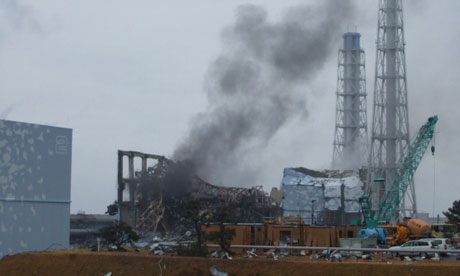
The firm's chairman said it had 'no choice' but to scrap reactors No 1-4, but held out hope that the remaining two could continue to operate
Thursday 31 March 2011 04.43 BST
http://www.guardian.co.uk/world/2011/mar/31/japan-battle-save-nuclear-reactors-failed [and (items linked in) http://investorshub.advfn.com/boards/read_msg.aspx?message_id=61549642 ]
===
Tepco’s Reactors May Take 30 Years, $12 Billion to Scrap
By Shigeru Sato, Yuji Okada and Tsuyoshi Inajima - Mar 30, 2011 3:36 AM CT
Damaged reactors at the crippled Fukushima Dai-Ichi nuclear plant may take three decades to decommission and cost operator Tokyo Electric Power Co. more than 1 trillion yen ($12 billion), engineers and analysts said.
Four of the plant’s six reactors became useless when sea water was used to cool them after the March 11 earthquake and tsunami knocked out generators running its cooling systems. The reactors need to be decommissioned, Tepco Chairman Tsunehisa Katsumata said today. He couldn’t give a timeframe.
All the reactors, including Units 5 and 6, will be shut down, and the government hasn’t ruled out sealing the plant in concrete, Chief Cabinet Secretary Yukio Edano told reporters today in Tokyo.
The damaged reactors need to be demolished after they have cooled and radioactive materials are removed and stored, said Tomoko Murakami, a nuclear researcher at the Institute of Energy Economics, Japan. The process will take longer than the 12 years needed to decommission the Three Mile Island reactor in Pennsylvania following a partial meltdown, said Hironobu Unesaki, a nuclear engineering professor at Kyoto University.
“Lack of public support may force the decommissioning of all six reactors,” said Daniel Aldrich, a political science professor at Purdue University in Indiana. Tepco “will try to salvage two if it can find public support, which may be unlikely.”
The damaged reactors will take more than a few weeks to stabilize, Katsumata, who took charge of Tepco’s response after President Masataka Shimizu was hospitalized, told reporters.
Kan’s Criticism
Prime Minister Naoto Kan yesterday blamed inadequate tsunami defenses at the plant for the world’s worst nuclear accident since Chernobyl in 1986, saying that the safety standards set by Tepco were too low. Efforts to cool fuel rods at the four reactors have been hindered by detection of radiation levels that can prove fatal for a person exposed for several hours.
The utility is focusing on bringing the crisis at the Fukushima Dai-Ichi plant under control and can’t comment on the power station’s future, Naoyuki Matsumoto, a spokesman for Tepco, said by telephone yesterday.
Japan is studying various ways to cool water at the plant’s reactors and fuel-rod ponds, Chief Cabinet Secretary Edano said. It will take “considerable time” until the temperature drops and is stable, he said.
Covering the plant with fabric and removing contaminated water to a tanker are among options under consideration for reducing the threat from radiation, Edano said.
‘Considering Possibilities’
“Specialists are considering various possibilities and means to contain the nuclear power plant situation and minimize radiation effects in surrounding areas and harm to health,” he said. “We haven’t reached a conclusion about what means are possible or effective.”
Japanese authorities rated the Fukushima accident a 5 on the International Atomic Energy Agency’s 7-step scale for nuclear incidents, under which each extra point represents a 10- fold increase in seriousness.
At Pennsylvania’s Three Mile Island in 1979, one reactor partially melted in the worst U.S. accident, earning a 5 rating. Its $973 million repair and cleanup took almost 12 years to complete, according to a report on the World Nuclear Association’s website. More than 1,000 workers were involved in designing and conducting the cleanup operation, the report said.
Chernobyl Sarcophagus
Ukraine is unable to fund alone the cost of a new sarcophagus to cover the burned out reactor at Chernobyl, due to be in place by 2014. The 110 meter-high arched containment structure has a 1.55 billion euro ($2.2 billion) total price tag and the London-based European Bank for Reconstruction and Development has so far raised about 65 percent of that.
The Fukushima reactors may take about three decades to decommission, based on Japan’s sole attempt to dismantle a commercial reactor, said Murakami of the Institute of Energy Economics.
Japan Atomic Power Co. began decommissioning a 166-megawatt reactor at Tokai in Ibaraki Prefecture near Tokyo in 1998 after the unit had completed 32 years of operations, according to documents posted on the company’s website. The project will be completed by March 2021, or after 23 years of work, and cost 88.5 billion yen, the documents show.
Japan Atomic took three years through June 2001 to stabilize and remove nuclear fuels from the reactor core.
“It looks indisputable that Tepco will go ahead and dismantle the four reactors, and costs may exceed 1 trillion yen,” said Murakami, who worked at Japan Atomic for 13 years and was involved in the decommissioning of the Tokai plant. “Removing damaged fuels from the reactors may take more than two years, and any delays would further increase the cost.”
To contact the reporters on this story: Shigeru Sato in Tokyo at ssato10@bloomberg.net; Yuji Okada in Tokyo at yokada6@bloomberg.net; Tsuyoshi Inajima in Tokyo at tinajima@bloomberg.net
To contact the editors responsible for this story: Amit Prakash at aprakash1@bloomberg.net; Clyde Russell at crussell7@bloomberg.net
©2011 BLOOMBERG L.P.
http://www.bloomberg.com/news/2011-03-30/tokyo-electric-s-damaged-reactors-may-take-30-years-12-billion-to-scrap.html
---
Chernobyl: A Nuclear Accident With No End?
March 30, 2011
[...]
The tour bus rolls on to Chernobyl nuclear power station, stopping 200 yards from Reactor Number 4. Due to high levels of ambient radiation, we have only 20 minutes to pose for souvenir pictures in front of the old sarcophagus of decaying cement and rusting steel.
Laurin Dodd, an American engineer, has come to the site to talk to VOA. He is directing an American-led project to build a new, modern sarcophagus.
"The structure itself is almost a house of cards," says Dodd. "It was built with some robotics and under extreme conditions. And there are large gaping holes. If you go inside, you will see holes the size of picture windows with small mammals going in and out, birds flying in and out."
As scaffolding props up the old ventilation stack, Dodd races to keep the nuclear genie in the bottle.
"There is almost 200 tons of radioactive material still inside the old sarcophagus," said Dodd, who has worked here off and on since 1995. "And the existing sarcophagus was built in six months in 1986 under, I should say, fairly heroic conditions and it had a design life of 10 years - that’s almost 25 years ago."
Built on rails and rising high enough to cover the Statue of Liberty, the new containment structure is to be the largest moveable structure in the world. On April 19, Ukraine officials will hold a donor conference in Kyiv to raise $1 billion to build a structure designed to contain Chernobyl’s nuclear mess for another century.
As authorities in Japan may soon discover, big nuclear accidents have a defined beginning. It is unclear when they ever end.
http://www.voanews.com/english/news/europe/Chernobyl-A-Nuclear-Accident-With-No-End-118943489.html
===
Ideas floated to stanch leak of radiation

Seeking your understanding: Tokyo Electric Power Co. Chairman Tsunehisa Katsumata (center), flanked by Vice Presidents Takashi Fujimoto (left) and Sakae Muto, apologize at Tepco's Tokyo headquarters Wednesday.
KYODO PHOTO
Storing tainted water in tankers, draping reactors with fabric eyed
By KAZUAKI NAGATA and KANAKO TAKAHARA
Staff writers
Thursday, March 31, 2011
With operations to pump out massive amounts of contaminated water at the crippled Fukushima No. 1 nuclear plant running into trouble, new ideas surfaced Wednesday to move the effort forward, including storing the tainted water in tankers and covering the reactor sites with fabric shrouds.
"To stabilize the situation at the plant and keep radioactive contamination at a minimum, we are asking experts to consider various" methods, Chief Cabinet Secretary Yukio Edano told a news conference.
While many ideas are under consideration, no concrete decisions have been made, he said.
One of the ideas being mulled would be to cover the walls and ceilings of the reactor buildings damaged in explosions with special fabric capable of containing radiation.
However, the feasibility of the proposed ideas had yet to be studied.
Hidehiko Nishiyama of the Nuclear and Industrial Safety Agency said various options to remove the contaminated water are being discussed, but the work will continue based on what is available at the site.
Tokyo Electric Power Co. Chairman Tsunehisa Katsumata, appearing for the first time since the crisis began, told a news conference that although it will probably be hard to bring tankers near the reactors, "if there are good ideas, we would like to examine them."
Katsumata said scrapping the plant's four troubled reactors is inevitable, and Tepco will face a heavy nuclear disaster compensation tab.
His comment suggested that reactors 5 and 6, which are less damaged, may be able to fire up again in the future.
Edano, however, quickly ruled out this possibility.
"I believe (scrapping all six reactors) is very clear from the viewpoint of society. That is my perception," he said.
Tepco has been trying to pump out the accumulated toxic water in the basements of turbine buildings for reactors 1 through 4, as well as from the trenches below the turbine buildings of reactors 1, 2 and 3.
As for the water in the No. 1 building, Tepco had been pumping it into a storage tank since March 24 but stopped work Tuesday after it became full. The depth of the water in the basement has decreased to about 20 cm from an earlier 40 cm, the NISA said.
But work to remove the water at reactors 2 and 3 has yet to start because the storage tanks for those reactors are full. The water in the basement of the No. 2 turbine building and in its trench contains especially high-level radiation, with 1,000 millisieverts per hour detected.
The limit for total radiation exposure per year set by the health ministry for each nuclear plant worker is 100 millisieverts, although the level has been raised to 250 millisieverts for the Fukushima plant workers, given the graveness and urgency of the crisis.
The high level of contamination indicates the water may have come in contact with the partially melted fuel rods inside the No. 2 reactor's pressure vessel and leaked from an unknown location, although NISA has said the essential components of the reactor, its core and containment vessel, are probably still intact.
Radioactivity levels found in the environment around the Fukushima plant appeared to be rising.
The monitoring data collected at 1:55 p.m. Tuesday 330 meters south of the drain outlets for the No. 1 and 4 reactor buildings detected radioactive iodine-131 levels in the seawater 3,355 times above the government standard — the highest ever detected.
The level had actually declined several days ago, to some 250 times above the standard, according to data from Sunday, indicating the current levels detected were flowing to the sea from unknown routes.
"The level has been increasing . . . it is important to find out where (radioactive materials) are coming from and prevent the figure from rising," Nishiyama said.
In a related development, Tepco said its president, Masataka Shimizu, who hasn't appeared since March 13, was hospitalized Tuesday for hypertension and dizziness while tackling the crisis.
Shimizu has not appeared in public since attending a news conference on March 13, prompting a public backlash. Katsumata's Wednesday appearance was his first.
Information from Kyodo added
Copyright 2011 The Japan Times Ltd.
http://search.japantimes.co.jp/cgi-bin/nn20110331a1.html
===
Fukushima Workers Face Risk of Uncontrolled Reactions
By Jonathan Tirone, Sachiko Sakamaki and Yuriy Humber - Mar 31, 2011 1:00 AM CT
Japan’s damaged nuclear plant may be in danger of emitting sudden bursts of heat and radiation, undermining efforts to cool the reactors and contain fallout.
The potential for limited, uncontrolled chain reactions, voiced yesterday by the International Atomic Energy Agency, is among the phenomena that might occur, Chief Cabinet Secretary Yukio Edano told reporters in Tokyo today. The IAEA "emphasized that the nuclear reactors won’t explode," he said.
Three workers at a separate Japanese plant received high doses of radiation in 1999 from a similar nuclear reaction, known as ‘criticality.’ Two of them died within seven months [ http://www.world-nuclear.org/info/inf37.html ].
Tokyo Electric Power Co., the Fukushima Dai-Ichi plant’s operator, and Japan’s nuclear watchdog, dismissed the threat of renewed nuclear reactions, three weeks after an earthquake and tsunami triggered an automatic shutdown. Tokyo Electric has been spraying water on the reactors since the March 11 disaster in an effort to cool nuclear fuel rods.
"The reactors are stopped, so it’s hard to imagine re- criticality," occurring, Tsuyoshi Makigami, a spokesman for the utility, told a news conference today.
A partial meltdown of fuel in the No. 1 reactor building may be causing isolated reactions, Denis Flory, nuclear safety director for the IAEA, said at a press conference in Vienna. This might increase the danger to workers at the site.
‘Ethereal Blue Flash’
Nuclear experts call such reactions "localized criticality." They consist of a burst of heat, radiation and sometimes an "ethereal blue flash," according to the U.S. Energy Department’s Los Alamos National Laboratory website [ http://www.lanl.gov/news/index.php/fuseaction/home.story/story_id/1054 ]. Twenty-one workers worldwide have been killed by “criticality accidents” since 1945, the site said.
The IAEA acknowledged "they don’t have clear signs that show such a phenomenon is happening," Edano said.
Radioactive chlorine [ http://www.nisa.meti.go.jp/english/files/en20110325-6.pdf ] found March 25 in the No. 1 turbine building suggests chain reactions continued after the reactor shut down, physicist Ferenc Dalnoki-Veress of the James Martin Center for Nonproliferation Studies in Monterey, California, wrote in a March 28 paper. Radioactive chlorine has a half-life of 37 minutes, according to the report.
Japan’s Nuclear and Industrial Safety Agency said there’s no possibility of uncontrolled chain reactions. Boron, an element that absorbs neutrons and hinders nuclear fission, has been mixed with cooling water to prevent this, Hidehiko Nishiyama, a spokesman for the agency, told reporters today.
Ocean Contamination
Contamination of seawater found near the plant has increased. Radioactive iodine rose to 4,385 times the regulated safety limit yesterday from 2,572 times on Tuesday, Nishiyama said. No fishing is occurring nearby and the sea is dispersing the iodine so there is no threat, he said.
There was 180 becquerel per cubic centimeter of radioactive iodine-131 found in the ocean 330 meters (1,082 feet) south of the plant. Drinking one liter of fresh water with that level would be equivalent to getting double the annual dose of radiation a person typically receives.
Workers have averted the threat of a total meltdown by injecting water into the damaged reactors. The complex’s six units have been reconnected with the power grid and two are using temporary motor-driven pumps. Work to repair the plant’s monitoring and cooling systems has been hampered by discoveries of hazardous radioactive water.
Dismantling the plant and decontaminating the site may take 30 years and cost Tokyo Electric more than 1 trillion yen ($12 billion), engineers and analysts said. The government hasn’t ruled out pouring concrete over the whole facility as one way to shut it down, Edano said.
Dumping Concrete
Dumping concrete on the plant would serve a second purpose: it would trap contaminated water, said Tony Roulstone, an atomic engineer who directs the University of Cambridge’s masters program in nuclear energy.
“They need to immobilize this water and they need something to soak it up,” he said. “You don’t want to create another hazard, but you need to get it away from the reactors.”
The process will take longer than the 12 years needed to decommission the Three Mile Island reactor in Pennsylvania following a partial meltdown in 1979, said Hironobu Unesaki, a nuclear engineering professor at Kyoto University.
Tokyo Electric’s shareholders may be wiped out by clean-up costs and liabilities stemming from the nuclear accident, the worst since Chernobyl. The company faces claims of as much as 11 trillion yen if the crisis lasts two years and potential takeover by the government, according to a March 29 Bank of America Merrill Lynch report.
Radiation “far below” levels that pose a risk to humans was found in milk from California and Washington, the first signs Japan’s nuclear accident is affecting U.S. food, state and Obama administration officials said.
The U.S. is stepping up monitoring of radiation in milk, rain and drinking water, the Environmental Protection Agency and Food and Drug Administration said yesterday in a statement.
The number of dead and missing from the earthquake and tsunami had reached 27,690 as of 10 a.m. today, Japan’s National Police Agency said.
To contact the reporters on this story: Jonathan Tirone in Vienna at jtirone@bloomberg.net; Sachiko Sakamaki in Tokyo at ssakamaki1@bloomberg.net; Yuriy Humber in Tokyo at yhumber@bloomberg.net
To contact the editor responsible for this story: Patrick Chu at pachu@bloomberg.net
©2011 BLOOMBERG L.P.
http://www.bloomberg.com/news/2011-03-30/record-high-levels-of-radiation-found-in-sea-near-crippled-nuclear-reactor.html [and in particular the last item (linked) at http://investorshub.advfn.com/boards/read_msg.aspx?message_id=61089702 ]
===
Analysis: Japan's nuclear nightmare set to run and run
By Scott DiSavino and Eileen O'Grady
NEW YORK/HOUSTON | Thu Mar 31, 2011 1:55am EDT
NEW YORK/HOUSTON (Reuters) - Workers struggling to prevent more radiation from escaping Japan's crippled nuclear plant face a hellish scenario -- with every attempt to get it under control seemingly creating life-threatening problems. Unfortunately they are going to have to get used to it.
A final resolution of the nuclear disaster at the Fukushima Daiichi power station will likely take decades and experts say there could be many further setbacks and frightening moments to come. The cost in terms of money or the health of the workers is almost impossible to assess at this stage.
Even though officials at plant owner Tokyo Electric Power Co (TEPCO) have said the four most damaged reactors at the six-reactor plant, located about 240 km (150 miles) northeast of Tokyo, will have to be scrapped, that can't happen for years because many of the fuel rods are still in a very dangerous state.
For now, workers must keep pumping water into the reactor vessel and spent fuel pools to prevent overheating and a further meltdown while they try to rebuild the cooling system.
There are no easy choices, though.
"They are trapped in a situation where they have to feed and bleed the water in the reactor," Arnie Gundersen, a 29-year veteran of the nuclear industry who worked on reactors similar to those at Daiichi and who is now chief engineer at Fairewinds Associates Inc of Burlington, Vermont.
Until the cooling systems are working normally workers have to allow the steam to escape to stop the pressure from getting dangerously high, even though that steam is radioactive. But as the steam comes out they have to pour more water in.
Some radioactive water is also escaping from the reactors and storage pools, possibly because of damage from the earthquake or explosions in the early stages of the crisis. It is getting into unexpected places inside and outside the plant, making it unsafe for workers to navigate the buildings to make needed repairs.
"There's definitely a conflict now between trying to keep the reactors cool and managing the contaminated waste water being generated by the operation," said Ed Lyman, a senior scientist with the Union of Concerned Scientists, a U.S.-based nuclear watchdog group.
WATER EVERYWHERE
On Monday, TEPCO said it cut back the amount of water being injected into the Unit 2 reactor by half, a move which it probably made to reduce the threat from contaminated water. The result, though, was rising temperatures in the reactor.
"They need to continue to pump water into the reactor to keep the fuel cool, but some of that water is escaping and the contamination in the building is growing ... making it harder for the workers to get in there," Richard Meserve, former Chairman of the U.S. Nuclear Regulatory Commission and current President of the Carnegie Institution, told Reuters.
"They need to be able to cool the fuel for periods longer than months," he said.
To reestablish a cooling system, TEPCO may use robots or have to employ so-called "jumpers".
Jumpers are people who rush into a highly radioactive area, do one job, and then jump out within minutes. Some in the industry even refer to them as "gamma sponges" or "glow boys" because they can absorb a year's worth of radiation in those few minutes.
Keeping the contaminated water in the reactor is vital to stop radioactive steam from poisoning surrounding communities.
The International Atomic Energy Agency (IAEA), the U.N. nuclear watchdog, suggested on Wednesday that Japan widen the evacuation zone from the current 20 kilometers after radiation exceeded the criterion for evacuation in the village of Iitate, 40 kilometers from the Daiichi plant.
Workers are also struggling to deal with highly radioactive water in at least three large trenches that run from the basement of the turbine buildings toward the ocean.
TEPCO is pumping the water out of the turbine basements and into the condensers - equipment normally used to turn steam back into water - but those condensers are also filling up.
Indeed, if TEPCO cannot find other ways to collect, store, and treat the contaminated water it may be forced to pump it out to sea.
IN THE PACIFIC
No one wants the company to pump contaminated water into the Pacific Ocean. Radioactive iodine is already more than 3,000 times the legal limit in the sea near the plant.
But all of the nuclear experts acknowledge the sea would at least dilute the radiation that is currently concentrated in the water around the plant.
"The radioactive water in the turbine hall considerably hampers any intervention," said French nuclear watchdog ASN Chairman Andre-Claude Lacoste at a parliamentary hearing earlier Wednesday.
Lacoste said other options to deal with the contaminated water could include finding a new storage solution or to "throw it into the sea."
The experts are encouraged by signs that TEPCO's efforts are preventing further damage to nuclear fuel and that electric power has been restored to some areas at the site.
Nearly three weeks after a massive earthquake and tsunami struck Japan, however, there are still no easy ways to deal with the high levels of radiation that are hampering progress.
At Three Mile Island, the worst nuclear power accident in the United States, workers were able to stabilize the reactor, which suffered a partial meltdown, in four days. No one was injured in the 1979 crisis and there was no radiation release above the legal limit.
At Chernobyl in the Ukraine, the scene of the world's worst nuclear accident in 1986, it took weeks to "stabilize" what remained of the plant and months to build a concrete and steel sarcophagus to try to protect the environment from further releases of radiation. But even today, the situation there is far from stable.
DON'T BURY IT YET
No one is yet calling for the drastic step of abandoning the Fukushima site without trying to regain control. To do so, would likely mean Japan had accepted significant radiation releases from the plant for many years.
For now, workers are "doing the best they can under the circumstances," said Lyman of UCS. "But conditions are becoming so challenging that there may not be any easy way out. More hard choices may have to be made."
Tearing down the damaged nuclear reactors may take decades, said Hidehiko Nishiyama, deputy director-general of the Nuclear and Industry Safety Agency (NISA).
The ongoing nuclear crisis will continue to take its toll on the nation's economy, said Jesper Koll, director of equity research at JPMorgan Securities in Tokyo.
"The worst-case scenario is that this drags on not one month or two months or six months, but for two years, or indefinitely," Koll said.
(Reporting by Scott DiSavino in New York, Eileen O'Grady in Houston and Shinichi Saoshiro and Yoko Nishikawa in Tokyo. Editing by Martin Howell)
© Thomson Reuters 2011
http://www.reuters.com/article/2011/03/31/us-japan-nuclear-idUSTRE72U04N20110331 [with comment]
===
Japan nuclear crisis: evacuees turned away from shelters

A man sits inside a bar in central Fukushima. The situation at the Fukushima plant remains critical
Photo: REUTERS
Hundreds of people evacuated from towns and villages close to the stricken Fukushima nuclear plant are being turned away by medical institutions and emergency shelters as fears of radioactive contagion catch on.
By Julian Ryall, in Tokyo 3:54PM BST 30 Mar 2011
Hospitals and temporary refuges are demanding that evacuees provide them with certificates confirming that they have not been exposed to radiation before they are admitted.
The situation at the plant remains critical, with the Nuclear and Industrial Safety Agency yesterday that radioactive iodine-131 at more than 3,350 times permitted levels has been found in a sample of seawater taken from near the facility.
The water is the most highly contaminated sample taken from the sea and indicates that radiation from the core of one or more of the reactors, where fuel rods have partly melted, is leaking into the Pacific Ocean.
A spokesman for the agency said the radioactivity poses no immediate threat to human health because fishing has been banned close to the plant and iodine will have been "significantly diluted" before it comes into contact with marine species and then enters the food chain for humans.
The eight-year-old daughter of Takayuki Okamura was refused treatment for a skin rash by a clinic in Fukushima City, where the family is living in a shelter after abandoning their home in Minamisoma, 18 miles from the crippled nuclear plant.
"Just being forced to live in a shelter causes us anxiety," Mr Okamura, 49, said. "The institution's refusal to treat my daughter came as a great shock to us."
Medical experts have condemned those that are meant to be assisting the evacuees for turning them away. "This is a knee-jerk reaction based on the fear that these people are going to harm you," said Dr. Robert Gale, a haematologist at Imperial College, London, who is advising the Japanese government on health issues.
"If someone has been contaminated externally, such as on their shoes or clothes, then precautions can be taken, such as by removing those garments to stop the contamination from getting into a hospital," he told The Daily Telegraph. "That is very easy to do, but unfortunately I'm not surprised this sort of thing is happening."
Prejudice against people who used to live near the plant is reminiscent of the ostracism that survivors of the atomic bombings of Hiroshima and Nagasaki in 1945 experienced. Many suffered discrimination when they tried to rent housing, find employment or marriage partners.
More than 65 years ago, Dr. Gale points out, far less was known about the effects of radiation on the human body and that it is "completely irrational" to turn evacuees away today.
Masataka Shimizu, the president of Tokyo Electric Power Co., has been admitted to a hospital to be treated for hypertension and dizziness. Shimizu had previously taken several days off after being taken ill as he oversaw efforts to bring the crisis at the nuclear plant under control.
Tsunehisa Katsumata, the TEPCO chairman, said that Shimizu would return to work soon and again take the lead in dealing with the crisis.
"We apologise for causing the public anxiety, worry and trouble due to the explosions at reactor buildings and the release of radioactive materials," Katsumata added.
There are also growing concerns about thousands of gallons of radioactive water that have collected in concrete trenches beneath the reactors. The water was sprayed on the reactors in the early days of the crisis in an effort to keep them cool, but now poses a serious hazard to the emergency crews given the task of bringing the plant back under control.
With experienced engineers close to exhaustion after working around the clock, TEPCO is reportedly offering up to Y400,000 (£2,995) per day for anyone willing to brave the rigours of the plant – with the employees now being described in the media here as modern-day samurai or "suicide squads."
The government announced that it will upgrade safety standards for nuclear power plants, a tacit admission that previous standards were inadequate, while Yukio Edano, the chief cabinet secretary, told a press conference that no estimates were being made on when the crisis might be under control.
The United States has confirmed that it plans to send robots to the stricken reactor. The robots will work in areas considered too dangerous for human emergency repair teams to operate in.
French President Nicolas Sarkozy is also due to arrive in Tokyo on Thursday to express his solidarity with Japan as it struggles to cope with the world's worst nuclear crisis for more than a quarter of a century.
© Copyright of Telegraph Media Group Limited 2011
http://www.telegraph.co.uk/news/worldnews/asia/japan/8416302/Japan-nuclear-crisis-evacuees-turned-away-from-shelters.html
===
Japanese Plant Had Barebones Risk Plan

By PHRED DVORAK And PETER LANDERS
MARCH 31, 2011
TOKYO—Tokyo Electric Power Co.'s disaster plans greatly underestimated the scope of a potential accident at its Fukushima Daiichi nuclear plant, calling for only one stretcher, one satellite phone and 50 protective suits in case of emergencies.
Disaster-response documents for Fukushima Daiichi, examined by The Wall Street Journal, also contain few guidelines for obtaining outside help, providing insight into why Japan struggled to cope with a nuclear crisis after an earthquake and tsunami devastated the facility.
The disaster plans, approved by Japanese regulators, offer guidelines for responding to smaller emergencies and outline in detail how to back up key systems in case of failure. Yet the plans fail to envision the kind of worst-case scenario that befell Japan: damage so extensive that the plant couldn't respond on its own or call for help from nearby plants. There are no references to Tokyo firefighters, Japanese military forces or U.S. equipment, all of which the plant operators eventually relied upon to battle their overheating reactors.
On Wednesday, the president of plant operator Tepco was hospitalized for dizziness, offering the latest sign of leadership trouble. Earlier in the disaster, Tepco was faulted for a sluggish initial response; now it appears that its written emergency plans were themselves inadequate.
"The disaster plan didn't function," said a former Tepco executive. "It didn't envision something this big."
The two main documents examined by the Journal are Fukushima Daiichi's disaster-readiness plan, which discusses general preparations and communications, and its accident-management protocol, which focuses on technical operation of plant equipment in an accident.
The main disaster-readiness manual, updated annually, envisions the fax machine as a principal means of communication with the outside world and includes detailed forms for Tepco managers when faxing government officials. One form offers a multiple-choice list of disasters, including "loss of AC power," "inability to use the control room" and "probable nuclear chain reaction outside the reactor."
Tepco spokesman Hiro Hasegawa said the plans followed and sometimes exceeded legal requirements, and proved useful in the crisis. For example, he said the emergency injection of water to cool the reactors followed the accident-management protocol.
Nuclear-power experts say few operators anywhere are likely prepared for the kind of disaster that struck Fukushima Daiichi. On March 11, the plant was hit with a magnitude 9.0 quake, followed by a tsunami estimated at 45 feet. The twin catastrophes wiped out the normal power and backup generators of nearly all the plant's six reactors and also damaged roads and communication lines through which the plant could seek help.
Previous big nuclear accidents, such as those at Three Mile Island in the U.S. and Chernobyl in the former Soviet Union, resulted from poor safety standards and bad management, said Kazuo Sato, a consultant at the Nuclear Safety Research Association, who headed Japan's watchdog Nuclear Safety Commission in the late 1990s. "This one was a natural disaster—it's qualitatively different," he said.
The International Atomic Energy Agency, a United Nations agency, has hundreds of pages of safety recommendations for nuclear-facility operators, but its recommendations aren't binding on individual countries. An IAEA spokesman declined to comment on whether Japanese emergency plans fulfill IAEA guidelines.
The Journal compared the Fukushima Daiichi accident-management protocol against the IAEA's general principles, and it appears the plant document generally hews to them. However, the IAEA calls for operators to cover "appropriately selected external events, such as fires, floods, seismic events and extreme weather conditions…that could damage large parts of the plant." The Fukushima Daiichi protocol doesn't specifically discuss how such events could damage the plant.
In the U.S., operators are expected to continuously update emergency plans and to conduct large-scale drills, typically lasting from eight hours to two days, at least every two years. The exercises are graded by the U.S. Nuclear Regulatory Commission, which requires correction of deficiencies. The NRC describes the capabilities it expects plants to have but often doesn't specify the equipment required.
Critics allege Japan's regulators and operators tend to avoid talking about or preparing fuller disaster scenarios, partly to avoid scaring the public. Fukushima Daiichi's own report on its accident-management protocols says: "The possibility of a severe accident occurring is so small that from an engineering standpoint, it is practically unthinkable."
Banri Kaieda, chief of the Ministry of Economy, Trade and Industry, said Wednesday that the ministry's Nuclear and Industrial Safety Agency plans to tighten scrutiny of emergency plans in light of Fukushima Daiichi. "We are painfully aware" the plans were inadequate, an agency spokesman said.
Following Three Mile Island and Chernobyl, Japan's industry ministry in 1992 asked nuclear operators to come up with voluntary protocols for each of their plants in the case of accidents that exceeded their safety specifications. Those "accident-management plans" don't have to be periodically revised. Tepco submitted the report on its plan for Fukushima Daiichi in 2002.
A serious accident at a Japanese uranium-processing facility in 1999 led Parliament to pass a law on nuclear emergencies. The law requires operators to have "disaster-readiness operation plans," reviewed annually. It also sets base protocols that operators must follow, such as minimum numbers of masks.
In some cases, Fukushima Daiichi's crisis planners exceeded minimums. The plan calls for 49 radiation-detecting meters, versus six required by law, and 100 cellphones on two systems, versus the seven required.
Still, many of the numbers suggest the six-reactor plant anticipated at most a modest emergency. It calls for a four-man medical team to attend to people exposed to radiation and other victims. Four protective suits with oxygen tanks were to be stocked, as well as a single ambulance and radiation-measuring vehicle.
Much hinged on the fax machine. One section directs managers to notify the industry minister, the local governor and mayors of nearby towns of any problems "all at once, within 15 minutes, by facsimile." In certain cases, the managers were advised to follow up by phone to make sure the fax had arrived.
The disaster-response plans at other operators in Japan follow the same structure as Fukushima Daiichi's, although some are more thorough.
Accident-management plans are generally written to deal with internal plant problems and don't take into account external shocks such as a quake or terrorist attack, said Hokkaido University Prof. Kenichiro Sugiyama, who served on a government panel on nuclear accident readiness.
Tepco's Mr. Hasegawa said the company is doing its utmost to put in place "emergency-response measures based on the operational plan for disaster prevention." He pointed to successful steps such as the establishment of a disaster headquarters as soon as the quake struck.
After this crisis is settled, Japan will have to rethink everything, industry veterans said. This catastrophe shows "there is no such thing as overdoing it" in preparing a disaster manual, said Tsuneo Futami, who was superintendant at Fukushima Daiichi from 1997 to 2000. The attitude must be that "anything can happen tomorrow."
—Rebecca Smith and David Crawford contributed
to this report.
Write to Phred Dvorak at phred.dvorak@wsj.com and Peter Landers at peter.landers@wsj.com
Copyright ©2011 Dow Jones & Company, Inc.
http://online.wsj.com/article/SB10001424052748703712504576232961004646464.html [with comments]
Posted: 31 March 2011 1143 hrs
OSAKA: The level of radioactive iodine in the sea off Japan's disaster-hit Fukushima nuclear plant has soared to its highest reading yet at 4,385 times the legal limit, the plant operator said on Thursday.
The level of iodine-131, reported a few hundred metres (yards) south of its southern water outlet has risen in a series of tests since last week, carried out by plant operator the Tokyo Electric Power Company (TEPCO).
Previous readings there were 1,250 times the legal maximum on Friday, 1,850 times the limit on Saturday and 3,355 times the limit on Tuesday.
A 9.0 magnitude earthquake and tsunami on March 11 knocked out the cooling systems of the Fukushima plant's six reactors -- triggering explosions and fires, releasing radiation and sparking global fears of a widening disaster.
- AFP/fa
Copyright © 2011 MediaCorp Pte Ltd.
http://www.channelnewsasia.com/stories/afp_asiapacific/view/1119850/1/.html
===
Fukushima update: Recovery efforts stalled, as hotspot concerns grow - March 30, 2011
Posted by Declan Butler on March 30, 2011
After an eventful recent few days at the Fukushima Daichii nuclear power plant, which I've reported on here [ http://blogs.nature.com/news/thegreatbeyond/2011/03/fukushima_crisis_new_setbacks_1.html ], and here last night --see "Radioactivity spreads in Japan [ http://www.nature.com/news/2011/110329/full/471555a.html ]", today has seen few major developments, and the situation remains very serious. The detection of radioactive hotspots outside of the evacuation zone is a growing concern, with the International Atomic Energy Agency (IAEA) tonight confirming hotspots Northwest of the plant where radioactivity is so high as to require urgent evacuation of people in the area.
Meanwhile, authorities trying to bring the reactors at the Fukushima Daichii plant under control are still battling with the same problems that since the weekend have prevented them from even beginning the critical task of reestablishing electrical supplies to the coolant systems of the plant's reactors 1 to 4. The basements of the reactors have been flooded with radioactive water, which in reactor 2 is so radioactive – with a dose rate of 1000mSv/h – that a few hours exposure would deliver a lethal dose. The problem is that while electricity has been restored to the control rooms, the cabling that needs to be connected to get electricity to, and restart, the reactors coolant systems, is in these basements. So workers are first having to pump out and clean out the basements before work on trying to stabilize the reactors can proceed.
Efforts are also being hampered by problems on other new fronts at the plant. As I reported yesterday in Nature, radioactive water has been found in trenches, outside of the reactor buildings, and less than 70 metres from the sea shore, raising the spectre of serious contamination of the sea and groundwater in the area. The dose rates at the trench adjacent to reactor 2 is also at a potentially lethal 1000mSv/h. The trenches in question are not what most people might think of as trenches; they are several metres wide and up to 15m deep, and they are filled to the brim. Workers are trying to pump the contaminated water from the trenches, and from the basement, into holding tanks, but may soon run out of space, and so the idea is being floated of digging a new containment vessel. To add to their worries, very low levels of plutonium have been found in the soil.
Fallout hotspots
In terms of the impact of fallout from the plant, the US Department of Energy last night released updated data [ http://blog.energy.gov/content/situation-japan/ ] from its aerial monitoring of the zone. Its maps show a continuing decline of ground radioactivity since its first survey on 17–19 March due to radioactive decay of short-lived isotopes such as I-131 -- they also suggest that there has not been a significant additional dump of radioisotopes since, despite continued emissions from the plant (see maps below). Its surveys are increasingly flying further outside of the 20km compulsory evacuation zone around the plant. It's picking up levels far higher than background more than 40 km from the plant, but assessed that these levels did not warrant evacuation, but did call for greater monitoring of agriculture and food in these regions.
IAEA tonight, however, reported results [ http://www.iaea.org/newscenter/news/tsunamiupdate01.html ] from new soil monitoring in localized hotspots outside of the zone which exceeded its evacuation criteria with iodine-131 levels as high as 25 megaBq/m2, and cesium-137 levels as high as 3.7 megaBq/m2 -- these hotspot readings are *very* high, as evacuation starts being considered at around a few hundred thousand Bq/m2 (and even a few thousand Bqs/m2 exceeds recommended contamination levels for growing green leafy vegetables). This emphasizes the need for extensive local soil sampling in addition to getting the big picture of the overall zone from aerial monitoring.
The high Bq/m2 readings above are obviously well above levels requiring evacuation. Formally, limits for evacuation are based on dose rates -- measured in Sieverts -- and not on radioactivity units of Bq/m2 or Bq/kg, though obviously dose is related to both the latter. IAEA guidelines recommend temporary evacuation from zones where people risk a dose of 30mSv/month, and permanent resettlement if the lifetime dose people would be exposed to is 1Sv. For more on the relation between dose and health effects see this table [ http://www.hpa.org.uk/Topics/Radiation/UnderstandingRadiation/UnderstandingRadiationTopics/DoseComparisonsForIonisingRadiation/ ] from the UK Health Protection Agency).
Hotspots result from the patchy distribution of fallout, which reflects the role of wind patterns and rainfall in washing out radioisotopes to the ground, and similar hotspots were observed after the Chernobyl accident. IAEA confirmed that the same is being observed at Fukushima:
"Based on measurements of I-131 and Cs-137 in soil, sampled from 18 to 26 March in 9 municipalities at distances of 25 to 58 km from the Fukushima Nuclear Power Plant, the total deposition of iodine-131 and cesium-137 has been calculated. The results indicate a pronounced spatial variability of the total deposition of iodine-131 and cesium-137. The average total deposition determined at these locations for iodine-131 range from 0.2 to 25 Megabecquerel per square metre and for cesium-137 from 0.02-3.7 Megabecquerel per square metre."
On the coastal front, increased radioactivity near sea discharge points from the reactors was reported earlier this week by IAEA [ http://www.iaea.org/newscenter/news/tsunamiupdate01.html ], citing Japanese data showing 74,000 Bq/l of I-131 and 12,000 Bq/l of Cs-134. Yesterday it reported,however, that levels had fallen to 11,000 and 1,900 respectively. Recommended maximum coastal discharges from nuclear power plants are typically lower than 4,000 Bq/l. Press reports today suggested that levels had increased again, though no concentrations in Bequerels were given. As IAEA rightly points out, however, reported levels could fluctuate considerably depending on discharge rates and the prevailing currents, so short-term changes in marine data should perhaps be taken with a pinch of salt.
US DOE maps of aerial monitoring data
For an explanation of the units used in the legend, and how these dose rates translate into health effects see my article from last night [ http://www.nature.com/news/2011/110329/full/471555a.html ].
17-19 March

24-26 March

And from a wider zone, 27-28 March

© 2011 Nature Publishing Group, a division of Macmillan Publishers Limited
http://blogs.nature.com/news/thegreatbeyond/2011/03/fukushima_update_against_the_o_1.html [no comments yet]
===
Radiation Traces Found in U.S. Milk
MARCH 31, 2011
The U.S. government said Wednesday that traces of radiation have been found in milk in Washington state, but said the amounts are far too low to trigger any public-health concern.
The Environmental Protection Agency said a March 25 sample of milk produced in the Spokane, Wash., area contained a 0.8 pico curies per literlevel of iodine-131, which it said was less than one five-thousandth of the safety safety guideline set by the U.S. Food and Drug Administration.
The EPA said it increased monitoring after radiation leaked from Japan's Fukushima Daiichi nuclear plant. It expects more such findings in coming days, but in amounts "far below levels of public-health concern, including for infants and children."
[...]
http://online.wsj.com/article/SB10001424052748703806304576233221749626458.html [with comments]
===
Japan says battle to save nuclear reactors has failed
The firm's chairman said it had 'no choice' but to scrap reactors No 1-4, but held out hope that the remaining two could continue to operate
Thursday 31 March 2011 04.43 BST
http://www.guardian.co.uk/world/2011/mar/31/japan-battle-save-nuclear-reactors-failed [and (items linked in) http://investorshub.advfn.com/boards/read_msg.aspx?message_id=61549642 ]
===
Tepco’s Reactors May Take 30 Years, $12 Billion to Scrap
By Shigeru Sato, Yuji Okada and Tsuyoshi Inajima - Mar 30, 2011 3:36 AM CT
Damaged reactors at the crippled Fukushima Dai-Ichi nuclear plant may take three decades to decommission and cost operator Tokyo Electric Power Co. more than 1 trillion yen ($12 billion), engineers and analysts said.
Four of the plant’s six reactors became useless when sea water was used to cool them after the March 11 earthquake and tsunami knocked out generators running its cooling systems. The reactors need to be decommissioned, Tepco Chairman Tsunehisa Katsumata said today. He couldn’t give a timeframe.
All the reactors, including Units 5 and 6, will be shut down, and the government hasn’t ruled out sealing the plant in concrete, Chief Cabinet Secretary Yukio Edano told reporters today in Tokyo.
The damaged reactors need to be demolished after they have cooled and radioactive materials are removed and stored, said Tomoko Murakami, a nuclear researcher at the Institute of Energy Economics, Japan. The process will take longer than the 12 years needed to decommission the Three Mile Island reactor in Pennsylvania following a partial meltdown, said Hironobu Unesaki, a nuclear engineering professor at Kyoto University.
“Lack of public support may force the decommissioning of all six reactors,” said Daniel Aldrich, a political science professor at Purdue University in Indiana. Tepco “will try to salvage two if it can find public support, which may be unlikely.”
The damaged reactors will take more than a few weeks to stabilize, Katsumata, who took charge of Tepco’s response after President Masataka Shimizu was hospitalized, told reporters.
Kan’s Criticism
Prime Minister Naoto Kan yesterday blamed inadequate tsunami defenses at the plant for the world’s worst nuclear accident since Chernobyl in 1986, saying that the safety standards set by Tepco were too low. Efforts to cool fuel rods at the four reactors have been hindered by detection of radiation levels that can prove fatal for a person exposed for several hours.
The utility is focusing on bringing the crisis at the Fukushima Dai-Ichi plant under control and can’t comment on the power station’s future, Naoyuki Matsumoto, a spokesman for Tepco, said by telephone yesterday.
Japan is studying various ways to cool water at the plant’s reactors and fuel-rod ponds, Chief Cabinet Secretary Edano said. It will take “considerable time” until the temperature drops and is stable, he said.
Covering the plant with fabric and removing contaminated water to a tanker are among options under consideration for reducing the threat from radiation, Edano said.
‘Considering Possibilities’
“Specialists are considering various possibilities and means to contain the nuclear power plant situation and minimize radiation effects in surrounding areas and harm to health,” he said. “We haven’t reached a conclusion about what means are possible or effective.”
Japanese authorities rated the Fukushima accident a 5 on the International Atomic Energy Agency’s 7-step scale for nuclear incidents, under which each extra point represents a 10- fold increase in seriousness.
At Pennsylvania’s Three Mile Island in 1979, one reactor partially melted in the worst U.S. accident, earning a 5 rating. Its $973 million repair and cleanup took almost 12 years to complete, according to a report on the World Nuclear Association’s website. More than 1,000 workers were involved in designing and conducting the cleanup operation, the report said.
Chernobyl Sarcophagus
Ukraine is unable to fund alone the cost of a new sarcophagus to cover the burned out reactor at Chernobyl, due to be in place by 2014. The 110 meter-high arched containment structure has a 1.55 billion euro ($2.2 billion) total price tag and the London-based European Bank for Reconstruction and Development has so far raised about 65 percent of that.
The Fukushima reactors may take about three decades to decommission, based on Japan’s sole attempt to dismantle a commercial reactor, said Murakami of the Institute of Energy Economics.
Japan Atomic Power Co. began decommissioning a 166-megawatt reactor at Tokai in Ibaraki Prefecture near Tokyo in 1998 after the unit had completed 32 years of operations, according to documents posted on the company’s website. The project will be completed by March 2021, or after 23 years of work, and cost 88.5 billion yen, the documents show.
Japan Atomic took three years through June 2001 to stabilize and remove nuclear fuels from the reactor core.
“It looks indisputable that Tepco will go ahead and dismantle the four reactors, and costs may exceed 1 trillion yen,” said Murakami, who worked at Japan Atomic for 13 years and was involved in the decommissioning of the Tokai plant. “Removing damaged fuels from the reactors may take more than two years, and any delays would further increase the cost.”
To contact the reporters on this story: Shigeru Sato in Tokyo at ssato10@bloomberg.net; Yuji Okada in Tokyo at yokada6@bloomberg.net; Tsuyoshi Inajima in Tokyo at tinajima@bloomberg.net
To contact the editors responsible for this story: Amit Prakash at aprakash1@bloomberg.net; Clyde Russell at crussell7@bloomberg.net
©2011 BLOOMBERG L.P.
http://www.bloomberg.com/news/2011-03-30/tokyo-electric-s-damaged-reactors-may-take-30-years-12-billion-to-scrap.html
---
Chernobyl: A Nuclear Accident With No End?
March 30, 2011
[...]
The tour bus rolls on to Chernobyl nuclear power station, stopping 200 yards from Reactor Number 4. Due to high levels of ambient radiation, we have only 20 minutes to pose for souvenir pictures in front of the old sarcophagus of decaying cement and rusting steel.
Laurin Dodd, an American engineer, has come to the site to talk to VOA. He is directing an American-led project to build a new, modern sarcophagus.
"The structure itself is almost a house of cards," says Dodd. "It was built with some robotics and under extreme conditions. And there are large gaping holes. If you go inside, you will see holes the size of picture windows with small mammals going in and out, birds flying in and out."
As scaffolding props up the old ventilation stack, Dodd races to keep the nuclear genie in the bottle.
"There is almost 200 tons of radioactive material still inside the old sarcophagus," said Dodd, who has worked here off and on since 1995. "And the existing sarcophagus was built in six months in 1986 under, I should say, fairly heroic conditions and it had a design life of 10 years - that’s almost 25 years ago."
Built on rails and rising high enough to cover the Statue of Liberty, the new containment structure is to be the largest moveable structure in the world. On April 19, Ukraine officials will hold a donor conference in Kyiv to raise $1 billion to build a structure designed to contain Chernobyl’s nuclear mess for another century.
As authorities in Japan may soon discover, big nuclear accidents have a defined beginning. It is unclear when they ever end.
http://www.voanews.com/english/news/europe/Chernobyl-A-Nuclear-Accident-With-No-End-118943489.html
===
Ideas floated to stanch leak of radiation

Seeking your understanding: Tokyo Electric Power Co. Chairman Tsunehisa Katsumata (center), flanked by Vice Presidents Takashi Fujimoto (left) and Sakae Muto, apologize at Tepco's Tokyo headquarters Wednesday.
KYODO PHOTO
Storing tainted water in tankers, draping reactors with fabric eyed
By KAZUAKI NAGATA and KANAKO TAKAHARA
Staff writers
Thursday, March 31, 2011
With operations to pump out massive amounts of contaminated water at the crippled Fukushima No. 1 nuclear plant running into trouble, new ideas surfaced Wednesday to move the effort forward, including storing the tainted water in tankers and covering the reactor sites with fabric shrouds.
"To stabilize the situation at the plant and keep radioactive contamination at a minimum, we are asking experts to consider various" methods, Chief Cabinet Secretary Yukio Edano told a news conference.
While many ideas are under consideration, no concrete decisions have been made, he said.
One of the ideas being mulled would be to cover the walls and ceilings of the reactor buildings damaged in explosions with special fabric capable of containing radiation.
However, the feasibility of the proposed ideas had yet to be studied.
Hidehiko Nishiyama of the Nuclear and Industrial Safety Agency said various options to remove the contaminated water are being discussed, but the work will continue based on what is available at the site.
Tokyo Electric Power Co. Chairman Tsunehisa Katsumata, appearing for the first time since the crisis began, told a news conference that although it will probably be hard to bring tankers near the reactors, "if there are good ideas, we would like to examine them."
Katsumata said scrapping the plant's four troubled reactors is inevitable, and Tepco will face a heavy nuclear disaster compensation tab.
His comment suggested that reactors 5 and 6, which are less damaged, may be able to fire up again in the future.
Edano, however, quickly ruled out this possibility.
"I believe (scrapping all six reactors) is very clear from the viewpoint of society. That is my perception," he said.
Tepco has been trying to pump out the accumulated toxic water in the basements of turbine buildings for reactors 1 through 4, as well as from the trenches below the turbine buildings of reactors 1, 2 and 3.
As for the water in the No. 1 building, Tepco had been pumping it into a storage tank since March 24 but stopped work Tuesday after it became full. The depth of the water in the basement has decreased to about 20 cm from an earlier 40 cm, the NISA said.
But work to remove the water at reactors 2 and 3 has yet to start because the storage tanks for those reactors are full. The water in the basement of the No. 2 turbine building and in its trench contains especially high-level radiation, with 1,000 millisieverts per hour detected.
The limit for total radiation exposure per year set by the health ministry for each nuclear plant worker is 100 millisieverts, although the level has been raised to 250 millisieverts for the Fukushima plant workers, given the graveness and urgency of the crisis.
The high level of contamination indicates the water may have come in contact with the partially melted fuel rods inside the No. 2 reactor's pressure vessel and leaked from an unknown location, although NISA has said the essential components of the reactor, its core and containment vessel, are probably still intact.
Radioactivity levels found in the environment around the Fukushima plant appeared to be rising.
The monitoring data collected at 1:55 p.m. Tuesday 330 meters south of the drain outlets for the No. 1 and 4 reactor buildings detected radioactive iodine-131 levels in the seawater 3,355 times above the government standard — the highest ever detected.
The level had actually declined several days ago, to some 250 times above the standard, according to data from Sunday, indicating the current levels detected were flowing to the sea from unknown routes.
"The level has been increasing . . . it is important to find out where (radioactive materials) are coming from and prevent the figure from rising," Nishiyama said.
In a related development, Tepco said its president, Masataka Shimizu, who hasn't appeared since March 13, was hospitalized Tuesday for hypertension and dizziness while tackling the crisis.
Shimizu has not appeared in public since attending a news conference on March 13, prompting a public backlash. Katsumata's Wednesday appearance was his first.
Information from Kyodo added
Copyright 2011 The Japan Times Ltd.
http://search.japantimes.co.jp/cgi-bin/nn20110331a1.html
===
Fukushima Workers Face Risk of Uncontrolled Reactions
By Jonathan Tirone, Sachiko Sakamaki and Yuriy Humber - Mar 31, 2011 1:00 AM CT
Japan’s damaged nuclear plant may be in danger of emitting sudden bursts of heat and radiation, undermining efforts to cool the reactors and contain fallout.
The potential for limited, uncontrolled chain reactions, voiced yesterday by the International Atomic Energy Agency, is among the phenomena that might occur, Chief Cabinet Secretary Yukio Edano told reporters in Tokyo today. The IAEA "emphasized that the nuclear reactors won’t explode," he said.
Three workers at a separate Japanese plant received high doses of radiation in 1999 from a similar nuclear reaction, known as ‘criticality.’ Two of them died within seven months [ http://www.world-nuclear.org/info/inf37.html ].
Tokyo Electric Power Co., the Fukushima Dai-Ichi plant’s operator, and Japan’s nuclear watchdog, dismissed the threat of renewed nuclear reactions, three weeks after an earthquake and tsunami triggered an automatic shutdown. Tokyo Electric has been spraying water on the reactors since the March 11 disaster in an effort to cool nuclear fuel rods.
"The reactors are stopped, so it’s hard to imagine re- criticality," occurring, Tsuyoshi Makigami, a spokesman for the utility, told a news conference today.
A partial meltdown of fuel in the No. 1 reactor building may be causing isolated reactions, Denis Flory, nuclear safety director for the IAEA, said at a press conference in Vienna. This might increase the danger to workers at the site.
‘Ethereal Blue Flash’
Nuclear experts call such reactions "localized criticality." They consist of a burst of heat, radiation and sometimes an "ethereal blue flash," according to the U.S. Energy Department’s Los Alamos National Laboratory website [ http://www.lanl.gov/news/index.php/fuseaction/home.story/story_id/1054 ]. Twenty-one workers worldwide have been killed by “criticality accidents” since 1945, the site said.
The IAEA acknowledged "they don’t have clear signs that show such a phenomenon is happening," Edano said.
Radioactive chlorine [ http://www.nisa.meti.go.jp/english/files/en20110325-6.pdf ] found March 25 in the No. 1 turbine building suggests chain reactions continued after the reactor shut down, physicist Ferenc Dalnoki-Veress of the James Martin Center for Nonproliferation Studies in Monterey, California, wrote in a March 28 paper. Radioactive chlorine has a half-life of 37 minutes, according to the report.
Japan’s Nuclear and Industrial Safety Agency said there’s no possibility of uncontrolled chain reactions. Boron, an element that absorbs neutrons and hinders nuclear fission, has been mixed with cooling water to prevent this, Hidehiko Nishiyama, a spokesman for the agency, told reporters today.
Ocean Contamination
Contamination of seawater found near the plant has increased. Radioactive iodine rose to 4,385 times the regulated safety limit yesterday from 2,572 times on Tuesday, Nishiyama said. No fishing is occurring nearby and the sea is dispersing the iodine so there is no threat, he said.
There was 180 becquerel per cubic centimeter of radioactive iodine-131 found in the ocean 330 meters (1,082 feet) south of the plant. Drinking one liter of fresh water with that level would be equivalent to getting double the annual dose of radiation a person typically receives.
Workers have averted the threat of a total meltdown by injecting water into the damaged reactors. The complex’s six units have been reconnected with the power grid and two are using temporary motor-driven pumps. Work to repair the plant’s monitoring and cooling systems has been hampered by discoveries of hazardous radioactive water.
Dismantling the plant and decontaminating the site may take 30 years and cost Tokyo Electric more than 1 trillion yen ($12 billion), engineers and analysts said. The government hasn’t ruled out pouring concrete over the whole facility as one way to shut it down, Edano said.
Dumping Concrete
Dumping concrete on the plant would serve a second purpose: it would trap contaminated water, said Tony Roulstone, an atomic engineer who directs the University of Cambridge’s masters program in nuclear energy.
“They need to immobilize this water and they need something to soak it up,” he said. “You don’t want to create another hazard, but you need to get it away from the reactors.”
The process will take longer than the 12 years needed to decommission the Three Mile Island reactor in Pennsylvania following a partial meltdown in 1979, said Hironobu Unesaki, a nuclear engineering professor at Kyoto University.
Tokyo Electric’s shareholders may be wiped out by clean-up costs and liabilities stemming from the nuclear accident, the worst since Chernobyl. The company faces claims of as much as 11 trillion yen if the crisis lasts two years and potential takeover by the government, according to a March 29 Bank of America Merrill Lynch report.
Radiation “far below” levels that pose a risk to humans was found in milk from California and Washington, the first signs Japan’s nuclear accident is affecting U.S. food, state and Obama administration officials said.
The U.S. is stepping up monitoring of radiation in milk, rain and drinking water, the Environmental Protection Agency and Food and Drug Administration said yesterday in a statement.
The number of dead and missing from the earthquake and tsunami had reached 27,690 as of 10 a.m. today, Japan’s National Police Agency said.
To contact the reporters on this story: Jonathan Tirone in Vienna at jtirone@bloomberg.net; Sachiko Sakamaki in Tokyo at ssakamaki1@bloomberg.net; Yuriy Humber in Tokyo at yhumber@bloomberg.net
To contact the editor responsible for this story: Patrick Chu at pachu@bloomberg.net
©2011 BLOOMBERG L.P.
http://www.bloomberg.com/news/2011-03-30/record-high-levels-of-radiation-found-in-sea-near-crippled-nuclear-reactor.html [and in particular the last item (linked) at http://investorshub.advfn.com/boards/read_msg.aspx?message_id=61089702 ]
===
Analysis: Japan's nuclear nightmare set to run and run
By Scott DiSavino and Eileen O'Grady
NEW YORK/HOUSTON | Thu Mar 31, 2011 1:55am EDT
NEW YORK/HOUSTON (Reuters) - Workers struggling to prevent more radiation from escaping Japan's crippled nuclear plant face a hellish scenario -- with every attempt to get it under control seemingly creating life-threatening problems. Unfortunately they are going to have to get used to it.
A final resolution of the nuclear disaster at the Fukushima Daiichi power station will likely take decades and experts say there could be many further setbacks and frightening moments to come. The cost in terms of money or the health of the workers is almost impossible to assess at this stage.
Even though officials at plant owner Tokyo Electric Power Co (TEPCO) have said the four most damaged reactors at the six-reactor plant, located about 240 km (150 miles) northeast of Tokyo, will have to be scrapped, that can't happen for years because many of the fuel rods are still in a very dangerous state.
For now, workers must keep pumping water into the reactor vessel and spent fuel pools to prevent overheating and a further meltdown while they try to rebuild the cooling system.
There are no easy choices, though.
"They are trapped in a situation where they have to feed and bleed the water in the reactor," Arnie Gundersen, a 29-year veteran of the nuclear industry who worked on reactors similar to those at Daiichi and who is now chief engineer at Fairewinds Associates Inc of Burlington, Vermont.
Until the cooling systems are working normally workers have to allow the steam to escape to stop the pressure from getting dangerously high, even though that steam is radioactive. But as the steam comes out they have to pour more water in.
Some radioactive water is also escaping from the reactors and storage pools, possibly because of damage from the earthquake or explosions in the early stages of the crisis. It is getting into unexpected places inside and outside the plant, making it unsafe for workers to navigate the buildings to make needed repairs.
"There's definitely a conflict now between trying to keep the reactors cool and managing the contaminated waste water being generated by the operation," said Ed Lyman, a senior scientist with the Union of Concerned Scientists, a U.S.-based nuclear watchdog group.
WATER EVERYWHERE
On Monday, TEPCO said it cut back the amount of water being injected into the Unit 2 reactor by half, a move which it probably made to reduce the threat from contaminated water. The result, though, was rising temperatures in the reactor.
"They need to continue to pump water into the reactor to keep the fuel cool, but some of that water is escaping and the contamination in the building is growing ... making it harder for the workers to get in there," Richard Meserve, former Chairman of the U.S. Nuclear Regulatory Commission and current President of the Carnegie Institution, told Reuters.
"They need to be able to cool the fuel for periods longer than months," he said.
To reestablish a cooling system, TEPCO may use robots or have to employ so-called "jumpers".
Jumpers are people who rush into a highly radioactive area, do one job, and then jump out within minutes. Some in the industry even refer to them as "gamma sponges" or "glow boys" because they can absorb a year's worth of radiation in those few minutes.
Keeping the contaminated water in the reactor is vital to stop radioactive steam from poisoning surrounding communities.
The International Atomic Energy Agency (IAEA), the U.N. nuclear watchdog, suggested on Wednesday that Japan widen the evacuation zone from the current 20 kilometers after radiation exceeded the criterion for evacuation in the village of Iitate, 40 kilometers from the Daiichi plant.
Workers are also struggling to deal with highly radioactive water in at least three large trenches that run from the basement of the turbine buildings toward the ocean.
TEPCO is pumping the water out of the turbine basements and into the condensers - equipment normally used to turn steam back into water - but those condensers are also filling up.
Indeed, if TEPCO cannot find other ways to collect, store, and treat the contaminated water it may be forced to pump it out to sea.
IN THE PACIFIC
No one wants the company to pump contaminated water into the Pacific Ocean. Radioactive iodine is already more than 3,000 times the legal limit in the sea near the plant.
But all of the nuclear experts acknowledge the sea would at least dilute the radiation that is currently concentrated in the water around the plant.
"The radioactive water in the turbine hall considerably hampers any intervention," said French nuclear watchdog ASN Chairman Andre-Claude Lacoste at a parliamentary hearing earlier Wednesday.
Lacoste said other options to deal with the contaminated water could include finding a new storage solution or to "throw it into the sea."
The experts are encouraged by signs that TEPCO's efforts are preventing further damage to nuclear fuel and that electric power has been restored to some areas at the site.
Nearly three weeks after a massive earthquake and tsunami struck Japan, however, there are still no easy ways to deal with the high levels of radiation that are hampering progress.
At Three Mile Island, the worst nuclear power accident in the United States, workers were able to stabilize the reactor, which suffered a partial meltdown, in four days. No one was injured in the 1979 crisis and there was no radiation release above the legal limit.
At Chernobyl in the Ukraine, the scene of the world's worst nuclear accident in 1986, it took weeks to "stabilize" what remained of the plant and months to build a concrete and steel sarcophagus to try to protect the environment from further releases of radiation. But even today, the situation there is far from stable.
DON'T BURY IT YET
No one is yet calling for the drastic step of abandoning the Fukushima site without trying to regain control. To do so, would likely mean Japan had accepted significant radiation releases from the plant for many years.
For now, workers are "doing the best they can under the circumstances," said Lyman of UCS. "But conditions are becoming so challenging that there may not be any easy way out. More hard choices may have to be made."
Tearing down the damaged nuclear reactors may take decades, said Hidehiko Nishiyama, deputy director-general of the Nuclear and Industry Safety Agency (NISA).
The ongoing nuclear crisis will continue to take its toll on the nation's economy, said Jesper Koll, director of equity research at JPMorgan Securities in Tokyo.
"The worst-case scenario is that this drags on not one month or two months or six months, but for two years, or indefinitely," Koll said.
(Reporting by Scott DiSavino in New York, Eileen O'Grady in Houston and Shinichi Saoshiro and Yoko Nishikawa in Tokyo. Editing by Martin Howell)
© Thomson Reuters 2011
http://www.reuters.com/article/2011/03/31/us-japan-nuclear-idUSTRE72U04N20110331 [with comment]
===
Japan nuclear crisis: evacuees turned away from shelters

A man sits inside a bar in central Fukushima. The situation at the Fukushima plant remains critical
Photo: REUTERS
Hundreds of people evacuated from towns and villages close to the stricken Fukushima nuclear plant are being turned away by medical institutions and emergency shelters as fears of radioactive contagion catch on.
By Julian Ryall, in Tokyo 3:54PM BST 30 Mar 2011
Hospitals and temporary refuges are demanding that evacuees provide them with certificates confirming that they have not been exposed to radiation before they are admitted.
The situation at the plant remains critical, with the Nuclear and Industrial Safety Agency yesterday that radioactive iodine-131 at more than 3,350 times permitted levels has been found in a sample of seawater taken from near the facility.
The water is the most highly contaminated sample taken from the sea and indicates that radiation from the core of one or more of the reactors, where fuel rods have partly melted, is leaking into the Pacific Ocean.
A spokesman for the agency said the radioactivity poses no immediate threat to human health because fishing has been banned close to the plant and iodine will have been "significantly diluted" before it comes into contact with marine species and then enters the food chain for humans.
The eight-year-old daughter of Takayuki Okamura was refused treatment for a skin rash by a clinic in Fukushima City, where the family is living in a shelter after abandoning their home in Minamisoma, 18 miles from the crippled nuclear plant.
"Just being forced to live in a shelter causes us anxiety," Mr Okamura, 49, said. "The institution's refusal to treat my daughter came as a great shock to us."
Medical experts have condemned those that are meant to be assisting the evacuees for turning them away. "This is a knee-jerk reaction based on the fear that these people are going to harm you," said Dr. Robert Gale, a haematologist at Imperial College, London, who is advising the Japanese government on health issues.
"If someone has been contaminated externally, such as on their shoes or clothes, then precautions can be taken, such as by removing those garments to stop the contamination from getting into a hospital," he told The Daily Telegraph. "That is very easy to do, but unfortunately I'm not surprised this sort of thing is happening."
Prejudice against people who used to live near the plant is reminiscent of the ostracism that survivors of the atomic bombings of Hiroshima and Nagasaki in 1945 experienced. Many suffered discrimination when they tried to rent housing, find employment or marriage partners.
More than 65 years ago, Dr. Gale points out, far less was known about the effects of radiation on the human body and that it is "completely irrational" to turn evacuees away today.
Masataka Shimizu, the president of Tokyo Electric Power Co., has been admitted to a hospital to be treated for hypertension and dizziness. Shimizu had previously taken several days off after being taken ill as he oversaw efforts to bring the crisis at the nuclear plant under control.
Tsunehisa Katsumata, the TEPCO chairman, said that Shimizu would return to work soon and again take the lead in dealing with the crisis.
"We apologise for causing the public anxiety, worry and trouble due to the explosions at reactor buildings and the release of radioactive materials," Katsumata added.
There are also growing concerns about thousands of gallons of radioactive water that have collected in concrete trenches beneath the reactors. The water was sprayed on the reactors in the early days of the crisis in an effort to keep them cool, but now poses a serious hazard to the emergency crews given the task of bringing the plant back under control.
With experienced engineers close to exhaustion after working around the clock, TEPCO is reportedly offering up to Y400,000 (£2,995) per day for anyone willing to brave the rigours of the plant – with the employees now being described in the media here as modern-day samurai or "suicide squads."
The government announced that it will upgrade safety standards for nuclear power plants, a tacit admission that previous standards were inadequate, while Yukio Edano, the chief cabinet secretary, told a press conference that no estimates were being made on when the crisis might be under control.
The United States has confirmed that it plans to send robots to the stricken reactor. The robots will work in areas considered too dangerous for human emergency repair teams to operate in.
French President Nicolas Sarkozy is also due to arrive in Tokyo on Thursday to express his solidarity with Japan as it struggles to cope with the world's worst nuclear crisis for more than a quarter of a century.
© Copyright of Telegraph Media Group Limited 2011
http://www.telegraph.co.uk/news/worldnews/asia/japan/8416302/Japan-nuclear-crisis-evacuees-turned-away-from-shelters.html
===
Japanese Plant Had Barebones Risk Plan

By PHRED DVORAK And PETER LANDERS
MARCH 31, 2011
TOKYO—Tokyo Electric Power Co.'s disaster plans greatly underestimated the scope of a potential accident at its Fukushima Daiichi nuclear plant, calling for only one stretcher, one satellite phone and 50 protective suits in case of emergencies.
Disaster-response documents for Fukushima Daiichi, examined by The Wall Street Journal, also contain few guidelines for obtaining outside help, providing insight into why Japan struggled to cope with a nuclear crisis after an earthquake and tsunami devastated the facility.
The disaster plans, approved by Japanese regulators, offer guidelines for responding to smaller emergencies and outline in detail how to back up key systems in case of failure. Yet the plans fail to envision the kind of worst-case scenario that befell Japan: damage so extensive that the plant couldn't respond on its own or call for help from nearby plants. There are no references to Tokyo firefighters, Japanese military forces or U.S. equipment, all of which the plant operators eventually relied upon to battle their overheating reactors.
On Wednesday, the president of plant operator Tepco was hospitalized for dizziness, offering the latest sign of leadership trouble. Earlier in the disaster, Tepco was faulted for a sluggish initial response; now it appears that its written emergency plans were themselves inadequate.
"The disaster plan didn't function," said a former Tepco executive. "It didn't envision something this big."
The two main documents examined by the Journal are Fukushima Daiichi's disaster-readiness plan, which discusses general preparations and communications, and its accident-management protocol, which focuses on technical operation of plant equipment in an accident.
The main disaster-readiness manual, updated annually, envisions the fax machine as a principal means of communication with the outside world and includes detailed forms for Tepco managers when faxing government officials. One form offers a multiple-choice list of disasters, including "loss of AC power," "inability to use the control room" and "probable nuclear chain reaction outside the reactor."
Tepco spokesman Hiro Hasegawa said the plans followed and sometimes exceeded legal requirements, and proved useful in the crisis. For example, he said the emergency injection of water to cool the reactors followed the accident-management protocol.
Nuclear-power experts say few operators anywhere are likely prepared for the kind of disaster that struck Fukushima Daiichi. On March 11, the plant was hit with a magnitude 9.0 quake, followed by a tsunami estimated at 45 feet. The twin catastrophes wiped out the normal power and backup generators of nearly all the plant's six reactors and also damaged roads and communication lines through which the plant could seek help.
Previous big nuclear accidents, such as those at Three Mile Island in the U.S. and Chernobyl in the former Soviet Union, resulted from poor safety standards and bad management, said Kazuo Sato, a consultant at the Nuclear Safety Research Association, who headed Japan's watchdog Nuclear Safety Commission in the late 1990s. "This one was a natural disaster—it's qualitatively different," he said.
The International Atomic Energy Agency, a United Nations agency, has hundreds of pages of safety recommendations for nuclear-facility operators, but its recommendations aren't binding on individual countries. An IAEA spokesman declined to comment on whether Japanese emergency plans fulfill IAEA guidelines.
The Journal compared the Fukushima Daiichi accident-management protocol against the IAEA's general principles, and it appears the plant document generally hews to them. However, the IAEA calls for operators to cover "appropriately selected external events, such as fires, floods, seismic events and extreme weather conditions…that could damage large parts of the plant." The Fukushima Daiichi protocol doesn't specifically discuss how such events could damage the plant.
In the U.S., operators are expected to continuously update emergency plans and to conduct large-scale drills, typically lasting from eight hours to two days, at least every two years. The exercises are graded by the U.S. Nuclear Regulatory Commission, which requires correction of deficiencies. The NRC describes the capabilities it expects plants to have but often doesn't specify the equipment required.
Critics allege Japan's regulators and operators tend to avoid talking about or preparing fuller disaster scenarios, partly to avoid scaring the public. Fukushima Daiichi's own report on its accident-management protocols says: "The possibility of a severe accident occurring is so small that from an engineering standpoint, it is practically unthinkable."
Banri Kaieda, chief of the Ministry of Economy, Trade and Industry, said Wednesday that the ministry's Nuclear and Industrial Safety Agency plans to tighten scrutiny of emergency plans in light of Fukushima Daiichi. "We are painfully aware" the plans were inadequate, an agency spokesman said.
Following Three Mile Island and Chernobyl, Japan's industry ministry in 1992 asked nuclear operators to come up with voluntary protocols for each of their plants in the case of accidents that exceeded their safety specifications. Those "accident-management plans" don't have to be periodically revised. Tepco submitted the report on its plan for Fukushima Daiichi in 2002.
A serious accident at a Japanese uranium-processing facility in 1999 led Parliament to pass a law on nuclear emergencies. The law requires operators to have "disaster-readiness operation plans," reviewed annually. It also sets base protocols that operators must follow, such as minimum numbers of masks.
In some cases, Fukushima Daiichi's crisis planners exceeded minimums. The plan calls for 49 radiation-detecting meters, versus six required by law, and 100 cellphones on two systems, versus the seven required.
Still, many of the numbers suggest the six-reactor plant anticipated at most a modest emergency. It calls for a four-man medical team to attend to people exposed to radiation and other victims. Four protective suits with oxygen tanks were to be stocked, as well as a single ambulance and radiation-measuring vehicle.
Much hinged on the fax machine. One section directs managers to notify the industry minister, the local governor and mayors of nearby towns of any problems "all at once, within 15 minutes, by facsimile." In certain cases, the managers were advised to follow up by phone to make sure the fax had arrived.
The disaster-response plans at other operators in Japan follow the same structure as Fukushima Daiichi's, although some are more thorough.
Accident-management plans are generally written to deal with internal plant problems and don't take into account external shocks such as a quake or terrorist attack, said Hokkaido University Prof. Kenichiro Sugiyama, who served on a government panel on nuclear accident readiness.
Tepco's Mr. Hasegawa said the company is doing its utmost to put in place "emergency-response measures based on the operational plan for disaster prevention." He pointed to successful steps such as the establishment of a disaster headquarters as soon as the quake struck.
After this crisis is settled, Japan will have to rethink everything, industry veterans said. This catastrophe shows "there is no such thing as overdoing it" in preparing a disaster manual, said Tsuneo Futami, who was superintendant at Fukushima Daiichi from 1997 to 2000. The attitude must be that "anything can happen tomorrow."
—Rebecca Smith and David Crawford contributed
to this report.
Write to Phred Dvorak at phred.dvorak@wsj.com and Peter Landers at peter.landers@wsj.com
Copyright ©2011 Dow Jones & Company, Inc.
http://online.wsj.com/article/SB10001424052748703712504576232961004646464.html [with comments]

Greensburg, KS - 5/4/07
"Eternal vigilance is the price of Liberty."
from John Philpot Curran, Speech
upon the Right of Election, 1790
F6
Where Real Traders Talk Markets
Join thousands of traders sharing insights, catalysts, and charts.



