[Updated for VRUS’ PSI-879/PSI-938; clarified that new-generation nucleotide prodrugs resolve to the monophosphate nucleotide.]
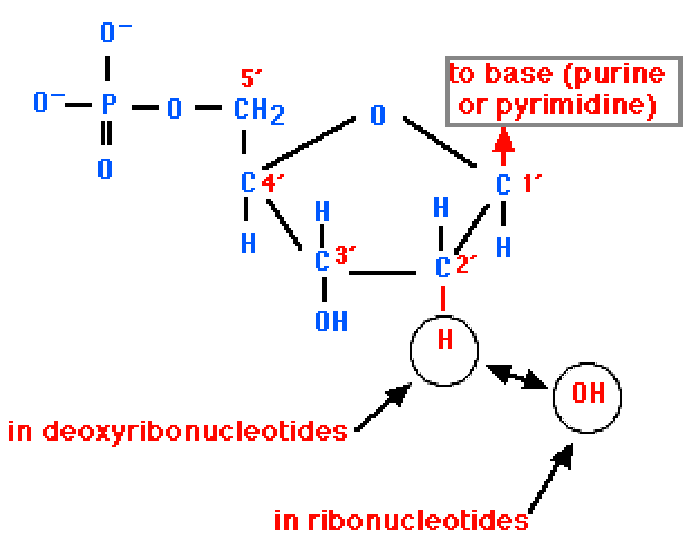
A nucleotide (right) consists of a nucleoside (left) and 1-3 attached phosphate groups. The nucleotide depicted below right is a monophosphate.
Why does the distinction between a nucleoside and a nucleotide matter?
The active agent for all nucleoside/nucleotide antiviral drugs is the triphosphate nucleotide, which is three phosphorylation steps removed from the nucleoside.
IDIX found that a major reason for the failure of NM283, a first-generation nucleoside, was the in vivo inefficiency and patient-to-patient variability of the first phosphorylation step, which converts a nucleoside into a monophosphate nucleotide.
IDIX’s IDX184 and VRUS’ PSI-7851, PSI-879, and PSI-938 are prodrugs of the monophosphate nucleotide; these drugs thus sidestep the problem encountered with NM283 by performing the first phosphorylation step ex vivo.
(The new-generation drugs mentioned above perform the second and third phosphorylation steps in vivo, but these steps do not present a practical problem because they are more efficient and less prone to variability than in vivo performance of the first phosphorylation step.)
“The efficient-market hypothesis may be the foremost piece of B.S. ever promulgated in any area of human knowledge!”