



 AI
AI







Sunday, January 30, 2022 9:45:27 PM
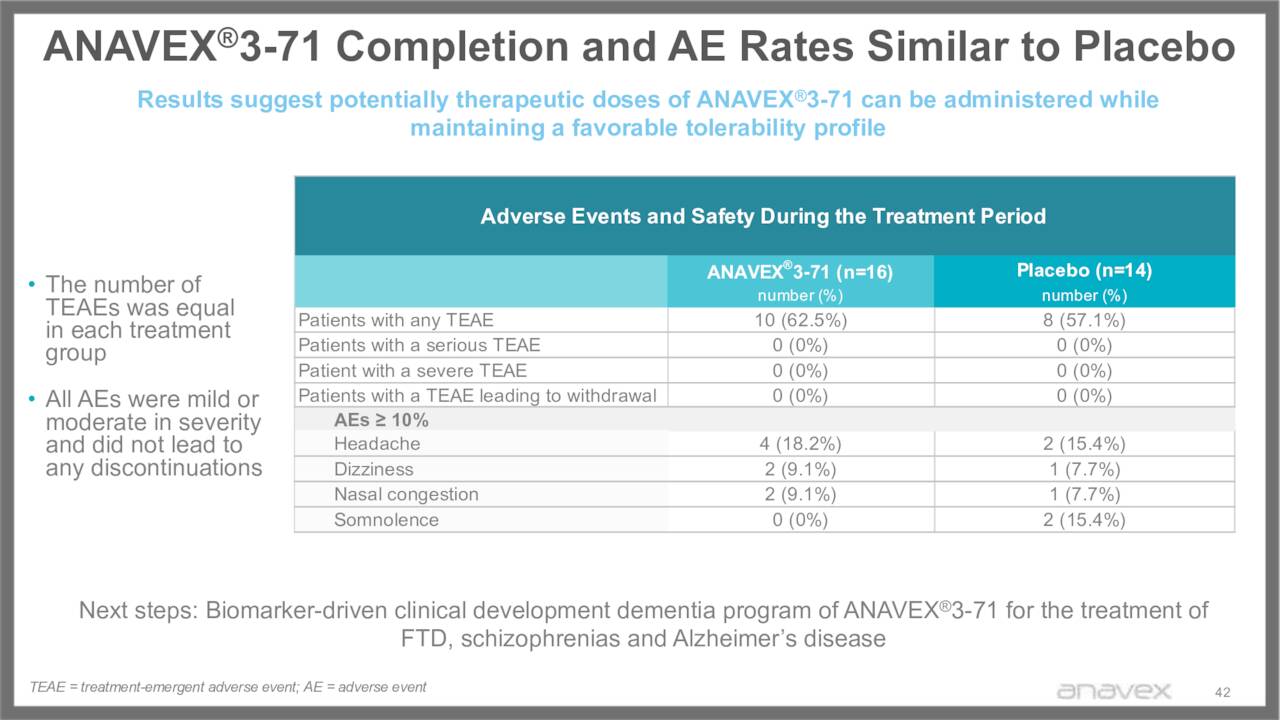
Anavex not only has Blarcamesine (Anavex 2-73) but also has Anavex 3-71 which could be orders of magnitude more effective than another drug for the treatment of Alzheimer's disease and other CNS diseases and/or conditions.
Do you know what orders of magnitude means
10X is one order of magnitude increase
100X is two orders of magnitude increase
1,000X is 3 orders of magnitude increase
10,000X is 4 orders of magnitude increase
orders of magnitude is plural meaning more than 1
Anavex 3-71 (formerly known as AF710B) is orders of magnitude more potent than donepezil (Aricept)and other agonists acting either on the M1 or the s-1 receptors, respectively,” Fisher said.
Quote:
First, s-1 receptors. They are strangers to published AD drug development, though pharmaceutical industry research on compounds active in the CNS comes across them frequently. First identified in the 1970s, these receptors were studied pharmacologically until Austrian researchers cloned the gene (Hanner et al., 1996). In the years after, scientists learned that many endogenous peptides, for example, pregnanolone and neuropeptide Y, interact with these receptors, and subsequent knockout and other biological studies showed they act as chaperones associated with the endoplasmic reticulum (Hayashi and Su, 2007). Unusually for chaperones, a slew of endogenous ligands that act as agonists or antagonists operate the s-1 receptor, Tangui Maurice at INSERM in Montpellier, France, told the audience in Zuers.
The s-1 receptor’s role in neurodegenerative diseases is poorly understood. One mutation appears to cause juvenile ALS (Al-Saif et al., 2011), but beyond that, data on its genetic contribution remain sparse (see AlzGene listing).
The receptor is ubiquitous. Besides neurons, astrocytes, oligodendrocytes, and Schwann cells, the liver, spleen, heart, kidney, intestine, and other organs express it. It is a transmembrane protein that lives in the ER, particularly at touch points with mitochondria. There, it modulates calcium and influences the composition of lipid rafts. The receptor becomes active in response to ligand binding and in conditions of ER stress. It protects mitochondria by influencing production of radical oxygen species and expression of the anti-apoptotic gene BCL2. It also sits in the plasma membrane, where it interacts with receptors ranging from TrkB, the muscarinic acetylcholine receptor, to sodium and potassium channels. “The s-1 receptor is an important activity-dependent signaling modulator of multiple intracellular pathways in the cell,” Maurice told the audience in Zuers.
How can the s-1 receptor influence myriad functions in cells? It does so by way of cooperating with other receptors. At least in some cases, it forms heteromers with them, said Abraham Fisher, Israel Institute for Biological Research, Ness-Ziona (e.g., see Navarro et al., 2010). This constellation is how the s-1 receptor may work as a target for certain drugs. For example, haloperidol treats schizophrenia by acting on the dopamine D2 and s-1 receptors; fluoxetine treats depression through a combined effect on the serotonin and s-1 receptors, and donepezil treats AD through an effect on a cholinesterase and the s-1 receptor.
In Zuers, both Fisher and Maurice presented their respective efforts at finding small molecules that tickle this receptor in a way that might treat AD better than current drugs do. Fisher introduced AF710B, a bicyclic heterocyclic spiro-compound that he said selectively activates both the muscarinic M1 receptor and the s-1 receptor. In detailing its effects on a list of phenotypic parameters—it increases sAPPa secretion, decreases tau hyperphosphorylation and GSK-3ß activity, decreases Bax, and increases BCL2 expression in mitochondria—Fisher emphasized that the former two effects come through the M1 receptor and the latter two through the s-1 receptor. Unlike previous compounds Fisher developed, which were mainly M1-selective orthosteric agonists, AF710B is an allosteric M1 receptor agonist. Its heteromer-specific effects differentiate it from other M1 agonists and modulators. Fisher claimed that the new compound is exquisitely potent, acting as a cognitive enhancer in rats at 1 to 30 micrograms (not milligrams) per kilogram body weight. According to Fisher, the compound is orally available with a safety margin of more than 50,000 times the minimally active dose. “Those are orders of magnitude more potent than donepezil and other agonists acting either on the M1 or the s-1 receptors, respectively,” Fisher said.
Fisher proposed that the compound has a unique mechanism of action, whereby it sensitizes the M1 receptor through heterodimerization with the s-1 receptor in the membrane of the ER, adding, however, that heteromerization of these receptors has not been formally proven. “We are looking to license it for drug development,” Fisher said.
Good luck and GOD bless,
Do you know what orders of magnitude means
10X is one order of magnitude increase
100X is two orders of magnitude increase
1,000X is 3 orders of magnitude increase
10,000X is 4 orders of magnitude increase
orders of magnitude is plural meaning more than 1
Anavex 3-71 (formerly known as AF710B) is orders of magnitude more potent than donepezil (Aricept)and other agonists acting either on the M1 or the s-1 receptors, respectively,” Fisher said.
Quote:
First, s-1 receptors. They are strangers to published AD drug development, though pharmaceutical industry research on compounds active in the CNS comes across them frequently. First identified in the 1970s, these receptors were studied pharmacologically until Austrian researchers cloned the gene (Hanner et al., 1996). In the years after, scientists learned that many endogenous peptides, for example, pregnanolone and neuropeptide Y, interact with these receptors, and subsequent knockout and other biological studies showed they act as chaperones associated with the endoplasmic reticulum (Hayashi and Su, 2007). Unusually for chaperones, a slew of endogenous ligands that act as agonists or antagonists operate the s-1 receptor, Tangui Maurice at INSERM in Montpellier, France, told the audience in Zuers.
The s-1 receptor’s role in neurodegenerative diseases is poorly understood. One mutation appears to cause juvenile ALS (Al-Saif et al., 2011), but beyond that, data on its genetic contribution remain sparse (see AlzGene listing).
The receptor is ubiquitous. Besides neurons, astrocytes, oligodendrocytes, and Schwann cells, the liver, spleen, heart, kidney, intestine, and other organs express it. It is a transmembrane protein that lives in the ER, particularly at touch points with mitochondria. There, it modulates calcium and influences the composition of lipid rafts. The receptor becomes active in response to ligand binding and in conditions of ER stress. It protects mitochondria by influencing production of radical oxygen species and expression of the anti-apoptotic gene BCL2. It also sits in the plasma membrane, where it interacts with receptors ranging from TrkB, the muscarinic acetylcholine receptor, to sodium and potassium channels. “The s-1 receptor is an important activity-dependent signaling modulator of multiple intracellular pathways in the cell,” Maurice told the audience in Zuers.
How can the s-1 receptor influence myriad functions in cells? It does so by way of cooperating with other receptors. At least in some cases, it forms heteromers with them, said Abraham Fisher, Israel Institute for Biological Research, Ness-Ziona (e.g., see Navarro et al., 2010). This constellation is how the s-1 receptor may work as a target for certain drugs. For example, haloperidol treats schizophrenia by acting on the dopamine D2 and s-1 receptors; fluoxetine treats depression through a combined effect on the serotonin and s-1 receptors, and donepezil treats AD through an effect on a cholinesterase and the s-1 receptor.
In Zuers, both Fisher and Maurice presented their respective efforts at finding small molecules that tickle this receptor in a way that might treat AD better than current drugs do. Fisher introduced AF710B, a bicyclic heterocyclic spiro-compound that he said selectively activates both the muscarinic M1 receptor and the s-1 receptor. In detailing its effects on a list of phenotypic parameters—it increases sAPPa secretion, decreases tau hyperphosphorylation and GSK-3ß activity, decreases Bax, and increases BCL2 expression in mitochondria—Fisher emphasized that the former two effects come through the M1 receptor and the latter two through the s-1 receptor. Unlike previous compounds Fisher developed, which were mainly M1-selective orthosteric agonists, AF710B is an allosteric M1 receptor agonist. Its heteromer-specific effects differentiate it from other M1 agonists and modulators. Fisher claimed that the new compound is exquisitely potent, acting as a cognitive enhancer in rats at 1 to 30 micrograms (not milligrams) per kilogram body weight. According to Fisher, the compound is orally available with a safety margin of more than 50,000 times the minimally active dose. “Those are orders of magnitude more potent than donepezil and other agonists acting either on the M1 or the s-1 receptors, respectively,” Fisher said.
Fisher proposed that the compound has a unique mechanism of action, whereby it sensitizes the M1 receptor through heterodimerization with the s-1 receptor in the membrane of the ER, adding, however, that heteromerization of these receptors has not been formally proven. “We are looking to license it for drug development,” Fisher said.
Good luck and GOD bless,
Recent AVXL News
- Anavex Life Sciences to Present at the 25th Annual Needham Virtual Healthcare Conference • GlobeNewswire Inc. • 04/07/2026 11:30:00 AM
- Anavex withdraws EU approval filing for Alzheimer’s therapy • IH Market News • 03/30/2026 12:39:26 PM
- Anavex Life Sciences Provides Comprehensive Regulatory Update • GlobeNewswire Inc. • 03/30/2026 11:30:00 AM
- Form 8-K - Current report • Edgar (US Regulatory) • 03/25/2026 08:06:00 PM
- Anavex withdraws EU marketing application for Alzheimer’s therapy blarcamesine • IH Market News • 03/25/2026 02:06:58 PM
- Anavex Life Sciences Provides Update on Regulatory Review in the EU for Blarcamesine to Treat Early Alzheimer’s Disease • GlobeNewswire Inc. • 03/25/2026 11:30:00 AM
- Anavex Life Sciences Presents New Data from its AD-004 Phase IIb/III Trial at AD/PD 2026 Conference Demonstrating Consistent Correlation Between the Treatment Effect of Oral Blarcamesine and Preservation of Brain Volume in Early Alzheimer’s Disease • GlobeNewswire Inc. • 03/23/2026 11:30:00 AM
- New Scientific Findings Highlight Hypothesis of Autophagy Failure as a Precursor of Amyloid Beta and Tau Pathology in Alzheimer’s Disease • GlobeNewswire Inc. • 03/20/2026 11:30:00 AM
- Anavex Life Sciences Presents Significant Treatment Effects of Blarcamesine in New Advanced Alpha-Synuclein Model of Parkinson’s Disease at AD/PD 2026 Conference • GlobeNewswire Inc. • 03/17/2026 11:30:00 AM
- Anavex Life Sciences to Present at the Citizens Life Sciences Conference • GlobeNewswire Inc. • 03/03/2026 12:30:00 PM
- Anavex Life Sciences to Present at the 46th TD Cowen Annual Health Care Conference • GlobeNewswire Inc. • 02/25/2026 12:30:00 PM
- Form 8-K - Current report • Edgar (US Regulatory) • 02/25/2026 11:07:01 AM
- Anavex Life Sciences Appoints Seasoned Healthcare Leader to Board of Directors • GlobeNewswire Inc. • 02/23/2026 12:30:00 PM
- Form 10-Q - Quarterly report [Sections 13 or 15(d)] • Edgar (US Regulatory) • 02/09/2026 09:40:27 PM
- Form 8-K - Current report • Edgar (US Regulatory) • 02/09/2026 12:31:17 PM
- Anavex Life Sciences Reports Fiscal 2026 First Quarter Financial Results and Provides Business Update • GlobeNewswire Inc. • 02/09/2026 12:30:00 PM
- Anavex Life Sciences to Announce Fiscal 2026 First Quarter Financial Results on Monday, February 9, 2026 • GlobeNewswire Inc. • 02/03/2026 12:30:00 PM
- Anavex Joins ACCESS-AD, a Major Initiative Funded by the European Commission, Through the Clinical Evaluation of Blarcamesine as Part of a Precision Medicine Approach in Alzheimer’s Disease • GlobeNewswire Inc. • 01/13/2026 12:30:00 PM
- Form 4 - Statement of changes in beneficial ownership of securities • Edgar (US Regulatory) • 01/09/2026 10:26:26 PM
- Edelson Lechtzin LLP Announces an Investigation of Anavex Life Sciences Corp. (NASDAQ: AVXL) and Encourages Investors with Substantial Losses Contact the Firm • PR Newswire (US) • 01/09/2026 01:13:00 AM
- Anavex Life Sciences Appoints Senior Vice President Global Head of Neurology • GlobeNewswire Inc. • 01/08/2026 12:30:00 PM
- Anavex Life Sciences Receives FDA Feedback on Alzheimer’s Disease Program • GlobeNewswire Inc. • 01/06/2026 12:30:00 PM
- Anavex Life Sciences Submitted Request for EMA to Re-Examine Its Opinion • GlobeNewswire Inc. • 12/18/2025 12:30:00 PM
- Anavex Life Sciences Provides Update on Regulatory Review in the EU for Blarcamesine to Treat Early Alzheimer’s Disease • GlobeNewswire Inc. • 12/12/2025 09:05:00 PM
- Anavex Life Sciences to Present Oral Blarcamesine Data at the 18th Clinical Trials on Alzheimer’s Disease (CTAD) Conference • GlobeNewswire Inc. • 11/26/2025 12:30:00 PM



