



 AI
AI








Monday, May 13, 2019 6:45:58 PM
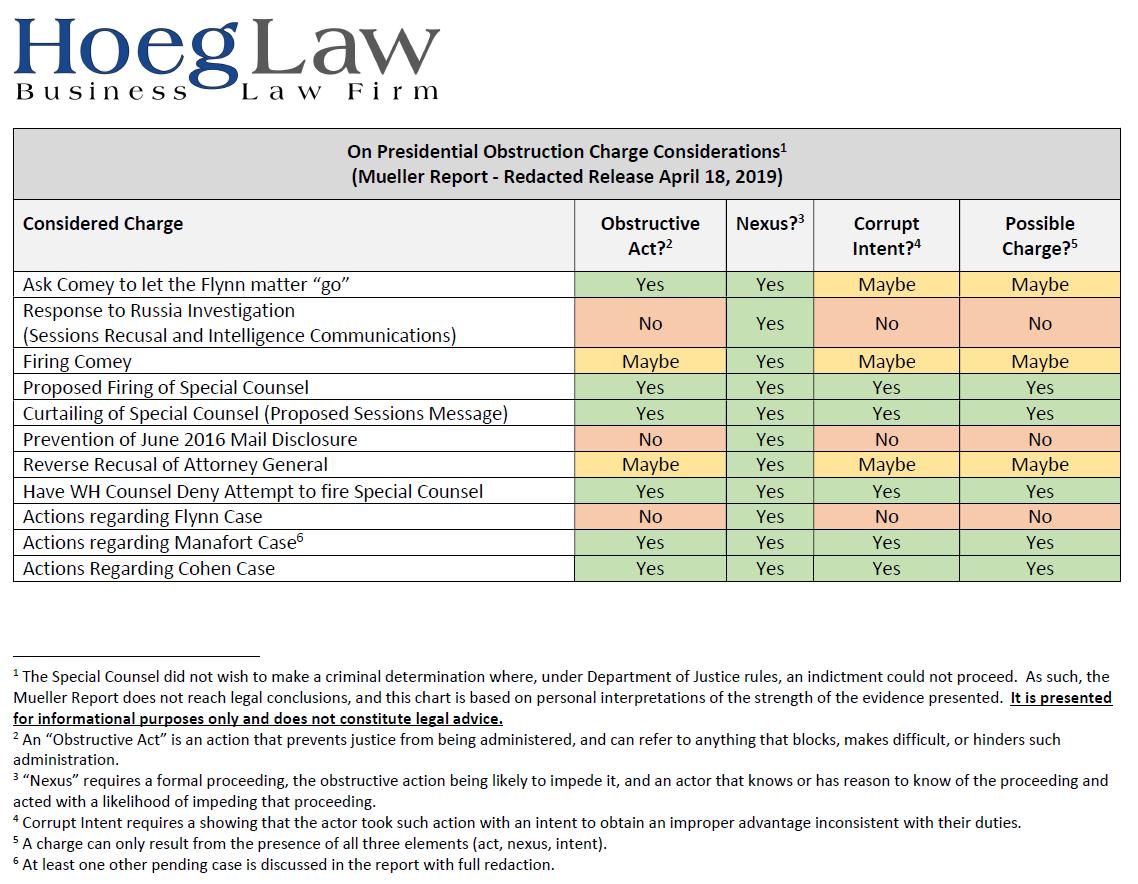
Obstruction of Justice in the Mueller Report: A Heat Map
[...]
The key question is how Robert Mueller and his team assessed the three elements “common to most of the relevant statutes” relating to obstruction of justice: an obstructive act, a nexus between the act and an official proceeding, and corrupt intent. As Mueller describes, the special counsel’s office “gathered evidence … relevant to the elements of those crimes and analyzed them within an elements framework—while refraining from reaching ultimate conclusions about whether crimes were committed,” because of the Office of Legal Counsel (OLC)’s guidelines against the indictment of a sitting president.
[...]
[...]
C. Conduct regarding public confirmation of the Russia investigation
Obstructive act (p. 60): Though “evidence shows” that Trump reached out to intelligence community leadership, that outreach was “not interpreted … as directives to improperly interfere with the investigation.” Mueller notes that Trump’s outreach to NSA Director Mike Rogers was “significant enough that Rogers thought it important to document the encounter in a written memorandum.”
Nexus (p. 60): The outreach took place following FBI Director James Comey’s announcement of the FBI’s counterintelligence and criminal investigation of Russian election interference.
Intent (p. 60): “The evidence does not establish that the President asked or directed intelligence agency leaders to stop or interfere with the FBI’s Russia investigation[.]” However, “the President’s intent in trying to prevent Sessions’s recusal, and in reaching out the Coats, Pompeo, Rogers, and Comey following Comey’s public announcement of the FBI’s Russia investigation, is nevertheless relevant to understanding what motivated the President’s other actions towards the investigation.” In other words, while Trump’s actions here do not indicate intent as to the specific potentially obstructive conduct at issue in this section, they are relevant to understanding his intent as to his broader pattern of conduct toward the investigation.
[...]
F. Efforts to curtail Mueller
Obstructive act (p. 97): Trump’s effort to force Sessions to confine the investigation to only investigating future election interference “would qualify as an obstructive act if it would naturally obstruct the investigation and any grand jury proceedings that might flow from the inquiry.” “Taken together, the President’s directives indicate that Sessions was being instructed to tell the Special Counsel to end the existing investigation into the President and his campaign[.]”
Nexus (p. 97): At the relevant point, “the existence of a grand jury investigation supervised by the Special Counsel was public knowledge.”
Intent (p. 97): “Substantial evidence” indicates that Trump’s efforts were “intended to prevent further investigative structiny of the President’s and his campaign’s conduct.”
[...]
I. Order to McGahn to deny Trump’s order to fire Mueller
Obstructive act (p. 118): This effort “would qualify as an obstructive act if it had the natural tendency to constrain McGahn from testifying truthfully or to undermine his credibility as a potential witness[.]” There is “some evidence” that Trump genuinely believed press reports that he had ordered McGahn to fire Mueller were wrong. However, “[o]ther evidence cuts against that understanding of the president’s conduct”—and the special counsel lists a great deal more evidence on this latter point.
Nexus (p. 119): At this point “the Special Counsel’s use of a grand jury had been further confirmed by the return of several indictments.” Mueller’s office had indicated to Trump’s lawyers that it was investigating obstruction, and Trump knew that McGahn had already been interviewed by Mueller on the topic. “That evidence indicates the President’s awareness” that his efforts to fire Mueller were relevant to official proceedings. Trump “likely contemplated the ongoing investigation and any proceedings arising from it” in directing McGahn to create a false record of the earlier interaction.
Intent (p. 120): “Substantial evidence indicates that … the President acted for the purpose of influencing McGahn’s account in order to deflect or prevent further scrutiny” of Trump.
Of course there are more - https://investorshub.advfn.com/boards/read_msg.aspx?message_id=148425785
Trump committed criminal obstruction. His presidency is the only thing that saved him.
See also:
Nearly 800 former federal prosecutors say they would've charged Trump based on the Mueller report
https://investorshub.advfn.com/boards/read_msg.aspx?message_id=148698726
[...]
The key question is how Robert Mueller and his team assessed the three elements “common to most of the relevant statutes” relating to obstruction of justice: an obstructive act, a nexus between the act and an official proceeding, and corrupt intent. As Mueller describes, the special counsel’s office “gathered evidence … relevant to the elements of those crimes and analyzed them within an elements framework—while refraining from reaching ultimate conclusions about whether crimes were committed,” because of the Office of Legal Counsel (OLC)’s guidelines against the indictment of a sitting president.
[...]
[...]
C. Conduct regarding public confirmation of the Russia investigation
Obstructive act (p. 60): Though “evidence shows” that Trump reached out to intelligence community leadership, that outreach was “not interpreted … as directives to improperly interfere with the investigation.” Mueller notes that Trump’s outreach to NSA Director Mike Rogers was “significant enough that Rogers thought it important to document the encounter in a written memorandum.”
Nexus (p. 60): The outreach took place following FBI Director James Comey’s announcement of the FBI’s counterintelligence and criminal investigation of Russian election interference.
Intent (p. 60): “The evidence does not establish that the President asked or directed intelligence agency leaders to stop or interfere with the FBI’s Russia investigation[.]” However, “the President’s intent in trying to prevent Sessions’s recusal, and in reaching out the Coats, Pompeo, Rogers, and Comey following Comey’s public announcement of the FBI’s Russia investigation, is nevertheless relevant to understanding what motivated the President’s other actions towards the investigation.” In other words, while Trump’s actions here do not indicate intent as to the specific potentially obstructive conduct at issue in this section, they are relevant to understanding his intent as to his broader pattern of conduct toward the investigation.
[...]
F. Efforts to curtail Mueller
Obstructive act (p. 97): Trump’s effort to force Sessions to confine the investigation to only investigating future election interference “would qualify as an obstructive act if it would naturally obstruct the investigation and any grand jury proceedings that might flow from the inquiry.” “Taken together, the President’s directives indicate that Sessions was being instructed to tell the Special Counsel to end the existing investigation into the President and his campaign[.]”
Nexus (p. 97): At the relevant point, “the existence of a grand jury investigation supervised by the Special Counsel was public knowledge.”
Intent (p. 97): “Substantial evidence” indicates that Trump’s efforts were “intended to prevent further investigative structiny of the President’s and his campaign’s conduct.”
[...]
I. Order to McGahn to deny Trump’s order to fire Mueller
Obstructive act (p. 118): This effort “would qualify as an obstructive act if it had the natural tendency to constrain McGahn from testifying truthfully or to undermine his credibility as a potential witness[.]” There is “some evidence” that Trump genuinely believed press reports that he had ordered McGahn to fire Mueller were wrong. However, “[o]ther evidence cuts against that understanding of the president’s conduct”—and the special counsel lists a great deal more evidence on this latter point.
Nexus (p. 119): At this point “the Special Counsel’s use of a grand jury had been further confirmed by the return of several indictments.” Mueller’s office had indicated to Trump’s lawyers that it was investigating obstruction, and Trump knew that McGahn had already been interviewed by Mueller on the topic. “That evidence indicates the President’s awareness” that his efforts to fire Mueller were relevant to official proceedings. Trump “likely contemplated the ongoing investigation and any proceedings arising from it” in directing McGahn to create a false record of the earlier interaction.
Intent (p. 120): “Substantial evidence indicates that … the President acted for the purpose of influencing McGahn’s account in order to deflect or prevent further scrutiny” of Trump.
Of course there are more - https://investorshub.advfn.com/boards/read_msg.aspx?message_id=148425785
Trump committed criminal obstruction. His presidency is the only thing that saved him.
See also:
Nearly 800 former federal prosecutors say they would've charged Trump based on the Mueller report
https://investorshub.advfn.com/boards/read_msg.aspx?message_id=148698726
It was Plato who said, “He, O men, is the wisest, who like Socrates, knows that his wisdom is in truth worth nothing”
Discover What Traders Are Watching
Explore small cap ideas before they hit the headlines.



