



 AI
AI






| Followers | 0 |
| Posts | 148553 |
| Boards Moderated | 7 |
| Alias Born | 03/10/2004 |

Friday, March 23, 2018 4:17:16 PM
Could Google’s ‘Smart Sound’ be more than just a gimmick?
By: Engadget | March 23, 2018
Welcome to your living room, the latest battleground for tech companies vying for your allegiance. What started as Amazon staking its claim with the Echo line of smart speakers now includes competition from Google and Apple, too. It's not just smart speakers, either -- all three companies have launched a Hi-Fi speaker in the past few months in an attempt to appeal to audiophiles. But while the Sonos One with Alexa and the Apple HomePod have mustered a ton of press since their debuts, the Google Home Max hasn't picked up quite as much traction.
It's not that the Home Max is underwhelming -- it's just that the Sonos One is surprisingly affordable, while the HomePod launched to much fanfare because it's Apple's first foray into the smart-speaker space. For its part, Google has focused on extolling the benefits of machine learning in the Home Max. This time it's being marketed as Smart Sound, and it's the special sauce that enables the Max to tune itself to any room. But it's still a work in progress, and whether it's doing anything that's discernible to the human ear is up for debate.
How Smart Sound works
Smart Sound has as much to do with the hardware as the machine-learning engine that's programmed into it.
Smart Sound is often referred to as what makes the Google Home Max speaker "smarter" than its smaller siblings, the Home and Home Mini, but that hardly explains what's happening under the hood.
Smart Sound's main component is a feature called Room EQ, which was designed to help mitigate muddled sound resulting from nearby walls and objects. Room EQ uses each of the Max's six onboard microphones to measure the low frequencies of the music playing. Those measurements are then fed to a machine-learning model that adjusts the bass output so that the sound is balanced relative to its environment.
Room EQ is made possible entirely by a machine-learning algorithm, which Google trained by placing the device in thousands of different demonstration rooms and real-life homes provided by the employees enrolled in the company's "dogfooding" program. "We collected an immense amount of data throughout the whole product development cycle," explained Frances Kwee, the lead acoustics engineer, who helped design the microphone and speaker systems on the Home Max. This data was used to help determine everything about the Max, including how it performed in different temperature environments and whether it could still hear commands at the loudest volume.
Even tuning the speaker's sound involved hard quantitative data. "Having a seamless listening window for the Google Home Max required a lot of measurements from different angles, different heights," said Kwee. "No one just stands in front of the speaker. People are walking around and living their life in their home, and we wanted to make sure it sounded balanced no matter what angle you're at in front of the Google Home Max."
Can Smart Sound make music sound better?
A screenshot from Google's promotional video for the Smart Sound in the Home Max.
Some audio professionals aren't entirely sold on the idea of machine-learning as the cure-all for bad room acoustics. Ethan Winer, author of The Audio Expert: Everything You Need to Know About Audio, compares the Max's Smart Sound feature to digital room correction (DRC), which relies on the same concept of digital filters to help reduce noise and increase fidelity. "It can help a little bit, but there's a lot of things it can't help. There's nothing you can do electronically inside a box to counter echos—echoes happen outside the box," he explained. "There's also a thing called nulls, where certain frequencies get canceled out because of room acoustics, and there's nothing these things can do to fix that either."
Winer is also suspicious of the lack of specifications available on the Max's audio capabilities. "They say technical specs, but it's really features," said Winer, noting that there is no available information for the Max's frequency or decibel (dB) range, which are the main criteria for audio fidelity. He later clarified in an email what an appropriate listing would look like by sending over the owner's manual for another high-end speaker. "It says the speaker is uniform within 1.5 dB over most of its range, then at the top of the second page, it shows that it's 3 dB softer at 49 Hz and 22 KHz. The only important thing missing is the amount of distortion. Most consumers don't need all the rest shown, though savvy consumers would want that!"
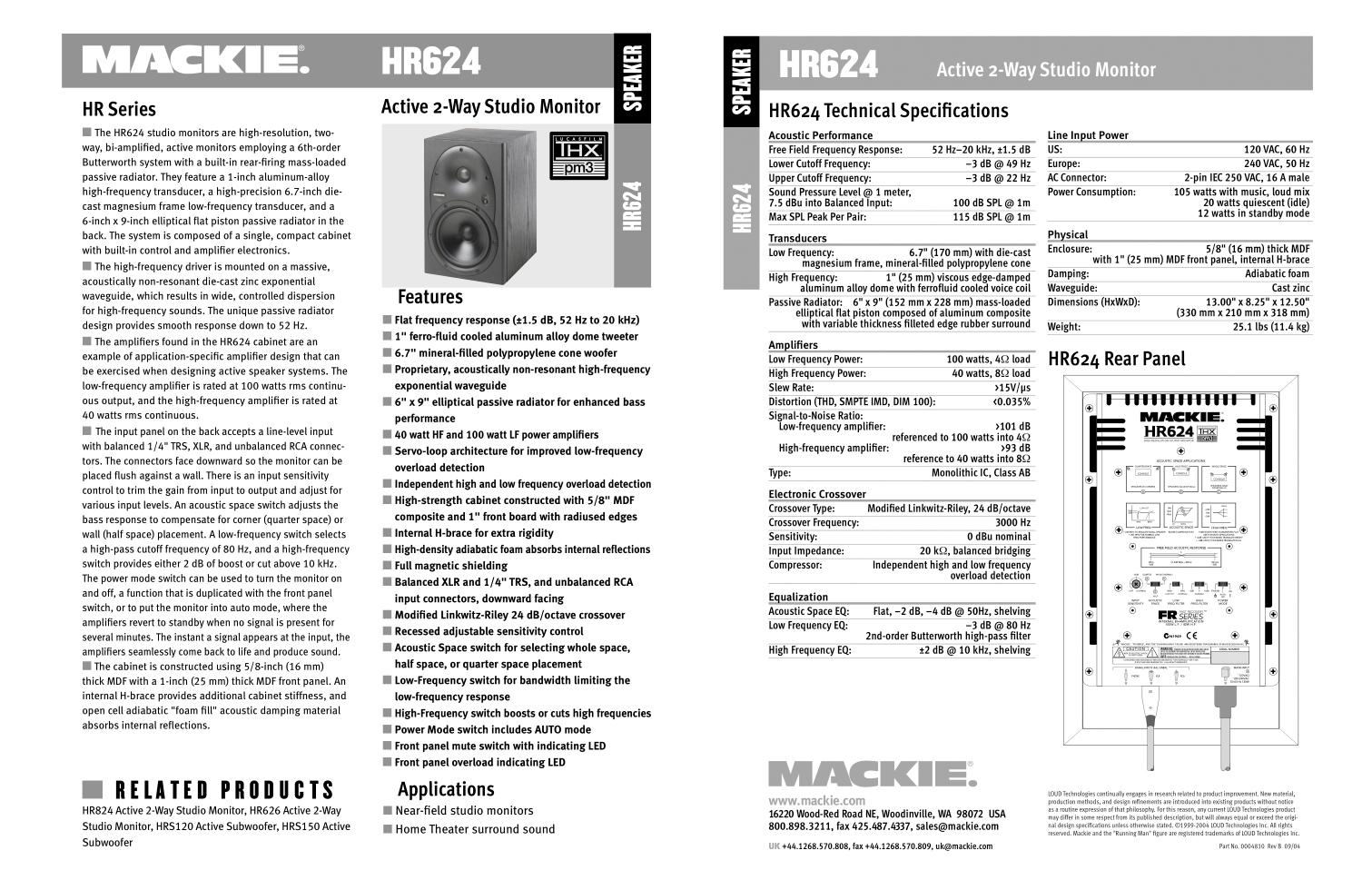
Winer said Mackie's owner's manual provides the kind of thorough specifications every HiFi stereo should flaunt.
Less skeptical about Smart Sound's abilities is Daniel Rothmann, a machine learning engineer who has programmed AI for audio processing and is currently working on a project in collaboration with Dynaudio A/S and Aarhus University in Denmark. "AI definitely promises us better audio processing technologies that are more flexible and situationally aware," he wrote in an email. "Up to this point, we've had a bit of trouble understanding audio as well as we do images, so that's probably why we're only now seeing technologies like Google's Smart Sound emerging. But in a simple sense, AI technologies are becoming a reality for audio processing."
Despite his optimism, however, Rothmann admits that there's still work to be done before the AI in a speaker like the Max can be truly situationally aware. "It is still really difficult to understand 'auditory scenes,' or situations with several sounds going on at once. So for now, we deal mostly with the broader idea of a sound 'profile' or 'fingerprint' from which we can choose a processing setting."
As for whether audiophiles will ever find a smart speaker like the Google Home Max a compelling product, Rothman thinks it will take time. "As techniques improve in the future, I think they will start to like it."
Buy it because it's smart
The Google Home Max's Smart Sound is certainly smart—Google poured a ton of research into the product in an effort to help make it stand out from its competition. But whether there's a keen difference between the Max and other HiFi speakers is as of yet indeterminable. Fortunately, it has plenty of other worthy features to rely on, most notably its integration with the Google Assistant. And if you've seen the wave of "Make Google do it" commercials then you may have realized it's the main reason to consider buying one of these speakers in the first place.
If you specifically want the best sounding speaker for blaring music, Winer suggested going the old-fashioned route by heading to a brick-and-mortar store like Best Buy and listening to a few of your favorite songs on the demo models. After a couple of listens, pick the one that sounds best to your ears. "If you want a stereo you're better off getting a real boombox."
https://www.engadget.com/2018/03/23/google-smart-sound-gimmick/
• DiscoverGold
By: Engadget | March 23, 2018
Welcome to your living room, the latest battleground for tech companies vying for your allegiance. What started as Amazon staking its claim with the Echo line of smart speakers now includes competition from Google and Apple, too. It's not just smart speakers, either -- all three companies have launched a Hi-Fi speaker in the past few months in an attempt to appeal to audiophiles. But while the Sonos One with Alexa and the Apple HomePod have mustered a ton of press since their debuts, the Google Home Max hasn't picked up quite as much traction.
It's not that the Home Max is underwhelming -- it's just that the Sonos One is surprisingly affordable, while the HomePod launched to much fanfare because it's Apple's first foray into the smart-speaker space. For its part, Google has focused on extolling the benefits of machine learning in the Home Max. This time it's being marketed as Smart Sound, and it's the special sauce that enables the Max to tune itself to any room. But it's still a work in progress, and whether it's doing anything that's discernible to the human ear is up for debate.
How Smart Sound works
Smart Sound has as much to do with the hardware as the machine-learning engine that's programmed into it.
Smart Sound is often referred to as what makes the Google Home Max speaker "smarter" than its smaller siblings, the Home and Home Mini, but that hardly explains what's happening under the hood.
Smart Sound's main component is a feature called Room EQ, which was designed to help mitigate muddled sound resulting from nearby walls and objects. Room EQ uses each of the Max's six onboard microphones to measure the low frequencies of the music playing. Those measurements are then fed to a machine-learning model that adjusts the bass output so that the sound is balanced relative to its environment.
Room EQ is made possible entirely by a machine-learning algorithm, which Google trained by placing the device in thousands of different demonstration rooms and real-life homes provided by the employees enrolled in the company's "dogfooding" program. "We collected an immense amount of data throughout the whole product development cycle," explained Frances Kwee, the lead acoustics engineer, who helped design the microphone and speaker systems on the Home Max. This data was used to help determine everything about the Max, including how it performed in different temperature environments and whether it could still hear commands at the loudest volume.
Even tuning the speaker's sound involved hard quantitative data. "Having a seamless listening window for the Google Home Max required a lot of measurements from different angles, different heights," said Kwee. "No one just stands in front of the speaker. People are walking around and living their life in their home, and we wanted to make sure it sounded balanced no matter what angle you're at in front of the Google Home Max."
Can Smart Sound make music sound better?
A screenshot from Google's promotional video for the Smart Sound in the Home Max.
Some audio professionals aren't entirely sold on the idea of machine-learning as the cure-all for bad room acoustics. Ethan Winer, author of The Audio Expert: Everything You Need to Know About Audio, compares the Max's Smart Sound feature to digital room correction (DRC), which relies on the same concept of digital filters to help reduce noise and increase fidelity. "It can help a little bit, but there's a lot of things it can't help. There's nothing you can do electronically inside a box to counter echos—echoes happen outside the box," he explained. "There's also a thing called nulls, where certain frequencies get canceled out because of room acoustics, and there's nothing these things can do to fix that either."
Winer is also suspicious of the lack of specifications available on the Max's audio capabilities. "They say technical specs, but it's really features," said Winer, noting that there is no available information for the Max's frequency or decibel (dB) range, which are the main criteria for audio fidelity. He later clarified in an email what an appropriate listing would look like by sending over the owner's manual for another high-end speaker. "It says the speaker is uniform within 1.5 dB over most of its range, then at the top of the second page, it shows that it's 3 dB softer at 49 Hz and 22 KHz. The only important thing missing is the amount of distortion. Most consumers don't need all the rest shown, though savvy consumers would want that!"
Winer said Mackie's owner's manual provides the kind of thorough specifications every HiFi stereo should flaunt.
Less skeptical about Smart Sound's abilities is Daniel Rothmann, a machine learning engineer who has programmed AI for audio processing and is currently working on a project in collaboration with Dynaudio A/S and Aarhus University in Denmark. "AI definitely promises us better audio processing technologies that are more flexible and situationally aware," he wrote in an email. "Up to this point, we've had a bit of trouble understanding audio as well as we do images, so that's probably why we're only now seeing technologies like Google's Smart Sound emerging. But in a simple sense, AI technologies are becoming a reality for audio processing."
Despite his optimism, however, Rothmann admits that there's still work to be done before the AI in a speaker like the Max can be truly situationally aware. "It is still really difficult to understand 'auditory scenes,' or situations with several sounds going on at once. So for now, we deal mostly with the broader idea of a sound 'profile' or 'fingerprint' from which we can choose a processing setting."
As for whether audiophiles will ever find a smart speaker like the Google Home Max a compelling product, Rothman thinks it will take time. "As techniques improve in the future, I think they will start to like it."
Buy it because it's smart
The Google Home Max's Smart Sound is certainly smart—Google poured a ton of research into the product in an effort to help make it stand out from its competition. But whether there's a keen difference between the Max and other HiFi speakers is as of yet indeterminable. Fortunately, it has plenty of other worthy features to rely on, most notably its integration with the Google Assistant. And if you've seen the wave of "Make Google do it" commercials then you may have realized it's the main reason to consider buying one of these speakers in the first place.
If you specifically want the best sounding speaker for blaring music, Winer suggested going the old-fashioned route by heading to a brick-and-mortar store like Best Buy and listening to a few of your favorite songs on the demo models. After a couple of listens, pick the one that sounds best to your ears. "If you want a stereo you're better off getting a real boombox."
https://www.engadget.com/2018/03/23/google-smart-sound-gimmick/
• DiscoverGold
Information posted to this board is not meant to suggest any specific action, but to point out the technical signs that can help our readers make their own specific decisions. Your Due Dilegence is a must!
• DiscoverGold
Recent GOOG News
- Investors seeking SpaceX exposure have alternatives ahead of blockbuster IPO • IH Market News • 05/26/2026 02:05:09 PM
- Google commits $15 billion to Missouri expansion with new data center project (GOOG) • IH Market News • 05/21/2026 10:23:23 AM
- Google expands AI push at I/O with enterprise-focused Gemini upgrades and smarter search tools • IH Market News • 05/20/2026 10:35:17 AM
- EssilorLuxottica shares retreat as Google and Samsung step up competition in AI glasses market • UK Market News • 05/20/2026 09:17:08 AM
- Trump’s Iran Remarks Lift Hopes for Peace Deal as Markets Track Oil and AI Momentum: Dow Jones, S&P, Nasdaq, Wall Street Futures • IH Market News • 05/19/2026 09:29:24 AM
- Markets rise on renewed optimism over possible U.S.-Iran breakthrough: Dow Jones, S&P, Nasdaq, Wall Street Futures • UK Market News • 05/19/2026 09:29:15 AM
- Tech results, oil rally and Fed decision shape market direction: Dow Jones, S&P, Nasdaq, Wall Street Futures • UK Market News • 04/30/2026 09:23:09 AM
- Tech earnings, oil spike and Fed decision drive market moves: Dow Jones, S&P, Nasdaq, Wall Street Futures • IH Market News • 04/30/2026 09:23:05 AM
- Alphabet shares rise after earnings beat fueled by Cloud and Search strength • IH Market News • 04/30/2026 06:32:35 AM
- Markets Steady Ahead of Fed Decision and Key Tech Earnings: Dow Jones, S&P, Nasdaq, Wall Street Futures • IH Market News • 04/29/2026 09:16:13 AM
- Markets Hold Steady Ahead of Fed Call and Big Tech Earnings: Dow Jones, S&P, Nasdaq, Wall Street Futures • UK Market News • 04/29/2026 09:15:43 AM
- Google expands Pentagon partnership with AI deal for classified operations • IH Market News • 04/28/2026 10:04:58 AM
- Five Key Market Themes to Watch in the Week Ahead • IH Market News • 04/27/2026 10:29:55 AM
- Google DeepMind Teams Up With South Korea on AI Research Drive • IH Market News • 04/27/2026 10:09:38 AM
- Google Cloud Launches $750m Fund to Accelerate AI Partner Ecosystem • IH Market News • 04/22/2026 12:48:34 PM
- Apple Takes Top Spot in Global Smartphone Market for First Time in Q1 2026 • IH Market News • 04/10/2026 12:29:49 PM
- Waymo Says Remote Staff Do Not “Directly” Operate Its Robotaxis • IH Market News • 02/18/2026 10:10:13 AM
- Closing the Intent-to-Execution Gap May Define Next Wave of AI Investment • InvestorsHub NewsWire • 02/17/2026 02:00:00 PM
- Closing the Intent-to-Execution Gap May Define Next Wave of AI Investment • GlobeNewswire Inc. • 02/17/2026 01:30:00 PM
- Alphabet completes pricing of $20 billion multi-tranche bond sale • IH Market News • 02/10/2026 03:05:55 PM
- Apple and Google agree to app store reforms following UK competition scrutiny • IH Market News • 02/10/2026 01:19:10 PM
- Markets Turn to Earnings and Key Data as Japan PM’s Election Gamble Pays Off: Dow Jones, S&P, Nasdaq, Wall Street Futures • IH Market News • 02/09/2026 10:03:14 AM
- Markets Look to Earnings and Data This Week as Japan PM’s Election Bet Pays Off: Dow Jones, S&P, Nasdaq, Wall Street Futures • UK Market News • 02/09/2026 10:03:02 AM
- Wall Street Futures Point Higher as Bargain Buyers Step In After Tech Selloff: Dow Jones, S&P, Nasdaq • IH Market News • 02/06/2026 02:15:21 PM
- Wall Street Seen Opening Firmer as Investors Eye Bargains After Tech Rout: Dow Jones, S&P, Nasdaq • UK Market News • 02/06/2026 02:15:09 PM



