.. thanks, F6, it looks that one is the latest i can see now, or hmm, that one might not appear there .. i'll look elsewhere later .. anyway, the lead-up to the Rachel Maddow Show above has lots of interesting stuff including the disastrous .. well, weird and not wonderful, anyway .. lol .. news that Texas Dems mainstream candidate against Cornyn couldn't avoid a primary run-off with a LaRouche 'impeach Obama' crazy ..
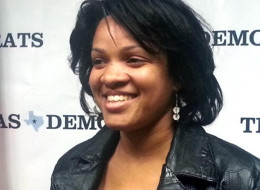
Kesha Rogers, Lyndon LaRouche Disciple, Heads To Run-Off Election In Texas Senate Race
The Huffington Post | by Amanda Terkel
Posted: 03/05/2014 11:26 am EST Updated: 03/05/2014 11:59 am EST
Kesha Rogers, a political activist who wants to impeach President Barack Obama, is still in the running to become the Democratic nominee for U.S. Senate in Texas, after no candidate secured a majority of the votes in Tuesday's primary election. Rogers, who garnered 21.7 percent, will face Dallas dentist David Alameel, who received 47.1 percent, in a run-off on May 27.
Rogers and Alameel were the top two vote-getters in the five-way contest Tuesday. The winner of the Democratic primary will face Sen. John Cornyn (R-Texas), who easily won his primary contest despite a challenge from Rep. Steve Stockman (R-Texas), who tried to argue that the incumbent senator was too liberal.
.. aside .. i don't know if anyone noticed, but i was shocked to see i had posted an article by Robert Dreyfus .. the 3rd one here .. http://investorshub.advfn.com/boards/read_msg.aspx?message_id=98003759 when later i found he had written a book commissioned by LaRouche .. http://en.wikipedia.org/wiki/Robert_Dreyfuss .. that put his article into a slightly different perspective for me .. lol .. just maybe Dreyfuss would like to see Putin get more of the Ukraine ..
.. thanks again, F6, lol, this from sophist in '03 will always fit ..
"The Awful Truth" By Russell Baker [This is an interesting review, from the current New York Times Magazine, of the following book of economic and political commentary by economist Paul Klugman.]
The Great Unraveling: Losing Our Way in the New Century by Paul Krugman (Norton, 426 pp., $25.95)
When The New York Times tempted Paul Krugman to try daily journalism, no one, including Krugman, could have anticipated what was to come. Krugman was an Ivy League professor of economics, a scholar acclaimed for his youthful brilliance, and an author of learned books and occasional commentary on international money crises. All clues pointed to a master of the tedious. One suspected the Times wanted someone to be boring in a genteel, scholarly way twice a week on its Op-Ed page. Krugman himself may have thought so. In The Great Unraveling he says he intended to write about globalization, world financial problems, and sometimes the "vagaries" of the domestic economy.
Before anyone could say "narcolepsy," politics intruded, and it quickly became obvious that Krugman was incapable of being either boring or genteel, but was highly gifted at writing political journalism. Starting in January of the election year 2000, he rapidly acquired a large, adoring readership which treasured his column as an antidote for the curiously polite treatment President Bush was receiving from most of the mainstream media.
At his most polite, Krugman was irreverent, but much of the time he seemed to think irreverence was much too good for the President, the people around him, and almost everything he stood for. In The Great Unraveling he commits the ultimate rudeness: Bush, he says, is surreptitiously leading a radical right-wing political movement against American government as it has developed in the past century. The words "radical" and "right-wing" are bad words in the political lexicon of mainstream American journalism. Normally they are simply not used to describe presidents, except by the kind of people who write for funky little out-of-the-mainstream journals.
As a Times columnist, Krugman is as mainstream as it gets. His readiness to apply disapproved words to the President helps to explain why his column quickly became catnip to so many who had voted for Al Gore and were still angry about the bizarre manner of Bush's elevation. For them, to have the Bush presidency so relentlessly and expertly savaged was a consolation of sorts. From the White House viewpoint criticism itself was bad enough—Bush people are famous for thin skin—but the really troublesome problem was that Krugman seemed to know what he was talking about. This is not entirely unheard of among political columnists, but the typical Washington pundit is stupefyingly uninformed about economics, a field in which Krugman is exceedingly well informed. He had the professional skills needed to tell when the political rhetoric was nonsense and he took a short-tempered professor's sadistic delight in holding oafs up to ridicule.
The vocabulary Krugman applied to the President bristled with words such as "dishonesty," "lying," "mendacity," and "fraud." Among political pundits such language verges on the taboo. As a class, political columnists do not shrink from the occasional well poisoning, but on matters of etiquette they are conservative to the verge of stuffiness, and they tend to view plain speech as the mark of the ill-mannered bumpkin.
The good opinion of his colleagues does not seem to concern Krugman. His indifference toward journalism's conventional etiquette may even contribute to his success. By speaking rudely about the President and his policies he gave loud voice to what many of his readers had been wishing somebody important would say ever since Bush was created president by Supreme Court fiat. In some measure Krugman helped satisfy a hunger for political opposition, a longing which, not surprisingly, became acute after the election of 2000 turned out to be a nonelection.
It is hard to imagine the Republicans, had the Supreme Court appointed a Democrat to the White House, accepting the decision as meekly as the Democrats accepted the Court's anointing of Bush. Republicans thrive on combat and have a passion for opposing, which is rooted in all those years of opposing the New and Fair Deals, not to mention Theodore Roosevelt's "square deal" a century ago. Theirs is a party so dedicated to opposition that it opposes government itself and often seeks power mainly to dismantle a great deal of it. A favorite Republican battle cry is: "Government is the problem!"
Democrats have a flabbier tradition. Congressional Democrats, who might have been the natural source of an opposition to Bush, chose instead to be good sports about the aborted election. They promptly joined the President in granting lavish tax cuts to the richest part of the population, then moved en masse to endorse his request for authority to make the war he wanted in Iraq. After managing to lose the off-year congressional elections of 2002, they settled into a torpor so restful that they are still vexed with Howard Dean for disturbing their peace.


 Market Data
  Markets


 AI
AI