Crimean coup is payback by Putin for Ukraine's revolution
After what Moscow regards as the western-backed takeover of Kiev, the Kremlin's choreography has been impressive
Luke Harding theguardian.com, Saturday 1 March 2014 02.35 AEST
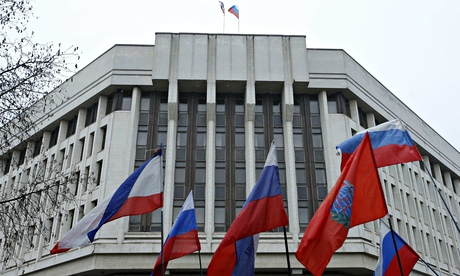
Russian flags outside the Crimean parliament building in Simferopol. Photograph: David Mdzinarishvili/Reuters
Days after the end of Vladimir Putin's Sochi Olympics, the borders of Europe are shifting. Or, more accurately, military forces suspected of acting on Moscow's orders are creating a new cartographic reality on the ground.
Overnight, alleged undercover Russian special forces seized control of Simferopol airport, in the administrative capital of Crimea. The move comes less than 24 hours after a similar squad of shadowy, well-armed, Russian-speaking gunmen seized Simferopol's parliament building and administrative complex. If anyone was in doubt what this meant, the gunmen left a clue. They raised a Russian flag above the parliament building.
Moscow's military moves so far resemble a classically executed coup: seize control of strategic infrastructure, seal the borders between Crimea and the rest of Ukraine, invoke the need to protect the peninsula's ethnic Russian majority. The Kremlin's favourite news website, Lifenews.ru .. http://www.lifenews.ru/ , was on hand to record the historic moment. Its journalists were allowed to video Russian forces patrolling ostentatiously outside Simferopol airport .. http://lifenews.ru/news/128083 .
Wearing khaki uniforms – they had removed their insignia – and carrying Kalashnikovs, the soldiers seemed relaxed and in control. Other journalists filming from the road ..
.. captured Russian helicopters flying into Crimea from the east. They passed truckloads of Russian reinforcements arriving from Sevastopol, home to Russia .. http://www.theguardian.com/world/russia 's Black Sea fleet.
The Kremlin has denied any involvement in this very Crimean coup. But Putin's playbook in the coming days and months is easy to predict. On Thursday, the Crimean parliament announced it would hold a referendum on the peninsula's future status on 25 May. That is the same day Ukraine goes to the polls in fresh presidential elections.
The referendum can have only one outcome: a vote to secede from Ukraine. After that, Crimea can go one of two ways. It could formally join the Russian Federation. Or, more probably, it might become a sort of giant version of South Ossetia or Abkhazia, Georgia's two Russian-occupied breakaway republics – a Kremlin-controlled puppet exclave, with its own local administration, "protected" by Russian troops and naval frigates. Either way, this amounts to Moscow's annexation of Crimea, de facto or de jure.
From Putin's perspective, a coup would be payback for what he regards as the western-backed takeover of Kiev by opposition forces – or fascists, as the Kremlin media calls them. The Kremlin argument runs something like this: if armed gangs can seize power in the Ukrainian capital, storming government buildings, why can't pro-Russian forces do the same thing in Crimea? (It is another high-stakes manifestation of the Kremlin's favourite doctrine, "whataboutism". If Kosovo, then Crimea etc.)
There are, of course, signal differences. Despite the presence of radical Ukrainian nationalists, the vast majority of opposition demonstrators in Kiev were ordinary citizens. They were fed up with the corruption and misrule of President Viktor Yanukovych and his clique. It was a bottom-up revolution. The protesters were armed with little more than homemade shields, rubbish helmets and molotov cocktails.
In Crimea, by contrast, the shadowy Russian troops are equipped with the latest gear – they are professionals, not amateur homegrown revolutionaries. Ukrainian officials point to the GRU, Russian military intelligence. And the warp-speed tempo of events in Crimea is being dictated from the top, not the bottom – from Moscow, rather than the street.
The choreography has been impressive. Within hours of the airport seizure, Russian MPs proposed a bill in the state Duma simplifying procedures for getting Russian passports to Ukrainians .. http://m.lenta.ru/news/2014/02/28/passports/ . The goal, the MPs said, was to protect a "brotherly nation". Russia's most important opposition leader, Alexei Navalny, meanwhile, has been placed under house arrest .. http://www.theguardian.com/world/2014/feb/28/alexei-navalny-russia-opposition-leader-house-arrest .. for two months and denied access to the internet. The Kremlin, that most risk-averse of entities, has everything covered.
It only remains to be seen what role Yanukovych will play in this fast-moving drama. Despite having fled the country, he insists that he is still Ukraine's legitimate president. He is giving a press conference on Friday in the southern Russian town of Rostov-on-Don, close to the Ukrainian border.
This may seem like a bizarre provincial venue. But there is method here too: Russia refuses to recognise Kiev's new pro-western interim government as a legitimate partner. It is likely to continue to treat Yanukovych – whose regime is accused of plundering $70bn .. http://www.theguardian.com/world/2014/feb/27/ukraine-search-missing-billions-yanukovych-russia .. (£42bn) from Ukraine's treasury – as the head of a government-in-exile. It may even seek to return him to Crimea to continue his "executive" functions. Given Yanukovych's love of bling, Crimea's sumptuous Livadia Palace – where Stalin, Roosevelt and Churchill met to discuss Europe's 1945 postwar carve-up .. http://en.wikipedia.org/wiki/Yalta_Conference – might serve as his new HQ.
Spare a thought, meanwhile, for Crimea's Tartars. They are the peninsula's original Turkic-speaking Muslim inhabitants. Well-educated and politically organised, they now number 300,000, 15% of Crimea's population. They want to remain part of Ukraine. They support Kiev's new pro-EU leadership.
They also have their own awful folk memories of Russian colonisation and exile: in 1944, Stalin deported the Tartars and other smaller groups to central Asia. They mostly came home after the collapse of the Soviet Union. Understandably, they may now fear being cast once again in the role of fifth columnists. So far the Kremlin has said nothing about their rights.
All of this presents the west with one of its biggest crises since the cold war. Russia has mounted a major land grab of a neighbouring sovereign state. How will the west react?
“Understanding my responsibility for the life and security of citizens, I appeal to the president of Russia, Vladimir Putin, for assistance in guaranteeing peace and calmness on the territory of the autonomous republic of Crimea,” Aksenov, the head of the main pro-Russia party on the peninsula, said in his statement.
Aksenov was appointed by the Crimean parliament on Thursday after pro-Russia gunmen seized the building and as tensions soared over Crimea’s resistance to the new authorities in Kiev, who took power last week.
Ukraine’s population is divided in loyalties between Russia and the West, with much of western Ukraine advocating closer ties with the EU while eastern and southern regions, where Crimea is, look to Russia for support.
Crimea, a southeastern peninsula of Ukraine that has semi-autonomous status, was seized by Russian forces in the 18th century under Catherine the Great. It became part of Ukraine in 1954 when Soviet leader Nikita Khrushchev transferred jurisdiction from Russia, a move that was a mere formality until the 1991 Soviet collapse meant Crimea landed in an independent Ukraine.
Budapest Memorandum calls for talking (consulting) if a border violation occurs
...the legal obligation on the part of the United States and Russia and the UK is, under paragraph 1, “to respect the independence and sovereignty and the existing borders of Ukraine.” But what happens if one state does not do this? The only specific obligation is under paragraph 6, which provides that the parties “will consult in the event a situation arises that raises a question concerning these commitments.” So, clearly there is no obligation to use force. The requirement under paragraph 5– to seek action by the Security Council– seem to be triggered only if Ukraine is a victim of aggression or the threat of aggression when nuclear weapons are involved. That does not seem to be the case here, and even if it were, the obligation would be to take the matter to the Security Council, where, of course, Russia has a veto.
According to a Kremlin statement about a Sunday phone call, Vladimir Putin told Barack Obama that Crimea was in line with the so-called 'Kosovo precedent'. Photograph: Sasha Mordovets / Getty
Contrarians and critics of American foreign policy like to play a game called Less Hypocritical Than Thou. The rules are simple:
Rule No 1: seek out the narrative about a global crisis triggered by some “bad” international actor;
Rule No 2: point out the ways in which the US has done the very same thing at some point in recent history;
Rule No 3: stress the need to perceive world politics from another point of view;
Rule No 4: revel in the hypocrisy of your intellectual adversaries.
This is a fun game, especially when many pundits and officials elide obvious parallels between the crisis of the moment and recent American history. And it’s certainly been easy to play Less Hypocritical Than Thou with respect to Ukraine. When John Kerry said .. http://www.reuters.com/article/2014/03/02/us-ukraine-crisis-usa-kerry-idUSBREA210DG20140302 .. earlier this month that, “You just don’t in the 21st century behave in 19th-century fashion by invading another country on completely trumped up pretext”, it did not take long for social media to hoot with derision at the unironic echoes of the 2003 invasion of Iraq.
The parallels seem pretty obvious: not entirely unlike Crimea, Kosovo was an autonomous republic with a majority of citizens that belonged to an ethnic minority. And the ethnic Albanians living in Kosovo feared Serbian repression, just as Russians living in Crimea feared the newly-empowered Ukrainian nationalists that has assumed power in Kiev.
Let’s count the ways why Moscow and its defenders are sighting false precedent and taking tu quoque-ery too far:
What was the role of using force?
In 1999, without any United Nations imprimatur, NATO used lethal force to thwart Serbian actions in that autonomous republic, killing hundreds on the ground. Russia acted more stealthily and peacefully in Crimea, effectively taking control of the peninsula with nary a shot being fired.
In contrast, Russia acted unilaterally in Crimea – and officially, the Russian government still denies that Russian troops are the ones controlling the territory.
What was the pathway to independence?
In Kosovo, NATO’s actions left a de facto independent state. Nevertheless, Kosovo took its route to independence after nearly a decade of frustrating negotiations that tried to accommodate Serbian and Russian interests.
The Crimean referendum, mind you, was planned less than two weeks after Russia seized control of the region.
Stepping back, the big difference between Kosovo and Crimea is that the US only took action after giving diplomacy numerous chances. (Today, the sanctions are coming .. http://www.theguardian.com/world/2014/mar/17/us-eu-expected-sanctions-against-russia .) Russia, on the other hand, has chosen to occupy first and negotiate later. Cynics might argue that the outcomes have been the same. But process matters in foreign policy, and Russia’s process has been a shambles.
None of this is to say that the United States is free of hypocrisy, or that critics of US policy toward Kosovo didn’t warn that something like this would happen. Defenders of Russia’s actions in Crimea can make a case that the United States opened the door to such actions – it’s just not a terribly convincing one.


 Market Data
  Markets


 AI
AI