*Some GMO versions of apples and other crops are being tested but are not currently approved to be planted for commercial production. GMO versions of tomatoes and potatoes have been approved for planting, but are not currently in commercial production.
WHAT TO KNOW
Fast fact: In 1994, the transgenic FlavrSavr tomato hit the market and they were last grown in 1997. Currently, no GMO tomatoes are in commercial production.
WHAT WE'RE DOING IN PRODUCE
We are working to provide verified non-GMO versions of these five high-risk produce items in our stores and, in the meantime, ask us about the source or buy organic.
~ ~ ~ ~ ~ ~ ~
PACKAGED FOODS: How To Shop if Avoiding GMOs
Find over 4800 Non-GMO Project Verified products in our stores.
Over 70% of packaged food products in North America contain GMOs. To avoid them:
Go organic!
The USDA National Organic Standards prohibit GMOs.
Look for the Non-GMO Project Verified seal
Third-party verification that a product is made without the use of GMO ingredients.
Choose 365 Everyday Value® brand Food Products
All plant-derived ingredients in food products are sourced to avoid GMOs. (Note: If a product has meat, eggs or dairy ingredients, they could be from animals that were given GMO feed — unless the product is organic or Non-GMO Project Verified.)
Feel Good About Frozen
Most frozen fruits and vegetables are non-GMO. Frozen fruits and vegetables without additives are good non-GMO choices unless from one of these five high-risk crops: sweet corn, Hawaiian papaya, edamame, zucchini and yellow summer squash.
Check the Source on Meat, Eggs & Dairy
Milk, cheese, eggs, beef, chicken and pork could be from animals that were fed GMO feed. Choose organic or Non-GMO Project Verified.
Consider the Additives
The five most prevalent GMO crops of corn, canola, soy, cotton and sugar beets end up as additives in all kinds of packaged foods as corn syrup, oil, sugar, flavoring agents, thickeners and other ingredients. Choose organic or Non-GMO Project Verified.
Go for Dry Grains, Beans, Nuts and Seeds
As long as you avoid corn and soy, choosing dry beans, grains, nuts and seeds is a great way to go non-GMO.
WHAT WE'RE DOING IN PACKAGED FOODS
Since 2012, we've encouraged national suppliers sourcing conventional, at-risk ingredients to seek Non-GMO Project Verification.
The majority of our grocery items launched nationally in the last two years have been Non-GMO Project Verified and/or Organic.
All alternative meat products launched nationally since 2011 have been organic and/or Non-GMO Project verified and produced without hexane.
Pioneered products from animals fed Non-GMO feed (eggs, yogurt, milk) and launched over a dozen Biodynamic products, which have zero tolerance for GMOs (with many more in the pipeline).
* Some GMO versions of apples and other crops are being tested but are not currently approved to be planted for commercial production. GMO versions of tomatoes and potatoes have been approved for planting, but are not currently in commercial production.
~ ~ ~ ~ ~ ~ ~
MEAT: How To Shop if Avoiding GMOs
WHAT TO CHOOSE
Go organic!
The USDA National Organic Standards prohibit GMOs.
Look for the Non-GMO Project Verified seal
Third-party verification that a product is made without the intentional use of GMO ingredients.
The U.S. National Organic Standards prohibit the intentional use of GMOs, and the Non-GMO Project verifies meat items.
WHAT TO KNOW
Animals eat soy, corn and alfalfa that can be grown from GMO seed.
GMOs are prevalent in the commodity grain market — 94% of soy and 88% of corn crops.
There is limited availability of verified Non-GMO feed at this time.
WHAT WE'RE DOING IN MEAT
We are working with all of our national suppliers to encourage the use of Non-GMO Project Verified feed, and the availability of feed will affect how soon they are able to comply.
A few of our major suppliers are already using Non-GMO Project Verified feed and many more are in process.
Some of our local and regional suppliers are in the process of becoming Non-GMO Project Verified. Their size makes it easier for them to work with a small mill to provide Non-GMO Project Verified feed.
~ ~ ~ ~ ~ ~ ~
DAIRY, EGGS & CHEESE: How To Shop if Avoiding GMOs
WHAT TO CHOOSE
Go organic!
The USDA National Organic Standards prohibit GMOs Look for the Non-GMO Project Verified seal
Third-party verification that a product is made without the intentional use of GMO ingredients
WHAT TO KNOW
Animals eat soy, corn and alfalfa that can be grown from GMO seed.
GMOs are prevalent in the commodity grain market — 94% of soy and 88% of corn crops.
There is limited availability of verified Non-GMO feed at this time. WHAT WE'RE DOING IN DAIRY, EGGS & CHEESE
Working with all of our national suppliers to encourage the use Non-GMO Project Verified feed, and the availability of feed will affect how soon they are able to comply.
Supporting Organic Valley in getting all of their feed Non-GMO Project Verified, which means that our largest supplier will be organic and Non-GMO.
Pioneering new products from animals fed Non-GMO feed (eggs, yogurt, milk).
~ ~ ~ ~ ~ ~ ~
SEAFOOD: How To Shop if Avoiding GMOs
WHAT TO CHOOSE
Go Wild We offer a range of sustainable wild-caught seafood from marine fisheries that maintain healthy fish populations and ecosystems.
Chose oysters, mussels and clams (since they are not given supplemental feed once placed in farms for grow-out).
WHAT TO KNOW
There are no USDA organic standards for seafood.
Some farmed fish eat GMO feed.
GMOs are prevalent in the commodity grain market.
There is limited availability of verified Non-GMO feed at this time. WHAT WE'RE DOING IN SEAFOOD
We've reached out to all of our aquaculture suppliers to discuss feed.
We are working to launch Non-GMO Project Verified seafood products.
~ ~ ~ ~ ~ ~ ~
WINE & BEER: How To Shop if Avoiding GMOs
WHAT TO CHOOSE
Go organic!
The USDA National Organic Standards prohibit GMOs.
Look for the Non-GMO Project Verified seal
Third-party verification that a product is made without the intentional use of GMO ingredients.
WHAT TO KNOW
Grapes and the grains used to make beer are not typically GMO.
Wine and beer use yeast in their processing and many commercially available yeasts are GMO.
~ ~ ~ ~ ~ ~ ~ PREPARED FOODS: How To Shop if Avoiding GMOs
WHAT TO CHOOSE
Go organic!
The USDA National Organic Standards prohibit GMOs.
WHAT TO KNOW
All canola oil used in the preparation of products made in our stores and our commissary kitchens is Non-GMO Project Verified. (We are working with our vendor partners on this as well.)
We've pushed for more organic chickens and organic now accounts for 18% of all rotisserie chickens sold.
We offer organic hot soup in many stores and cold organic soup for reheating in all stores.
We have organic ingredients on salad bars in almost all of our stores.
WHAT WE'RE DOING IN PREPARED FOODS
We've communicated with vendor partners about our goal to use Non-GMO Project Verified ingredients as much as possible and as soon as possible.
We're working to use our 365 Everyday Value® brand (all plant-derived ingredients sourced to avoid GMOs) wherever possible, including canned and frozen vegetables, beans and tomato products, as well as Non-GMO Project Verified mayo, both egg-based and vegan.
~ ~ ~ ~ ~ ~ ~ BAKERY: How To Shop if Avoiding GMOs
WHAT TO CHOOSE
Go organic!
The USDA National Organic Standards prohibit GMOs. Look for the Non-GMO Project Verified seal
Third-party verification that a product is made without the intentional use of GMO ingredients.
WHAT TO KNOW
Areas of potential GMO risk in bakery could include canola, soy and dairy ingredients.
The best way to avoid GMOs in these products is either to buy certified organic or to choose Non-GMO Project verified items.
Some of our bakehouses are certified organic facilities that ship organic bakery goods to our stores.
~ ~ ~ ~ ~ ~ ~
BODY CARE & SUPPLEMENTS: How To Shop if Avoiding GMOs
WHAT TO CHOOSE
Go organic!
The USDA National Organic Standards prohibit GMOs. Look for the Non-GMO Project Verified seal
Third-party verification that a product is made without the intentional use of GMO ingredients.
WHAT TO KNOW
Due to a very complex supply chain, there are fewer organic and non-GMO Project Verified body care and supplement products than food ones.
Despite this complexity, we offer over 600 organic body care products that are certified to the USDA Organic Standards or the NSF 305 Organic Personal Care Product Standards, both of which prohibit GMOs. We also offer a growing number of Non-GMO Project Verified body care products.
We offer a growing number of organic and Non-GMO Project Verified supplements.
WHAT WE'RE DOING IN BODY CARE & SUPPLEMENTS
We are working closely with the supplement and body care industries to understand the very complex supply chain, identify areas of GMO risk and encourage the use of GMO alternatives.
In March 2013, Whole Foods Market set a deadline that all products in our US and Canadian stores must be labeled to indicate whether they contain genetically modified organisms (GMOs) by 2018.
Since March, the Non-GMO Project has received more than 900 inquiries from producers and manufacturers about starting the non-GMO verification process.
We now have thousands of products within our stores verified as certified organic and/or Non-GMO Project Verified. In fact, we sell 4,800 Non-GMO Project verified products, more than any other retailer in North America.
Why can't we make GMO labeling happen now? Why 2018?
Our non-GMO labeling initiative includes all the products we sell, going far beyond what any of the state initiatives and legislation has proposed so far. It's a complicated process and with over 100,000 supplier partners, it is going to take some time.
Products based on or containing ingredients created from government approved GMO crops will need to be labeled by manufacturers.
Additionally, we are requiring our meat, dairy, egg and farmed seafood vendors to verify whether or not animals were fed GMO corn, soy or alfalfa.
In our Whole Body department, the ingredient list of each product will have to be examined for possible GMO-derived items.
We will roll out our GMO labeling program by product and category. While it will take five years to achieve our goal for every product across the entire store, we expect the GMO labeling to be completed sooner in some product categories.
Also, the Non-GMO Project is working to increase its capacity for verifying products given this increased demand. They have been examining the capabilities of other certifiers, and some will be accredited to perform third-party audits to the Non-GMO Project's standards. This will allow a larger volume of products to be verified more quickly.
What's happening right now in the process?
Lots! All departments have communicated with their supplier partners, letting them know about our initiative. With many of those producers, we are discussing ways to help them transition to Non-GMO Project Verified ingredients and non-GMO feed for meat and dairy animals and farmed fish.
Here's a breakdown of just some of the work going on. Grocery | Produce | Meat | Prepared Foods Dairy, Eggs & Cheese | Seafood | Body Care & Supplements | Wine & Beer
GROCERY Since 2012, we've encouraged national suppliers sourcing conventional, at-risk ingredients to seek Non-GMO Project Verification.
The majority of our grocery items launched nationally in the last two years have been Non-GMO Project Verified and/or Organic.
All alternative meat products launched nationally since 2011 have been organic and/or Non-GMO Project verified and produced without hexane.
Pioneered products from animals fed Non-GMO feed (eggs, yogurt, milk) and launched over a dozen Biodynamic products, which have zero tolerance for GMOs (with many more in the pipeline).
PRODUCE Very few GMO crops end up in your local produce department. These five are considered to be "high-risk" for GMOs unless they are grown organically: sweet corn, Hawaiian papaya, zucchini, yellow summer squash and edamame (soy).
We are working to provide verified non-GMO versions of these five high-risk produce items. We have verified all of our national growers and are in the process of gathering non-GMO affidavits from our regional and local growers. In the meantime, ask us about the source or buy organic.
MEAT We are working with all of our national suppliers to encourage the use of Non-GMO Project Verified feed, and the availability of feed will affect how soon they are able to comply.
A few of our major suppliers are already using Non-GMO Project Verified feed and many more are in process.
Some of our local and regional suppliers are in the process of becoming Non-GMO Project Verified. Their size makes it easier for them to work with a small mill to provide Non-GMO Project Verified feed.
PREPARED FOODS All canola oil used in the preparation of products made in our stores and our commissary kitchens is Non-GMO Project Verified. (We are working with our vendor partners on this as well.)
We've pushed for more organic chickens and organic now accounts for 18% of all rotisserie chickens sold.
We offer organic hot soup in many stores and cold organic soup for reheating in all stores.
We have organic ingredients on salad bars in almost all of our stores.
We've communicated with vendor partners about our goal to use Non-GMO Project Verified ingredients as much as possible and as soon as possible.
We're working to use our 365 Everyday Value® brand (all plant-derived ingredients sourced to avoid GMOs) wherever possible, including canned and frozen vegetables, beans and tomato products, as well as Non-GMO Project Verified mayo, both egg-based and vegan.
DAIRY, EGGS & CHEESE We are working with all of our national suppliers to encourage the use Non-GMO Project Verified feed, and the availability of feed will affect how soon they are able to comply.
Supporting Organic Valley in getting all of their feed Non-GMO Project Verified, which means that our largest supplier will be organic and Non-GMO.
Pioneering new products from animals fed Non-GMO feed (eggs, yogurt, milk).
Working in partnership with key cheese industry experts to identify all enzymes and cultures that are currently Non-GMO.
Announced the Whole Foods Market transparency initiative to the 900+ cheese makers at the American Cheese Society Conference —the largest gathering of cheese professionals in the world.
SEAFOOD We've reached out to all of our aquaculture suppliers to discuss their sourcing non-GMO feed.
We are working to launch Non-GMO Project Verified seafood products.
BODY CARE & SUPPLEMENTS In many body care products, the ingredients are at low-risk for containing GMOs. Many of our suppliers are in various stages of non-GMO Project Verification.
Higher risk soy- and corn-based ingredients and micro ingredients in supplements are more difficult to address. Supply of non-GMO sources is extremely limited for supplements. The standards and criteria for supplements is an active conversation and the Non-GMO Project has solicited feedback from suppliers so they can continue to work on a solid program.
Team has conducted nearly 40 supplier meetings in recent months and discussed GMO transparency with all of them.
Despite the complexity, we offer over 600 organic body care products that are certified to the USDA Organic Standards or the NSF 305 Organic Personal Care Product Standards, both of which prohibit GMOs. We also offer a growing number of Non-GMO Project Verified body care products.
We offer a growing number of organic and Non-GMO Project Verified supplements.
WINE & BEER Grapes and the grains used to make beer are not typically GMO.
Wine and beer use yeast in their processing and many commercially available yeasts are GMO.
Taken at face value excellent news .. please note: no part of this post is meant as a knock on the Whole Foods non-GMO effort now, as it seems a fact that relative to other major food chains they deserve some real kudos for their current non-GMO project .. just wandering, is all, as per .. lol ..
Firstly, what i hope is a real positive, seems logical it must be with all the work involved .. surely it must mean extra hiring, so more, more jobs? .. not confirmed, except for this one ..
Now Hiring: Non-GMO Project Communications Manager
July 6, 2010
Help change the future of food. The Non-GMO Project is seeking an energetic, detail-oriented, articulate and well-organized “people person” to fill our new Communications Manager position. The Non-GMO Project is a non-profit collaboration of manufacturers, retailers, processors, distributors, farmers, seed companies and consumers committed to providing North Americans with clearly labeled and independently verified non-GMO food and products. http://www.nongmoproject.org/2010/07/06/now-hiring-non-gmo-project-communications-manager/
heh, anyhow .. judging from the video in yours the "“people person”" seems to be doing a good job ..
This one may be useful for one .. Whole Foods verified non-GMO items list by store it says ..
Now to past not so positive, just because it's part of the whole picture look (guess all you here know all this) .. chuckle .. i've just learned about it so, please, bear with me .. i see Whole Foods have been subjected to some considerable bad press particularly from an outfit called Organic Spies, can't find who is behind that .. there was a video ..
Before that, this one suggests a better non-GMO effort effort by some local stores ..
"The store Natures Food Patch, based in the Tampa Bay area (in Clearwater), currently employs a full-time “GMO Researcher” named Patience Melton, who spoke with the website WFLA.com in this article. Natures Food Patch in Clearwater, Florida has taken a stance against GMOs."
surely from your video Whole Foods must have at least one of them .. then there is this bit ..
which on the face of your 3 latest excellent posts Whole Foods are doing plenty on it now, so i don't know what that means .. unless it (seems misinformed) is more just a plug for small stores than much else .. or, maybe it means small stores have pulled product off shelves and Whole Foods haven't .. dunno ..
Ah .. just got this one on the Organic Spies video .. 'an Organic Spies/Whole Foods controversy' .. actually, i see it's dated, so maybe is just all background information now ..
My Take on the Organic Spies Video About Whole Foods
Written by Max Goldberg on October 5, 2012. Follow Max on Twitter.
With people constantly asking for my opinion on the Whole Foods/GMO controversy and with the event finally over, I saw the Organic Spies video .. http://tv.naturalnews.com/v.asp?v=484FC93C887B206A895A116C0A3469E3 .. in its entirety last night and here is my reaction.
The fact that Whole Foods sells GMOs is nothing new to me. [ i figured that would be the case with many, if not most?] In the past, I have had very specific conversations with the people in PR at Whole Foods about this issue, and they told me point blank “Yes, we sell products that have GMOs in them.”
This is unacceptable. Employees cannot be giving out the wrong information, especially when it comes to GMOs.
Yet, it is something that the company has since acknowledged.
A.C. Gallo, President and Chief Operating Officer of Whole Foods, said in a blog post .. http://www.wholefoodsmarket.com/blog/lets-talk-about-gmos-whole-foods-market .. that “Some products in our stores DO contain GMOs” and that “we need to do a better job of making sure our Team Members understand this so they can provide customers with the facts.”
He also went on to say that “I hope you don’t believe the claims that Whole Foods Market is coaching its Team Members to give false information to its customers, because it’s completely untrue. The idea goes directly against who we are as a company – for years, we’ve worked hard to provide as much information as possible about our products to our customers.”
[after seeing the sites that highlighted it, including Alex Jones' cesspool infowars, i took it as such, no still haven't watched it]
The Organic Spies video insinuates that Whole Foods is coaching its people to give out false information, and I find this to be preposterous.
While I don’t know A.C. Gallo personally, I do know Walter Robb, Co-CEO of Whole Foods, and I find him to be an individual of great integrity and someone who would never allow this to happen.
I have no doubt that this issue about employees being properly informed about GMOs is something that is being addressed internally and in a very serious way.
While Whole Foods does sell products with GMOs, all of its 365 Everyday Value products are either Non-GMO Verified or are in the verification process.
Has Whole Foods made a financial contribution to CA Right to Know .. http://www.carighttoknow.org/ ? No, and they’re not the only one who hasn’t done so.
—-
I have two closing thoughts.
1) Just like the rest of us, Whole Foods makes mistakes and is by no means perfect.
Yet, the importance of Whole Foods to the organic food industry can never be underestimated, and the company’s positive contributions to consumers and to society .. http://livingmaxwell.com/whole-planet-foundation-costa-rica .. are easily and often overlooked.
2) If we want to fight back against GMOs and have Whole Foods and other supermarkets stop selling them, it is quite simple – we have to stop buying these products.
The number that has been talked about is 5%. If we can cause a decrease in sales by 5% of a specific GMO-food product, then the manufacturer would strongly consider switching to non-GMO ingredients.
Nothing is more powerful than voting with our dollars, and we need to start using capitalism to enact the change that we want to see in the world.
Our protests to politicians about GMOs are falling on deaf ears, so it is time we get serious and take our fight to the cash register.
Because if we do, you can be guaranteed that companies will be listening.
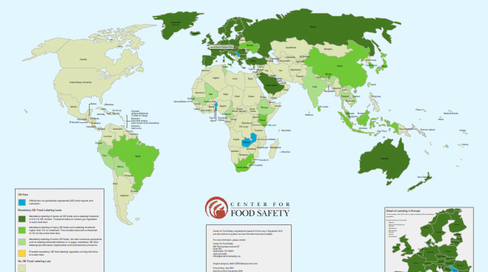
Latest research shows 64 nations enforce consumer 'right to know' laws for GE foods, while U.S. lags behind [image changes inside]
Center for Food Safety (CFS) has announced the release of its new, interactive Genetically Engineered (GE) Food Labeling Laws map .. http://www.centerforfoodsafety.org/ge-map .. detailing the powerful, growing presence of laws requiring information on GE content in consumer food products around the world. Global food policy research conducted by CFS confirms that 61 countries, including member nations of the European Union, Russia, China, Brazil, Australia, Turkey and South Africa require standards of mandatory GE food labeling. The United States is not included on the list of governments providing open, accurate information on the source of foods on grocery shelves.
As the spread of commercialized GE food products mount, the number of people exposed to GE foods globally has grown. This makes truth in labeling of GE food ingredients increasingly fundamental to preserving consumer choice and protecting personal health. The CFS GE Food Labeling Laws map provides an instant overview on the advance of labeling mandates across the globe, and will continue documenting the growth of GE labeling as more nations establish these laws. As detailed on the map, India will join the roster of nations requiring GE labeling in 2013.
“One quick glance at the map and you know the U.S. is truly lost on GE labeling,” said CFS executive director, Andrew Kimbrell. “With all we know about the human health and environmental impacts of GE products, it’s encouraging to see the number of nations that have embraced labeling. Yet, at the same time it’s frustrating and offensive that Americans are denied the information about their food that those in Kenya and Saudi Arabia receive.”
Despite polls consistently showing up to 90% of Americans favor GE food labeling, efforts supporting labeling in the U.S. have been unsuccessful to-date. In November 2011, CFS filed a groundbreaking legal petition with the U.S. Food and Drug Administration demanding the agency requiring GE labeling. Currently, over 1 million people have joined the petition. Additionally, twenty states have considered bills requiring labeling for or prohibiting GE food over the past three years. On November 6th, California’s Prop 37 will give voters the opportunity to join the citizens of 61 nations across the globe who have the information and the lawful power to choose whether GE foods will be a part of their daily diet.
“Global GE labeling laws are springing up because both governments and citizens alike instinctively understand we all have the basic human right to know what we put in our bodies and where it came from,” said Kimbrell. “If food manufacturers and elected officials don’t want to put the facts of food ingredients on product labels, you can bet something is very wrong.”
The interactive, color-coded GE Food Labeling Laws map offers a quick, navigable guide of those countries that have mandated GE foods labeling laws, and the strength of each policy. It also recognizes those countries that have banned GE foods completely.
Countries with Mandatory Labeling of GE Foods [excuse, it's neat inside .. :)]
Australia ...... Latvia Austria ...... Lithuania Belarus ...... Luxembourg Belgium ...... Malaysia Bolivia ...... Mali Bosnia and Herzegovina ...... Malta Brazil ...... Mauritius Bulgaria ...... Netherlands Cameroon ...... New Zealand China ...... Norway Croatia ...... Peru Cyprus ...... Poland Czech Republic ...... Portugal Denmark ...... Romania Ecuador ...... Russia El Salvador ...... Saudi Arabia Estonia ...... Senegal Ethiopia ...... Slovakia Finland ...... Slovenia France ...... South Africa Germany ...... South Korea Greece ...... Spain Hungary ...... Sri Lanka Iceland ...... Sweden India ...... Switzerland Indonesia ...... Taiwan Ireland ...... Thailand Italy ...... Tunisia Japan ...... Turkey Jordan ...... Ukraine Kazakhstan ...... United Kingdom Kenya ...... Vietnam
About Center for Food Safety The Center for Food Safety is a national, non-profit, membership organization founded in 1997 to protect human health and the environment by curbing the use of harmful food production technologies and by promoting organic and other forms of sustainable agriculture. More information can be found atwww.centerforfoodsafety.org .. http://www.centerforfoodsafety.org/


 Market Data
  Markets


 AI
AI