Rafael Correa not considering Snowden asylum: 'we helped him by mistake'
lol .. according to this one Correa never considered Snowden's plea .. maybe he is covering himself, but taken at face value one could consider the whole Ecuador thing as being a bit of a furphy (just speculation could be a better way to say it) .. which would seem to support your thinking on that letter ..
edit: oops, this
"as the whistleblower made a personal plea to Quito for his case to be heard."
suggests that letter could be valid ..
Ecuador's president reveals travel pass was granted 'without authorisation' and says whistleblower is now Russia's problem
Rory Carroll in Quito guardian.co.uk, Tuesday 2 July 2013 11.44 AEST Jump to comments (208)
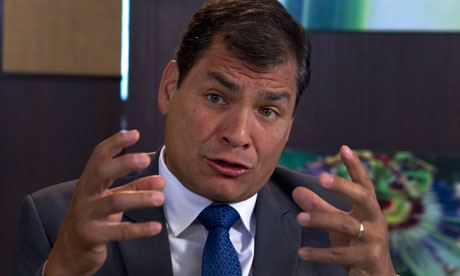
Ecuador's president Rafael Correa said Snowden 'must be on Ecuadorean territory' to make an asylum request. Photograph: Martin Mejia/AP
Ecuador is not considering Edward Snowden's asylum request and never intended to facilitate his flight from Hong Kong, president Rafael Correa said as the whistleblower made a personal plea to Quito for his case to be heard.
Snowden was Russia's responsibility and would have to reach Ecuadorean territory before the country would consider any asylum request, the president said in an interview with the Guardian on Monday.
"Are we responsible for getting him to Ecuador? It's not logical. The country that has to give him a safe conduct document is Russia."
The president, speaking at the presidential palace in Quito, said his government did not intentionally help Snowden travel from Hong Kong to Moscow with a temporary travel pass. "It was a mistake on our part," he added.
Asked if he thought the former NSA contractor would ever make it to Quito, he replied: "Mr Snowden's situation is very complicated, but in this moment he is in Russian territory and these are decisions for the Russian authorities."
On whether Correa would like to meet him, the president said: "Not particularly. He's a very complicated person. Strictly speaking, Mr Snowden spied for some time."
The comments contrasted with expressions of gratitude the 30-year-old fugitive issued hours later, before Correa's views had been published.
"I must express my deep respect for your principles and sincere thanks for your government's action in considering my request for political asylum," Snowden said, according to a letter written in Spanish and obtained by the Press Association news agency, based in London.
"There are few world leaders who would risk standing for the human rights of an individual against the most powerful government on earth, and the bravery of Ecuador and its people is an example to the world."
Snowden compared the silence of governments afraid of US retaliation with Ecuador's help in his flight to Moscow on 22 June. A temporary Ecuadorean travel document substituted for his cancelled US passport.
"The decisive action of your consul in London, Fidel Narvaez, guaranteed my rights would be protected upon departing Hong Kong – I could never have risked travel without that. Now, as a result, and through the continued support of your government, I remain free and able to publish information that serves the public interest."
The letter will boost Ecuador's reputation with Snowden's supporters but sat awkwardly with the president's attempt to distance Quito from the saga. Correa said Quito respected the right of asylum and appreciated Snowden exposing the extent of US spying, but would not consider an asylum request unless he made it to an Ecuadorean embassy or the country itself – a remote possibility while he remains reportedly marooned in Sheremetyevo airport's transit lounge. "He must be on Ecuadorean territory," the president said.
In his Guardian interview, Correa said his government had not, and would not, give Snowden an authorised travel document to extract himself from Moscow airport. "The right of asylum request is one thing but helping someone travel from one country to another — Ecuador has never done this. "
He said the temporary travel document issued by his London consul on 22 June – and publicly disowned five days later — was a blunder.
"It was a mistake on our part. Look, this crisis hit us in a very vulnerable moment. Our foreign minister was touring Asia. Our deputy foreign minister was in the Czech Republic. Our US ambassador was in Italy."
Narvaez and the WikiLeaks founder Julian Assange, who has sheltered at Ecuador's London embassy for the past year to escape extradition, took matters into their own hands because they feared Snowden risked capture, Correa said.
"The consul, in his desperation, probably he couldn't reach the foreign minister ... and he issued a safe conduct document without validity, without authorisation, without us even knowing."
Correa said the consul was a "cultured" man who cited the example of Ecuadorean diplomats in Czechoslovakia giving Jews visas in defiance of their foreign ministry during the second world war.
"Look, he [Assange] is in the embassy, he's a friend of the consul, and he calls him at four in the morning to say they are going to capture Snowden. The [consul] is desperate – 'how are we going to save the life of this man?' – and does it.
"So I told him: OK, if you think you did the right thing, I respect your decision, but you could not give, without authorisation, that safe conduct pass. It was completely invalid, and he will have to accept the consequences."
Narvaez would be "sanctioned", the president said, without elaborating.
Some Ecuadorean diplomats have complained that Assange appeared to usurp Quito but the president said there was no rupture. "Mr Assange continues to enjoy our total respect and is under the protection of the Ecuadorean state."
Correa, a standard bearer for the left in Latin America, has joined European and other Latin Americans leaders in denouncing US espionage.
However he softened his tone over the weekend and praised vice-president Joe Biden for a gracious phone call, saying he would consider Washington's request to refuse any asylum claim from Snowden while retaining Ecuador's sovereignty.
editing .. On the general question of countries surveillance
Surveillance Monitor 2007 - International country rankings Publication date: 31-Dec-2007
Since 1997, the US-based Electronic Privacy Information Center and the UK-based Privacy International have undertaken what has now become the most comprehensive survey of global privacy ever published. The Privacy & Human Rights Report surveys developments in 70 countries, assessing the state of surveillance and privacy protection.
The most recent collection of global country reports was published in 2007, and is probably the most comprehensive single volume report published in the human rights field. The collective reporting runs over 1,100 pages and includes 6,000 footnotes. More than 200 experts from around the world have provided materials and commentary. The participants range from eminent privacy scholars to high-level officials charged with safeguarding constitutional freedoms in their countries. Academics, human rights advocates, journalists and researchers provided reports, insight, documents and advice. In 2006 Privacy International took the decision to use this annual report as the basis for a ranking assessment of the state of privacy in all EU countries together with eleven non-EU benchmark countries. Funding for the project was provided by the Open Society Institute (OSI) and the Joseph Rowntree Reform Trust.
The 2007 global rankings extend the survey to 47 countries (from the original 37) and, for the first time, provide an opportunity to assess trends.
The intention behind this project is two-fold. First, we hope to recognize countries in which privacy protection and respect for privacy is nurtured. This is done in the hope that others can learn from their example. Second we intend to identify countries in which governments and privacy regulators have failed to create a healthy privacy environment. The aim is not to humiliate the worst ranking nations, but to demonstrate that it is possible to maintain a healthy respect for privacy within a secure and fully functional democracy.
Important note
This study and the accompanying ranking chart measure the extent of surveillance and privacy. They do not intend to comprehensively reflect the state of democracy or the full extent of legal or parliamentary health or dysfunction in these countries (though the two conditions are frequently linked). The aim of this study is to present an assessment of the extent of information disclosure, surveillance, data exploitation and the general state of information privacy.
I. Summary of key findings .. bits ..
-- The lowest ranking countries in the survey continue to be Malaysia, Russia and China. The highest-ranking countries in 2007 are Greece, Romania and Canada. -- The 2006 leader, Germany, slipped significantly in the 2007 rankings, dropping from 1st to 7th place behind Portugal and Slovenia. -- In terms of statutory protections and privacy enforcement, the US is the worst ranking country in the democratic world. In terms of overall privacy protection the United States has performed very poorly, being out-ranked by both India and the Philippines and falling into the "black" category, denoting endemic surveillance. -- The worst ranking EU country is the United Kingdom, which again fell into the "black" category along with Russia and Singapore. However for the first time Scotland has been given its own ranking score and performed significantly better than England & Wales. https://www.privacyinternational.org/reports/surveillance-monitor-2007-international-country-rankings/i-summary-of-key-findings
II. Methodology III. Criteria IV. Summary of country results
.. i couldn't find the actual country rank list, and am posting it just to remind (some others) the surveillance of citizens is sure not just a US situation, but rather a worldwide phenomenon ..


 Market Data
  Markets


 AI
AI