Awards Bradsher won the George Polk Award for national reporting on his coverage of sport utility vehicles (SUVs) in 1997 and was a finalist for the Pulitzer Prize the same year. Later, he published a book on SUVs called High and Mighty which won the New York Public Library Helen Bernstein Award. He won the Society of Publishers in Asia (SOPA) award for coverage of avian flu in the area. He won the Asia Society’s Osborn Elliott Award and the Overseas Press Club’s Malcolm Forbes Award in 2010, for coverage of clean energy in China. The Asia Society summarized the work on China he was being honored for: "Through a dozen front-page articles, Bradsher revealed how China, as one of the world’s largest polluters, has also begun to develop some of the world’s most advanced solutions to global warming and has pursued them aggressively." .. http://en.wikipedia.org/wiki/Keith_Bradsher
====== .. this looks likely the article he is talking about..
Edward Snowden: Classified US data shows Hong Kong hacking targets
Top-secret US government records shown to Post by whistle-blower give details of computer IP addresses hacked by NSA in HK and mainland
Friday, 14 June, 2013, 1:19pm
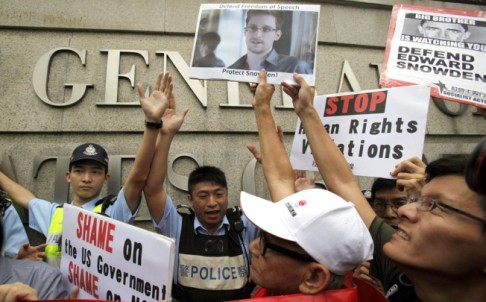
Members of the League of Social Democrats gather at HSBC headquarters in Central before marching to the US consulate general in support of whistle-blower Edward Snowden yesterday. Photo: Edward Wong
Classified US government data shown to the South China Morning Post by whistle-blower Edward Snowden has provided a rare insight into the effectiveness of Washington's top-secret global cyberspying programme.
New details about the data can be revealed by the Post after further analysis of information Snowden divulged during an exclusive interview on Wednesday in which the former CIA computer analyst exposed extensive hacking by the US in Hong Kong and the mainland.
The FBI said yesterday it had launched a criminal investigation and was taking "all necessary steps" to prosecute Snowden for exposing secret US surveillance programmes.
FBI Director Robert Mueller told the House Judiciary Committee: "These disclosures have caused significant harm to our nation and to our safety. We are taking all necessary steps to hold the person responsible for these disclosures," he said.
Snowden, the man behind explosive leaks of information on the US government's Prism programme that collected phone and web data from its citizens, has pledged to stay in Hong Kong to fight any attempts by his government to have him extradited.
The detailed records - which cannot be independently verified - show specific dates and the IP addresses of computers in Hong Kong and on the mainland hacked by the National Security Agency over a four-year period.
They also include information indicating whether an attack on a computer was ongoing or had been completed, along with an amount of additional operational information.
The small sample data suggests secret and illegal NSA attacks on Hong Kong computers had a success rate of more than 75 per cent, according to the documents. The information only pertains to attacks on civilian computers with no reference to Chinese military operations, Snowden said.
"I don't know what specific information they were looking for on these machines, only that using technical exploits to gain unauthorised access to civilian machines is a violation of law. It's ethically dubious," Snowden said in the interview on Wednesday.
Snowden, who came to Hong Kong on May 20 and has been in hiding since, said the data points to the frequency and nature of how NSA operatives were able to successfully hack into servers and computers, with specific reference to machines in Hong Kong and on the mainland.
According to a New York Times report yesterday, US government lawyers, working with their counterparts in Hong Kong, are understood to have identified several dozen criminal offences with which Snowden could be charged under both Hong Kong and American laws. One of the targets Snowden revealed was Chinese University, home to the Hong Kong Internet Exchange which is a central hub of servers through which all web traffic in the city passes.
A university spokeswoman said yesterday that staff had not detected any attacks to its "backbone network".
Yesterday's revelation that the US was secretly hacking computers in Hong Kong and on the mainland sent shockwaves around the world and came just days after Snowden first exposed the Prism programme to The Guardian newspaper in Britain.
"The primary issue of public importance to Hong Kong and mainland China should be that the NSA is illegally seizing the communications of tens of millions of individuals without any individualised suspicion of wrongdoing," Snowden said. "They simply steal everything so they can search for any topics of interest."
Snowden's most recent job was as an NSA contractor with Booz Allen Hamilton but he was fired shortly after he identified himself on Sunday as the source of one of the most significant leaks in US history.
Formal charges are the first necessary step that would prompt an extradition request to the Hong Kong government.
Snowden could find himself at the centre of a diplomatic storm between Washington and Beijing as he has explicitly chosen to seek refuge in Hong Kong, a move that will test the Sino-US relationship. He said he had chosen Hong Kong because he believed the city's semi-autonomous status and rule of law would protect him from attempts to extradite him to the US.
It is understood that Snowden arrived in Hong Kong after leaving his home in Hawaii, telling his girlfriend that he would be away for a few weeks.
He stayed at the Mira Hotel in Tsim Sha Tsui before checking out on Monday and has been in hiding since.
Snowden said he has not spoken to his family since the revelations were made and lives in constant fear for his own safety.
I see both your comment on England not wanting him because they have the Assange hassle .. and Geoffrey Robertson's points that England's no no to Snowden entry is new as used against "someone who has denounced government policies" .. and because ..
"“The British government is simply afraid that its judges, who are fiercely independent, and the European court would embarrass its closest ally by ruling that Snowden could not be extradited because, even if his “revelations” prove to be mistaken, he would be subjected to oppressive treatment akin to that being meted out to Bradley Manning,”"
as being spot on .. Robertson .. http://en.wikipedia.org/wiki/Geoffrey_Robertson , i have seen heaps on Australian tv over years most .. he has been ever since i can remember a very highly respected, objective and non-partisan defender of human rights. You would like him for sure.
====== .. this, yet another opinion on Snowden's HK decision .. it's been on tab ..
Why Snowden's Flight to Hong Kong Might Be Brilliant
By: Benjamin Carlson Published: Monday, 10 Jun 2013 | 10:23 PM ET
There are many reasons why NSA whistleblower Edward Snowden's decision to come to Hong Kong could be foolish.
Hong Kong has an extradition treaty with the United States; its government is weak; its foreign policy is dictated by Beijing — no friend of free speech or internet freedom.
But there is at least one reason it could be incredibly shrewd: Hong Kong's asylum system is currently stuck in a state of limbo that could allow Snowden to exploit a loophole and buy some valuable time.


 Market Data
  Markets


 AI
AI