Pope Francis 1 has identified with the poor, and has lived a life that supports that .. will he speak out strongly against the injustice and dangers of gross inequality? .. that would be a good thing .. he worries radical reactionaries within the church in that he is not a supporter of the traditional Latin mass .. http://torontotlmserving.blogspot.com.au/ .. that is a plus and reflects a commitment to communication .. he has reached out to other churches which is another plus .. will he reach out to Muslims as his Francis of Assisi did?
Character and legacy
Habit of Francis of Assisi
It has been argued that no one in history was as dedicated as Francis to imitate the life, and carry out the work, of Christ in Christ’s own way. This is important in understanding Francis' character and his affinity for the Eucharist and respect for the priests who carried out the sacrament. He and his followers celebrated and even venerated poverty. Poverty was so central to his character that in his last written work, the Testament, he said that absolute personal and corporate poverty was the essential lifestyle for the members of his order. He believed that nature itself was the mirror of God. He called all creatures his “brothers” and “sisters,” and even preached to the birds and supposedly persuaded a wolf to stop attacking some locals if they agreed to feed the wolf. In his “Canticle of the Creatures” (“Praises of Creatures” or “Canticle of the Sun”), he mentioned the “Brother Sun” and “Sister Moon,” the wind and water, and “Sister Death.” He referred to his chronic illnesses as his “sisters." His deep sense of brotherhood under God embraced others, and declared that “he considered himself no friend of Christ if he did not cherish those for whom Christ died.” Francis's visit to Egypt and attempted rapprochement with the Muslim world had far-reaching consequences, long past his own death, since after the fall of the Crusader Kingdom it would be the Franciscans, of all Catholics, who would be allowed to stay on in the Holy Land and be recognized as "Custodians of the Holy Land" on behalf of the Catholic Church. .. http://en.wikipedia.org/wiki/Francis_of_Assisi
Though he probably would fail to stop the conflict as Assisi did, any direct overture would be a good thing .. of course, he is strongly in favor of crunch Catholic beliefs as euthanasia, abortion and gay marriage .. would any Cardinal who wasn't have any chance at the Pope's seat? .. i don't think so, too much to hope for today .. i'm thinking just maybe the progressives within the church have followed something akin to the Republican's Buckley Rule .. http://dailycaller.com/2011/11/08/bucking-buckleys-rule/ .. and backed the most liberal Cardinal they thought had a chance .. for all those in favor of a more humane church at least that is a better option than the alternative ..
A Surprise Choice From Afar, Winning Over Some Skeptics
L'Osservatore Romano, via European Pressphoto Agency
Pope Francis on a balcony of St. Peter’s Basilica on Wednesday evening. Among his first acts, he asked the people of Rome to ask for God’s blessing for him before he blessed them. More Photos »
By JIM YARDLEY Published: March 13, 2013
VATICAN CITY — Twenty minutes had passed, maybe 30, and the white smoke had finally stopped billowing out of the smokestack atop the Sistine Chapel, and the bells had stopped clanging. Outside St. Peter’s Basilica, thousands of people huddled under umbrellas, ensnared in a strange limbo, waiting to learn the identity of their new pope.
Two Roman priests, the Rev. Adriano Furgoni and the Rev. Maurizio Piscola, stood together, both a bit nervous, given their rooting interest. They wanted the Austrian cardinal, Christoph Schönborn, considered a progressive. Father Piscola even pulled out his cellphone to show off a recent text message from the cardinal bearing a special prayer.
The rain kept coming in a steady drizzle as a thought suddenly struck Father Furgoni, 69. “It is the first time I’m going to see a pope younger than me!” he declared, excited.
For that was the promise of the moment, a promise sending a current of anticipation through the crowds pouring into St. Peter’s Square from across the ancient city. The bells and the white smoke had announced that the cardinals had selected a new pope, and soon he would step onto the balcony of St. Peter’s, a fresh face, expected to be a younger man, perhaps charismatic, to guide a church faced with crises and in disarray.
When the window opened, the expectant crowd roared. People waved national flags from Spain, the United States, Brazil, Argentina, Italy and the Philippines. “Papa! Papa! Papa!” came the shouts.
Cardinal Jean-Louis Tauran, a senior official, appeared and uttered the familiar Latin phrase “Habemus Papam!” — “We have a pope!” Then the name of the new pope: Francis. And finally the name of the cardinal who was now the pope: Jorge Mario Bergoglio .. http://topics.nytimes.com/top/reference/timestopics/people/f/francis_i/index.html?inline=nyt-per , 76, archbishop of Buenos Aires.
“Mamma mia!” a startled Father Furgoni shouted. “Bergoglio?” He struggled to hide his disappointment.
“An Argentine!” Father Piscola shouted.
“I didn’t expect it, I didn’t expect it,” Father Furgoni muttered, shaking his head. “And he is also old!”
A confused, stunned silence settled over the huge crowd. Cardinal Bergoglio? Many people expected the Italian cardinal, Angelo Scola of Milan, or the Brazilian, Odilo Pedro Scherer. But Bergoglio? He had been passed over in 2005, reportedly as the runner-up to Benedict XVI.
“We don’t know him,” Father Piscola said.
Father Furgoni said, “He has a reputation as a very tough man.”
Father Furgoni fidgeted in the rain, moving from side-to-side, rubbing his fingers through his shock of white hair, staring up at the huge television screens as he awaited his new pope.
“We’re going to love him,” he finally said. “But poor him.”
A few minutes more, and then cheers arose as Pope Francis stepped through the red curtains onto the balcony and looked out on the thousands and thousands of people who had come to greet him. For a few moments, the new pope stood in the light, barely moving, stiff and expressionless.
“Brothers and sisters,” he finally began, speaking in clear Italian. “Good evening.”
The two priests fell quiet with the crowd. If the pope is the leader of the universal church, he is also the bishop of Rome, and his first remarks were those of a bishop to his flock.
“You know that it was the duty of the conclave to give Rome a bishop,” he told the crowd. “It seems that my brother cardinals have gone to the ends of the earth to get one.”
It was a small joke from the new Argentine pope. The crowd, filled with many Romans, laughed.
“I thank you for your welcome,” he continued. He offered a prayer to Benedict, and, as he prepared to bless the people, he did a small, unexpected thing.
“I ask a favor of you,” he said. Would the people of Rome pray for God to bless him before he blessed them? He bowed in an unexpected gesture of humility. “Let us make, in silence, this prayer: your prayer over me.”
The two priests, startled, lowered their heads, and this time a different silence filled the square. Moments passed and then the new pope blessed the masses. A man bellowed out “Viva il Papa!” and the crowd responded, shouting out the name of their new pope.
“Francesco! Francesco! Francesco!” they chanted in Italian.
His appearance seemed over, but Francis asked for the microphone once more. He smiled broadly and wished for the crowd to have “a good night, and have a good rest.” He seemed as much a grandfather as a pope.
Father Furgoni was fidgeting again, twitching, but this time with excitement.
“He conquered me!” the priest proclaimed. “The fact that he was so simple. And the fact that he spoke as the bishop of Rome. I can’t remember the pope asking to be blessed by the people, rather than him blessing the people first.”
The crowds were singing, or waving flags, or buzzing with chatter. Television reporters were thrusting microphones at people, asking for reaction. People slowly began to depart, squeezing through the gates, everyone backlit by the lights of St. Peter’s glowing in the night. For a moment, at least, the problems pressing down on the church seemed lifted, even for the two priests who did not get the Austrian pope they had wanted only minutes earlier.
“I expect big changes,” Father Furgoni now predicted, suddenly confident, as he turned to leave. “I’m really moved.”
Father Piscola agreed. “Great humility,” he said of the new pope. “Strong in his faith.”
The Argentine pope also demonstrated one other trait that seemed to please his Roman flock. “He spoke excellent Italian,” one woman said.
Gaia Pianigiani contributed reporting. A version of this article appeared in print on March 14, 2013, on page A14 of the New York edition with the headline: A Surprise Choice From Afar, Winning Over Some Skeptics.
lol .. well written if it's true .. have a tiny feeling this one could be more interesting than all i have read on him so far have suggested .. hope so ..
Brazil readies for Pope Francis's visit amid uncertain times
Pontiff's tour to country for World Youth Day follows mass protests and comes as number of Catholic followers declines
Dom Phillips in Rio de Janeiro guardian.co.uk, Monday 22 July 2013 03.05 AEST Jump to comments (82)
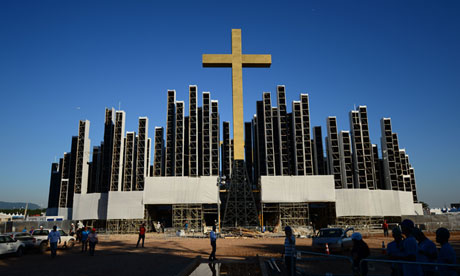
Workers give the finishing touches to the stage at the 'Field of Faith' in Pedra de Guaratiba, near Rio de Janeiro, before Pope Francis arrives. Photograph: Christophe Simon/AFP/Getty Images
With just days to go before Pope Francis .. http://www.guardian.co.uk/world/pope-francis .. takes the stage beneath a 33-metre-high golden cross in front of an expected 2.5 million Catholics, the "Field of Faith" near Rio de Janeiro looked like a building site.
Six months ago, this was an uninhabited swamp beside the poor community of Pedra de Guaratiba. Over the weekend, bulldozers tore into the earth as trucks rumbled past carrying stones to lay over the mud that covered large areas of the site.
Teams were working day and night to make the site ready for one of the biggest events in Francis's first official visit to Brazil .. http://www.guardian.co.uk/world/brazil : a massive overnight prayer vigil on Saturday and an open-air mass the following morning. "They are digging up the last vestiges of the swamp," said Lucas Guerra, a press assistant for World Youth Day – JMJ in its Portuguese abbreviation – and one of 60,000 volunteers for the event.
A lone traffic cone sat in a puddle before the stage, where teams of workers hammered away under the golden arches representing hands in prayer – not McDonald's, one of the official suppliers of "pilgrim meals" for the millions of Catholics visiting Rio for a week of events around the papal visit.600,000 have signed up so far, said Guerra. (At the last World Youth Day in Madrid in 2011, the fast food chain's turnover in five days was what it normally took in five months for the whole city, according to official JMJ literature.)
The Rio site covers 1.36m square metres. If the expected 2.5 million pilgrims turn up, having walked eight miles along a highway, they will have less than half a square metre each for their 48-hour stay.
The pope has a week of open-air events. On Wednesday he will say mass at Aparecida, a religious shrine in São Paulo state. On Thursday he visits the Varginha favela, which was "pacified" by police last year. Later that day, up to 1.5 million are expected to watch as he addresses crowds at Copacabana beach.
Pope Francis waves to the crowds in Saint Peter's Square, Vatican City, on Sunday ahead of his Brazil visit. Photograph: Max Rossi/Reuters
But the readiness of the Field of Faith is just one of the worries surrounding the visit. Transport is another – even with 35,500 buses due to take pilgrims back to Rio from Guaratiba, organisers believe it will still take 12 hours to get everybody out.
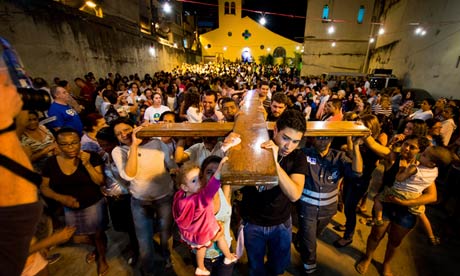
Last Wednesday night, a protest in the Rocinha favela closed a key road tunnel. A separate protest outside the house of state governor, Sérgio Cabral, in nearby Leblon also caused road closures, and traffic ground to a halt all over south Rio. Later masked gangs rampaged for two hours through Leblon and another upmarket district, Ipanema, trashing banks and looting shops. Police used water cannon, tear gas and rubber bullets to battle protesters.
Despite pressure from Brazilian authorities, Francis will not use the popemobile but one of two open-topped Mercedes, which have already arrived in Brazil., which he will parade in through the centre of Rio when he arrives on Monday. About 14,300 army, navy and air force personnel will be on duty, as well as more than 7,000 police. The Rio newspaper O Globo said in May that security for the visit would cost 118m reals (£34.6m).
Catholics carry the World Youth Day cross through Rocinha the night after a protest closed a key road tunnel in the Rio favela. Photograph: Buda Mendes/Getty Images
At least six protests are planned, including one on Monday at the Guanabara state government palace, when the pontiff meets President Dilma Rousseff, Cabral and Rio's mayor, Eduardo Paes, as well as a gay rights protest, and a SlutWalk on Copacabana beach to protest against a culture in which victims of rape or abuse are blamed, rather than the perpetrators.
In Pedra de Guaratiba, residents are more concerned about the scale of the Field of Faith event. "Everyone is a little worried," said Luis Marçal, as he stood shirtless outside his home and surveyed the mud and the trucks. "People don't know what it will be like."
Marçal is Catholic but he said he would not attend the event. Many of his neighbours are not Catholics. Like many poorer communities in Brazil, Pedra de Guaratiba is dotted with dozens of evangelical churches.
"I have nothing against Catholics, but I won't go," said Claudinete de Silva, who lives nearby. She welcomed the event because of improvements being made to the area. "This was earth," she said, pointing to the newly asphalted side road beneath her feet that runs beside the main highway. "They are fixing things."
But her friend Maria das Graças, also an evangelical Christian, disagreed. "Politicians and government are investing millions in the visit while health and education are bad," she said. "Transport is terrible."
Pastor Edimilson Nunes, of the Evangélica Verbo da Vida church in the town, said much of the work done in the town was "makeup". The side road had not been properly asphalted. "They put down some material and put a roller on top of it," he said. "The way it was done, it won't resist a good rain. It will become full of holes."
Evangelical numbers are on the rise in Brazil, at the expense of the Catholic church. According to the 2010 census, Catholics now make up 64.6% of the Brazilian population, down from 92% in 1970. Evangelicals have increased from 15.4% of the population 10 years ago to 22.2%.
According to a survey released on Sunday by Datafolha, 57% of Brazilians say they are Catholic, while 17% say they go to church more than once a week. Almost one in five Brazilians say they are pentecostals.
"The evangelical church, in general, adapted to way interaction with social questions changed," Nunes said. "Today the youth want an answer to what is happening … in their language." With live music and a less formal approach, evangelical churches like his responded to that need, he said.
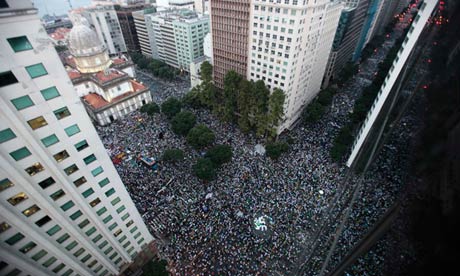
Brazilians take to the streets in Rio to protest against fare hikes, failing transport and education services, spiralling World Cup costs, and political corruption. Photograph: Sergio Moraes/Reuters
The Field of Faith itself has also attracted controversy. The land was ceded for free for the event, but once drained and cleared, in works paid for by the church and the city of Rio, it will be sold at a profit.
The church has paid for the drainage work, but around that the city has paid for infrastructure that will eventually benefit the owners of the land too. This includes lighting, cleaning, roads and drainage, to a cost of 26m reals.
Work was clearly visible on the main street of Pedra de Guaratiba, where municipal workers painted railings on a bridge, while a digger dredged a canal that drains water from the site. "It was a swamp, with water up to your chest," said Evaldo de Moura, one of the workers involved in dredging the canal.
Rain is forecast for this week, and the organisers are worried about mud. "We are taking a lot of care so there is not too much mud," said Lucas Guerra. "But it's like Woodstock [the music festival in the US] – these things end up escaping our control a little."
And if it rains, said Father Marcus, from the São Pedro Catholic church in Pedra de Guaratiba, whose parishioners are housing 250 pilgrims, the faithful will do what they did at other World Youth Days: "We are going to stay there."


 Market Data
  Markets


 AI
AI