Meet our ancestors the Denisovans, of southern Siberia
Uploaded by LozTheAtheist on Dec 22, 2010
An entirely separate kind of human existed alongside Neanderthals and our early ancestors - and even interbred with them, scientists say.
An international group of researchers used DNA extracted from a finger bone of one of the "Denisovans", named after the caves where their remains were first discovered.
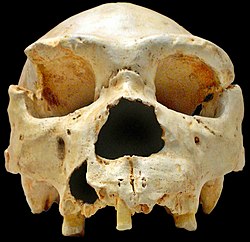
The Natural History Museum's Professor Chris Stringer said the implications of the study, published in the journal Nature, were "nothing short of sensational". ~~~~~~~~~~~~~~~~~~~~~~ Mentioned by Professor Stringer in the video above is this character ..
Homo heidelbergensis ("Heidelberg Man", named after the University of Heidelberg) is an extinct species of the genus Homo which may be the direct ancestor of both Homo neanderthalensis in Europe and Homo sapiens. The best evidence found for these hominins dates them between 600,000 and 400,000 years ago. H. heidelbergensis stone tool technology was very close to that of the Acheulean tools used by Homo erectus.
Scientific classification
Kingdom: Animalia Phylum: Chordata Class: Mammalia Order: Primates Family: Hominidae Subfamily: Homininae Tribe: Hominini Subtribe: Hominina Genus: Homo Species: H. heidelbergensis Binomial name Homo heidelbergensis Schoetensack, 1908
======== .. lol, the certainty of the BBC announcer in this one stands in stark contrast with the proper uncertainty of the scientist Professor Stringer ..
======== .. all of us it seems have about 2-2.5% of the genetic Neanderthal ..
oh .. later in that one the guy suggests up to 4% .. that might explain the unsocial attitudes of so many non-liberals .. chuckle ..
An amphioxus (also called a lancelet), which is a very distant cousin to humans and other vertebrates. It is the creature most similar to the original spineless organism that existed before a major genomic event occurred. Carol MacKintosh
A spineless creature experienced two doublings in DNA, triggering the evolution of humans and other animals.
The good news is that these ancient DNA doublings boosted cellular communication systems, so that our body cells are now better at integrating information than even the smartest smartphones. The bad part is that communication breakdowns, traced back to the very same genome duplications of the Cambrian Period, can cause diabetes, cancer and neurological disorders.
"Organisms that reproduce sexually usually have two copies of their entire genome, one inherited from each of the two parents," co-author Carol MacKintosh explained to Discovery News. "What happened over 500 million years ago is that this process 'went wrong' in an invertebrate animal, which somehow inherited twice the usual number of genes. In a later generation, the fault recurred, doubling the number of copies of each gene once again."
"The duplications were not stable, however, and most of the resulting gene duplicates were lost quickly -- long before humans evolved," she continued. But some did survive, as MacKintosh and her team discovered.
Her research group studies a network of several hundred proteins that work inside human cells to coordinate their responses to growth factors and to insulin, a hormone. Key proteins involved in this process are called 14-3-3.
For this latest study, the scientists mapped, classified and conducted a biochemical analysis of the proteins. This found that they date back to the genome duplications, which occurred during the Cambrian.
The first animal to carry them remains unknown, but gene sequencing shows that a modern day invertebrate known as amphioxus "is most similar to the original spineless creature before the two rounds of whole genome duplication," MacKintosh said. "Amphioxus can therefore be regarded as a ‘very distant cousin’ to all the vertebrate (backboned) species."
The inherited proteins appear to have evolved to make a "team" that can tune into more growth factor instructions than would be possible with a single protein.
"These systems inside human cells therefore behave like the signal multiplexing systems that enable our smartphones to pick up multiple messages," MacKintosh shared.
The teamwork may not always be a good thing, though. The researchers propose that if a critical function were performed by a single protein, as in amphioxus, then its loss or mutation would likely be lethal, resulting in no disease.
If multiple proteins are working as a team, however, and one or more becomes lost or mutated, the individual may survive, but could still wind up with a debilitating disorder. Such breakdowns could help to explain how diseases, such as diabetes and cancer, are so entrenched in humans.
"In type 2 diabetes, muscle cells lose their ability to absorb sugars in response to insulin," MacKintosh said. "In contrast, greedy cancer cells don't await instructions, but scavenge nutrients and grow out of control."
Chris Marshall, a professor of cell biology at the Institute of Cancer Research at Royal Cancer Hospital, told Discovery News that he thinks the research "gives new insights into the evolution of signaling mechanisms that control cell behavior."
MacKintosh and her team are now focusing on the protein families whose upset causes melanoma and neurological disorders. Because of the likely connection to ancient genetic events, the research could shed light on human and other animal evolution while also helping to unravel diseases.
Numerous tribal peoples from history have also adorned themselves with feathers, and the authors stress that they are not suggesting we learned the practice from Neanderthals.
Feather ornamentation could in fact go back even further, to a common ancestor of modern humans and Neanderthals.
Clive Finlayson and Kimberly Brown from the Gibraltar Museum, along with colleagues from Spain, Canada and Belgium, examined a database of 1,699 ancient sites across Eurasia, comparing data on birds at locations used by humans with those that were not.
They found a clear association between raptor and corvid remains and sites that had been occupied by humans.
They then looked more closely at bird bones found at Neanderthal sites in Gibraltar, including Gorham's and Vanguard cave, near the base of the rock: "The Neanderthals had cut through and marked the bones. But what were they cutting? We realised a lot of it was wing bones, particularly those holding large primary feathers," Prof Finlayson told BBC News.
Co-author Jordi Rosell, from Rovira i Virgili University in Tarragona, Spain, said: "We saw the cut-marks on bird bones at one cave, and then started seeing them in others. I think it's a common aspect to the caves in this rock."
Juan Jose Negro, director of the Donana Biological Station in Seville, Spain, who is another co-author, said: "The wings make up less than 20% of the weight of the body of those birds," adding, "there is no meat in the wings - they were not consuming these animals.
"The only explanation left is the use of those long feathers."
Not only this, but the ancient humans appeared to have a preference for birds with dark or black plumage. Species represented at the sites include ravens, crows, rooks, magpies, jackdaws, various types of eagle and vulture, red and black kites, kestrels and falcons.
Image correction
Speaking to me at this year's Calpe conference in Gibraltar [ http://www.gibmuseum.gi/Calpe_Home.html ], Prof Finlayson explained: "What all this suggests to us is that Neanderthals had the cognitive abilities to think in symbolic terms. The feathers were almost certainly being used for ornamental purposes, and this is a quite unbelievable thing to find."
For much of the last century, Neanderthals were portrayed as knuckle-dragging brutes, whose extinction some 30,000 years ago was the natural outcome of competing against a more intelligent, creative and resourceful human species - Homo sapiens.
In recent years, the Neanderthals - who lived across Europe, the Middle East and Central Asia in Pleistocene times - have come to be rehabilitated amid mounting evidence that their abilities had been underestimated.
"I think this is the tip of the iceberg," said Prof Finlayson: "It is showing that Neanderthals simply expressed themselves in media other than cave walls. The last bastion of defence in favour of our superiority was cognition."
Neanderthals, he said, may have been "different", but "their processes of thinking were obviously very similar".
Dr Negro cautioned that there was no way to tell how the feathers were put to use. But he observed: "Current uses of feathers typically involve the same species. If you think of the Plains Indians in North America, they put those feathers in headdresses and they are signalling. They are signalling power and status. Perhaps the Neanderthals were using feathers in the same way."
Asked how the ancient humans might have caught the birds, Clive Finlayson speculated: "It's possible that these birds were nesting near the caves. Some may have fallen, but there's too much of it to be a random collection of dead animals.
"It's possible the Neanderthals were climbing up the cliffs and collecting birds from nests. But a large proportion of these birds are scavengers.
"An intelligent hominid, aware of this - and who may have used vultures as an indication of food sources - could easily have found ways of ambushing vultures and eagles when they came down to carcasses."
Other evidence of symbolic behaviour in Neanderthals includes the discovery of ochre - used to paint their bodies - at archaeological sites in Europe and the Levant. Earlier this year, another team published evidence [ http://www.plosone.org/article/info%3Adoi%2F10.1371%2Fjournal.pone.0032856 ] of the possible symbolic use of eagle claws by Neanderthals, although they might also have been using the items as tools.


 Market Data
  Markets


 AI
AI