Abdul Nasir has flourished since the American invasion, and Abdul Nasir's secular family "flourished under the regime of Mohammad Najibullah, the country’s last Communist President." .. your link .. http://www.newyorker.com/reporting/2012/07/09/120709fa_fact_filkins ..
So who wants civil war? Who wants Afghanistan .. one bit ..
"Afghanistan is not just the front line in Nato's fight against the Taliban, but also a proxy war between India and Pakistan. Until relations really improve between the nuclear neighbours, Afghanistan will remain another of their battlegrounds – and no safe place for serious investors." http://investorshub.advfn.com/boards/read_msg.aspx?message_id=68584300
that's discouraging and bad ~~~~~~~~~~~~~~~~~~~~~~~~~~~~~~~~~~ fun break ..
ps: F6, have to thank you for a fun coincidence today .. heh, while sticking the blues in this one, awhile ago ..
US adds Boko Haram leaders to terrorist list
a rough 'fine'-line having to walk .. ..
"The US stopped short of putting the group as a whole on its terror list."
i was 'desperately' trying to think of a post which fit .. lolol .. then yours i am replying to here came in .. ha! .. you linked it to the post i was thinking of just that while back .. this bit ..
"His focus on strikes has made it impossible to forge, for now, the new relationship with the Muslim world that he had envisioned. Both Pakistan and Yemen are arguably less stable and more hostile to the United States than when Mr. Obama became president." .. http://investorshub.advfn.com/boards/read_msg.aspx?message_id=76038936
U.S. Grants Special Ally Status to Afghans, Easing Fears of Abandonment
Pool photo by Brendan Smialowski
Secretary of State Hillary Clinton spoke as President Hamid Karzai, right, listened during a news conference at the Presidential Palace in Kabul on Saturday.
By MATTHEW ROSENBERG and GRAHAM BOWLEY Published: July 7, 2012
The move, announced as Mrs. Clinton stood with President Hamid Karzai .. http://topics.nytimes.com/top/reference/timestopics/people/k/hamid_karzai/index.html?8qa .. amid the rose beds and towering trees on the grounds of the presidential palace here, was part of a broad strategic partnership deal signed by the United States and Afghanistan in May, she said. The pact went into effect last week.
“Please know that the United States will be your friend,” she told Mr. Karzai. “We are not even imagining abandoning Afghanistan. Quite the opposite. We are building a partnership with Afghanistan that will endure far into the future.”
The designation by the United States grants a country special privileges, like access to American military training and excess military supplies, Mrs. Clinton said.
In a separate statement, the State Department said Afghanistan would also be able to obtain loans of equipment from the United States and financing for leasing equipment. The agreement does not, however, “entail any security commitment” by the United States to Afghanistan, the State Department said.
Iraq was never given the status of a major ally, and American troops withdrew last year.
Afghanistan’s designation as a formal ally was the latest in a series of recent American moves that have eased — though not erased — Afghan fears of being abandoned at the end of NATO’s combat mission in 2014.
On Saturday, he welcomed Mrs. Clinton, calling her “my old American friend” in his remarks. “We appreciate your concern and good will toward Afghanistan,” he said.
Later, as Mrs. Clinton said she was sorry to have to leave so soon, Mr. Karzai offered what he said was an old saying in Persian: “When a friend is alive, they will meet again.”
American and Afghan officials say they now must turn to working out a deal that would keep a residual American force here to continue training Afghan soldiers and tracking down insurgents after 2014. Talks on the arrangement have not yet begun, American officials say. Estimates of the number of troops that could stay vary from as little as 10,000 to as many as 25,000 or 30,000.
But Mrs. Clinton reiterated on Saturday that Washington did envision keeping American troops in Afghanistan, where they would provide the kind of air power and surveillance capabilities needed to give Afghan forces an edge over the Taliban.
“This is the kind of relationship that we think will be especially beneficial as we do the transition and as we plan for the post-2014 presence,” she said. “It will open the door to Afghanistan’s military to have a greater capability and a broader kind of relationship with the United States and especially the United States military.”
Mrs. Clinton made a short stop in Kabul en route to Tokyo, where an international conference will be held to raise money to support the Afghan government after 2014. At the American Embassy, she praised the work done by civilians in the war. State Department officials said that her remarks were intended to rebut what many in the State Department consider unfair criticism of their work in Afghanistan, where they have often been portrayed as not carrying their weight compared with the military.
But American soldiers and civilians alike have faced one common struggle: assuaging Afghan fears of abandonment. Many here fear that the country is headed toward a repeat of the early 1990s, when the fall of the Soviet-backed government, coupled with an American pullback from the region, left Afghanistan mired in a brutal civil war.
The Taliban grew out of the chaos, and they quickly took over much of the country.
Along with reassuring Afghans, Mrs. Clinton made clear that she was also sending a message to the Taliban.
The alliance and other American commitments to Afghanistan “should make clear to the Taliban that they cannot wait us out,” she said, according to a copy of her prepared remarks. “They can renounce international terrorism and commit to an Afghan peace process, or they will face the increasingly capable Afghan national security forces, backed by the United States.”
At the same time, Washington remains committed to the stalled Afghan peace process, she said. The insurgents suspended talks in March — halting negotiations before they really began — over delays in a proposed prisoner swap that would have the United States release five Taliban prisoners from Guantánamo Bay, Cuba, in exchange for Sgt. Bowe Bergdahl, .. http://www.nytimes.com/2012/05/14/us/bowe-bergdahls-unlikely-journey-to-life-as-a-taliban-prisoner.html?_r=1&pagewanted=all .. the only American soldier known to be held by the insurgents.
Designating Afghanistan an ally, however, has the potential to raise awkward issues for the United States. There is Afghanistan’s hot-and-cold relationship with Pakistan, also an ally, and the possibility the two neighbors could have a falling-out, especially if Afghan officials believe in the years after 2014 that their Pakistani counterparts continue to aid the Taliban.
Afghanistan, one of the 10 poorest countries in the world, is also the least developed of America’s major, non-NATO allies by a wide margin. Other allies — like South Korea, Argentina, Australia and Thailand — are far more capable of defending themselves and policing their own territory; Afghanistan is capable of doing that now and for the foreseeable future only with ample American help.
A version of this article appeared in print on July 8, 2012, on page A9 of the National edition with the headline: U.S. Grants Special Ally Status to Afghans, Easing Fears of Abandonment.
The announcement by Clinton during a brief visit to Kabul means Afghanistan will join a small, rather disparate group of 14 countries, including Israel, Japan, the Philippines, Bahrain and Pakistan, which hold the privileged status. This status allows for streamlined military co-operation with the US, with access to weapons and training among other advantages.
The extent of US military spending in Afghanistan already put it effectively on a par with some other "major non-Nato allies", but with US troops expected to be mostly home by the end of 2014, Clinton described the formal label as a sign of long-term commitment. It is the first country awarded the status by Barack Obama's administration.
"We see this as a powerful commitment to Afghanistan's future," she told a joint news conference, after a breakfast meeting with the Afghan president, Hamid Karzai. "We are not even imagining abandoning Afghanistan."
Clinton and Karzai then flew to Tokyo, where Karzai will seek promises of up to $4bn a year in development aid, to match a similar amount of funding for the police and army.
Clinton said she would hold a joint meeting with the Pakistani and Afghan foreign ministers on the sidelines of the Tokyo meeting, which could help boost a largely moribund effort to set up talks with the Taliban.
Although Clinton noted that security is improving, Afghanistan's porous border, the resilience of the insurgency and slow progress in building the capacity of the Afghan police and army mean that a negotiated settlement is widely seen as a strong hope of ending the conflict and staving off possible civil war.
The Tokyo conference is also expected to address the massive problem of corruption in Afghanistan, last year ranked fourth most corrupt country in the world.
Up to $1bn of the $8bn donated to Afghanistan over the past eight years has been lost to corruption, Huguette Labelle, the chairwoman of the anti-fraud group Transparency International, warned in a recent editorial in the New York Times.
While there have been a string of high-profile graft cases in recent years, including a $900m banking scandal, no high-profile convictions or sentences have been handed down.
Donors will lay out at the conference a "framework of accountability" that will require Kabul to make progress on issues such as women's rights and rule of law in return for the funds it gets. Clinton said she believed the government was sincere about tackling fraud.
"This is an issue the government and the people of Afghanistan want action on, and we want to ensure they are successful," she told the news conference, under vast trees in a garden at the heart of the presidential palace.
========= .. feels a good strategic move by the Obama administration .. wonder how India and Pakistan who many see as fighting a proxy war in Afghanistan feel about this new development ..
.. also from inside the one just above ..
Afghanistan aid conference pledges $16bn over four years
Hamid Karzai urges international community not to abandon his country after most foreign troops withdraw in 2014
Associated Press guardian.co.uk, Sunday 8 July 2012 03.42 BST
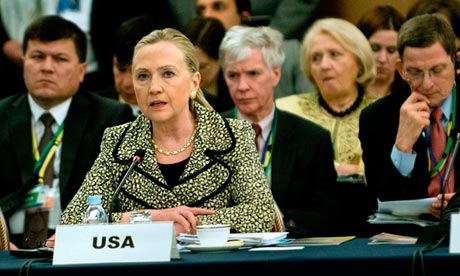
The US secretary of state, Hillary Clinton, at the Afghanistan aid conference in Tokyo. Photograph: Brendan Smialowski/AFP/Getty Images
International donors have pledged $16bn (£10bn) in badly needed development aid for Afghanistan over the next four years as the Afghan president, Hamid Karzai, urged the international community not to abandon his country.
The donors' conference in Tokyo, attended by about 70 countries and organisations, is aimed at setting aid levels for the crucial period until and beyond 2014, when most Nato-led foreign combat troops will leave and the war-torn country will assume responsibility for most of its own security.
"I request Afghanistan's friends and partners to reassure the Afghan people that you will be with us," Karzai said in his opening statement.
The Japanese foreign minister and officials travelling with the US secretary of state, Hillary Rodham Clinton, said the donors had made $16bn available by 2015, which would be in line with the nearly $4bn a year that the Japanese co-hosts had said they were hoping to achieve during the one-day conference.
Japan, the second-largest donor, says it will provide up to $3bn by 2016, and Germany has announced it will keep its contribution to rebuilding and development at its current level of $536m a year at least until 2016.
But the donors are also expected to set up monitoring measures to ensure the aid is used for development and not wasted by corruption or mismanagement, which has been a major hurdle in putting aid projects into practice.
"We have to face harsh realities filled with difficulties,'" said Japan's prime minister, Yoshihiko Noda.
Afghanistan has received nearly $60bn in civilian aid since 2002. The World Bank says foreign aid makes up nearly the equivalent of the country's gross domestic product.
Foreign aid in the decade since the US invasion in 2001 has led to better education and healthcare, with nearly 8 million children, including 3 million girls, enrolled in schools. That compares with 1 million children more than a decade ago, when girls were banned from school under the Taliban.
Improved health facilities have halved child mortality and expanded basic health services to nearly 60% of Afghanistan's population of more than 25 million, compared with less than 10% in 2001.
But the flow of aid is expected to sharply diminish after international troops withdraw, despite the ongoing threat the country faces from the Taliban and other militants.
Along with security issues, donors have become wary of widespread corruption and poor project governance. Before the conference, Japanese officials said they were seeking a mechanism to regularly review how the aid money was spent, and guarantees from Kabul that it would not be squandered.
The US portion is expected to be between $1bn and $2.3bn – this year's figure – every year for the next decade. Officials declined to outline the future annual US amounts, but the Obama administration has requested a similarly high figure for next year as it draws down American troops and hands over greater authority to Afghan forces.
The total amount of international civilian support represents a slight trailing off from the current annual level of about $5bn, a number somewhat inflated by US efforts to give a short-term boost to civilian reconstruction projects in Afghanistan, mirroring Barack Obama's decision in 2009 to ramp up military numbers in the hope of routing the Taliban insurgency.
The aid will come with conditions. The pledges are expected to establish a road map of accountability to ensure that Afghanistan does more to improve governance and finance management, and to safeguard the democratic process, rule of law and human rights – especially those of women.
Karzai vowed to "fight corruption with strong resolve". But he still faces international weariness with the war and frustration over his failure to crack down on corruption.
Clinton, who briefly visited the Afghan capital on Saturday before heading to Tokyo, had breakfast with Karzai and acknowledged that corruption was a "major problem".
The $4bn in annual civilian aid comes on top of $4.1bn in yearly assistance pledged last May at a Nato conference in Chicago to fund the Afghan National Security Forces from 2015 to 2017.
Note: The one this post replies to is linked here ..
"So will Europe save itself? The stakes are very high, and Europe’s leaders are, by and large, neither evil nor stupid. But the same could be said, believe it or not, about Europe’s leaders in 1914. We can only hope that this time is different."


 Market Data
  Markets


 AI
AI