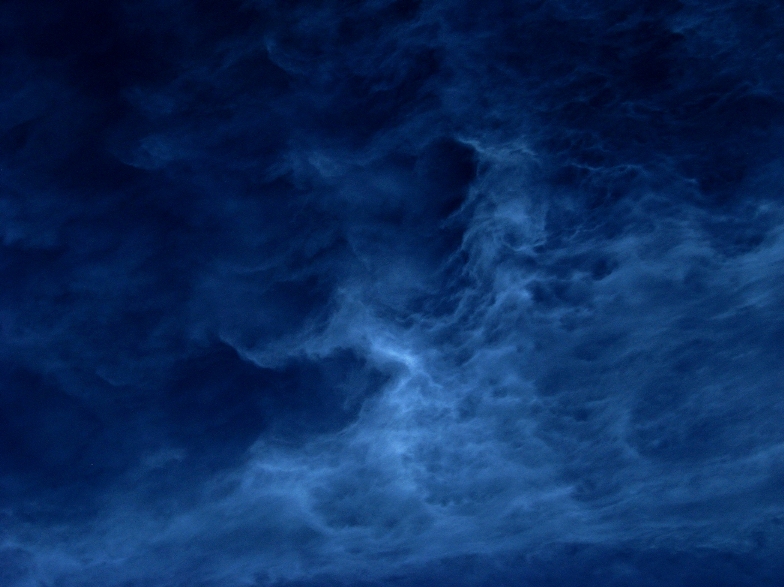
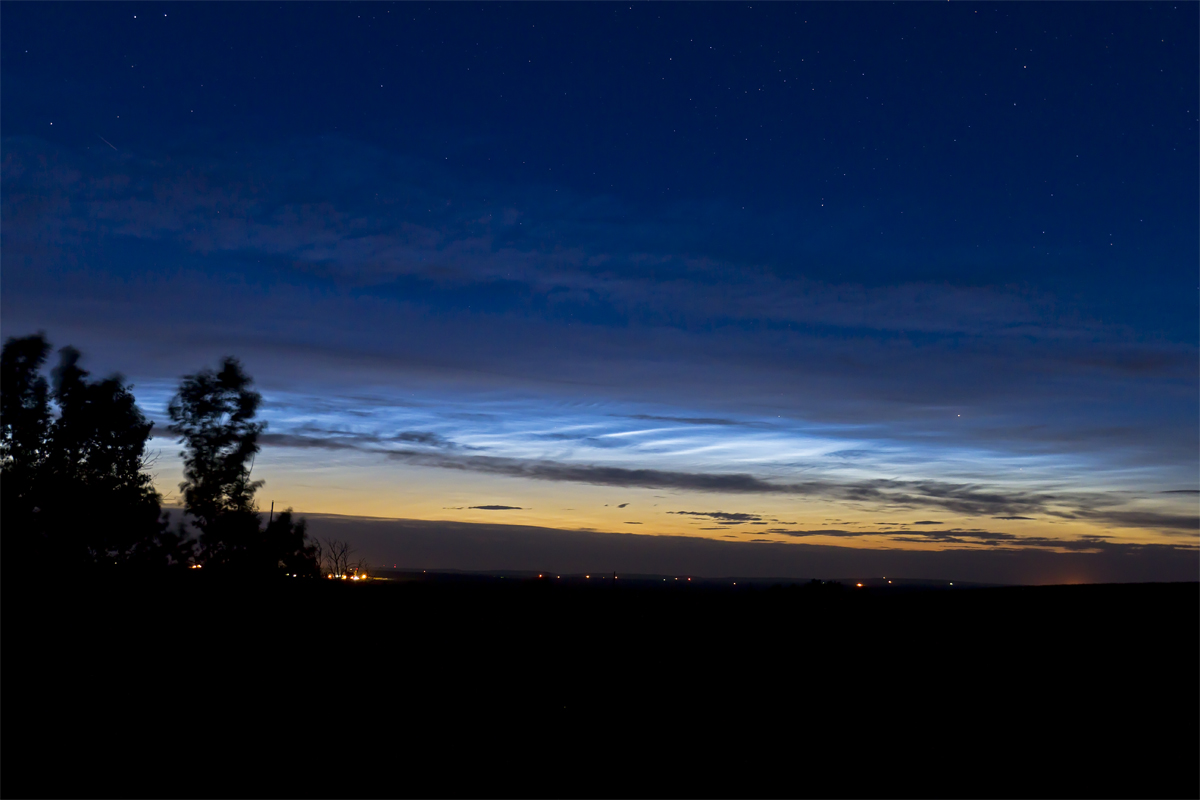
Very bright noctilucent clouds. They appeared an hour after the sunset. NLC reached 90+ degrees above horizon. They covered more than half of the sky! As the night came only a few clouds near the horizon remained sunlit. It was a beatiful nlc display.
Alan Dyer, near Gleichen, Alberta, Canada Jun. 28, 2011
This was our first sighting of NLCs for the season, from southern Alberta, and a few of us have been looking most nights it's been clear. But the NLC season for us began with a good display low in the north, quite bright at 11:45 pm MDT, June 28, local time but fading shortly after midnight. The vertical shot takes in the Big Dipper and Polaris.
Above: Noctilucent clouds over Finland. The orange hues near the horizon are ordinary sunset colors, notes Gary Thomas. NLCs, on the other hand, are usually "luminous blue-white or sometimes just pale white," he says. Image credit Pekka Parviainen.
The optimum viewing geometry for noctilucent clouds. Sunlight scattered by tiny ice crystals in NLCs is what gives the clouds their characteristic blue color.
People who live in latitudes between 55 and 65 degrees may be lucky enough to experience a stunning bright phenomenon at twilight, namely noctilucent clouds. These are clouds that form the "ragged edge" of the even brighter polar mesopheric clouds in the upper atmosphere. The Latin name means "night shining" and as the following images show, that they do.
Photo: Andres Kuusk
The connection to climate change is an important one. Noctilucent clouds were observed fairly recently, have increased gradually in numbers of occurrence, and climate models predict greenhouse gas emissions will cool the mesophere, thereby increasing the number of noctilucent clouds even more. Another theory proposed on Wiki is that "larger methane emissions from intensive farming activities produce more water vapor in the upper atmosphere."


 Market Data
  Markets


 AI
AI