~~~~~ 1. Monetary policy does not matter. 2. Financial factors are the symptoms, not the causes, of the recent downturn. 3. The recession was due to an Obama shock, i.e. labor supply fell because US workers anticipate higher future taxes. ~~~~~
But was it really any more reasonable to assert, more than 20 years ago, that recessions are the result of technological retrogression? That Paul Volcker’s actions had nothing to do either with the 1981-2 recession or the subsequent recovery?
Nothing has really changed; what you see now in real business cycle theory is what you were always getting.
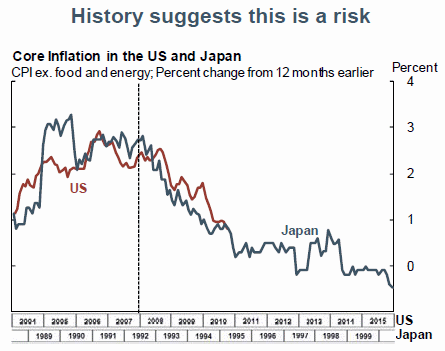
I mean, look at our current situation. On one side, we’re witnessing a steady slide toward lower inflation, tracking almost perfectly Japan’s slide toward corrosive deflation:
On the other, we have sharply rising gold prices, reflecting some combination of Chinese demand and Glenn Beck.
So put this together: doesn’t this strongly suggest that we’d be facing very strong deflationary pressure if we had been on a gold standard? Yes, gold demand is endogenous – it might be lower if you knew that the Fed and the ECB were securely bound by golden fetters. On the other hand, there would be a lot more demand for gold reserves.
The question I’d ask is, what problem does Zoellick think gold would solve?
The descent into a Dark Age of economics continues.
Let me follow up a bit on the sudden discovery by Republicans that cuts in government spending cost jobs and drive up the unemployment rate – as long as the spending is on destruction .. http://krugman.blogs.nytimes.com/2011/10/28/coalmines-and-military-keynesians/ .. rather than construction. Oh, and thanks to commenters for reminding me of Barney Frank’s coinage, “weaponized Keynesianism.”
The first thing to say is that liberals shouldn’t engage in mirror-image thinking, and imagine that spending we dislike somehow lacks the job-creating virtues of spending we like. Economics, as I say often, is not a morality play. As far as creating aggregate demand is concerned, spending is spending – public spending is as good as but also no better than private spending, spending on bombs is as good as spending on public parks. As I pointed out not long ago, a perceived threat of alien invasion, by getting us to spend on anti-invasion measures, would quickly restore full employment, even though the spending would be on totally useless object.
It’s also worth noting that one of the main sources of evidence that fiscal expansion really does stimulate the economy comes from tracking the effects of changes in defense spending. That’s true of Depression-era studies like Almunia et al .. http://www.voxeu.org/index.php?q=node/4227 , and also of several of the studies described in the Romer and Romer lecture .. http://www.econ.berkeley.edu/users/webfac/cromer/e210c_f11/e210c.shtml .. on fiscal policy. Why the focus on defense? Two reasons, actually. One is that in practice defense spending is what moves: the fact is that large-scale stimulus programs consisting of domestic spending basically don’t happen, while wars and arms races do.
The other is that domestic spending tends to be endogenous, responding to events in the economy, so that cause and effect get blurred – spending on unemployment insurance generally soars during recessions, but the causation runs from recession to spending and not the other way around.
And the evidence clearly shows that weaponized Keynesianism works – which means that Keynesianism in general works.
So why do politicians and their hired economic propagandists say differently? On reflection, I think it’s a bit more complicated than I suggested in my previous post on this topic, because there’s a strong element of cynicism as well as genuine intellectual confusion.
What kind of cynicism am I talking about? First, there’s the general fear on the part of conservatives that if you admit that the government can do anything useful other than fighting wars, you open the door to do-gooding in general; that explains why conservatives have always seen Keynesianism as a dangerous leftist doctrine even though that makes no sense in terms of the theory’s actual content. On top of that there’s the Kalecki point .. http://rortybomb.wordpress.com/2011/01/21/kristol-kalecki-and-a-19th-century-economist-defending-patriarchy-all-on-political-macroeconomics/ .. that admitting that the government can create jobs undermines demands that policies be framed to cater to all-important business confidence.
That said, there’s also the Keynes/coalmines point: there’s a strong tendency to take any spending that looks like a business proposition – building bridges or tunnels, supporting solar energy or mass transit – and demanding that it appear to be a sound investment in terms of its financial return. This makes most such spending look bad, since almost by definition a depressed economy is one in which businesses aren’t seeing good reasons to invest. Defense gets exempted because nobody expects bombs to be a good business proposition.
The moral here should be that spending to promote employment in a depressed economy should not be viewed as something that has to generate a good financial return; in effect, most of the resources being used are in reality free.
I wonder if we’ll ever have a political system mature enough to understand this.
What Beckworth does is show that there isn’t a correlation between either federal expenditures or the federal deficit and nominal GDP growth in recent years; Noah’s point is that fiscal policy is endogenous, affected by the state of the economy. When things seemed to be collapsing, Washington managed to pass a stimulus bill; when they stopped collapsing, the stimulus was allowed to fade away. So?
It is, by the way, kind of dispiriting to see this kind of argument still being trotted out four years into this whole debate — and presented as if it were something new, too. Been there, addressed that; is it really so hard to make any sort of progress here?
Anyway, where Noah goes too far is in asserting that this kind of thing means that we basically know nothing. Um, no — good economists have been aware of this problem for a long time, and serious work on both monetary and fiscal policy takes it into account. How? By looking for natural experiments – cases of large changes in policy (so that policy is the dominant factor in what happens) that are clearly not a response to the state of the business cycle.
That’s why Milton Friedman and Anna Schwartz’s monetary history wasn’t just about correlations; it relied on a narrative method to attempt to show that the monetary movements it stressed were more or less exogenous. (You can quarrel with some of their judgements, but the method was sound). It’s why Romer and Romer, in their classic paper .. http://www.nber.org/papers/w2966 .. on the real effects of monetary policy, relied on a study of Fed minutes to identify major changes in policy.
In the same vein, this is why serious analysis of fiscal policy relies a lot on wartime booms and busts .. http://krugman.blogs.nytimes.com/2012/02/19/wars-and-growth/ .. in government spending, which are clearly not responses to unemployment.
And it’s why, if you want a read on the effects of fiscal policy in recent years, you want to look not at the fairly small events here but at austerity in Europe. The austerity programs have two great virtues from an economic research point of view (they are, of course, terrible from a human point of view). First, they are huge — in Greece, we’re looking at austerity measures amounting to 16 percent of GDP, the equivalent for the US of $2.5 trillion every year. Second, they are plausibly related mainly to market access issues rather than the state of the economy, so they’re relatively exogenous. Only relatively; you do have to worry that austerity ends up being imposed only in economies that would be in trouble anyway. But the IMF has tried to correct for this, by focusing on forecast errors ..
So I think it’s very wrong to suggest that we don’t know anything. History offers many natural experiments in macroeconomics; recent disasters have thrown up quite a few more. And the case for the effectiveness of fiscal policy, for good or evil, has never been stronger.
I’m in San Diego for the annual economics meetings, and am starting off this morning as a discussant of a paper by Roger Gordon and Gordon Dahl on the question of agreement versus disagreement among economists. (As far as I can tell, no public version of the paper is available yet).
Interestingly, Gordon and Dahl’s paper is empirical and quantitative. Their data come from the panel of economic experts .. http://www.igmchicago.org/igm-economic-experts-panel .. put together by Chicago’s Booth School of Business. Each week since the fall of 2011, members of the panel have been asked whether they agree or disagree with a sample statement about economic affairs. These responses offer a quantitative measure of consensus or lack thereof on economic ideas; they can also be used to ask such questions as whether disagreements, when they occur, fall along a liberal/conservative divide.
And the picture Gordon and Dahl derive from this evidence is quite benign. On most issues, particularly where there is a lot of research, there is considerable consensus; and they can’t find evidence of ideological divides driving disagreement. Economics, they find, looks a lot like a normal field of scientific inquiry; to the extent that it seems otherwise, they suggest, it’s only because sometimes economists are working for politicians and are obliged to seem supportive.
This picture seems, of course, to be at odds with what I have written about the state of macroeconomics .. http://www.nytimes.com/2009/09/06/magazine/06Economic-t.html?pagewanted=all&_r=0 . Why are they telling such a different story? One possible answer is that I was all wrong. Another possible answer, however, is that macroeconomics – and in particular the study of recessions and policy responses thereto – is special, and that the Booth panel responses just don’t provide sufficient information on what is happening in that corner of the field.
Obviously I prefer the second answer, and in fact I’m quite sure I’m right. In the spirit of the paper, however, I should do my best to justify that belief quantitatively, with as little subjective interpretation as possible.
So here’s a stab at doing that.
The first question is, how well are economists specializing in business-cycle models represented on the panel? There are 42 economists on the panel, 6 from each of the top 7 schools. A simple if rough way to identify the business-cycle types is to ask how many of the panelists are also members of the NBER’s Economic Fluctuations and Growth .. http://www.nber.org/programs/efg/efg.html .. (EFG) program; the answer is, 11. So we aren’t getting nearly as large a sample here as the overall size of the panel might suggest.
The next question is, how many of the statements the panel was asked to address focused on the core areas of dispute among macroeconomists? Here I can’t avoid making some subjective judgments. There were a number of statements focusing on macroeconomic issues, but many of those statements were clearly outside the range of dispute among professional economists. For example, while there may be significant political support for the gold standard, you won’t find that support echoed even by economists who are very hostile to active monetary policy.
By my count, in fact, there were only two statements that lay within the range of serious intra-academic dispute. One involved the effects of quantitative easing; the other, on which I’ll focus my attention, regarded the effects of the Recovery Act .. http://www.igmchicago.org/igm-economic-experts-panel/poll-results?SurveyID=SV_cw5O9LNJL1oz4Xi , and hence the question of fiscal stimulus. (Actually, this was a two-part, with the first statement involving the Act’s effectiveness, the second its desirability).
What did the panel have to say about fiscal stimulus? The answers actually suggested a lot of consensus: 80 percent of the panel agreed that the Recovery Act significantly boosted output and employment, with only 5 percent disagreeing. (By the way, that’s Caroline Hoxby and Eddie Lazear). There was a lot more uncertainty over whether the Act was a good idea, but among those who did have a view, the yeas outnumbered the nays almost three to one.
So, are impressions of a bitter ideological divide over fiscal policy just wrong? Or is the panel failing to reflect the realities of modern macroeconomics?
Again, let’s go to the NBER’s EFG program. Ideally, we should go through all the members and assess their views on stimulus. For now, I’ll take a quicker approach, and focus only on highly prominent members of the program, using an objective measure of prominence – namely, possession of a Nobel Prize.
There are, it turns out, five laureates among the EFG members, and three of them have expressed strong views on the effects of stimulus. The most moderate of these statements comes from Thomas Sargent, who denounced the president .. http://neighborhoodeffects.mercatus.org/2011/10/11/a-nobelist-on-fiscal-stimulus/ .. for, in his view, falsely implying that there was a consensus among economists of the kind the Booth experts panel data also seem to suggest:
~~~~~ In early 2009, I recall President Obama as having said that while there was ample disagreement among economists about the appropriate monetary policy and regulatory responses to the financial crisis, there was widespread agreement in favor of a big fiscal stimulus among the vast majority of informed economists. His advisers surely knew that was not an accurate description of the full range of professional opinion. ~~~~~
~~~~~ Stimulus is not part of the language of economics. ~~~~~
Finally, Robert Lucas made a personal attack on Christina Romer .. http://www.cfr.org/economics/why-second-look-matters/p18996 .. for advocating stimulus, calling it “shlock economics” and questioning her intellectual honesty. Her analysis, he asserted, was
~~~~~ a very naked rationalization for policies that were already, you know, decided on for other reasons. ~~~~~
Hmm. This doesn’t sound much like the consensus supposedly demonstrated by the Booth panel. And do you really want to say that the divide here has nothing to do with ideology? Really?
OK, here’s how I read the Gordon and Dahl results: what they show is that most of what economists do is indeed fairly objective and non-ideological; business-cycle macro, although it’s not at all like that, is a small enough part of the academic field that their data don’t pick it up.
Unfortunately, while business-cycle macro may not be a large part of what economists do, it’s a field that matters a lot – especially with the world still facing its worst economic crisis in three generations.
And business-cycle macro is also, I’d argue, more important to the field of economics in general than most economists themselves realize.
Long ago I stumbled on an analogy that still seems relevant to me: business-cycle macro is to economics in general in something like the way that nuclear bombs (and to some extent, to be fair, nuclear power) are to high-energy physics. I’m sure that very few physicists working on the mysteries of the universe trouble themselves at all thinking about how to make things go boom. Yet the reason the field continues to receive public funding is in large part precisely the fact that once upon a time physicists did, indeed, find a way to make things go boom, and you never know what they might come up with in the future.
Similarly, while the vast majority of economists may work on issues far removed from the question of what to do in a depression, an important part of our field’s prestige and the support it receives comes from the perception that economists do indeed have useful advice to offer in times of depression, and may come up with more useful advice in the future.
And if the perception spreads, instead, that business-cycle macro is just ideological posturing, that influential economists choose their doctrines to suit their political prejudices, and that the field not only fails to progress but sometimes actually retrogresses, this will be bad for the profession as well as the world.


 Market Data
  Markets


 AI
AI