A group of nuns is protesting Rep. Paul Ryan's budget proposal.
June 6th, 2012 06:56 PM ET
By Dan Merica, CNN
Washington (CNN) - American nuns are taking their opposition of the proposed Paul Ryan budget to the American people and embarking on a bus tour through some of America’s most politically important states.
NETWORK, a group founded by 47 Catholic sisters that speaks out on social justice issues in particular, will be hitting states like Iowa, Wisconsin, Ohio, Pennsylvania and Virginia in order to reveal “how federal budget cuts proposed by Rep. Paul Ryan, (R-WI), and passed by the House of Representatives will hurt struggling families in these states,” a release by the group reads.
In interviews after unveiling his budget, Ryan said that he applied his view of Catholic social teaching in his budget proposal, a statement that Sister Simone Campbell, the executive director of NETWORK, said co-opted sacred Catholic teachings.
“I think he was so direct in draping himself in the mantle of Catholic social teaching,” Campbell said. “He took the words but he took none of the meaning in the forming of the budget.”
Campbell continued: “It is one thing to have political differences, but to try to hide a budget that will devastate people and claim that it is supported by your faith. It is unacceptable. He is wrong and he needs to be told so.”
Ryan’s $3.53 trillion dollar budget doubles down on past proposals Republicans have made to overhaul Medicare and other government programs that are seen as politically sensitive. While the budget has little chance to become law, it draws a distinct contrast with Democratic views on spending and will loom large in the 2012 race for the presidency.
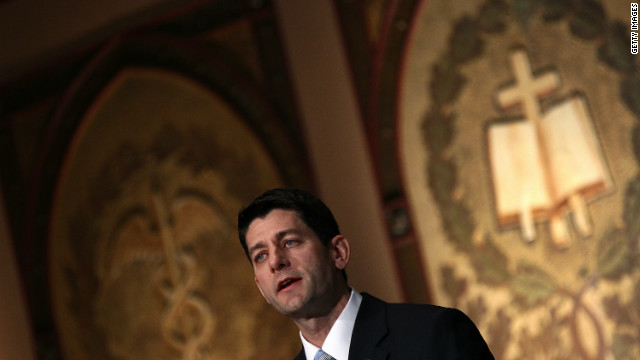
Ryan was given an opportunity to respond to Catholics who have questioned his budget in a speech at Georgetown University, the oldest Catholic university in the country.
“Of course, there can be differences among faithful Catholics on this. The work I do, as a Catholic holding office, conforms to the social doctrine as best I can make of it,” said Ryan, a Wisconsin Republican. “What I have to say about the social doctrine of the church is from the viewpoint of a Catholic in politics applying my understanding of the problems of the day.”
The Georgetown speech also gave Catholic opponents an opportunity to confront Ryan with their disapproval. As Ryan delivered the remarks, he came face-to-face with protesters who unveiled a banner that read “Stop the War on the Poor.” Outside the event, Catholics United protested the event. A little over a dozen people stood outside Healy Hall, where the speech took place, and held a sign the read, “WERE YOU THERE WHEN THEY CRUCIFIED THE POOR?”
The nuns' bus trip will go through Wisconsin, Ryan’s home state, and Campbell said the nuns will meet with congressional representatives and their staffs. In particular, Campbell indicated that NETWORK is specifically targeting Catholic representatives who had voted for Ryan’s budget.
“There are some Catholic representatives who have voted for the House budget that Representative Ryan proposed and we as Catholics believe that we should go talk to them and talk to their staffs,” Campbell said.
The trip comes during a controversial time between American nuns and their leadership in Vatican City. Recently, the Vatican has been critical of the nuns, in particular, charging the nuns of espousing “radical feminism” and straying from church teaching.
The busing nuns referenced this controversy in their announcement of the event, stating that “despite the controversy, Catholic Sisters stand with the Bishops in criticizing the Ryan budget and are committed to staying faithful to their mission to serve those in need.”
“In fact, on this issue, we stand with the bishops,” Campbell said.
And that is true. In an April release from the United States Conference of Catholic Bishops, the bishops call on "Congress and the Administration to protect essential help for poor families and vulnerable children and to put the poor first in budget priorities.”
Catholic Cardinal's Hawaii Getaway Ends In DUI Arrest
Hawaii County
New cardinal William Joseph Levada receives the biretta cap from Pope Benedict XVI in Saint Peter's Square, March 24, 2006 in Vatican City. The Pontiff installed 15 new cardinals during the Consistory ceremony. Franco Origlia via Getty Images
"I regret my error in judgment," the high-ranking Vatican official said
By Chris D'Angelo Posted: 08/24/2015 11:18 PM EDT
One of the Roman Catholic Church's most senior clergymen was arrested last week for driving under the influence during a trip to Hawaii.
Levada, formerly the highest ranking American official in the Vatican [ http://www.nytimes.com/2010/05/06/world/europe/06levada.html ], was charged with driving under the influence and was released from police custody after posting $500 bail.
In a statement emailed to The Huffington Post by a spokesman for the Archdiocese of San Francisco, Levada said, “I regret my error in judgment. I intend to continue fully cooperating with the authorities.”
Levada, the former archbishop of Portland and San Francisco, was reportedly vacationing with other priests on the Big Island when the arrest occurred.
When asked how the archdiocese handles situations like this, spokesman Michael Brown said that in this specific case, "'punishment' is not a factor."
“Speaking generally at all levels of the organization, such things would be looked at on a case-by-case basis," he wrote in an email to HuffPost. "Where a lapse in judgment occurred, the matter would probably be considered less serious. If the matter seemed to indicate a more serious problem, this would be treated more seriously. This would be true at all employee levels."
In 2005, former Pope Benedict XVI named Levada as his successor as Prefect for the Congregation for the Doctrine of the Faith. One year later, Benedict named him a cardinal.
The Hawaii Tribune-Herald reported Levada is scheduled to appear in Kona District Court Sept. 24. A police spokeswoman declined to provide the newspaper with Levada's blood alcohol content.
Like Pope Francis, many USA Catholics' beliefs surprising
Greg Toppo, USATODAY 12:07 a.m. EDT September 2, 2015
(Photo: Murizio Brambatti, EPA)
Pope Francis' evolving views on a host of fraught social issues have surprised observers since his rise to the Vatican two-and-a-half years ago. Now an unprecedented bit of research shows that USA Catholics' views may be just as surprising.
A trove of data out Wednesday from the Pew Research Center finds that the typical American Catholic doesn't find it sinful to use contraception or to live with a romantic partner outside of marriage. While nearly half of Catholics believe the church should not recognize the marriages of gay and lesbian couples, just as many think it should.
The findings come as Pope Francis this week waded into one of the thorniest topics of his papacy: abortion.
On Tuesday, he said priests can forgive the "sin of abortion" for women who are sorry about it. In a letter published by the Vatican, the pontiff — who has been striving to build a more inclusive church — said priests will have the power during a special "Holy Year of Mercy" that begins in December.
The new Pew survey of 5,122 adults found that while most Catholics — 57% — believe it's "sinful" to terminate a pregnancy, opposing abortion ranks relatively low among a list of 10 beliefs when it comes to defining what's "essential" to being a Catholic. Only about one in three respondents said opposing abortion was essential to being a Catholic. By contrast, about two-thirds said "having a personal relationship with Jesus Christ" was essential.
"I think it just says something about how salient this issue is to Catholics overall," said Jessica Martinez, a Pew senior researcher. "When they think about living out their faith day to day, it doesn't seem like opposing abortion is high on the list for most Catholics."
Like much of the survey, the questions asking Catholics to rank essential beliefs are unprecedented for Pew, Martinez said, so they don't have comparable data from previous years.
In his brief tenure, which began in the spring of 2013, Pope Francis has laid out sometimes controversial stances on a host of social issues, including divorce, gay marriage and contraception.
Francis hasn't budged much from the church's view that artificial contraception is a sin — in remarks he later walked back, Francis said Catholics need not reproduce "like rabbits.'' Days later, he praised big families for "welcoming children as a true gift of God."
The Pew survey found that 66% of Catholics believe it's not sinful to use contraception — actually, that's several percentage points higher than the general public's view. Overall, 63% of Americans believe it's not sinful to use contraception.
Asked by Pew if they believe the church will "definitely" or "probably" allow contraception by 2050, 59% of Catholics agreed. And three-fourths believe the church should allow it.
Just months after being named pontiff, Francis struck a tolerant tone on gay marriage, saying, "Who am I to judge?" when asked whether gays and lesbians could be good Christians. "They shouldn't be marginalized," he said. "The tendency (to be homosexual) is not the problem. They are our brothers."
The Pew survey found that Catholics are evenly split, at 46% apiece, on whether the church should recognize the marriages of gay and lesbian couples. Another 8% are undecided.
On divorce, the Pope issued a call last month for the church to embrace divorced and remarried Catholics. He said such couples "are not excommunicated, and they absolutely must not be treated that way." Francis told a Vatican crowd, "They always belong to the church."
The Pew survey actually revealed that, given the choice between a divorced or same-sex couple raising children, more Catholics believe that the same-sex arrangement is "acceptable and as good as any other arrangement."
Even as the findings suggest that many USA Catholics are at odds with traditional church teachings on social issues, Martinez noted, seven in 10 say they couldn't imagine quitting Catholicism.
"They're still very much attached to their church," she said.
Contributing: Katharine Lackey, John Bacon, USA TODAY
As years roll on beliefs of earthly people-loving Catholics will inevitably become more unglued from avowed Vatican Catholic orthodoxy. Until the church has another masturbation-like spurt of reform. Just as inevitably it seems is that evangelicalism will stand as a more negative barrier to the evolution of attitude.
Conservative dissent is brewing inside the Vatican
U.S. Cardinal Raymond Leo Burke, left, stands by Pope Francis saluting bishops, at the end of weekly general audience in St. Peter's Square at the Vatican, Sept. 2, 2015. (Alessandra Tarantino/AP)
By Anthony Faiola September 7 at 7:33 PM .. 746 ..
VATICAN CITY — On a sunny morning earlier this year, a camera crew entered a well-appointed apartment just outside the 9th-century gates of Vatican City. Pristinely dressed in the black robes and scarlet sash of the princes of the Roman Catholic Church, the Wisconsin-born Cardinal Raymond Burke sat in his elaborately upholstered armchair and appeared to issue a warning to Pope Francis.
A staunch conservative and Vatican bureaucrat, Burke had been demoted by the pope a few months earlier, but it did not take the fight out of him. Francis had been backing a more inclusive era, giving space to progressive voices on divorced Catholics as well as gays and lesbians. In front of the camera, Burke said he would “resist” liberal changes — and seemed to caution Francis about the limits of his authority. “One must be very attentive regarding the power of the pope,” Burke told the French news crew.
Papal power, Burke warned, “is not absolute.” He added, “The pope does not have the power to change teaching [or] doctrine.”
Burke’s words belied a growing sense of alarm among strict conservatives, exposing what is fast emerging as a culture war over Francis’s papacy and the powerful hierarchy that governs the Roman Catholic Church.
Pope Francis: Acts of humility The new prelate is rewriting the rules in his first year at the Vatican. Here are a few of Francis’s symbolic moves and statements. View Photos [inside].
This month, Francis makes his first trip to the United States at a time when his progressive allies are heralding him as a revolutionary, a man who only last week broadened the power of priests to forgive women who commit what Catholic teachings call the “mortal sin” of abortion during his newly declared “year of mercy” starting in December. On Sunday, he called for “every” Catholic parish in Europe to offer shelter to one refugee family from the thousands of asylum-seekers risking all to escape war-torn Syria and other pockets of conflict and poverty.
Yet as he upends church convention, Francis also is grappling with a conservative backlash to the liberal momentum building inside the church. In more than a dozen interviews, including with seven senior church officials, insiders say the change has left the hierarchy more polarized over the direction of the church than at any point since the great papal reformers of the 1960s.
The conservative rebellion is taking on many guises, in public comments, yes, but also in the rising popularity of conservative Catholic Web sites promoting Francis dissenters; books and promotional materials backed by conservative clerics seeking to counter the liberal trend; and leaks to the news media, aimed at Vatican reformers.
In his recent comments, Burke was also merely stating fact. Despite the vast powers of the pope, church doctrine serves as a kind of constitution. And for liberal reformers, the bruising theological pushback by conservatives is complicating efforts to translate the pope’s transformative style into tangible changes.
“At least we aren’t poisoning each other’s chalices anymore,” said the Rev. Timothy Radcliffe, a liberal British priest and Francis ally appointed to an influential Vatican post in May. Radcliffe said he welcomed open debate, even critical dissent within the church. But he professed himself as being “afraid” of “some of what we’re seeing”
Testing newfound freedom
Rather than stake out clear stances, the pope is more subtly, often implicitly, backing liberal church leaders who are pressing for radical change, while dramatically opening the parameters of the debate over how far reforms can go. For instance, during the opening of a major synod, or meeting, of senior bishops on the family last year, Francis told those gathered, “Let no one say, ‘This you cannot say.’?”
Since then, liberals have tested the boundaries of their new freedom, with one Belgian bishop going as far as openly calling for the Catholic Church to formally recognize same-sex couples.
Conservatives counter that in the current climate of rising liberal thought, they have been thrust unfairly into a position in which “defending the real teachings of the church makes you look like an enemy of the pope,” a conservative and senior Vatican official said on the condition of anonymity in order to speak freely.
“We have a serious issue right now, a very alarming situation where Catholic priests and bishops are saying and doing things that are against what the church teaches, talking about same-sex unions, about Communion for those who are living in adultery,” the official said. “And yet the pope does nothing to silence them. So the inference is that this is what the pope wants.”
One method of pushback has been to give damaging leaks to the Italian news media. Vatican officials are now convinced that the biggest leak to date — of the papal encyclical on the environment in June — was driven by greed (it was sold to the media) rather than vengeance. But other disclosures have targeted key figures in the papal cleanup — including the conservative chosen to lead the pope’s financial reforms, the Australian Cardinal George Pell, who in March was the subject of a leak about his allegedly lavish personal tastes.
More often, dissent unfolds on ideological grounds. Criticism of a sitting pope is hardly unusual — liberal bishops on occasion challenged Benedict. But in an institution cloaked in traditional fealty to the pope, what shocks many is just how public the criticism of Francis has become.
In an open letter to his diocese, Bishop Thomas Tobin of Providence, R.I., wrote: “In trying to accommodate the needs of the age, as Pope Francis suggests, the Church risks the danger of losing its courageous, countercultural, prophetic voice, one that the world needs to hear.” For his part, Burke, the cardinal from Wisconsin, has called the church under Francis “a ship without a rudder.”
Even Pell appeared to undermine him on theological grounds. Commenting on the pope’s call for dramatic action on climate change, Pell told the Financial Times in July, “The church has got no mandate from the Lord to pronounce on scientific matters.”
In conservative circles, the word “confusion” also has become a euphemism for censuring the papacy without mentioning the pope. In one instance, 500 Catholic priests in Britain drafted an open letter this year that cited “much confusion” in “Catholic moral teaching” following the bishops’ conference on the family last year in which Francis threw open the floodgates of debate, resulting in proposed language offering an embraceable, new stance for divorced or gay Catholics.
That language ultimately was watered down in a vote that showed the still-ample power of conservatives. It set up another showdown for next month, when senior church leaders will meet in a follow-up conference that observers predict will turn into another theological slugfest. The pope himself will have the final word on any changes next year.
Conservatives have launched a campaign against a possible policy change that would grant divorced and remarried Catholics the right to take Communion at Mass. Last year, five senior leaders including Burke and the conservative Cardinal Carlo Caffarra of Bologna, Italy, drafted what has become known as “the manifesto” against such a change. In July, a DVD distributed to hundreds of dioceses in Europe and Australia, and backed by conservative Catholic clergy members, made the same point. In it, Burke, who has made similar arguments at a string of Catholic conferences, issued dire warnings of a world in which traditional teachings are ignored.
But this is still the Catholic Church, where hierarchical respect is as much tradition as anything else. Rather than targeting the pope, conservative bishops and cardinals more often take aim at their liberal peers. They include the German Cardinal Walter Kasper .. http://vaticaninsider.lastampa.it/en/inquiries-and-interviews/detail/articolo/sinodo-famiglia-36644/ , who has suggested that he has become a proxy for clergy members who are not brave enough to criticize the pope directly.
Yet conservatives counter that liberals are overstepping their bounds, putting their own spin on the pronouncements of a pope who has been more ambiguous than Kasper and his allies are willing to admit.
“I was born a papist, I have lived as a papist, and I will die a papist,” Caffarra said. “The pope has never said that divorced and remarried Catholics should be able to take Holy Communion, and yet, his words are being twisted to give them false meaning.”
Some of the pope’s allies insist that debate is precisely what Francis wants.
“I think that people are speaking their mind because they feel very strongly and passionately in their position, and I don’t think the Holy Father sees it as a personal attack on him,” said Chicago Archbishop Blase J. Cupich, considered a close ally of the pope. “The Holy Father has opened the possibility for these matters to be discussed openly; he has not predetermined where this is going.”
Anthony Faiola is The Post's Berlin bureau chief. Faiola joined the Post in 1994, since then reporting for the paper from six continents and serving as bureau chief in Tokyo, Buenos Aires, New York and London.
fuagf ..Capitalism is not doomed. It is already gone, that is what I am saying. Just an illusion has been created to make it appear that it is not, as the people slowly get mind controlled Vatican City (AFP) - Syrian President Bashar al-Assad sent a message to Pope Francis Saturday, that state media said expressed his determination to defend Syrians of all religions against hardline Islamists among the rebels. http://investorshub.advfn.com/boards/read_msg.aspx?message_id=95360019


 Market Data
  Markets


 AI
AI