FEDERAL INCOME TAXES, AS A SHARE OF GDP, DROP TO LOWEST LEVEL SINCE 1942, ACCORDING TO FINAL BUDGET DATA Erosion of income tax base drives other key budget developments
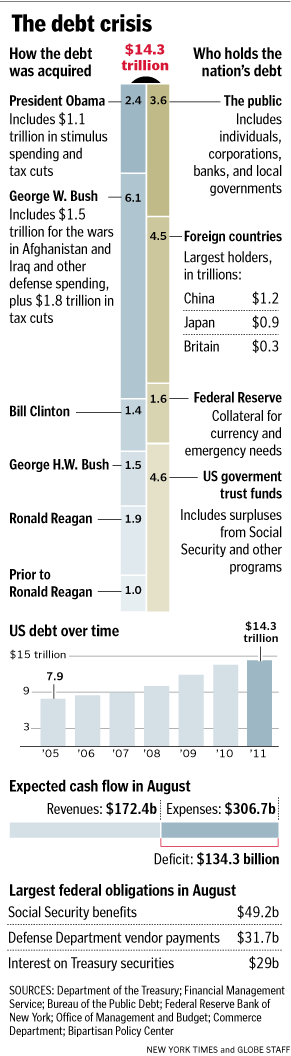
Republicans talk about job creation, about preserving family farms and defending small businesses, and reforming Medicare and Social Security. But almost without exception, every proposal put forth by GOP lawmakers and presidential candidates is intended to preserve or expand tax privileges for the wealthiest Americans. And most of their plans, which are presented as common-sense measures that will aid all Americans, would actually result in higher taxes for middle-class taxpayers and the poor. With 14 million Americans out of work, and with one in seven families turning to food stamps simply to feed their children, Republicans have responded to the worst economic crisis since the Great Depression by slashing inheritance taxes, extending the Bush tax cuts for millionaires and billionaires, and endorsing a tax amnesty for big corporations that have hidden billions in profits in offshore tax havens. They also wrecked the nation's credit rating by rejecting a debt-ceiling deal that would have slashed future deficits by $4 trillion – simply because one-quarter of the money would have come from closing tax loopholes on the rich.
[...]
That only changed in the late 1970s, when high inflation drove up wages and pushed the middle class into higher tax brackets. Harnessing the widespread anger, Reagan put it to work on behalf of the rich. In a move that GOP Majority Leader Howard Baker called a "riverboat gamble," Reagan sold the country on an "across-the-board" tax cut that brought the top rate down to 50 percent. According to supply-side economists, the wealthy would use their tax break to spur investment, and the economy would boom. And if it didn't – well, to Reagan's cadre of small-government conservatives, the resulting red ink could be a win-win. "We started talking about just cutting taxes and saying, 'Screw the deficit,'" Bartlett recalls. "We had this idea that if you lowered revenues, the concern about the deficit would be channeled into spending cuts."
It was the birth of what is now known as "Starve the Beast" – a conscious strategy by conservatives to force cuts in federal spending by bankrupting the country. As conceived by the right-wing intellectual Irving Kristol in 1980, the plan called for Republicans to create a "fiscal problem" by slashing taxes – and then foist the pain of reimposing fiscal discipline onto future Democratic administrations who, in Kristol's words, would be forced to "tidy up afterward."
There was only one problem: The Reagan tax cuts spiked the federal deficit to a dangerous level, even as the country remained mired in a deep recession. Republican leaders in Congress immediately moved to reverse themselves and feed the beast. "It was not a Democrat who led the effort in 1982 to undo about a third of the Reagan tax cuts," recalls Robert Greenstein, president of the nonpartisan Center on Budget and Policy Priorities. "It was Bob Dole." Even Reagan embraced the tax hike, Stockman says, "because he believed that, at some point, you have to pay the bills." .. more .. http://investorshub.advfn.com/boards/read_msg.aspx?message_id=69085167


 Market Data
  Markets


 AI
AI