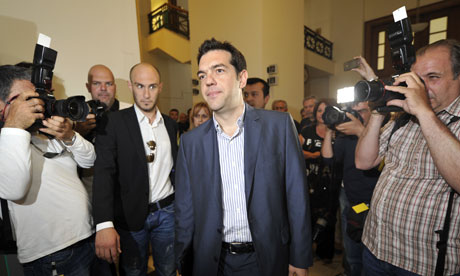
Greek elections: exit polls point to drubbing for major parties
New Democracy and Pasok see support drop dramatically, as voters turn to parties who had opposed austerity measures
Helena Smith in Athens Sunday 6 May 2012 14.06 EDT
Greeks vote in parliamentary elections. Link to this video
Governing parties backing EU-mandated austerity in Greece are on course for a major drubbing as hard-hit voters, venting their fury in elections, defected in droves, according to exit polls.
In a major upset that will not be welcomed by the crisis-plagued country's eurozone partners, the two forces that had agreed to enact unpopular belt-tightening in return for rescue funds appeared headed for a beating, with none being able to form a government.
After nearly 40 years of dominating the Greek political scene, the centre-right New Democracy and socialist Pasok saw support drop dramatically in favour of parties that had virulently opposed the tough austerity dictated by international creditors.
The latest figures showed New Democracy leading with between 19 – 20.5% of the vote, followed by the radical leftist party, Syriza, with as much as 17% and socialist party Pasok with between 13 – 14 %. And for the first time since the collapse of military rule, ultra-nationalists were also set to enter parliament with polls showing the neo-Nazi Chrysi Avgi (Golden Dawn) capturing as much as 8%.
With the nation wrestling its worst crisis in modern times, the big winner appeared to be Syriza, which had campaigned ardently against austerity and was poised to become the second biggest party in Athens's 300-seat House.
A Metron analysis poll showed the leftists gaining as much as 18.5%, more than the mainstream Pasok lead by former finance minister Evangelos Venizelos, who negotiated the latest €130bn (£105bn) loan agreement reached between Athens and the EU and IMF.
"That agreement now belongs to the past. It has been delegitimised," said Panaghiotis Lafazanis, a prominent Syriza MP. "Our strong showing sends a message especially to Europe that Greeks have rejected austerity."
Lafazanis said Syriza would keep to its pre-election pledge to form a government of "the united left" that would work to stop the fiscal remedies meted out to Athens by its EU partners.
The election, called by Lucas Papademos, the technocrat prime minister overseeing an emergency coalition for the past six months, is the most critical in decades. Not since the restoration of democracy in 1974 has so much been at stake, with politicians and analysts alike saying Greece's political stability and future in the eurozone would rest on the result.
The significance of the moment did not appear to be lost on Greeks. From early in the morning voters, many dressed in Sunday best, filed into the thousands of public schools serving as polling stations.
"I hope my vote will be for the good of my country," said Georgios Kladis, holding his grandson's hand. "Greece has to be governed. I hope that will be possible tomorrow."
Although elections are traditionally seen as a joyous affair, the pinnacle of democracy for a deeply politicised nation, volunteer lawyers working as election monitors in Athens reported voters as being in sombre mood. Many were said to have spent an "inordinately long time" in curtained-off booths before deciding which candidate to back.
Visibly moved, Fotis Kouvelis, who heads the small Democratic Left party, said: "We are voting to keep Greece alive and society intact."
"People are clearly troubled," observed Dimitris Anastasopoulos, a monitor at a polling station in one of the capital's leafy northern suburbs. "We've had some in booths for 10 minutes. It's got to the point where we've had to remind them there is a queue outside."
Pulling up at another polling station on his bicycle in shorts and sandals, Orestis Papadopoulos said he was excited to be among the 110,000 Greeks voting for the first time. "If you asked me whether I'd vote even a few months back I would have said 'bah, no way,'" he said. "But this is critical. First they put a pistol to our heads, now they're shoving it down our throats. All this austerity has been for nothing. It doesn't work. And I want to add my voice to those people saying 'no'."
Maria Stasini, 43, emerging from a polling station in central Athens, was also voting against the austerity measures. "It was a purely anti-austerity vote because all these measures have killed us," she said.
"My son has been unemployed for the past two years. He has sent out 400 emails and hasn't got even one reply.
"My husband is a plasterer and work for him has dropped by 80%. On top of everything, they pummel us with taxes," she said, adding she had been forced to close her restaurant last year.
"We were all New Democracy voters but how can we vote for them now when they, too, back such measures?"
Eurozone crisis: Greek left leader renounces bailout deal
Frontrunner to form a new government shocks financial markets with remarks over EU and IMF loan agreement
Alexis Tsipras, leader of Syriza, a coalition of left parties, said Athens commitment to secure rescue funds were null and void. Photograph: Louisa Gouliamaki/AFP
Helena Smith in Athens Tuesday 8 May 2012 14.45 EDT
The fate of Greece is, on Tuesday night, in the hands of the leader of a far-left party who launched the quest to form a government by declaring the country could no longer commit itself to the terms of an international loan agreement keeping its economy afloat.
After accepting a mandate to create a multi-party administration following inconclusive elections, Alexis Tsipras sent shockwaves through financial markets by announcing the pledges Athens had made to secure rescue funds from the EU and IMF were null and void.
"The popular verdict clearly renders the bailout deal null," the politician, whose stridently anti-austerity coalition of the radical left, known as Syriza, sprung the surprise of the weekend's poll, coming in second with 16.8% of the vote. "This is an historic moment for the left and the popular movement and a great responsibility for me."
With just three days in which to form a government that could fill the power vacuum that has emerged in Athens, Tsipras said he would begin by approaching other leftwing forces in an attempt to "end the agreements of subservience".
The signing of the loan had not been "a salvation but a tragedy", insisted Tsipras, who at 38 is Greece's youngest frontline politician. New Democracy and Pasok, the two parties that signed it – and until Sunday the dominant forces of Greek politics for the past four decades – should, he said, withdraw their support for the accord: "The pro-bailout parties no longer have a majority in parliament to vote in destructive measures for the Greek people. This is a very important victory for our society."
Tearing up the letters of guarantee they had given creditors would be evidence that "they [ND and Pasok] truly regret what they have done to the Greek people," he said before calling for a temporary halting of repayments of Greek debt.
Once brushed off as a lightweight, Tsipras has come into his own with the debt crisis with his fierce denunciations of the inequities of austerity. Syriza, as a result, is riding high on popular resentment about repeated waves of tax increases and pay and pension cuts. There are also hopes in Greece that the defeat of French president Nicolas Sarkozy by his Socialist rival, François Hollande, is a harbinger of an imminent shift away from austerity to development and growth in European policymaking.
"Greeks haven't become leftists overnight – the support for Syriza was about punishing the two main [pro-bailout] parties," said Haris Papasotiriou, professor of political science at Panteion University in Athens. "Greeks, however, are of the mind to give Tsipras a chance. Even if the room for manoeuvre is very tight, they believe he can get a better deal from the EU and IMF."
But finding the support to create an alliance will not be easy for Tsipras. Syriza, a coalition of ex-communists, Maoists, Trotskyists, socialists and greens, commands 52 seats in the 300-seat house under a complex electoral law that rewards the winner with a bonus 50 seats.
The centre-right New Democracy, whose efforts to form a government collapsed on Monday, clinched 18.9%, the largest share of the vote, but with just 108 members in parliament fell far short of a working majority.
, Tsipras's overtures were rebuffed out of hand by the hardline KKE communist party, with its secretary general, Aleka Papariga, refusing to even meet him. One of Europe's most dogmatic communist parties, with the hammer and sickle as its emblem, the KKE has never forgiven young reformists like Tsipras for rejecting orthodox Marxist-Leninist doctrine and embracing the spirit of glasnost.
However, Tsipras made headway with Fotis Kouvellis, the leader of the Democratic Left party, who said he would support "an anti-bailout coalition government" as long its objective was to keep Greece in the euro.
"On paper it might not look as if we can do it, as if the numbers don't add up, but we will approach all the parties [with the exception of the ultra-nationalist Chrysi Avgi] to see if they would be willing to endorse [if not participate in] such a government."
Alarm in EU capitals is growing, with Germany in particular emphasising that Greece must stick with the terms of the agreements it has signed with lenders who have committed themselves to give a total of €240bn to the crisis-hit country.
The prospect of protracted political instability has stoked fears that Greece is not just teetering on a political precipice but also laying the ground, however unwittingly, for its own euro exit.
Syriza MPs contend that the ultimatum "bailout or bankruptcy" has been overblown and is little more than a scare tactic used by the mainstream parties to whip up support for the "barbaric measures" outlined in the deeply unpopular fiscal adjustment programme that it entails.
Tsipras, whose casual demeanour belies a steely political backbone, told the Guardian on the eve of Sunday's vote: "We are not against the euro but we are opposed to the policies being pursued in the name of the euro."
"I hear that now, gone from protest party to possibly forming a government, they're reaching out in a big way to economists," said Papasotiriou. "I don't think they ever thought they would be in this position," he added. "But if, as looks likely, there are repeat elections, Syriza might even emerge with a better result as the first party."


 Market Data
  Markets


 AI
AI