Yup, WELCOME to EASTER ISLAND .. Hawaii, Easter Island, NZ form the 'Polynesian triangle' ..
Easter Island (Rapa Nui: Rapa Nui, Spanish: Isla de Pascua) is a Polynesian island in the southeastern Pacific Ocean, at the southeasternmost point of the Polynesian triangle. A special territory of Chile that was annexed in 1888, Easter Island is famous for its 887 extant monumental statues, called moai, created by the early Rapanui people. It is a World Heritage Site (as determined by UNESCO) with much of the island protected within Rapa Nui National Park. In recent times the island has served as a warning of the cultural and environmental dangers of overexploitation. Ethnographers and archaeologists also blame diseases carried by European colonizers and slave raiding of the 1860s for devastating the local peoples.
Easter Island is claimed to be the most remote inhabited island in the world. [.. some beautiful pictures ..]
A View of the Monuments of Easter Island, Rapanui, Oil on panel The first known painting of Easter Island in 1775 by William Hodges
Photo taken by Ian Sewell, July, 2006. Ahu Tongariki on Easter Island. These moai were restored in the 1990's by a Japanese research team after a cyclone knocked them over in the 1960's.
Rapa Nui National Park
View from the tip of the island. This is the island they used to swim to as part of the Birdman Cult. The islands are Motu Nui, Motu Iti and Motu Kao Kao - just off Cabo Te Manga. The last ceremonies took place in 1866.
Panorama of Anakena beach, Easter Island. The moai pictured here was the first to be raised back into place on its ahu in 1955 by islanders using the ancient method.
View toward the interior of the island
Tukuturi, an unusual bearded kneeling moai
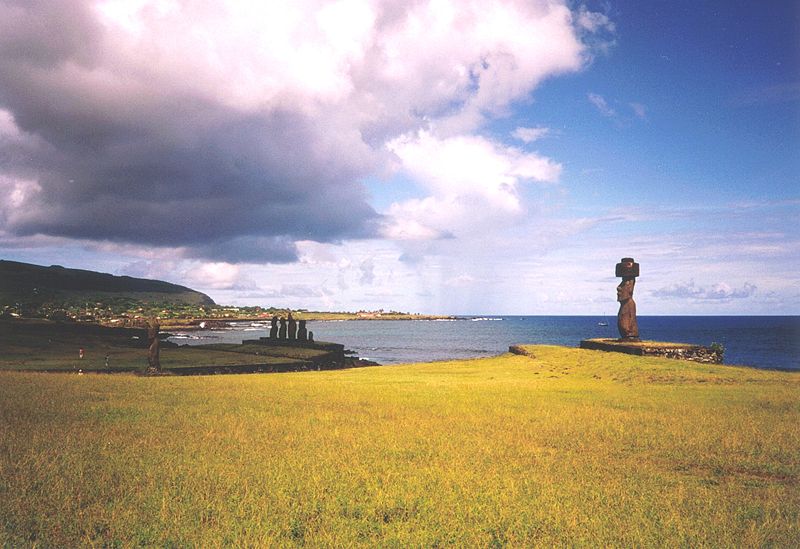
Two ahu at Hanga Roa. In foreground Ahu Ko Te Riku (with a pukao on its head). In the mid-ground is a side view of an ahu with five moai showing retaining wall, platform, ramp and pavement.


 Market Data
  Markets


 AI
AI