Australian Senator Condemns, Toll, Exploitation in USA
In the Australian Senate, an Australian Senator has just finished slamming, Toll, union busting in the USA. 'It is a blight on Toll executives in Australia to not afford workers in the USA work conditions and respect as they would get in Australia.' .. article starts ..
Company fires truck driver for taking emergency bathroom break—while supporting a union
Wed Mar 14, 2012 at 10:46 AM PDT by Laura ClawsonFollow for Daily Kos Labor
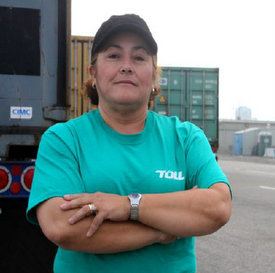
Xiomara Perez was fired for taking a bathroom break. (CleanandSafePorts.org)
It is illegal for a company to fire a worker for trying to join a union, but it happens all the time. The company doesn't admit that's the real reason for the firing, of course. It's just that coincidentally someone who's been an outspoken union supporter gets fired for a common practice that doesn't typically draw any disciplinary action, let alone firing. Companies do this because it removes a leader from the workplace and intimidates other workers who might support the union, and because the penalties for doing so are laughably small. So it's no coincidence that Xiomara Perez, who exactly fits that description, was targeted (PDF): .. http://grimtruthattollgroup.com/files/2012/03/Xiomara-Fired-2-pager.pdf ..
On Tuesday March 6th, Xiomara was driving to Rialto with a cargo load andbegan to feel slightly ill, thought she might throw up, and thus made an emergency detour. As a professional driver, Xiomara adheres to U.S. Department of Transportation regulations that require any hauler to pull over if they feel faint, fatigued, etc. – in other words, truckers must use their best judgment to protect their own safety, the public, and the merchandise they carry. She found a McDonald’s she was familiar with where she could freely use the restroom and get a sandwich to settle her stomach to continue her workday. She instantly felt better and got back on the road; the safety diversion took roughly 10 minutes at the most.
A male supervisor quickly questioned her, via radio, about why she had stopped; "Already feeling intimidated, and reluctant to disclose private information about her body functions to a male manager, she made an excuse in order to instead contact a female human resources supervisor." But when she got back to Toll after delivering her cargo, supervisors inspected her clothes and truck—apparently nothing less than vomit splattered all over would have justified her 10-minute bathroom break. Three days later:
Toll fired Xiomara, citing an unreasonably restrictive work policy prohibiting employees from stopping – even to use a restroom – when delivering a load. Xiomara had asked for the policy in writing but was denied. Many of her co-workers say it is common practice to stop to use the restroom...
Let the Toll Group know its truck drivers aren't the only ones who are outraged by this firing. Sign our petition calling on the Toll Group to reinstate Xiomara Perez, let truck drivers take bathroom breaks, and stop intimidating union supporters. .. http://campaigns.dailykos.com/p/dia/action/public/?action_KEY=89
Originally posted to Daily Kos Labor on Wed Mar 14, 2012 at 10:46 AM PDT. Also republished by Occupy Wall Street, ClassWarfare Newsletter: WallStreet VS Working Class Global Occupy movement, and Daily Kos.
Round One: American Truck Drivers v. Australian Transportation Giant
February 3, 2012
The first in a series of real-time dispatches, live updates and social media/video updates to assist LA workers achieve democracy in the workplace by monitoring and reporting Toll Group’s attempts to undermine their free and fair vote to unionize. [Check back or sign up here for instant alerts.]
Power at the Ports: Truckers Force Showdowns in Seattle, Los Angeles
A group of port workers in Los Angeles has filed for a rare union election, and another just ended a two-week strike that brought the Port of Seattle to a near standstill.
Continued from previous page
Workers who engage in collective action against their boss are always taking a risk, despite the legal protections for such actions on paper. But their status as “independent contractors” makes these drivers’ action that much more risky. What they had to protect them was not the law, but each other; the hope that involving enough people, and drawing enough attention and sympathy, would make it practically or politically unwieldy for management to sack them.


 Market Data
  Markets


 AI
AI