The pressure has to be getting to Santorum. He’s gone on the offensive drawing attention to the budding friendship between Romney and Rep. Ron Paul (TX), accusing the two of collaborating against him and even coordinating a Romney/Paul ticket.
For his part Paul laughed off .. http://livewire.talkingpointsmemo.com/entries/paul-denies-any-collaboration-with-romney .. Santorum’s claims noting the two don’t really agree on much. Except, of course, they do agree on quite a bit. Their positions on abortion, gay rights, immigration, labor laws and regulatory oversight are practically identical and really the only true places Paul veers away from Romney are on the gold standard and foreign policy.
But if Romney needs to patchwork a coalition in order to secure the nomination and the Christian conservatives have made it clear they’ll never vote for Romney, Paul with his third-place stash of delegates is Romney’s only choice. Of course there is collaboration, but whining about it doesn’t seem very presidential, which is more likely the reason the Paul and Romney camps are chuckling at this story–because Santorum is doing their work for them.
While on the topic of Christian crusades, Get ready for the contraception battle to gear back up. In anticipation of congressional debate over the Obama administration contraception rule Sen. Roy Blunt (R-MO) .. http://livewire.talkingpointsmemo.com/entries/blunt-writes-op-ed-insisting-birth-control-debate .. took the lead letting everyone know eradicating access to birth control is not about women, or women’s health, but about religious freedom. Of course. Religious freedom to subjugate women which your church may tolerate but our democracy does not.
Everybody else clear on the Santorum vision of the separation of church and state? Okay, let’s keep it handy for this next item. Mike Huckabee started chumming the waters .. http://thehill.com/blogs/ballot-box/presidential-races/212627-huckabee-not-ruling-out-2016-bid .. for a 2016 run, which shows the following: Republicans have no faith they can win in 2012 and 2016 is going to be a blood-bath of an election by comparison especially if we don’t get serious about campaign finance reform. Also, if we think the culture wars are hot now, just wait till the candidates include Huckabee and Gov. Mitch Daniels (R-IN) to start. I hate to say it, but they’re just really getting started.
THE BIG PICTURE: DELEGATE MATH. ABC's Rick Klein crunches the numbers: "With no one else able to boast of Romney's financial advantage and campaign infrastructure, precious few opportunities remain for his rivals to gain a foothold that would knock him off course. But this is where delegate math is not Romney's friend, not this year. The proportional allocation of delegates - as opposed to the winner-take-all format that dominated previous cycles - combines with a back-loaded calendar to leave virtually no chance for Romney to end the race quickly, unless his rivals cooperate. As of today, only 143 delegates have been awarded - barely 6 percent of the full complement of 2,286 who will be selected to cast ballots at the Republican National Convention. Fewer than 200 additional delegates are up for grabs through the remainder of February. And Super Tuesday isn't half as supersized as it was four years ago. At the end of the night March 6, only 820 of the 2286 delegates will have been awarded - less than 36 percent of the full total. What's more, the Super Tuesday states will be allocating delegates proportionally. The inclusion of several big southern states on that date would make a Romney sweep unlikely in any event. That means the only way to end the race early is for other candidates to drop out quickly." http://abcn.ws/zvbaV4 .. http://investorshub.advfn.com/boards/read_msg.aspx?message_id=71790621
======== .. sheeezzz, can't find one .. ok .. this covers it ..
Ron Paul quietly amassing an army of delegates while GOP frontrunners spar
Paul's tightly-organised campaign is racking up delegates even in states where he did poorly in the popular vote. It's all part of a complex system that could make Paul the election kingmaker.
Paul Harris in New York .. guardian.co.uk, Thursday 23 February 2012 20.59 GMT .. Comments (90)
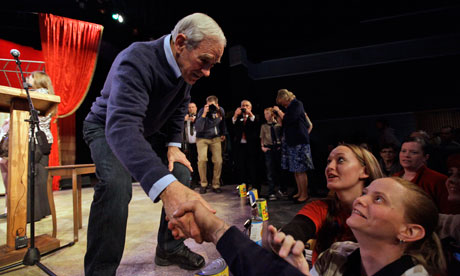
Ron Paul shakes hands with some of his young supporters at Twin Falls Senior High School in Idaho. Photograph: Marcio Jose Sanchez/AP
While the Republican nomination race is focused on the ongoing battle between frontrunners Mitt Romney and Rick Santorum, the Ron Paul .. http://www.guardian.co.uk/world/ronpaul .. campaign is waging an under-the-radar "delegate strategy" that could make the libertarian-leaning Texan the surprise kingmaker of the race.
In states that have already voted via a caucus system – rather than a straight primary ballot – Ron Paul supporters are conducting an intensively organised ground effort aimed at securing as many convention delegate slots as possible, often in numbers that far outweigh the number of actual votes that Paul got in the ballot.
If successful, it means Paul's campaign could arrive at the August Tampa convention at the head of an army of delegates far larger than the proportion of votes that it won during the nomination contest.
It could also increase the chances of a contested convention – where no candidate has enough delegates to declare the winner – as well as give Paul much greater ability to inject his beliefs into the Republicans' 2012 policy platform.
The strategy is based on the fact the GOP race is in fact a "delegate contest" despite an overwhelming focus by the media and most campaigns on "winning" individual states by coming top of the popular vote. But in reality, each state, weighted proportionally by population, sends a number of delegates to Tampa where a nominee is then chosen.
A total of 2,286 delegates are sent to Tampa and so a candidate must secure the support of 1,144 of them in order to win the nomination.
However, a bewilderingly complex set of rules, often varying from state to state, exists to actually assign these delegates. Ron Paul's campaign is seeking to work that system in order to maximise its delegate count.
So far signs are that the campaign is being so successful at its strategy that it may be able to "win" delegate counts in states where it did not win the popular vote.
"They will be able to perform well enough that in some states where they came in third or fourth in the straw poll, they will come in first or second in terms of the delegate totals. I am fairly confident in making that bet," said Professor Josh Putnam, a political scientist at Davidson College who runs the Frontloading HQ blog dedicated to tracking the delegate fight.
How the strategy works
The strategy works because of the varying ways each state assigns the delegates that get sent to Tampa. Some states hold a "winner takes all" primary that will assign all its delegates to the candidate who tops the vote.
Others assign delegates proportionally according to the vote, splitting the delegates roughly according to the results and ensuring each major candidate gets some delegates.
But it is in the caucus states that the Ron Paul campaign is focused. There the method of assigning delegates is complex and lasts a long time. In caucus states that have voted so far like Iowa, Nevada, Colorado, Minnesota and Maine, the process of assigning delegates in support of each candidate has barely begun.
That process begins on caucus night when each precinct votes and then chooses delegates to send to a county convention to be held later in the year. Those county conventions will then choose a smaller number of delegates to send to a state convention or conventions held in each state's congressional districts.
Those state and district level conventions are the bodies that actually finally choose which delegates to send to the Tampa national convention.
However, at the start of the process – the precinct level meetings held on caucus day – the delegates selected to go to the later county conventions are frequently under no obligation to declare which candidate they are supporting or to support the "winner" of the day's actual voting.
Ron Paul's campaign strategy is to get enough of his precinct-level supporters to volunteer to become delegates to the county conventions so that they outnumber other campaigns. "Their strategy is to gobble up as many of these slots as they can," said Putnam.
Then, if you manage to stack the beginning of the process with Ron Paul delegates, as the system moves through the county conventions and the district and state-wide conventions the chances of Ron Paul-supporting delegates emerging at the end and being chosen to go to Tampa is greatly increased.
The entire strategy is helped by the fact that Paul's supporters are seen as far more organised and dedicated than other campaigns.
Is it successful?
It is currently impossible to say. No caucus state that has already voted has yet held any county conventions at which an idea of the number of Ron Paul-supporting delegates chosen at the precinct level may emerge. Those first indications should come in March.
However, the Ron Paul campaign itself, which is at pains to point out their strategy is entirely within the rules, has released information from Colorado that shows how they hope it could be playing out.
In one precinct in Larimer County there were 13 delegate slots available. Santorum had won the precinct's vote by 23 votes to Paul's 13, with five votes going to Romney. But Paul supporters took all the delegate slots.
In a Delta County precinct all five delegate slots went to Paul supporters though he came behind Santorum and Romney in the popular vote. In a Pueblo County precinct Paul supporters got the two delegate slots available despite the fact Paul finished fourth in the precinct's vote with just two actual votes.
Those examples are likely cherry-picked by the Paul campaign as best case scenarios. But Colorado party officials are – officially, at least – sanguine about what is going on as it obeys the party rules. "We are just here to play out the process. Whatever happens happens," executive director of the Colorado GOP Chuck Poplstein told the Guardian.
But Poplstein did say a successful delegate strategy was not easy to pull off. "It is difficult for any campaign. You have to be very well organised and in all of the counties. It is not an easy process. You have to have a very good ground game," he said.
But that might not be too much of a problem. The Ron Paul campaign is highly organised and focused. "We are also seeing the same trends in Minnesota, Nevada and Iowa, and in Missouri as well," the campaign said in its statement on the precinct performances in Colorado.
A recent report by the Washington Post from a caucus in Portland, Maine, revealed a dedicated activist organisation complete with pre-printed lists of which delegates should be voted for at the precinct level. That is likely true across all the caucus states.
"They do tend to be very organised and very enthusiastic for Ron Paul," said Professor Tim Hagle, a political scientist at the University of Iowa.
What impact could it have?
The fact is that Paul's delegate strategy would have little impact in a normal Republican race. The system is set up with enough winner-take-all and primary states to ensure that Paul's strategy has no chance whatsoever of picking up enough delegates via this method to actually win the nomination himself.
But it all changes when the Republican race becomes protracted and closely fought. If Santorum, Romney and Newt Gingrich all stay in the race beyond Super Tuesday and start to amass their own large piles of delegates, then reaching the vital 1,144 delegates needed to win starts to become more difficult.
If that scenario plays out – something most experts see as possible but unlikely – then Paul's delegate total becomes crucial. He could become a kingmaker, agreeing to throw his hefty delegate total behind one candidate who could then claim victory.
As a candidate with a very clearly defined agenda – on foreign policy, the role of government and fiscal issues, especially the Federal Reserve – Paul could demand a high policy price for that support.
However, even if a nominee emerges prior to the convention, Paul's delegates will still be important. If he amasses a loyal and large delegate total he will able to secure a high-profile, possibly primetime, speaking slot.
He will also be more able to get his agenda into the party's official policy platform. Given Paul's stance on issues like American foreign policy and the wars in Afghanistan, that could upset the party elite and the nominee.
Modern conventions are supposed to be highly organised, tightly controlled displays of party unity. At the very least a successful Paul delegate strategy could shatter that prospect.
[.. the Pueblo Indians had a beautiful concept of religion, the gentlemen early on, says it well .. "all around" them .. "it is our religion" .. they greeted the Franciscan monks and expected to be treated in kind .. then .. we all know what happened to the trusting Indians ..... ]
Fri 24 Feb 2012, 8pm
Since the days when the Puritan 'city on a hill' beckoned on the horizon of the New World, religious faith and belief have forged America's ideals, moulded its identity and shaped its sense of mission at home and abroad.
Inside the tumultuous 400-year history of the intersection of religion and public life in America.
This six-part series examines how religious dissidents helped shape the American concept of religious liberty and the controversial evolution of that ideal in the nation's courts and political arena; how religious freedom and waves of new immigrants and religious revivals fuelled competition in the religious marketplace; how movements for social reform – from abolition to civil rights – galvanised men and women to put their faith into political action; and how religious faith influenced conflicts from the American Revolution to the Cold War.
Interweaving documentary footage, historical dramatisation and interviews with religious historians, the six-part series is narrated by actor Campbell Scott and includes appearances by actors Michael Emerson (as John Winthrop), Chris Sarandon (as Abraham Lincoln) and Keith David (as Frederick Douglass), among others.
"The American story cannot be fully understood without understanding the country's religious history," says series executive producer Michael Sullivan. "By examining that history, God in America will offer viewers a fresh, revealing and challenging portrait of the country."
As God in America unfolds, it reveals the deep roots of American religious identity in the universal quest for liberty and individualism – ideas that played out in the unlikely political union between Thomas Jefferson and defiant Baptists to oppose the established church in Virginia and that were later embraced by free-wheeling Methodists and maverick Presbyterians.
Catholic and Jewish immigrants battled for religious liberty and expanded its meaning. In their quest for social reform, movements as different as civil rights and the religious right found authority and energy in their religious faith. The fight to define religious liberty fuelled struggles between America's secular and religious cultures on issues from evolution to school prayer, and American individualism and the country's experiment in religious liberty were the engine that made America the most religiously diverse nation on earth.
Episode 1 - A New Adam
The first episode of God in America explores the origins of America's unique religious landscape – how the New World challenged and changed the faiths the first European settlers brought with them. In New Mexico, the spiritual rituals of the Pueblo Indians collided with the Catholic faith of Franciscan missionaries, ending in a bloody revolt.
In New England, Puritan leader John Winthrop faced-off against religious dissenters from within his own ranks. And a new message of spiritual rebirth from evangelical preachers like George Whitefield swept through the American colonies, upending traditional religious authority and kindling a rebellious spirit that converged with the political upheaval of the American Revolution.
Episode 2 - A New Eden
The second episode considers the origins of America's experiment in religious liberty, examining how the unlikely alliance between evangelical Baptists and enlightenment figures such as Thomas Jefferson forged a new concept of religious freedom. In the competitive religious marketplace unleashed by this freedom, upstart denominations raced ahead of traditional faiths and a new wave of religious revivals swept thousands of converts into the evangelical fold and inspired a new gospel of social reform. In a fierce political struggle, Catholic immigrants, led by New York Archbishop John Hughes, challenged Protestant domination of public schools and protested the daily classroom practice of reading from the King James Bible.
Episode 3 - A Nation Reborn
The third episode explores how religion suffused the Civil War. As slavery split the nation in two, Northern abolitionists and Southern slave-holders turned to the Bible to support their cause. Former slave and abolitionist Frederick Douglass condemned Christianity for sanctioning slavery. In the White House, Abraham Lincoln struggled to make sense of the war's carnage and the death of his young son. The president, who previously had put his faith in reason over revelation, embarked on a spiritual journey that transformed his ideas about God and the ultimate meaning of the war.
Episode 4 - A New Light
During the 19th century, the forces of modernity challenged traditional faith and drove a wedge between liberal and conservative believers. Bohemian immigrant Isaac Mayer Wise embraced change and established Reform Judaism in America while his opponents adhered to Old World traditions. In New York, Presbyterian biblical scholar Charles Briggs sought to wed his evangelical faith with modern biblical scholarship, leading to his trial for heresy. In the 1925 Scopes evolution trial, Christian fundamentalist William Jennings Bryan faced off against freethinker Clarence Darrow in a battle between scientific and religious truth.
Episode 5 - Soul of a Nation
Episode 5 explores the post-World War II era, when rising evangelist Billy Graham tried to inspire a religious revival that fused faith with patriotism in a Cold War battle with 'godless communism'. As Americans flocked in record numbers to houses of worship, non-believers and religious minorities appealed to the US Supreme Court to test the constitutionality of religious expression in public schools. And civil rights leader Martin Luther King Jr. emerged as a modern-day prophet, calling upon the nation to honour both biblical teachings and the founders' democratic ideals of equal justice.
Episode 6 - Of God and Caesar
The final episode of God in America brings the series into the present day, exploring the religious and political aspirations of conservative evangelicals' moral crusade over divisive social issues like abortion and gay marriage. Their embrace of presidential politics would end in disappointment and questions about the mixing of religion and politics.
Across America, the religious marketplace expanded as new waves of immigrants from Asia, the Middle East and Latin America made the United States the most religiously diverse nation on earth. In the 2008 presidential election, the re-emergence of a religious voice in the Democratic Party brought the country to a new plateau in its struggle to reconcile faith with politics. God in America closes with reflections on the role of faith in the public life of the country, from the ongoing quest for religious liberty to the enduring idea of America as the 'city on a hill' envisioned by the Puritans nearly 400 years ago.
Shucks .. missed the first episode last Friday .. oh well .. time really does slip by .. shucks .. did anyone here see it?
God in America, PBS: US TV review
PBS’s extraordinary six-hour documentary God in America is a dense, information-packed production spanning 400 years of the New World’s efforts to create its own brands of religion.
[sheeezzz, c'mon, Thor, you had your day .. i'm looking forward to it .. :)]
God in America, a co-production of the award winning shows American Experience and FRONTLINE, takes viewers from the mid-1600s to present times in explaining how Americans have always demanded and consequently developed their owns brands of religion and spirituality.
In a New World, religion would have a new face or more accurately, many new faces. Set against the gorgeous vistas of northern New Mexico, God in America opens with the first major struggle against state-enforced religion by the Spanish conquistadors and their priests.
In the mid-1660s, after 10 years of dealing with the Spanish Empire’s presence in North America, the Pueblo Indians became wary of the more than 40 Catholic churches that had been built on their land. The Indian “conversions” the priests so proudly reported were no more than polite observations or add-ons to the Pueblos who had been guided by their own spiritual traditions for more than 1000 years.
And when 45 of their leaders were jailed in Santa Fe as sorcerers, followed by the hanging of three and the public flogging of one, they decided to act. The 1680 Pueblo revolt left one-half of the priests murdered and within 10 days the Spaniards had fled.
Back in the eastern colony of Massachusetts, where Puritans sought to "purify" the Anglican Church, renegade Anne Hutchinson refused to accept the edicts of social conformity handed down by powerful Governor Winthrop. Even though she and her family were banished from the colony, her ideas about a one-to-one relationship with God that required no intermediaries or rituals were spreading like wildfire.
In 1740, Oxford student George Whitfield hit America’s preaching circuit with his rebirthing philosophy that would become known among Protestants as being born again. Protestant denominations flourished in America and Thomas Jefferson’s influence brought about the First Amendment to the US Constitution which abolished preferential government funding for any religion, now referred to as the separation of church and state.
In America, the individual’s power over his or her own religious experience signaled the end of the old aristocratic order and the rise of the voice of conscience against the state.
Using dramatic re-enactments, interviews with prominent religion scholars, documentary footage, and photographs, God in America goes on to look at how religious belief shaped the origins of the Civil War and President Abraham Lincoln’s actions. Later on, Rabbi Isaac Meyer Wise advocated a new reform Judaism that adopted ancient traditions to modern American culture. The battle over modernity peaked in the 1925 trial of John Scopes, a Dayton, Tennessee teacher arrested for teaching evolution.
In the post-war era, at the same time the Supreme Court handed down controversial decisions that required government actions to have secular purposes, new religious energy fueled the Cold War fight against “Godless Communism” and energised the Civil Rights movement.
The series ends with an exploration of the political aspirations of the religious right and the re-emergence of a religious voice in the Democratic Party.
God in America is a meticulous, thoughtful, and provocative production. It is a must-see for anyone who wants to understand the motivations and actions behind America’s relentless quest for religious freedom that began almost 400 years ago.
President Obama speaking to the National Governors Association at the White House. Doug Mills/The New York Times
By MICHAEL D. SHEAR February 27, 2012, 12:55 pm
President Obama did not mention Rick Santorum by name Monday morning, but it was pretty clear who he had in mind.
Three days after Mr. Santorum accused Mr. Obama of being a “snob” and of trying to “indoctrinate” young people by encouraging them to go to college, Mr. Obama responded.
“I have to make a point here,” Mr. Obama said during remarks to the nation’s governors at the White House. “When I speak about higher education, we are not just talking about a four-year degree.”
Mr. Obama, who has often talked about the need to encourage vocational training after high school, seemed to take issue with Mr. Santorum’s assertion that he, being Harvard-educated, wanted to “remake” students in his own image.
“We are talking about somebody going to a community college and getting trained for that manufacturing job that now is requiring someone walking through the door handling a million-dollar piece of equipment,” Mr. Obama said. “And they can’t go in there unless they have some basic training beyond what they received in high school.”
“We all want those jobs of the future,” he added. “So we are going to have to make sure that they are getting the education they need.”
In his comments last week, Mr. Santorum said that Mr. Obama’s efforts to get people to go to college were part of an effort to get them into “indoctrination mills” led by liberal professors.
“President Obama once said he wants everybody in America to go to college. What a snob,” Mr. Santorum said. “You’re good, decent men and women who go out and work hard every day and put their skills to tests that aren’t taught by some liberal college professor.”
Mr. Santorum reiterated that sentiment on ABC’s “This Week” program on Sunday.
“There are lot of people in this country that have no desire or no aspiration to go to college, because they have a different set of skills and desires and dreams that don’t include college,” Mr. Santorum said on the program. “And to sort of lay out there that somehow this should be everybody’s goal, I think, devalues the tremendous work” of people who don’t attend college.
In fact, the president has not called for everyone to attend a four-year college. In his first address to a joint session of Congress, Mr. Obama called on Americans to do more than just get a high school degree — but he did not urge everyone to go to college.
“I ask every American to commit to at least one year or more of higher education or career training,” Mr. Obama said in February 2009. “This can be community college or a four-year school; vocational training or an apprenticeship. But whatever the training may be, every American will need to get more than a high school diploma.”
Asked about that discrepancy on “This Week,” Mr. Santorum insisted that Mr. Obama had ulterior political motives in encouraging people to attend liberal colleges.
“Understand that we have some real problems at our college campuses with political correctness, with an ideology that is forced upon people who, you know, who may not agree with the politically correct left doctrine,” Mr. Santorum said.
But after Mr. Obama’s comments Monday morning, a spokeswoman for Mr. Santorum seemed to back away from the criticism of the president. Alice Stewart, the spokeswoman, said she was encouraged by Mr. Obama’s encouragement of trade or vocational schools
“We’re glad that the president clarified that after Rick pointed that out,” Ms. Stewart said on MSNBC. “That’s exactly what Rick was saying.”
Rick Santorum addresses the Livonia/Farmington Chamber of Commerce Breakfast at St. Mary’s Cultural & Banquet Center in Livonia, Michigan USA on 27 February 2012. Jeff Kowalsky/European Pressphoto Agency
By DAVID FIRESTONE February 27, 2012, 1:14 pm
DETROIT – Rick Santorum opened a new beachhead in the culture wars over the weekend with one of the stranger positions in what passes for conservatism in the Republican Party these days – arguing for a reduction in the number of people who seek higher education.
Mr. Santorum called President Obama “a snob” [ http://thecaucus.blogs.nytimes.com/2012/02/26/santorum-says-religion-and-conservative-principles-are-at-risk/ (the sixth item in the post to which this is a reply)] for urging students to go to college. Why is the president exerting so much pressure, he asked, campaigning here in Michigan in advance of Tuesday’s primary, when some people don’t want to attend, or lack the skills to succeed?
To make this a national goal, he said on ABC’s This Week [ http://abcnews.go.com/Politics/week-transcript-rick-santorum/story?id=15785514&singlePage=true ], “devalues the tremendous work that people who, frankly, don’t go to college and don’t want to go to college because they have a lot of other talents and skills that, frankly, college — you know, four-year colleges may not be able to assist them.” (It’s doubtful that any college could assist that sentence.)
Actually, President Obama has been encouraging students to attend community colleges to pick up specialized skills that companies need. But that’s quibbling. Throughout his term, he has indeed encouraged all students to strive for some form of higher education, whether a year or a graduate degree, and has pushed to make college more affordable.
On Monday morning, the president told the National Governors Association that “we can’t allow higher education to be a luxury in this country” and that college shouldn’t “be a partisan issue.” The research strongly suggests [ http://www.bls.gov/emp/ep_chart_001.htm ] that studying after high school improves the chances of finding a job, and of making more money.
Is Mr. Santorum really saying that the president is somehow sneering at those who don’t go to college? Is he upset about the hurt feelings of those who go to air conditioning school instead?
As it turns out, Mr. Santorum is concerned that conservative students who attend a four-year college will emerge fully indoctrinated as liberals. He even called colleges “indoctrination mills.”
“Oh, I understand why he wants you to go to college,” Mr. Santorum said. “He wants to remake you in his image.”
Mr. Santorum apparently sees students as easy prey to bearded professors and their dangerous ideas, but all ideas are subject to challenge in college. Some students may emerge more liberal, others more libertarian or conservative; some may lose their faith, or adopt a different one.
When his brand of ideas is put to the test, Mr. Santorum seems worried it might not hold up. If this new rant represents the current quality of conservative thinking, he is right to be worried.
By: Jenée Desmond-Harris | Posted: February 27, 2012
Education is one of those things, like creating jobs, that everyone agrees is a good thing. At least that's what we though until this weekend when Rick Santorum told a tea party group in Michigan that Obama is a “snob” because he wants “everybody in America to go to college."
No, we're not making this up.
“Not all folks are gifted in the same way,” Santorum told a crowd in Troy, Michigan. “Some people have incredible gifts with their hands. Some people have incredible gifts and ... want to work out there making things. President Obama once said he wants everybody in America to go to college. What a snob.”
And here's his theory about the President's true agenda: "Oh, I understand why he wants you to go to college. He wants to remake you in his image. I want to create jobs so people can remake their children into their image, not his,” Santorum said [ http://www.youtube.com/watch?v=GSn3YL1hZOU (embedded)].
Without mentioning Santorum by name or specifically addressing the bizarre personal attacks, President Obama returned to the issue in remarks to the National Governor's Association:
“When I talk of higher education, I’m not only talking about four-year degrees,” Obama said. “I’m also talking about going to community college to get a degree for a manufacturing job where you have to walk through the door to handle a million dollar piece of equipment.”
He added: “We all want Americans to get those jobs of the future. We need to make sure they get the education they need.”
By Brooks Jackson, FactCheck.org February 27, 2012
Rick Santorum misrepresented what John F. Kennedy said in 1960 about church-state separation. According to Santorum, Kennedy said that religious people could "have no role in the public square" and "should not be permitted . . . to influence public policy." But Kennedy didn't say those things. He said he wouldn't take orders from the Vatican if elected president.
Santorum, ABC's This Week: I don't believe in an America where the separation of church and state is absolute. The idea that the church can have no influence or no involvement in the operation of the state is absolutely antithetical to the objectives and vision of our country.
. . . Kennedy for the first time articulated the vision saying, no, faith is not allowed in the public square. I will keep it separate. Go on and read the speech. I will have nothing to do with faith. I won't consult with people of faith. . . . [T]o say that people of faith have no role in the public square? You bet that makes you throw up.
Santorum, NBC's Meet the Press: That is not the founders' vision. That's not the America that was made the greatest country in the history of the world. The idea that people of faith should not be permitted in the public square to influence public policy is antithetical to the First Amendment, which says the free exercise of religion —James Madison called people of faith, and by the way no faith and different faith — the ability to come in the public square with diverse opinions, motivated by a variety of different ideas and passions, the perfect remedy. Why — because everybody is allowed in.
It's true that in his famous address to the Greater Houston Ministerial Association [ http://www.americanrhetoric.com/speeches/jfkhoustonministers.html (full video and transcript of the speech in the post to which this is a reply)] on Sept. 12, 1960, Kennedy stated his belief in an "absolute" separation. But Santorum reads into that speech things that Kennedy did not actually say.
Kennedy, who was then the Democratic nominee for president, was assuring Protestant ministers that he would not be taking orders from the Vatican should become the first Catholic to be elected to the White House.
Kennedy, Sept. 12, 1960: I believe in an America where the separation of church and state is absolute; where no Catholic prelate would tell the president — should he be Catholic — how to act, and no Protestant minister would tell his parishioners for whom to vote; where no church or church school is granted any public funds or political preference, and where no man is denied public office merely because his religion differs from the president who might appoint him, or the people who might elect him.
But in his speech — and in his answers to several questions and answers that followed — he referred to the church "hierarchy" and the Pope, and church doctrine. He never said that religious people could not voice their opinions. We find nothing in Kennedy's words that could be reasonably construed to say that Kennedy would not "consult with people of faith," as Santorum claimed.
To the contrary, Kennedy made clear his support for "religious liberty" and said he wanted the president to be "responsible to all."
Kennedy: I would not look with favor upon a president working to subvert the first amendment's guarantees of religious liberty; nor would our system of checks and balances permit him to do so. . . .
I want a chief executive whose public acts are responsible to all and obligated to none, who can attend any ceremony, service, or dinner his office may appropriately require of him to fulfill; and whose fulfillment of his presidential office is not limited or conditioned by any religious oath, ritual, or obligation.
For example, in an exchange that starts at about 28:08 on the C-Span recording, Kennedy was asked whether the Catholic Church had a right and "privilege" to "direct" members in areas including "the political realm."
Question: [W]hat we would like to know, if you are elected president, and your church elects to use that privilege and obligation, what your response will be under those circumstances.
Kennedy: If my church attempted to influence me in a way which was improper, or which affected adversely my responsibility as a public servant sworn to uphold the Constitution, then I would reply to them this was an improper action on their part; it was one to which I could not subscribe; that I was opposed to it. It would be an unfortunate breach of, an interference with the American political system.
At another point, Kennedy was asked (starting at about 33:40 on the C-Span recording) about a statement attributed to Pope John XXIII, that "the Catholic hierarchy has the right and duty of guiding" Catholics "to the common aid."
Kennedy: Guiding them in what area? If you are talking about in the area of faith and morals, and the instructions of the Church, I would think any Baptist minister or Congregational minister has the right and duty to try to guide his flock. If you mean by that statement that the Pope or anyone else could bind me in the fulfillment, by a statement in the fulfillment of my public duties, I say no. … It all has to do with what you mean by 'guide.'
But none of the ministers asked Kennedy if he meant that "faith is not allowed in the public square" or that he "won't consult with people of faith," the assertions that Santorum now puts in Kennedy's mouth. Kennedy didn't say those things, and if any of the ministers who were present in 1960 thought that's what he meant, none of them said so at the time.
After Louisiana Win 5 of the Top 6 Porn Consuming Red States Have Voted For Rick Santorum
By: Jason Easley March 24, 2012
With his win in Louisiana tonight, 5 of the top 6 pornography consuming red states that have voted in 2012 have supported Rick Santorum.
According to a 2009 study by Benjamin G. Edelman .. http://people.hbs.edu/bedelman/papers/redlightstates.pdf .. eight of the top ten pornography consuming states are Red States. Of these top eight six have now voted in the Republican 2012 primary, and Rick Santorum has won five of them. Santorum has won in the third (Mississippi), fifth (Oklahoma), sixth (Arkansas), seventh (North Dakota), and eighth (Louisiana). Mitt Romney can take comfort in knowing that he has won the second (Alaska), and he is a lock to win number one (Utah). West Virginia has yet to vote, but one could easily see Mountaineer State supporting Rick Santorum.
Besides the fact, that this demonstrated how self-deluded some red state Republicans really can be, this is also another potential example of voters voting against their own self-interest. What we have here are a group of conservative states that consume a great deal of pornography, yet they ended up supporting the one candidate in the primary who has all but promised to take away their porn. .. http://www.politicususa.com/rick-santorum-ban-porn-facts/
Maybe these conservatives know that they are addicted to the stuff, and the only way they are ever going to kick the cyber nudie horse is if big government in the form of Rick Santorum and his purity crusade saves them? That’s possible, but a more likely scenario is that many of these conservatives who adore their adult entertainment are voting for Rick Santorum for the same reason that they go to church.
They see it as the right thing to do.
These male Republicans don’t see a conflict between their moral beliefs and their porn, which makes them hypocrites of the highest degree. In private they are watching who knows what, which is their right at least until Rick Santorum takes office thanks to their support, but in public they have to present the image of the God fearing Christian. When Election Day hits their state, they pull up their pants, shut off the laptop and with a hymn on their lips and a Hallelujah in their heart; they cast their ballot for Rick Santorum.
Perhaps these voters know that Santorum has no chance of winning, so they vote for him as one last chance to stick a thumb in Mitt Romney’s eye before they have to hold their nose and vote for him in November?
Political Scientists are always trying to measure and predict human political behavior with complicated mathematical formulas and numbers, but voters are irrational and unpredictable. When push comes to shove, red state voters would rather vote for Rick Santorum and keep up their good Christian image than publicly out themselves and their love of Internet porn.