Oh well .. back to the other FULL COURT PRESS .. sigh ..
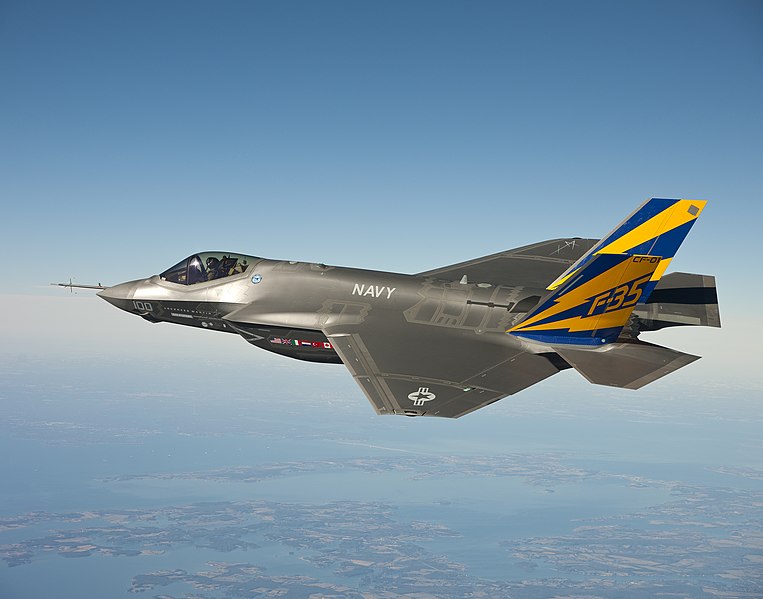
The U.S. Navy variant of the F-35 Joint Strike Fighter, the F-35C, conducts a test flight over the Chesapeake Bay. Lt. Cmdr. Eric "Magic" Buus flew the F-35C for two hours, checking instruments that will measure structural loads on the airframe during flight maneuvers. The F-35C is distinct from the F-35A and F-35B variants with larger wing surfaces and reinforced landing gear for greater control when operating in the demanding carrier take-off and landing environment.
The Lockheed Martin F-35 Lightning II is a family of single-seat, single-engine, fifth generation multirole fighters under development to perform ground attack, reconnaissance, and air defense missions with stealth capability. The F-35 has three main models; one is a conventional takeoff and landing variant, the second is a short take off and vertical-landing variant, and the third is a carrier-based variant.
The F-35 is descended from the X-35, the product of the Joint Strike Fighter (JSF) program. JSF development is being principally funded by the United States, with the United Kingdom and other partner governments providing additional funding. The partner nations are either NATO members or close U.S. allies. It is being designed and built by an aerospace industry team led by Lockheed Martin. The F-35 took its first flight on 15 December 2006.
The United States intends to buy a total of 2,443 aircraft for an estimated US$323 billion, making it the most expensive defense program ever. The United States Air Force (USAF) budget data in 2010, along with other sources, projects the F-35 to have a flyaway cost from US$89 million to US$200 million over the planned production of F-35s. Cost estimates have risen to $382 billion for 2,443 aircraft, at an average of $156 million each. The rising program cost estimates have cast doubt on the actual number to be produced for the U.S. In January 2011, the F-35B variant was placed on "probation" for two years because of development problems. In February 2011, the Pentagon put a price of $207.6 million for each of the 32 aircraft to be acquired in FY2012, rising to $304.15 million ($9,732.8/32) if its share of RDT&E spending is included.
[...]
Procurement and international participation
Participant nations:
Primary customer: United States Level 1 partner: United Kingdom Level 2 partners: Italy and the Netherlands Level 3 partners: Australia, Canada, Denmark, Norway, and Turkey Security Cooperative Participants: Israel and Singapore
While the United States is the primary customer and financial backer, the United Kingdom, Italy, the Netherlands, Canada, Turkey, Australia, Norway and Denmark have agreed to contribute US$4.375 billion toward the development costs of the program. Total development costs are estimated at more than US$40 billion (underwritten largely by the United States), while the purchase of an estimated 2,400 aircraft is expected to cost an additional US$200 billion. The nine major partner nations plan to acquire over 3,100 F-35s through 2035.
There are three levels of international participation. The levels generally reflect the financial stake in the program, the amount of technology transfer and subcontracts open for bid by national companies, and the order in which countries can obtain production aircraft. The United Kingdom is the sole "Level 1" partner, contributing US$2.5 billion, which was about 10% of the planned development costs under the 1995 Memorandum of Understanding that brought the UK into the project. Level 2 partners are Italy, which is contributing US$1 billion; and the Netherlands, US$800 million. Level 3 partners are Turkey, US$195 million; Canada, US$160 million; Australia, US$144 million; Norway, US$122 million and Denmark, US$110 million. Israel and Singapore have joined as Security Cooperative Participants (SCP). Japan announced on 20 December 2011 its intent to purchase 42 F-35s with deliveries beginning in 2016 to replace F-4 Phantom II aircraft. The country wants at least 38 of the F-35s to be assembled in Japan.


 Market Data
  Markets


 AI
AI