hookrider .. AHA! The Definition of a Vietnam Era Veteran
By Bob Hanafin, Staff Writer
A "Vietnam Era" Veteran is defined as any Veteran who served during the official time frame of the Vietnam War anywhere in the world as defined by Congress and the Department of Veterans Affairs.
I would assume that even National Guard members who have achieved official Veterans status as defined by the VA would be considered Vietnam Era Veterans.
I’m basically familiar with this, because most of the VA benefits I applied for and got when I served during the war were because I was a Vietnam Era Vet. However, I know that Congress passed a law in 1996 just after I retired from the Pentagon that changed the definition as it applied to those who served in-country Vietnam proper, and those Veterans who served elsewhere. The time frames are different. .. continued .. http://www.veteranstoday.com/2009/07/28/the-definition-of-a-vietnam-era-veteran/
LOL .. like OUR time frames .. earlier i missed the significance of this bit .. The U.S. government officially refers to all as "Vietnam era veterans" .. at the end of the 2nd paragraph here .. http://en.wikipedia.org/wiki/Vietnam_veteran ..
On your two meetings, which would have been interesting .. heh, i'd have mixed feelings .. :)
NOW, WOW! .. this IS a LONG one, difficult for me to even skim, finally found him .. small intro .. this oops, :( , with 'one of those things' sadly with fatal consequence .. about 2.7cm down ..
"The initial deployment to Vietnam got off on the wrong foot. The first two B-57Bs to land collided with each other on the ground and blocked the runway at Bien Hoa, forcing the rest of the flight to divert to Tan Son Nhut Airport on the other side of Saigon. One of the B-57Bs dived into the ground during approach at Tan Son Nhut and was destroyed, killing both crew members."
HA! .. more intro first because some of it, for me, was good to read .. at about 4.2cm ..
The following is from The Role of Airpower in Viet-Nam .. http://www.au.af.mil/au/awc/awcgate/vietnam/mcconn1.htm .. by Gen John P. McConnell, Chief of Staff, U.S. Air Force, in an address before the Dallas Council on World Affairs, Dallas, Texas, 16 September 1965. [NOTE: for original white, bold is substituted here and below, no meaning except for the obvious] The idea of nuclear umbrella seems antiquated now and the "wishful thinking" in the speech is self-evident. But in 1965, this message to most people was reasonable.
Strategic Aerospacepower in Viet-Nam?
The question has been raised why we are not using this powerful strategic capability to force an end to the war in Viet-Nam. There can be no doubt that we could destroy all of North Viet-Nam virtually overnight. But while this might end the war in Viet-Nam, it could easily spark a general nuclear war—the very contingency we are determined to avoid and deter. Moreover, such drastic action is neither necessary nor in accord with the declared intentions and policies of this country.
Our policies in this respect were spelled out by President Johnson in his historic address at Johns Hopkins University last April when he declared: "We have no desire to devastate that which the people of North Viet-Nam have built with toil and sacrifice. We will use our power with restraint and with all the wisdom that we can command. But we will use it."
And use it we do, but only to the extent necessary to achieve our declared aims. Toward this end, our strategic capability is utilized in two ways. First, our full nuclear strategic capability must continue to act as a deterrent, that is, provide us freedom of action in taking whatever military measures are required in Viet-Nam without risking escalation into nuclear war. Second, our conventional strategic capability is being applied, as the President said, with restraint and discrimination until the rulers of North Viet-Nam become persuaded to agree to negotiations on an equitable basis. That point will be reached when these rulers recognize that the price of continued aggression is higher than they are willing and prepared to pay.
It is evident, therefore, that the principle of "strategic persuasion" is not meant to achieve total military victory, as all-out strategic airpower helped to achieve in World War II. Rather, it is designed solely as an instrument of foreign policy for the attainment of a diplomatic objective. The great advantage of such strategic persuasion lies in its flexibility. Under the protection of the nuclear umbrella, its pressure can be increased in measured steps, as may be necessary, while still being kept well below the level uncontrollable escalation. By the same token, the pressure can be decreased if warranted by a reduction in the intensity of the enemy's aggressive actions, as Secretary of Defense McNamara indicated in a TV interview a few weeks ago. Finally, the pressure can be discontinued altogether at any time if it has achieved its purpose or if such action is expected to foster its achievement.
There are indications that this measured application of the principle of "strategic persuasion" in Viet-Nam is beginning to take effect. This is not surprising if it is realized that, in the past six months, South Vietnamese and U.S. aircraft have flown over 15,000 sorties against carefully selected targets in North Viet-Nam and dropped more than 14,000 tons of bombs on them.
The targets included primarily lines of communication and military facilities such as bridges, railroads, highways, barracks, ammunition depots, radar sites and the like. Most of the targets in North Viet-Nam were attacked for the added or principal purpose of helping to impede the flow of reinforcements and supplies to the Viet Cong in South Viet-Nam. And this brings me to the second new area of aerial operations in that war, namely, the use of airpower against guerrillas.
Use of Aerospacepower Against Guerrillas
Offhand, it may seem futile to employ airpower in trying to combat extensive guerrilla activities, especially under conditions as they exist in Viet-Nam. There are no well defined fronts; virtually all of South Viet-Nam is the battlefield and combat operations shift rapidly and unpredictably from one locale to the other. Hiding in the jungle or mixing with the civilian population, the Viet Cong normally strike in relatively small numbers and whenever they have the advantage of surprise.
Moreover, the Viet-Cong continue to receive sizable reinforcements and an incessant flow of materiel from the Hanoi regime. Deputy Secretary of Defense Cyrus Vance stated in a talk a few months ago that the bulk of the Viet Cong weapons—at least 60 to 70 percent, including almost all the heavy and modern weapons—come from external communist sources. But therein lies also one weakness of the Viet Cong which airpower is well suited to exploit, and that is through what is known as "interdiction" or attacks against the lines, means and sources of supply.
As you will remember, our initial aerial interdiction effort was limited to targets in South Viet-Nam in the hope that the conflict could be kept at the lowest possible level of intensity. But in granting the North Vietnamese a sanctuary where they could safely collect and store any amount of supplies for the Viet Cong guerrillas, we found ourselves in the same position as a narcotics squad that is trying to smash a dope ring by going after the pushers but has no warrant to enter the ring headquarters from where the pushers are directed and supplied.
When we began striking targets in North Viet-Nam last February, we not only added greatly to the effectiveness of our efforts to impede the flow of supplies to the guerrillas but we also made it increasingly costly for the North Vietnamese to engage in the provision of these supplies. A bridge and a highway which carry a flow of military supplies to the guerrillas in the South, normally serve local needs also, and when they are destroyed as interdiction targets, all other traffic is disrupted at the same time. This is the direct price which we are now exacting from the North Vietnamese themselves for their active support of the guerrillas in South Viet-Nam.
There can be no doubt that aerial interdiction, in combination with naval surveillance of the sea supply routes, has greatly reduced the support which the Viet Cong are receiving from the outside and that it will have an increasing impact on their guerrilla operations throughout the remainder of the war. But because of geographic conditions, these actions cannot cut off outside support entirely; they can only reduce it and make it more costly. Nor is reduction of outside support sufficient, by itself, to defeat the guerrillas because they will continue to capture weapons and ammunition and to take whatever else they need from the civilian populace.
BINGO! GOT HIM! ..
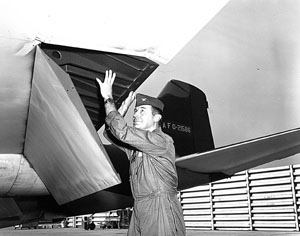
Left: Col. Yeager [my emphasis] preflighting his B-57 prior to taking off from Bien Hoa Air Base, South Vietnam, September 1966.
Right: A B-57 from one of Yeager's squadrons flying over Phan Rang Air Base, South Vietnam.
Col. Chuck Yeager "took command of the 405th Fighter Wing. With his headquarters at Clark Air Base in the Philippines, Yeager commanded five squadrons and detachments scattered across Southeast Asia: two tactical bomber squadrons flying B-57s out of Clark and Phan Rang Air Base in South Vietnam ... Yeager made an effort to visit and fly with each of these units once every 10-12 days. Flying primarily close air support and interdiction missions in a B-57, he added 127 flights and 414 hours to his combat record." (Bud Anderson: Yeager Display)
.. next (nice coincidence) ..
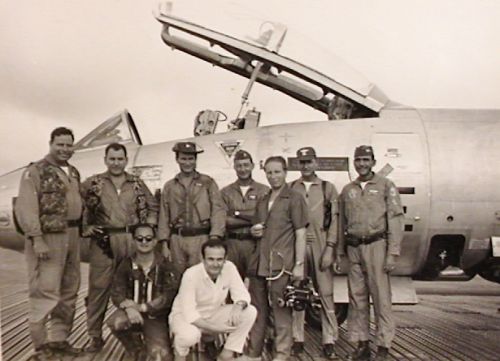
Canberra.org: Vietnam .. http://www.b-57canberra.org/vietnam.htm .. has a picture of a crew that was one of the first in Vietnam. However, if you look at the hats closely, you'll see the second man from the right in the rear row (Ken Blackwell) is wearing the 8th Bomb Squadron Liberty eagle hat.
(photo courtesy of Ken Blackwell) These men were among the very first to see action in Vietnam in the Doom Pussy Squadron. They have been identified as: Back Row "Smash" Chandler; (Bear?) "Nails" Nelson; Ed Cook; Jerry Russell; Ken Blackwell; and Bill Breedlove. The others are unidentified and believed to be photographers who wanted to "go on a combat mission".


 Market Data
  Markets


 AI
AI