Pakistan must end its policy of killings and kidnappings of Baloch people and recognise the importance of the region.
Last Modified: 15 Jan 2012 12:08
Despite Balochistan's rich cultural history and plentiful natural resources, Pakistan's government continues daily harassment and killings that are causing the people to think about independence [GALLO/GETTY]
Washington, DC - The behaviour of the powerful elite of Islamabad reminds me of the captain and crew of the RMS Titanic sailing into the night, heading straight towards an iceberg. The civilian, military and judicial authorities are locked up in a tussle coloured by political positions and personal egos. And there is a dangerous disconnect between Islamabad and the enormous problems that loom on the Pakistani horizon.
Law and order appears to have collapsed in many parts of the country. In the north-east, the former Frontier Province, there are daily killings as suicide bombers and the army continuously fight each other. Unemployment is widespread and inflation is sky-high. And there is still a desperate shortage of electricity and gas in much of the country.
But perhaps none of these problems is more pressing than the situation in Balochistan. If the simmering, but widespread movement for independence spins out of control, Pakistan will find it almost impossible to maintain nationhood.
I was reminded of Balochistan by the recent visit of Malik Siraj Akbar to my office. It made me happy to think back to my associations with its people and places, but I also became distressed as I thought of the current situation: a climate of killings and so-called "disappearances".
In his late twenties, Malik comes from Makran and was born in its northern town, Panjgur. His sharp intelligence, awareness of the world and passionate arguments for his people reminded me of all the people I met in Makran as Commissioner when I was posted there in the mid-1980s.
On arrival, what struck me was the resilience and faith of the Baloch, in spite of the widespread poverty and lack of economic development. Even after decades of the country's existence, Pakistan - it seemed - had done very little for the Baloch. There were only five miles of paved road in Makran - from the Commissioner's house, in Turbat, to the tiny airport. Flights were irregular and the telephone lines to the rest of the country were frequently out of order.
A land of honour
But I found it a fascinating experience: the people were welcoming and the area was redolent of history. Makran was, after all, where Alexander the Great got lost on his way to Persia after his battles in India. Over time, I had the privilege of meeting and getting to know legendary Baloch leaders such as Nawab Akbar Bugti, Mir Ghaus Bukh Bizenjo, Jam Ghulam Qadir and Mir Jafar Khan Jamali. From them, I learned that there was a time when a woman wearing gold ornaments could travel from the north of Balochistan to the south and not be molested.
"There was honour," they said, "in the land."
Nawab Bugti discussed Ibn Khaldun and the cyclical patterns of tribal society with me over dinner in his ancestral home in the Bugti Agency. He told me that Ibn Khaldun had kept him company when he was jailed by Pakistani authorities in Sahiwal. I often wondered how many Pakistanis belonging to the power elite had even heard of the Arab historian.
I grew to appreciate and admire the Baloch. I knew it was most important to deal with them on the basis of honour. In turn, they reciprocated my sentiments and I was posted as Commissioner of three divisions consecutively. Even the imperial British acknowledged that the key to dealing with the Baloch was honour. Not surprisingly, the Baloch complain that Pakistani officials treat them worse than the imperial British.
Malik, who has been a professional journalist all his life, has recently been given political asylum in the United States. Various threats and messages convinced him his life was in danger. He talks passionately and movingly of the hundreds of Baloch who have been brutally killed by the security agencies.
The policy of "kill and dump" is causing fear and terror among the Baloch.
"One chilling message engraved with a knife on the chest of a corpse said, 'Eid gift for Baloch'."
He claims there is a systematic policy to eliminate the "cream of the Baloch professionals". He lists names and professions with depressing accuracy - professors of medicine, scholars of Baloch history and, of course, numerous journalists.
"At least eight of my Baloch journalist friends have been killed over the past year," he said. Some had disappeared - until their mutilated, bullet-riddled bodies were found.
Cultural onslaught
The Baloch are angry not only at the killing of their intellectual and professional elite, but at what appears to be a wider, deliberate cultural onslaught. Security personnel, invariably non-Baloch, insult the Baloch at checkpoints by cutting off the shalwar, or baggy pants. More worryingly, Baloch corpses of those who have mysteriously disappeared are routinely found mutilated and desecrated. One chilling message engraved with a knife on the chest of a corpse said, "Eid gift for Baloch."
Nawab Bugti's brutal and senseless murder gave the Baloch independence movement a second wind [EPA]
The brutal and senseless murder of Nawab Bugti .. http://tribune.com.pk/story/297922/akbar-bugti-death-balochistan-issues-arrest-warrants-for-musharraf-aziz/ .. and the deliberate insult to his corpse by President Pervez Musharraf acted as a catalyst in Balochistan. It gave the Baloch independence movement a much needed second wind - the Baloch now had a legitimate martyr for their cause. Paradoxically, Malik points out, Nawab was one of the few advocates for a united Pakistan.
Islamabad has always underestimated, and therefore mismanaged, those living on the periphery. Islamabad tends to dismiss Balochistan because of its tiny population - about eight million of Pakistan's total 180 million people. There is also the prism of racial and cultural arrogance through which the Baloch are seen. Then there is sheer ignorance: the rich culture and traditions of the Baloch are generally not known in Pakistan.
Those who do not learn from the lessons of history, it is said, are doomed to repeat it.
In a different context, but one which illuminates the Balochistan situation, Islamabad's treatment of East Pakistan cost it half the country in terms of population. The colossal blunders and arrogance of the power elite of Islamabad and the tragic killings of 1971 led to the creation of Bangladesh.
"The Baloch must be made to feel an integral part of the federation; they need to be treated with honour and dignity"
Pakistanis seem to forget that Balochistan may only have a tiny population - but comprises 44 per cent of Pakistan's land territory. They forget it has vast natural resources and hundreds of miles of sea coast which make it a key geopolitical area. While Balochistan can survive without Pakistan, it is Pakistan that simply cannot survive without Balochistan.
Time is running out
Everything, therefore, must be done to resolve the civil war situation in that province. The stakes are too high for Pakistan. The power elite, obsessed with the place intrigue involving the sordid "Memogate" affair, needs to focus its attention on Balochistan.
Prime Minister Yousuf Reza Gilani and General Ashfaq Parvez Kayani, head of the army, need to fly to Balochistan together and, setting aside personal egos for the sake of the country, apologise to the people of Balochistan for the grievances they have suffered. They must promise a new beginning and radical shift in Pakistan's strategy for the Baloch. The Baloch must be made to feel an integral part of the federation; they need to be treated with honour and dignity.
This initiative should have been taken after the disastrous actions of Musharraf in Balochistan. Muddling through is no longer an option - time is running out for Pakistan.
Perhaps these Pakistani leaders, no doubt both patriotic in their own ways, need to ask themselves what the great MA Jinnah, the founder of Pakistan, would have done in a similar situation. Jinnah would have met the people of Balochistan and ensured that they knew they were a welcome, respected and genuine part of the federation of Pakistan. No democracy can be built on the foundations of the kind of mistrust and anger that prevails in Balochistan.
When I asked Malik what he had to say to Pakistan, he replied: "My message to Pakistan is simple: everyone should be provided equal opportunities of progress and prosperity. Who would like to live in a country which sends bullet-riddled dead bodies of young Baloch professionals on a regular basis? Underestimating the situation in Balochistan would amount to committing political suicide."
Professor Akbar Ahmed is Ibn Khaldun Chair of Islamic studies, American University, Washington DC and author of Journey into America (Brookings Press 2010). He was Pakistan's High Commissioner to the UK and Ireland.
The views expressed in this article are the author's own and do not necessarily reflect Al Jazeera's editorial policy.
Nearly 400 inmates of jail in Bannu, a town in country's northwest, escape following raid by anti-government fighters. Last Modified: 15 Apr 2012 08:48
{Britian] Police spies stole identities of dead children
"Israeli Mossad Agents allegedly Impersonated CIA in fostering Baluch Terrorism against Iran"
Exclusive: Undercover officers created aliases based on details found in birth and death records, Guardian investigation reveals
Paul Lewis and Rob Evans The Guardian, Sunday 3 February 2013 19.13 GMT Jump to comments (645)
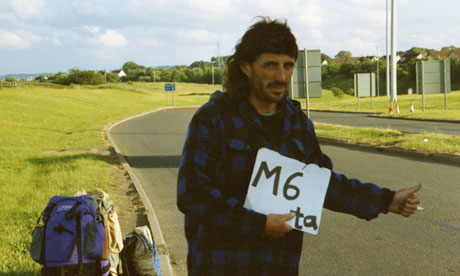
John Dines, an undercover police sergeant, as he appeared in the early 1990s when he posed as John Barker, a protester against capitalism
Britain's largest police .. http://www.guardian.co.uk/uk/police .. force stole the identities of an estimated 80 dead children and issued fake passports in their names for use by undercover police officers.
The Metropolitan police secretly authorised the practice for covert officers infiltrating protest groups without consulting or informing the children's parents.
The details are revealed in an investigation by the Guardian, which has established how over three decades generations of police officers trawled through national birth and death records in search of suitable matches.
Undercover officers created aliases based on the details of the dead children and were issued with accompanying identity records such as driving licences and national insurance numbers. Some of the police officers spent up to 10 years pretending to be people who had died.
The Met said the practice was not "currently" authorised, but announced an investigation into "past arrangements for undercover identities used by SDS [Special Demonstration Squad] officers".
Keith Vaz, the chairman of parliament's home affairs select committee, said he was shocked at the "gruesome" practice. "It will only cause enormous distress to families who will discover what has happened concerning the identities of their dead children," he said. "This is absolutely shocking."
The technique of using dead children as aliases has remained classified intelligence for several decades, although it was fictionalised in Frederick Forsyth's novel The Day of the Jackal. As a result, police have internally nicknamed the process of searching for suitable identities as the "jackal run". One former undercover agent compared an operation on which he was deployed to the methods used by the Stasi.
Two undercover officers have provided a detailed account .. http://www.guardian.co.uk/uk/2013/feb/03/police-spy-what-would-family-think .. of how they and others used the identities of dead children. One, who adopted the fake persona of Pete Black while undercover in anti-racist groups, said he felt he was "stomping on the grave" of the four-year-old boy whose identity he used.
"A part of me was thinking about how I would feel if someone was taking the names and details of my dead son for something like this," he said. The Guardian has chosen not to identify Black by his real name.
The other officer, who adopted the identity of a child who died in a car crash, said he was conscious the parents would "still be grief-stricken". He spoke on the condition of anonymity and argued his actions could be justified because they were for the "greater good".
A third undercover police officer in the SDS who adopted the identity of a dead child can be named as John Dines .. http://www.guardian.co.uk/uk/2013/feb/03/woman-search-police-spy , a sergeant. He adopted the identity of an eight-year-old boy named John Barker, who died in 1968 from leukaemia. The Met said in a statement: "We are not prepared to confirm nor deny the deployment of individuals on specific operations."
The force added: "A formal complaint has been received which is being investigated by the DPS [Directorate for Professional Standards] and we appreciate the concerns that have been raised. The DPS inquiry is taking place in conjunction with Operation Herne's investigation into the wider issue of past arrangements for undercover identities used by SDS officers. We can confirm that the practice referred to in the complaint is not something that would currently be authorised in the [Met police]."
There is a suggestion that the practice of using dead infant identities may have been stopped in the mid-1990s, when death records were digitised. However, the case being investigated by the Met relates to a suspected undercover police officer who may have used a dead child's identity in 2003.
Since then dozens of SDS officers, including those who posed as anti-capitalists, animal rights activists and violent far-right campaigners, have used the identities of dead children.
One document seen by the Guardian indicates that around 80 police officers used such identities between 1968 and 1994. The total number could be higher.
Black said he always felt guilty when celebrating the birthday of the four-year-old whose identity he took. He was particularly aware that somewhere the parents of the boy would be "thinking about their son and missing him". "I used to get this really odd feeling," he said.
To fully immerse himself in the adopted identity and appear convincing when speaking about his upbringing, Black visited the child's home town to familiarise himself with the surroundings.
Black, who was undercover in the 1990s, said his operation was "almost Stasi-like". He said SDS officers visited the house they were supposed to have been born in so they would have a memory of the building.
"It's those little details that really matter – the weird smell coming out of the drain that's been broken for years, the location of the corner Post Office, the number of the bus you get to go from one place to another," he said.
The second SDS officer said he believed the use of the harvested identities was for the "greater good". But he was also aware that the parents had not been consulted. "There were dilemmas that went through my head," he said.
The case of the third officer, John Dines, reveals the risks posed to families who were unaware that their children's identities were being used by undercover police.
During his covert deployment, Dines had a two-year relationship with a female activist before disappearing from her life. In an attempt to track down her disappeared boyfriend, the woman discovered the birth certificate of John Barker and tried to track down his family, unaware that she was actually searching for a dead child.
She said she was relieved that she never managed to find the parents of the dead boy. "It would have been horrendous," she said. "It would have completely freaked them out to have someone asking after a child who died 24 years earlier."
Vaz said MPs were now likely to demand answers from the Met police about the use of children's identities. "My disbelief at some of the tactics used [by undercover police] has become shock as a result of these latest revelations. It is clear that inappropriate action has been taken by undercover police in the past. But this has now taken it to a new level," he said.
"The committee will need to seek answers from the Metropolitan police, to find out why they allowed these gruesome practices to happen.


 Market Data
  Markets


 AI
AI