IMF warns of threat to global economies posed by austerity drives
International Monetary Fund and 10 other economic bodies make 'call to action' to boost growth and curb protectionism
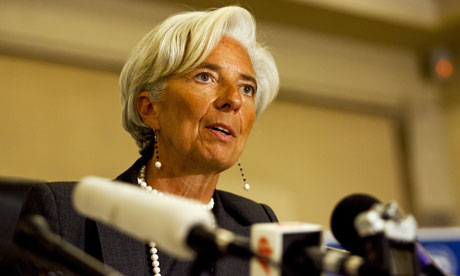
Christine Lagarde, head of the IMF, warned in a joint statement that the world faced 'significant and urgent challenges'. Photograph: Gallo Images/Getty Images
Larry Elliott Thursday 19 January 2012
The leaders of the International Monetary Fund, the World Bank and the World Trade Organisation on Friday issued a warning about the economic and social risks of austerity programmes in a "call to action" designed to boost growth and fight protectionism.
Expressing concern about the weakness of economic activity and rising unemployment, the IMF's Christine Lagarde, the World Bank's Robert Zoellick and the WTO's Pascal Lamy joined the heads of eight other multilateral and regional institutions in calling for policies to create jobs, tackle inequality and green the global economy.
"The world faces significant and urgent challenges that weigh heavily on prospects for future growth and on the cohesion of our societies," said the statement by the global issues group of the World Economic Forum. It was published ahead of the forum's annual meeting in Davos next week, amid concerns that 2012 will see the global economy flirt with recession as a result of the eurozone crisis.
"Our shared objective is the strengthening of growth, employment and the quality of life in every part of the world," said the statement. "But entering 2012, we worry about: decelerating global growth and rising uncertainty; high unemployment, especially youth unemployment, with all its negative economic and social consequences; potential resort to inward-looking protectionist policies."
In addition to Lagarde, Zoellick and Lamy, the signatories were Mark Carney of the Financial Stability Board, Margaret Chan of the World Health Organization, Angel Gurría of the Organisation for Economic Co-operation and Development, Donald Kaberuka of the African Development Bank, Haruhiko Kuroda of the Asian Development Bank, Luis Alberto Moreno of the Inter-American Development Bank, Josette Sheeran of the United Nations World Food Programme, and Juan Somavia of the International Labour Organisation. The forum said it was the first time the heads of the world's major institutions had come together in such a way.
Reflecting the IMF's concern about over-aggressive deficit reduction programmes, the joint statement said governments should "manage fiscal consolidation to promote rather than reduce prospects for growth and employment. It should be applied in a socially responsible manner."
The 11-strong group said it wanted to see a comprehensive action plan that could be agreed and implemented at the meeting of the G20 gathering of developed and developing nations in Mexico in June.
"We call on leaders to devote the necessary political energy to deliver concrete actions to exit the crisis and boost growth. Every country, working through its regional economic organisations and development banks and through the international financial and UN institutions, has a role to play."
While acknowledging that the global economy faced severe challenges, the action plan said momentum could be regained by increasing spending on infrastructure and by "beginning to realise the promise of a greener economy". To do so, the world would need an open trading system, resilient cross-border finance, sustainable government finances, determined and coordinated structural reforms and measures to address inequalities in all countries.
In the short term, the 11 leaders said the two most important challenges were to solve the sovereign debt and banking crisis and to restart growth. It urged the implementation of new, tougher regulations for finance and the rapid recapitalisation of banks where necessary.
With more than 200 million people currently unemployed around the world, the call to action said policymakers should "address youth and long-term unemployment to provide decent work prospects, along with country-specific structural reforms that are fairly implemented to achieve faster growth. Through dialogue, labour market reforms can be agreed that can both raise employment levels and ease fiscal adjustment."
It added: "Boosting jobs and investing in human capital is the most promising way of tackling inequality. We support the work of the ILO and others in assisting governments to examine realistic policy options, including cost-effective social policies to cushion the most vulnerable from adversity. Investment should target skills and education and thus equip people for the future.
"Rising inequality calls for heightened consideration of more inclusive models of growth. We must deliver tangible improvements in material living standards and greater social cohesion."
The call for action urged governments to resist the temptation to resort to trade barriers in an attempt to safeguard jobs. "Countries must reaffirm that none will resort to growth-destroying protectionism and demonstrate that trade restrictions introduced in response to the economic crisis will be rolled back."
Greece on verge of breakthrough in deal to cancel 70% of debt
• Agreement secured on interest rate for new bonds • Athens hopes to brief EU meeting on Monday
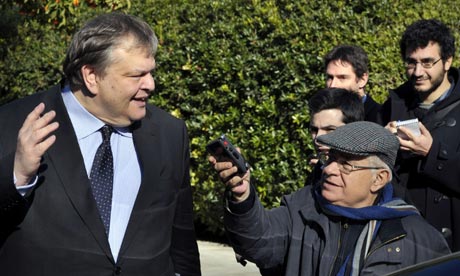
Greece's finance minister, Evangelos Venizelos, talks to reporters on Friday. Photograph: Louisa Gouliamaki/AFP/Getty Images
Phillip Inman and Helena Smith in Athens Friday 20 January 2012 14.04 EST
Greece is on the verge of a breakthrough in talks with its creditors that could wipe out up to 70% of its debts and alleviate the crisis in the eurozone.
An outline deal, hurriedly endorsed by Brussels, came after a frantic three days of negotiations that at one time appeared to be heading for deadlock.
It appeared that Greece had secured a deal to pay an interest rate of 3.1%, rising to 4.75%, on new 30-year bonds created from its outstanding €360bn (£300bn) debt burden. The effect would be for creditors to accept writedowns of up to 70% on many of their loans.
Sources close to the Greek government said it was still possible that major lenders could walk away if there was a failure to get agreement on some of the fine detail, but Athens was confident that further talks over the weekend would bring a comprehensive deal.
Before the news, trading on world stock markets was subdued, indicating the importance attached to a Greek deal as investors waited for the outcome before committing funds. The FTSE 100 finished the day down 12 points at 5728.55, closing before speculation surfaced that a Greek deal was imminent. The French CAC and the German Dax were also down 7 and 11 points respectively. The Dow Jones followed a more positive path into the afternoon in New York, rising more than 60 points towards 12700.
Greece has become the focus of tension in the eurozone for the third time in as many years after first announcing it was in trouble in the spring of 2010. It was bailed out along with Ireland and Portugal, then in May last year it became clear that the €110bn Athens had received would be insufficient to finance its growing debts and that a second bailout was necessary.
German resistance to giving any more financial support without a sacrifice by creditors of at least 50% of their loans has held up attempts by Brussels to co-ordinate a second bailout.
Greece's finance minister, Evangelos Venizelos, has spent the last two weeks locked in discussions with a team representing the banks, insurers and hedge funds that hold Greek debt. It is understood a framework deal is in place outlining the basic structure of a bond swap that Venizelos wants to present at the eurogroup meeting of finance ministers in Brussels on Monday.
He needs a deal in place, and approval for a second bailout plan, before a €14.5bn loan refinancing in March.
"The atmosphere of the talks is good, they are continuing today and we hope they will be concluded very soon," a government spokesman said. "This is very important for the sustainability of the national debt and our ability to handle the debt."
European Union ministers will be meeting in Brussels to reach agreement on a new pact enforcing stricter budget controls in the eurozone that could allow the single currency area's highest court to fine countries that fail to adopt key rules.
The European Central Bank wrecked an earlier draft of the agreement after warning that the enforcement powers it proposed were weak and would fail to keep errant countries in line.
Under the guidance of Germany's chancellor, Angela Merkel, Brussels has drafted a tighter pact that would allow the courts to punish a country that refuses to implement a balanced budget rule in its national law with a penalty of up to 0.1% of GDP. Every EU country except Britain is expected to sign off on the pact when leaders meet at a summit on 30 January.
The debt talks in Greece were expected to continue into Friday evening to thrash out the fine print of the deal. Even if a decisive agreement were to be reached, the proposals will have to be put to the technocrats and they would be likely to change it again.
But the prospect of a deal seemed to encourage investors to move away from safe havens in favour of riskier assets for the first time in several months.
US bond prices slipped and German bonds followed suit, both on hopes for a deal and on more upbeat news from the US housing market.
Kevin Flanagan, chief fixed-income strategist at Morgan Stanley Smith Barney, said the drop in demand for US bonds, and therefore decrease in the price, "seems due to a combination of developments beginning with yesterday's US jobless claims figures (which showed a sharp drop in the newly jobless) and reports that the Greek negotiations with private sector investors may yield results after all."
Benchmark 10-year bond yields rose to 2.01% from 1.97% late on Thursday. The rise in the yield, which follows a decline in the price, were in line with a decline in German bunds, another safe-haven asset.
"Europe is calmer. Their auctions have gone OK, and the euro has responded," said David Ader, head government bond strategist at CRT Capital Group. But he added that the "myopic focus" on rumours about Greece underscored the market's general lack of confidence.
Earlier, France's president Nicolas Sarkozy, warned that Europe remained at risk and urged Greece's political leaders not to delay important decisions to stabilise their debt-ridden economy.
"The eurozone remains in danger. The whole of Greece's political class must understand that it cannot put off decisions needed to resolve the country's crisis," he told a meeting with ambassadors.
Rescuing Greece Through A Selective Default Could Collapse CDS Markets 7/21/2011 @ 1:14PM
[Old .. just trying to understand some complexities a bit more.]
"This way, Papandreou, and you too, Zapatero": France and Germany show the PIIGS the way -AFP via @daylife
As markets await .. http://blogs.forbes.com/steveschaefer/2011/07/21/european-rally-crosses-atlantic-as-optimism-for-greek-deal-grows/ .. the final release of the European Union’s proposal to rescue Greece and save the Eurozone, it has been heard through the grape vine that the possibility of a sovereign default in Greece is on the table. If indeed Greece enters a state of “selective default” for a very short period, maybe just a few days, all attention will be focused on credit default swaps markets (CDS) and what constitutes a “trigger.”
News outlets have picked up a supposed draft proposal that delineates the basic shape of the Merkel-Sarkozy deal that will try to dig Europe out of a very deep ditch. Along with a new bail out, an extension of loan maturities coupled with a reduction of borrowing costs, the plan includes the controversial clause of “voluntary” involvement by Greek bondholders, major European banks. (Read European Rally Crosses Atlantic As Optimism For Greek Deal Grows). .. http://blogs.forbes.com/steveschaefer/2011/07/21/european-rally-crosses-atlantic-as-optimism-for-greek-deal-grows/
Private sector involvement, either through a bond-swap, roll-over, buy-back, or whatever mechanism, could trigger a credit event that would lead to a Greek default on its sovereign debt. Indeed Jean Claude Juncker, Eurogroup President, spooked markets when he said default was no longer an impossibility. His words were echoed by Dutch Finance Minister Jan Kees de Jager hours later. (Read Voluntary Greek Restructuring Still Constitutes Default, S&P Says). .. http://blogs.forbes.com/afontevecchia/2011/06/20/voluntary-greek-debt-restructuring-still-constitutes-default-sp-says/ ~~~~~~~~~~~~~~~~~~ Insert: from the one this is in reply to ..
"MYTH 1: Greece cannot solve its problems without a formal default
A decade ago, this would have been a distinction without a difference. Creditors only accept a voluntary haircut if the alternative is an involuntary one. But with the explosion of markets in credit default swaps, tens of billions of dollars can turn on the difference between an explicit default, which triggers payments on these swaps, and a voluntary restructuring, which does not. In theory, CDS markets are supposed to spread the risk associated with defaults, and thereby make financial markets operate more smoothly." ~~~~~~~~~~~~~~~~~~ If credit rating agencies classified Greece’s sovereign debt as in a state of default, not only would there be problems with the quality of collateral accepted by the European Central Bank, but the essence of CDS markets would be called into question. CDSs are derivatives that provide insurance against default. Yet, Greek Finance Minister Evangelos Venizelos told markets a selective default “is not even a real event,” while affirming that if it occurred, it wouldn’t activate CDS contracts, according to Business Insider.
Technically, a CDS would be triggered “if there is a failure to pay, a restructuring which entails a change of cash flows or a subordination or redenomination (into other than a G7 or OECD AAA-rated country’s currency) or a moratorium or repudiation in the context of a credit deterioration,” according to Nomura.
The impact of triggering CDS for those who hold protection against Greek sovereign debt default would reach far. Despite the relatively small volume of CDS held against Greek bonds (with gross exposure around $70 billion and net notional exposure below $5 billion), there would be a domino effect that could spread voraciously through the EU.
Page 2 of 2
Not only would some investors who sold CDS find themselves cash-strapped and fail to meet financial obligations, “a potential CDS trigger could [extend] to [other] OTC products (rather than CDS) and perhaps [affect] the solvency of individual banks which sold protection, or simply [lead] to a political desire to punish investors who are perceived as speculators,” explain Nomura’s experts. Contagion could even be made worst given that “CDS are thought of as a proxy for the spreading contagion” as they generally spark moves in bond spreads. (Read Euro Stress Tests Reveal 8 Banks Would Fail, 16 Barely Survived Adverse Conditions). .. http://blogs.forbes.com/afontevecchia/2011/07/15/euro-stress-test-reveal-8-banks-would-fail-16-barely-survive-adverse-conditions/
What if European authorities, along with Greek Prime Minister George Papandreou and his finance minister, manage to restructure the country’s debt without triggering a default?
The immediate market response would be a collapse of CDS markets. While it would boost bonds (lower their yields) in those countries at risk (Spain, Italy, the other bailed out PIIGS), the ability of CDS contracts to protect investors would be called into question and confidence completely eroded.
As the Euro gains strength and measures of risk on European assets falls, risk management teams across the world would be forced to re-hedge , “shedding any duration hedges recently bought “ while moving away from CDS markets (“[a] trigger should demonstrate that CDS was a particularly poor hedge for sovereign exposure”). (Read Roubini On Europe’s Last Stand: Don’t Fear A Greek Debt Restructuring And Selective Default). .. http://blogs.forbes.com/afontevecchia/2011/07/18/roubini-on-europes-last-stand-dont-fear-a-greek-debt-restructuring-and-a-selective-default/
This could indeed lead to an underestimation of risk by CVA desks (counterparty valuation desks) and build up substantial systemic risk in the system. It would also substantially increase moral hazard, sending mixed signals to investors as they attempt to make sense of intervened markets. While initially beneficial to many investors, the long-run repercussions could run deep.


 Market Data
  Markets


 AI
AI