As someone who tries to tell us he lives a godly life you certainly like to bullshit people and deceive people with your posts. Below is a basic argument against your crap and I suspect it still is way over your head.
The Skeptic Argument
Global warming stopped in 1998, 1995, 2002, 2007, 2010, ????
January 2008 capped a 12 month period of global temperature drops on all of the major well respected indicators. HadCRUT, RSS, UAH, and GISS global temperature sets all show sharp drops in the last year (source: Watts Up With That).
What the science says... Select a level.. Basic
A common claim amongst climate "skeptics" is that the Earth has been cooling recently. 1998 was the first year claimed by "skeptics" for "Global Cooling". Then 1995 followed by 2002. 'Skeptics' have also emphasized the year 2007-2008 and most recently the last half of 2010.
NASA and climate scientists throughout the world have said, however, that the years starting since 1998 have been the hottest in all recorded temperature history. Do these claims sound confusing and contradictory? Has the Earth been cooling, lately?
To find out whether there is actually a "cooling trend," it is important to consider all of these claims as a whole, since they follow the same pattern. In making these claims, 'skeptics' cherrypick short periods of time, usually about 10 years or less.
'Skeptics' also take selected areas of the world where cold records for the recent past are being set while ignoring other areas where all time heat records are being set.
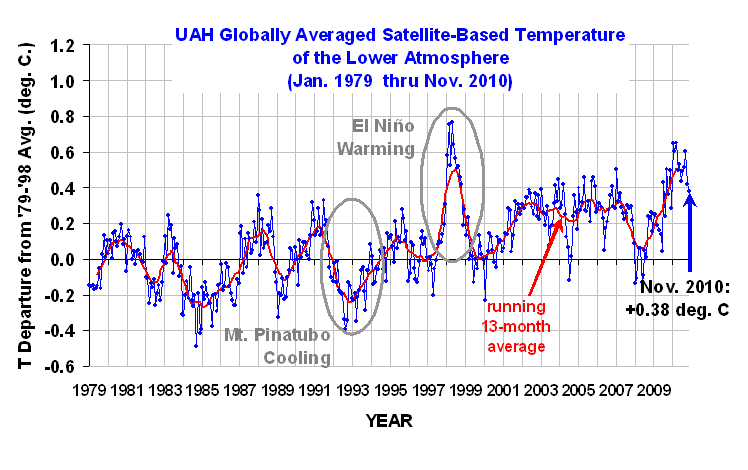
The temperature chart below is based on information acquired from NASA heat sensing satellites. It covers a 30 year period from January 1979 to November 2010. The red curve indicates the average temperature throughout the entire Earth.
The red line represents the average temperature. The top of the curves are warmer years caused by El Niño; a weather phenomenon where the Pacific Ocean gives out heat thus warming the Earth. The bottoms of the curves are usually La Niña years which cool the Earth. Volcanic eruptions, like Mount Pinatubo in 1991 will also cool the Earth over short timeframes of 1-2 years.
Figure 1: University of Alabama, Huntsville (UAH) temperature chart from January 1979 to November 2010. This chart is shown with no trend lines so the viewer may make his own judgment.
Below is the same temperature chart, showing how 'skeptics' manipulate the data to give the impression of 'Global Cooling'. First they choose the warmest most recent year they can find. Then, in this case, they exclude 20 years of previous temperature records. Next they draw a line from the warmest year (the high peak) to the lowest La Niña they can find. In doing this they falsely give the impression that an ordinary La Niña is actually a cooling trend.
Figure 2: Representation of how 'skeptics' distort the temperature chart. Even though the chart clearly indicates increased warming, 'skeptics' take small portions of out of context to claim the opposite.
What do the past 30 years of temperature data really show? Below is the answer.
Figure 3: Trend lines showing the sudden jump in temperatures in the 1995 La Niña (Green lines) and the 1998 (Pink lines) El Niño events. Brown line indicates overall increase in temperatures.
The chart above clearly shows that temperatures have gone up. When temperatures for the warm El Niño years (pink lines) during 1980-1995 are compared to 1998-2010, there is a sudden increase of at least 0.2o Centigrade (0.36o Fahrenheit). Temperatures also jumped up by about 0.15oC (0.27oF) between the cool La Niña years (Green lines) of 1979-1989 and those of 1996-2008 (the eruption of Mount Pinatubo in 1991 lowered the Earth's temperatures in the midst of an El Niño cycle). The overall trend from 1979 through November 2010 (Brown line) shows an unmistakable rise.
While these increases do not sound like much they are more than enough to disrupt weather systems and cause severe damage to crops and human populations.
In spite of these facts, 'skeptics' simply keep changing their dates for 'Global Cooling', constantly confusing short-term noise and long-term trends (Figure 4).
Figure 4: BEST land-only surface temperature data (green) with linear trends applied to the timeframes 1973 to 1980, 1980 to 1988, 1988 to 1995, 1995 to 2001, 1998 to 2005, 2002 to 2010 (blue), and 1973 to 2010 (red).
“It seems appropriate to expect the establishment to take the first steps in any attempt to bridge the divide between the sides,” he said, proposing we should, “recognise that not all climate sceptics are rogues and vagabonds.”
“The very first step should be for climate scientists to make a conscious effort to read some of the documentation appearing in the more respectable sceptic weblogs,” he argued.
Garth should get out more.
Many of us, including most of the authors of this series, have engaged with the arguments of self-styled “sceptics”.
We’ve looked at not just the blogs, but also the information from organised groups, the few published scientific papers and the books in which these their claims are presented in detail.
As a counter proposal, I would argue that any self-styled “sceptic” who claims to have a genuine case should do what normal scientists do and dissociate themselves from those who practise fabrication and misrepresentation, those who in Garth’s words might be called “rogues”, if not “vagabonds”.
The reality is that the most prominent pseudo-sceptical scientists are doing the opposite: gathering together to provide apparent respectability to front organisations that are designed to spread confusion.
This is the message from Merchants of Doubt: .. http://www.merchantsofdoubt.org/ .. How a Handful of Scientists Obscured Truth on Issues from Tobacco Smoke to Global Warming.
Authors Naomi Oreskes and Erik Conway, backed up by documents obtained in the course of tobacco litigation, show that not only was greenhouse denial using the same misinformation techniques as the tobacco industry, but that it was often the same groups and the same people. These anti-science activities hide behind names such as “Friends of Science”.
In Australia we have a similar phenomenon, with the additional twist of often using names that aim to capture a “martyr for science” image. They present themselves as being ignored by an entrenched establishment, when in reality they are ignoring or distorting the accumulated scientific knowledge.
An early starter was the Lavoisier Group .. http://www.lavoisier.com.au/index.php .. – a single issue organisation similar in structure and name to organisations like the Bennelong Society (on indigenous affairs), the HR Nicholls society (on industrial relations) and the Samuel Griffith Society (on constitutional matters and support for the monarchy). But for the Lavoisier Group, the “martyr for science” ethos is a bit of a stretch – Lavoisier was executed for his activities as a tax collector.
The latest entry is the Galileo Movement, .. http://www.galileomovement.com.au/ .. again co-opting the name of a “martyr for science” for an anti-science activity. The Galileo Movement’s founders funded the previous visit to Australia by Viscount Monckton. The movement’s “Independent Climate Science Group” includes Monckton, Bob Carter, S. Fred Singer and Ian Plimer as well as Garth Paltridge.
Monckton’s extravagant claims were described by John Abraham earlier in this series. Monckton’s recent testimony to the US Congress has been extensively refuted by a larger group of scientists.
The title of Bob Carter’s book Climate: The Counter-Consensus captures the problem succinctly. There is no such counter-consensus. What groups such as the Galileo Movement present as a alternative to mainstream view of climate is not an alternative consensus, but rather a collection of wildly conflicting and extensively discredited fragments designed to create confusion.
Singer’s book (with John Avery), Unstoppable Global Warming Every 1500 Years proposes a natural 1500 year cycle for global temperature. I find this unconvincing, with no evidence provided for the claim that Imperial Roman times were as cold as the Little Ice Age 1500 years later.
I am also puzzled as to how a man who claims we are in a natural warming cycle until about 2300 could be part of the Heartland Institute group. which convinced Senator Steve Fielding that the Earth is cooling.
But in Australia, it is Ian Plimer’s book Heaven + Earth. Global Warming: The Missing Science that has had most impact. Kurt Lambeck, President of the Academy of Science at the time, put it aptly when he stated that Heaven + Earth is not a work of science.
The book is extensively referenced with 2311 footnotes. But oddly many of these references directly support the mainstream view of climate change.
Plimer repeatedly quotes the paper that says “climate sensitivity greater than 1.5 degrees C has been a robust feature of the Earth’s climate over the last 420 million years.”
In other words, the geological record shows that doubling CO2 causes an increase in temperature of at least 1.5 degrees. That is what “climate sensitivity” means: how much warming CO2 causes.
This aspect of Heaven + Earth was recycled last year by Cardinal George Pell in a letter to the Senate, claiming that temperatures in Roman times were two to six degrees warmer than now, (the opposite of what is implied by Singer’s book).
While Pell cited the references in Plimer’s book as evidence, the reality is that Plimer’s whole section on “Roman Warming” cites seven scientific papers and none of them support this claim.
One of the scams used in Heaven + Earth is to plot graphs on different scales to claim that different data averaging gives different trends.
This device was used in Michael Crichton’s novel State of Fear as a simple fictional example of how to fool a gullible jury, though it also seemed to fool many gullible readers.
But, it is Plimer’s misrepresentation of the cited references in Heaven + Earth that really justifies Kurt Lambeck’s statement. Some of these are downright silly, the claim that New Orleans subsided a metre in the three years prior to hurricane Katrina, for example.
Comparable is the claim that the 1991 eruption of volcano Mount Pinatubo emitted large quantities of chlorofluorocarbons, citing a paper that says nothing of the sort. The serious fabrication arises when claiming that satellite measurements of temperature don’t show warming while citing a reference that says the opposite. So far, my analysis of Plimer’s references .. http://www.complex.org.au/tiki-download_file.php?fileId=91 .. shows 28 cases in which he misrepresents the content of his cited sources.
Finally, there is Garth Paltridge’s own book, The Climate Caper. This contains little science at all.
It is mainly about the institutional pressures that act on scientists. I agree with much of what Garth says, but my observation is that the pressures have largely acted in the opposite direction, inhibiting communication of mainstream climate science when governments found the implications inconvenient.
Thus organisations such as CSIRO and the Bureau of Meteorology remain muted on the inadequacy of proposals from both sides of politics.
Even those who support Garth’s views think that his book would have been more credible, more “respectable” perhaps, if he had chosen someone other than Monckton – indeed almost anyone other than Monckton – to write the foreword.
Scientists who claim genuinely respectable scepticism destroy their own case when they link their arguments to those who mis-use and misrepresent the processes of science.
Such links expose the activities of groups like the Galileo Movement for what they are: exercises in spreading confusion for political ends.
This is the eleventh part of our series Clearing up the Climate Debate. To read the other instalments, follow the links below:
kozuh, i hope you have many happy, healthy and cool years ahead .. you know i'm on record as saying i would love to see all the science on global climate proved wrong, butt.....
===============
Cherry-picking contrarian geologists tend to obscure scientific truth
by: Mike Sandiford From: The Australian December 31, 2011 12:00AM
GINA Rinehart notoriously claims she has never met a geologist who believes "adding more CO2 to the atmosphere will have any significant effect on climate".
To listen to prominent "contrarian" geologists such as Ian Plimer, you might imagine she never could.
But, despite the bluster, our contrarian geologists are out of kilter with their own community and seem deeply confused about the way the greenhouse effect - by adding more CO2 to the atmosphere, for example - has shaped both the past and the present.
All geology students learn of the importance of the greenhouse effect. It's simply impossible to understand the geological record without it.
In his 2001 award-winning book A Short History of Planet Earth, Plimer has numerous references to the greenhouse effect.
He explains what all young geologists learn as the faint young sun paradox:
"The early sun had a luminosity of some 30 per cent less than now and, over time, luminosity has increased in a steady state.
"The low luminosity of the early sun was such that the Earth's average surface temperature would have been below 0C from 4500 to 2000 million years ago. But there is evidence of running water and oceans as far back as 3800 million years ago." The question is, what kept the early Earth from freezing over?"
Plimer goes on to explain: "This paradox is solved if the Earth had an enhanced greenhouse with an atmosphere of a lot of carbon dioxide and methane."
Here's another quote from Plimer, referring to a time 100 million years ago when the dinosaurs roamed the planet: "The peak of 6 per cent carbon dioxide was at the time of a protracted greenhouse and maximum sea level. At this time, mean annual surface temperatures were 10C to 15C warmer than now."
The problem is, although his temperature estimate is about right, his CO2 estimate is about 50 times too high. CO2 levels were more like 0.12 per cent. At just three times present levels, this is a target we are on track to reach early next century.
Jump forward to 2009 and in his book Heaven and Earth Plimer seems to have quietly forgotten those geological lessons in stating: "Over geological time there is no observed relationship between global climate and atmospheric CO2."
Exactly which Plimer are we
to believe?
Scientists are notoriously sceptical of the data collected by others. But ignoring a respected source is reprehensible. Cherry-picking only the data that fits is borderline. Deliberately misrepresenting data or making it up is just not on.
Here's an example. In a section from his new book, How To Get Expelled from School, as reprinted in The Weekend Australian recently, Plimer claims: "Antarctic ice core (Siple) shows that there were 330 parts per million of carbon dioxide in the air in 1900; Mauna Loa Hawaiian measurements in 1960 show that the air then had 260ppm carbon dioxide."
Plimer goes on to say: "Either the ice core data is wrong, the Hawaiian carbon dioxide measurements are wrong, or the atmospheric carbon dioxide content was decreasing during a period of industrialisation."
The implication is there must be something terribly wrong with the orthodox climate science and we are all being taken for a ride.
The problem is that the primary data sources explicitly state the Hawaiian Mauna Loa CO2 measurements for 1960 were in the range 313-320ppm, and that Siple air of age about 1900 has a CO2 content of 295ppm, with the 330ppm concentrations having an estimated air age of 1962-83, entirely in keeping with Mauna Loa.
Who has been taken for a ride?
Sadly, this is not an isolated case. Plimer has persistently claimed that volcanoes contribute much more CO2 to the Earth's atmosphere than do our own activities, blithely ignoring US Geological Survey reference data showing just the opposite - volcanoes emit CO2 at about 1 per cent of the rate of anthropogenic emissions.
Another common meme promoted by our contrarian geologists is that it is now a fact that the climate is cooling.
But may we ask by whose data is this a fact?
Certainly not NASA's, which showed last year was the hottest on record, followed by 2005, 2007, 2009 and 1998. In fact, NASA ranks nine of the hottest 10 years ever recorded between 2001 and last year. You'd reckon NASA had learned a few lessons about being careful with data.
Variations on decadal timescales are more relevant to climate trends than annual variations. NASA shows the average temperature over the decade 2000-09 was a full 0.2C higher than in the 1990s - the biggest decadal rise in temperature ever recorded.
With an increase of more than 0.5C over the past 40 years, the decadal trend is now warming faster than ever. It beggars belief that any serious scientist could assert the climate is cooling.
Our contrarian geologists also avoid the devil in the detail. NASA's data shows that winters are warming faster than the summers and the Arctic faster than the tropics. While the lower atmosphere is warming, the upper atmosphere is cooling.
These characteristics provide diagnostic fingerprints of the heat trapping expected for a greenhouse effect. They provide the smoking gun that points to rising greenhouse gas levels as
the cause, and rule out warming because of additional heat input from the sun.
Could that be why you won't hear our contrarian geologists refer to such data? Could their real agenda be in manufacturing doubt rather than the search for scientific truth?
If so, it wouldn't be a first, as Naomi Oreskes points out in her recent book Merchants of Doubt: How a Handful of Scientists Obscured the Truth on Issues from Tobacco Smoke to Global Warming.
Now here's a point for those who, like Rinehart, think all geologists toe Plimer's contrarian line.
Oreskes is a noted geologist. Having published groundbreaking research on the origin of the giant South Australian Olympic Dam deposit, she has arguably contributed more to the understanding of Australian mineral wealth than has Plimer.
Now just imagine a meeting between Rinehart and Oreskes - that would be interesting!
Mike Sandiford is professor of geology at the University of Melbourne
How do we know more CO2 is causing warming? Link to this page The skeptic argument...
Increasing CO2 has little to no effect 'While major green house gas H2O substantially warms the Earth, minor green house gases such as CO2 have little effect.... The 6-fold increase in hydrocarbon use since 1940 has had no noticeable effect on atmospheric temperature.' (Environmental Effects of Increased Atmospheric Carbon Dioxide)
An enhanced greenhouse effect from CO2 has been confirmed by multiple lines of empirical evidence. Satellite measurements of infrared spectra over the past 40 years observe less energy escaping to space at the wavelengths associated with CO2. Surface measurements find more downward infrared radiation warming the planet's surface. This provides a direct, empirical causal link between CO2 and global warming.
The greenhouse gas qualities of carbon dioxide have been known for over a century. In 1861, John Tyndal published laboratory results identifying carbon dioxide as a greenhouse gas that absorbed heat rays (longwave radiation). Since then, the absorptive qualities of carbon dioxide have been more precisely quantified by decades of laboratory measurements (Herzberg 1953, Burch 1962, Burch 1970, etc).
The greenhouse effect occurs because greenhouse gases let sunlight (shortwave radiation) pass through the atmosphere. The earth absorbs sunlight, warms then reradiates heat (infrared or longwave radiation). The outgoing longwave radiation is absorbed by greenhouse gases in the atmosphere. This heats the atmosphere which in turn re-radiates longwave radiation in all directions. Some of it makes its way back to the surface of the earth. So with more carbon dioxide in the atmosphere, we expect to see less longwave radiation escaping to space at the wavelengths that carbon dioxide absorb. We also expect to see more infrared radiation returning back to Earth at these same wavelengths.
These guys are very good and have never lost as court case against the idiots who don't believe in evolution and now they will take on the dummy's who don't believe in science.
NCSE takes on climate change
Posted on: January 16, 2012 6:41 PM, by Josh Rosenau
The National Center for Science Education, where I work, has focused on fighting political attacks on evolution education for all of its 30 year history. When the group was founded in the early '80s, they didn't choose a name narrowly focused on evolution, hoping that they'd make quick work of creationism and then move on to other problems in science education. Today's announcement that NCSE's taking on climate change is a partial fulfillment of that dream.
Creationism is far from dead, of course. This year, legislators in Indiana have filed two bills attacking evolution. One bill revives the sorts of laws NCSE was founded to fight, and would require students who learn evolution also to be taught "creation science." The Supreme Court struck such laws down in 1987. Creationists responded at the time by talking up "intelligent design." Despite a federal court's ruling that teaching intelligent design creationism was a violation of students' rights under the First Amendment, legislators in New Hampshire and Missouri have already filed laws this year that would require or encourage teachers to teach it.
Those big flareup don't keep us as busy as the dozens of local incidents that never make the papers. A parent who wonders why her kid is coming home with quizzes asking about Adam and Eve. A teacher wanting help explaining to parents why it's important to cover evolution at all. A principal looking to please everyone by suggesting that biology classes just cover "both sides." It's not sexy, but that's the front line of the battle over evolution.
In our time on those front lines, we keep hearing from teachers facing similar pressure about climate change. We hear it from teachers in workshops. We see it in newspaper stories. We track legislation lumping evolution and climate change together as "controversial" issues in science class, even though both are supported by over a century of unchallenged scientific research. And as we looked around, we realized that, while lots of groups exist to encourage good climate change education and provide positive content for classrooms, no one else was focused exclusively on blocking bad science from climate change lessons.
So today we officially launched a new initiative on climate change, including our new climate change website section, and announced that we'd hired a specialist in climate change education. Our executive director, Genie Scott, and our new climate guy, Mark McCaffrey, spent most of last week and today in interviews with the press. I was up until 5 am last night putting the last touches on the website. We've already fought back a few climate change flareups (I was the interim climate guy, and am glad to be passing the reins to Mark), and we're looking forward to hearing about more of them.
I'm not revealing any internal secrets by saying that we've all been tremendously gratified by the positive response we've gotten from NCSE's members and allies. Today's response on Twitter seems entirely positive, and if there've been critical blog reports or news items, I've yet to find them. When Genie mentioned this new initiative at The Amazing Meeting! last summer, she got a spontaneous ovation. Scientific societies and teaching societies and environmental groups, skeptics and civil libertarians and science fans - everyone has been encouraging and supportive, even grateful. So thank you all for that.
It's a big change, and inevitably we'll get pushback. Some of our members may decide to withdraw their support over this decision. So it'd be great if those of you who do support this extension of our mission would help make up some of those losses.
There's a lot yet to catch up on. We've been tracking anti-evolution activities for 30 years, the teachers know us and know to call us when they've got trouble, and we know what they're facing. We have to get a feel for the challenges faced by climate change educators, and we have to learn what state science standards and textbooks cover, and what sorts of pseudoscience is being pushed into classrooms. We need to build a new archive to match our rather specialized collection of evolution books. We need to let parents and teachers know that we're here to help them.
You can help with all of that. Not just by joining NCSE (though you should!), but by asking your kids' teachers (or your nieces and nephews, or whatever) what the teach. There's an extensive discussion of ways teachers can teach climate change well on the new website, and I'm sure Mark would appreciate feedback from more teachers. There's also a handy primer on the science behind climate change, a discussion of what climate change denial is and how to respond to it, and suggestions on ways you can support and defend climate change education. We hope you find the advice useful, and that you recommend it to others.
It's an thrilling way to start the year, and I expect it'll only get more exciting.


 Market Data
  Markets


 AI
AI