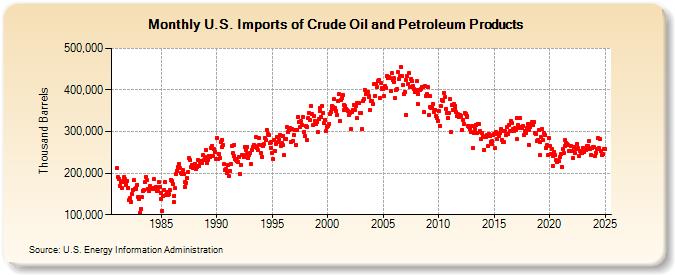
I say 50% of imported oil goes to plastics.... Include all plastics imported to this country, and I don't think 50% is a unreasonable number... Plus I read it somewhere, but I did not want to find it... Just to entertain you.
The most reliable statistics from the Pacific Institute put America’s love affair with water bottles at 31.2 billion liters of water in 2006. Due to negative press on the possible health effects of the use, most people are aware water bottles are sold in polyethylene terephthalate (PET) bottles. In order to manufacture these bottles over 900,000 tons of plastic is needed. The mainstream manufacturing process that produces PET bottles requires a combination of natural gas and petroleum. The petroleum requirement is where the statistics show that America’s obsession could be hurting their wallets at the gas pump.
Bottom line, the production of 31.2 billion liters of water for the U.S. bottled water market took roughly 17.6 million barrels of oil.
America also uses an astounding 100 billion plastic bags per year, and it takes 12 million barrels of oil to produce them. When you add in worldwide consumption, we could save 120 million barrels of oil annually by switching to reusable bags.
Bottled water and all of these mountains of plastic bags are easy addictions to kick. Faucet-mounted filters, reusable bottles and reusable bags make it really easy to avoid consumption of so much petroleum. Honestly, what’s the problem here? Why do people have such a hard time making such a simple switch?
I’ve been carrying a set of cute little reusable bags to the grocery store for years now, and when I first started, the baggers would look at me like I was out of my mind and then acted like filling my bags instead of the plastic ones was some kind of insurmountable chore. Now they’re used to it though, and the more people start doing it, the more expected it will be.
Discussion on Kestrel Hemp Body Design
As many have already heard the semi-structural body panels of our Kestrel car are made from bio-composite panels which at this time is derived from industrial hemp. When we officially unveiled the design of this vehicle and its construction techniques, we received a lot of inquiries from media and press officials who were particularly interested in the use of industrial hemp as a body material. Of course with that came the obvious hemp related jokes. The truth is there are many benefits achieved through the use of this material and unlike marijuana it cannot get you high.
One of the benefits of using bio-composites is that it is a less energy intensive manufacturing process. Hemp is a high yielding plant that can be grown with little water and pesticide. Much of the energy required to make the raw material for bio composite mats is done by nature from the sun, whereas the process for making fibreglass into the raw material to make the same mats is a very energy intensive process. The process to make the hemp plant into a form usable in car body panels is similar to that of making paper. The hemp is chopped up, decertified, clean and combed and then pressed into a mat. The mats are then used as part of the body panel as opposed to a synthetic fibre like fibreglass.
Another benefit of utilising hemp is its relative light weight. It is tougher and more durable than steel and lighter than some other composite alternatives. Light weight is key in today’s auto industry as it helps increase fuel economy. This is also a key factor for electric vehicles, looking to increase their range. The heavier the vehicle the less distance it can travel on one charge, as the batteries themselves add considerable weight it is therefore extremely important for electric vehicles to find other areas in which to decrease weight.
The idea of using hemp in vehicles is not a new one and not one unique to Motive. Henry Ford made a plastic vehicle in 1941 utilising hemp and wheat straw fibres, below is a short clip of the vehicle driving around and Henry demonstrating some of the benefits by hitting it with a sledge hammer. Many automakers today are also exploring the use of bio materials in other vehicle applications, like seat foam.


 Market Data
  Markets


 AI
AI