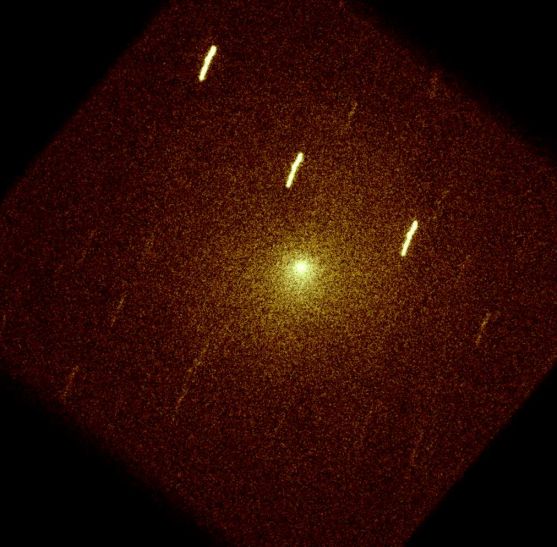
well -- here is some stuff that god is not controlling directly -- and I noted, a while back, that some tree huggers were objecting to this mission, because it was interfering with the natural order of things or something like that -- lol ============== A Swift Look at Tempel 1 Credit: UVOT Team, Swift, NASA Explanation: Comet Tempel 1 is targeted for a collision with the impactor probe from NASA's Deep Impact Spacecraft at about 1:52am EDT on July 4th (other time zones). Cameras on the impactor probe and the flyby spacecraft will capture close-up images of the event - expected to produce a crater on the surface of the comet's nucleus. Of course, Earth-orbiting and ground-based telescopes will be watching too, including instruments on the Swift satellite normally used to spot gamma-ray bursts in the distant universe. Swift's ultraviolet telescope recorded this picture of Tempel 1 on June 29th. Because the image is registered on the comet, the background stars appear as short trails. Want to follow the encounter? Media coverage chronicling the event, and the possibilities for viewing the comet with small telescopes can be found through the Deep Impact website. http://deepimpact.jpl.nasa.gov/home/index.html
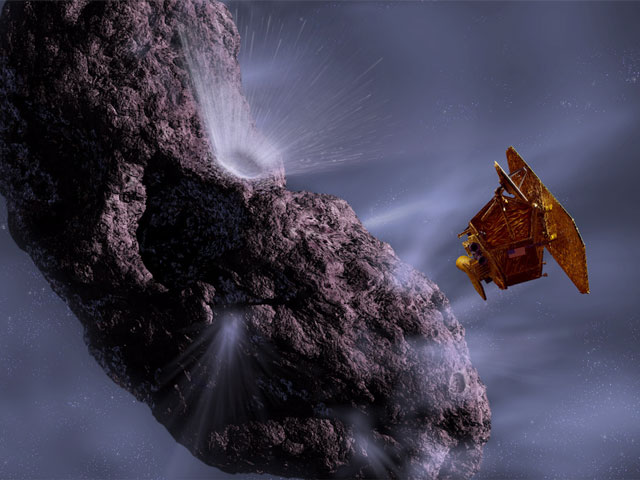
============ Deep Impact Spacecraft Hurtles Toward Comet Drawing Credit: Pat Rawlings, U. Md., JPL, NASA Explanation: What happens when you crash into a comet? That was a question considered by astronomers when they designed the Deep Impact mission, launched in January. This coming July 4, the Deep Impact spaceship will reach its target - Comet Tempel 1 -- and release an impactor over five times the mass of a person toward its surface. The mothership will photograph the result. The remaining crater may tell how Tempel 1 is constructed. If, for example, Comet Tempel 1 is an extremely loose pile of debris, the impactor may leave little or no discernable crater. On the other hand, if the comet's surface is relatively firm, the impactor's ripple may leave quite a large crater. A contest is even being held to predict the size of the resulting crater. Pictured above is an artist's impression of the initial encounter between the spacecraft and the comet.


 Market Data
  Markets


 AI
AI