Former CIA Official Backs Up Mullen's Pakistan Claim
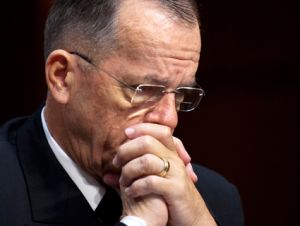
Admiral Mike Mullen. Pete Marovich/Zuma
Siddhartha Mahanta Fri Sep. 23, 2011 9:20 AM PDT
On Thursday, Admiral Mike Mullen, the outgoing Chairman of the Joint Chiefs of Staff, told a Senate committee that the Pakistan's army intelligence service, the ISI, has been working hand-in-hand with the the Pakistan-based Haqqani terrorist network, one of three allied insurgent groups fighting NATO forces alongside the Taliban. But how did the US know that for sure? Reuters posits an answer: [ http://www.reuters.com/article/2011/09/22/us-pakistan-usa-idUSTRE78L2MC20110922 ]
Bruce Riedel, a former top CIA analyst with close ties to the Obama White House, which he once advised, told Reuters administration officials have told him that militants who attacked the U.S. Embassy and NATO headquarters in Kabul on September 13 phoned individuals connected with the ISI before and during the attack.
Following the attacks, Riedel said, U.S. security forces collected cell phones the attackers had used. These are expected to provide further evidence linking militants to ISI.
Mullen has linked the alleged Haqqani-ISI tag team to at least three attacks against the US. This all comes as the Senate appropriations committee voted on Wednesday (the day before Mullen levelled his allegation) to make US aid to Pakistan "more rigorous, and contingent upon its cooperation in fighting militants such as the Haqqani network." But that's not exactly a game-changer for this fraught relationship. [ http://www.bbc.co.uk/news/world-south-asia-15014800 ]
Meanwhile, Reuters says that Mullen's "harsh words appear to represent a new low in U.S.-Pakistani relations"—yes, okay, given his prominence, maybe. But by what measure is this a new low? Apparently there's no drone strike too outrageous, no CIA-linked midnight murder too embarrassing, no terrorist bunker too cozy, and no special ops raid too invasive, for the US or Pakistan to say: At what point is enough enough?
Sirajuddin Haqqani dares US to attack N Waziristan
By Reuters .. Published: September 24, 2011
Sirajuddin is one of the world’s most wanted men with a $5 million bounty on his head. He said he discovered that while listening to the Voice of America. PHOTO: AFP
ISLAMABAD: While the United States, ever more strident, is ratcheting up pressure on Pakistan to snap its “ties with the Haqqani network”, the group’s chief Sirajuddin Haqqani on Friday warned Washington against any military adventure in the North Waziristan tribal agency.
Speaking to Reuters by satellite phone from an undisclosed location, Sirajuddin said he’d look forward to a US ground attack in North Waziristan. “The United States will suffer more losses [in North Waziristan] than they did in Afghanistan,” he said.
Still, he doesn’t take chances, especially with overhead drones a constant worry – 57 drone strikes have peppered the region so far this year, according to the New American Foundation, a think tank that keeps a database of such attacks.
Some 55 members of his family, including his brother, have been killed in such attacks.
According to the New American database, at least a quarter of the drone attacks since 2008 have targeted the Haqqanis.
“I always avoid travelling in a motorcade of armed fighters, as it puts your life in danger,” he said, adding that is also why he doesn’t wear a turban or carry a gun.
Yet he is far from being a desperate fugitive on the run. He acknowledges that Haqqani fighters now number around 15,000, making it probably the largest force among the Taliban warlords. He also moves easily across the border to areas of eastern Afghanistan where the Haqqanis are entrenched.
He even mediates disputes among the Taliban and takes part in their meetings in Afghanistan.
“His word is enough,” said Mahmood Shah, a former Pakistan intelligence official who monitored militants for years.
The forbidding terrain of Waziristan, which forms an ill-defined border with Afghanistan, is also his ally.
“There are certain houses and villages where the bathroom is in Afghanistan and the bedroom is in Pakistan and this creates some issues,” Interior Minister Rehman Malik told Reuters. “That no-man’s land, that is not (in the) control of Pakistani forces or Afghan authorities or the US forces.”
The Haqqani’s power and influence in Afghanistan is such that they are indispensable to any settlement of the decade-long Afghan conflict, America’s longest war, experts say.
“If there is to be a meaningful cessation of hostilities, the Haqqanis will have to be part of the peace process,” said Vahid Brown, an expert on Islamic militancy and author of a new book, “Fountainhead of Jihad: the Haqqani Nexus”.
Sirajuddin is one of the world’s most wanted men with a $5 million bounty on his head. He said he discovered that while listening to the Voice of America.
“I don’t know why, but I could not sleep that night,” he said in Thursday’s interview. “In the morning, I tuned into a Pashto-language broadcast of the Voice of America and came to know about this. “I have chosen the path of jihad and I know very well about the hardships and fruits of this path.”
Published in The Express Tribune, September 24th, 2011.


 Market Data
  Markets


 AI
AI