Witnesses say at least 26 people killed and dozens wounded after security forces open fire on protesters massed in Sana'a
Associated Press in Sana'a .. guardian.co.uk, Sunday 18 September 2011 22.15 BST
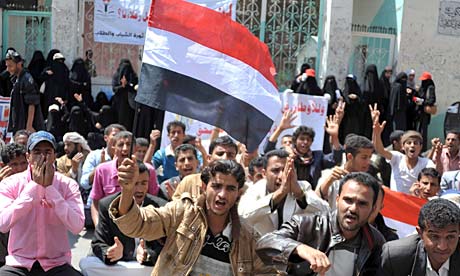
Yemeni anti-government protesters outside Sana'a University call for a boycott of university studies until President Ali Abdullah Saleh steps down. Photograph: Yahya Arhab/EPA
Yemeni forces reportedly opened fire with anti-aircraft guns and automatic weapons on tens of thousands of anti-government protesters who gathered on Sunday in the capital city, Sana'a, to demand the removal of President Ali Abdullah Saleh.
At least 26 people were killed and dozens were wounded, witnesses said, in the deadliest attack for months against protesters.
Tensions have been escalating in the long, drawn-out deadlock between the regime and the opposition. Saleh left for Saudi Arabia for treatment after being severely wounded in a 3 June attack on his palace, raising hopes for his swift removal but he has dug in, refusing to step down.
Demonstrations grew this week after Saleh assigned his vice president to negotiate a power-transfer deal – a move many believe is just the latest of many delaying tactics. Greater numbers of security forces and armed regime supporters have also been out on the streets, raising fears of a new bloody confrontation.
Witnesses said more than 100,000 protesters massed on Sunday around the state TV building and government offices, and security forces opened fire when they began to march toward the nearby presidential palace. Snipers fired from rooftops, and plainclothes Saleh supporters armed with automatic rifles, swords and batons attacked the protesters.
"This peaceful protest was confronted by heavy weapons and anti-aircraft guns," said Mohammed al-Sabri, an opposition spokesman. He vowed that the protests "will not stop and will not retreat".
A Yemeni opposition television network carried live footage of men carrying injured protesters on stretchers, including a motionless man whose face was covered with blood and bandaged. Other young men were lying on the floor in the chaotic field hospital.
Protesters throwing stones managed to break through security force lines and advance towards the Yemeni Republican Palace in the heart of Sana'a, turning the clashes with the security forces into street battles.
The Saba state news agency quoted a security official as saying that the Muslim Brotherhood had held "unlicensed protests" near the university of Sanaa, and "the militia threw firebombs at a power station, setting it on fire"
Although Saleh has been in Saudi Arabia since June, he has resisted calls to resign, despite a Gulf-mediated, US-backed deal under which he would step down in return for immunity from prosecution. Saleh has already backed away three times from signing the deal.
America once saw Saleh as a key ally in the battle against the dangerous Yemen-based al-Qaida branch, which has taken over parts of southern Yemen during the political turmoil. Its support was withdrawn as the protests gained strength.
Demonstrations also took place in many other Yemeni cities, including Taiz, Saada, Ibb and Damar, while government troops shelled for the third day a district in the capital held for months by a powerful anti-government tribal chief and his armed supporters.
Sheik Sadeq al-Ahmar said his fighters did not return fire after the shelling by the elite Republican Guard. Ahmar said he did not want to give Saleh any excuse not to sign a deal to transfer power after ruling the impoverished country for 33 years.
Pakistani officials say troops, Taliban militants clashed over downed drone
By Karin Brulliard and Haq Nawaz Khan, Updated: Monday, September 19, 2:02 AM
ISLAMABAD, Pakistan — Pakistani troops battled Taliban militants Sunday morning to win control of the remnants of a CIA drone that crashed in the nation’s borderlands, according to Pakistani security officials.
The cause of the crash of the unmanned Predator aircraft, among the drones the CIA uses to fire missiles at Taliban and al-Qaeda hideouts in the rocky region bordering Afghanistan, remained in dispute hours after it was downed in Zangarha village in South Waziristan. A military intelligence official based in the nearest city, Wana, said the drone suffered a mechanical failure. The Pakistani Taliban, a domestic offshoot of the Afghan insurgent organization, said its fighters had shot down the aircraft.
Comments .. Video .. inside .. Defense Secretary Leon Panetta on Wednesday expressed frustration with Islamabad, warning that the U.S. will not allow attacks on U.S. forces from Pakistan-based insurgents like the Haqqani network to continue.
Pakistan’s restive tribal belt is a no-go zone for journalists and outsiders, making it impossible to verify the accounts of the crash. U.S. officials do not publicly acknowledge or discuss the covert drone program, and the CIA declined to comment Sunday on the crash reports. The Pakistani security officials spoke on the condition of anonymity because they were not authorized to discuss the matter publicly.
But if the reports prove true, the crash would be among very few in the seven-year-long history of the drone campaign in Pakistan, and it could risk exposing extremely sensitive technology, including cameras and other sensors used to monitor insurgents. Although the Taliban might have little tactical use for the debris, some of Pakistan’s allies — including Iran and China — might be interested in it.
In May, a U.S. helicopter crashed during the American commando raid that killed terrorist leader Osama bin Laden in the northwestern Pakistani city of Abbottabad, and U.S. officials later said they suspected, but had not confirmed, that Pakistan gave the Chinese access to the largely destroyed helicopter. Pakistani officials denied doing so.
John Pike, a weapons expert at Globalsecurity.org, said that the drone crash Sunday could have exposed sensitive systems but that it would be difficult for adversaries to use the wreckage to replicate technology or adopt surveillance countermeasures. While the Chinese, for example, have sought to develop drone platforms and might gain insight from the downed U.S. aircraft, they already have a general understanding of drone capabilities. The downed copter, by contrast, used previously undisclosed stealth technologies.
“I don’t think the Chinese can do much more with it than the Taliban,” Pike said.
Drone strikes, which have skyrocketed during the Obama administration, are a growing source of tension between the United States and Pakistan, long-wary allies whose relationship has worsened this year. For years, the Pakistani government has allowed the program to continue while publicly protesting it and asking the United States to share its drone technology. But the Pakistani government’s tacit support for the drone campaign has waned as public outrage over it rises.
According to two Pakistani security officials, the drone crashed Sunday near a military base and Taliban militants quickly attempted to seize the debris. But the officials said Pakistani troops confronted the fighters and were able to collect the drone remnants after a clash lasting nearly four hours. Three militants were killed and two soldiers were injured in the fighting, an official from the paramilitary Frontier Corps said.
A Pakistani Taliban spokesman who identified himself as Saifullah Sayab said in a phone interview that 25 fighters used an antiaircraft gun to shoot down the drone. The Pakistani army deployed a gunship helicopter to repel the Taliban, he said.
Khan is a special correspondent. Staff writer Greg Miller in Washington contributed to this report.
Even Those Cleared of Crimes Can Stay on F.B.I.’s Watch List
People whose names appear on a government terrorist watch list can be barred from flying. Jim Watson/Agence France-Presse - Getty Images
Documenting the ‘Watch List” Process Documents obtained by the Electronic Privacy Information Center and provided to The New York Times open a window into the secretive process by which officials place the names of people suspected of links to terrorism on a “watch list” – a status that can keep them off planes, block them from entering the country, subject them to greater scrutiny or deny them government benefits and contracts. The documents,released by the Federal Bureau of Investigation under the Freedom of Information Act, shed new light on why it can be so difficult to get off the list, which was created after the terrorist attacks of Sept. 11, 2001, and had grown to include about 400,000 names by December 2009. http://www.nytimes.com/interactive/2011/09/28/us/20110928_WATCHLIST_DOC.html ]
By CHARLIE SAVAGE Published: September 27, 2011
WASHINGTON — The Federal Bureau of Investigation is permitted to include people on the government’s terrorist watch list even if they have been acquitted of terrorism-related offenses or the charges are dropped, according to newly released documents [ http://www.documentcloud.org/documents/253110-terror-watch-list-foia.html ].
The files, released by the F.B.I. under the Freedom of Information Act, disclose how the police are instructed to react if they encounter a person on the list. They lay out, for the first time in public view, the legal standard that national security officials must meet in order to add a name to the list. And they shed new light on how names are vetted for possible removal from the list.
Inclusion on the watch list can keep terrorism suspects off planes, block noncitizens from entering the country and subject people to delays and greater scrutiny at airports, border crossings and traffic stops.
The database now has about 420,000 names, including about 8,000 Americans, according to the statistics released in connection with the 10th anniversary of the Sept. 11 attacks. About 16,000 people, including about 500 Americans, are barred from flying.
Timothy J. Healy, the director of the F.B.I.’s Terrorist Screening Center [ http://www.fbi.gov/about-us/nsb/tsc ], which vets requests to add or remove names from the list, said the documents showed that the government was balancing civil liberties with a careful, multilayered process for vetting who goes on it — and for making sure that names that no longer need to be on it came off.
“There has been a lot of criticism about the watch list,” claiming that it is “haphazard,” he said. “But what this illustrates is that there is a very detailed process that the F.B.I. follows in terms of nominations of watch-listed people.”
Still, some of the procedures drew fire from civil liberties advocates, including the Electronic Privacy Information Center, which made the original request and provided the documents to The New York Times.
The 91 pages of newly disclosed files include a December 2010 guidance memorandum to F.B.I. field offices showing that even a not-guilty verdict may not always be enough to get someone off the list, if agents maintain they still have “reasonable suspicion” that the person might have ties to terrorism.
“If an individual is acquitted or charges are dismissed for a crime related to terrorism, the individual must still meet the reasonable suspicion standard in order to remain on, or be subsequently nominated to, the terrorist watch list,” the once-classified memorandum says.
Ginger McCall, a counsel at the Electronic Privacy Information Center [ http://epic.org/ ], said: “In the United States, you are supposed to be assumed innocent. But on the watch list, you may be assumed guilty, even after the court dismisses your case.”
But Stewart Baker, a former Homeland Security official in the Bush administration, argued that even if the intelligence about someone’s possible terrorism ties fell short of the courtroom standard of “beyond a reasonable doubt,” it could still be appropriate to keep the person on the watch list as having attracted suspicion.
Mr. Baker noted that being subjected to extra questioning — or even kept off flights — was different than going to prison.
The guidance memo to F.B.I. field offices says someone may be deemed a “known or suspected terrorist” if officials have “particularized derogatory information” to support their suspicions.
That standard may be met by an allegation that the suspect has terrorism ties if the claim is corroborated by at least one other source, it said, but “mere guesses or ‘hunches’ are not enough.”
Normally, it says, if agents close the investigation without charges, they should remove the subject’s name — as they should also normally do in the case of an acquittal. But for exceptions, the F.B.I. maintains a special file for people whose names it is keeping in the database because it has decided they pose a national security risk even though they are not the subject of any active investigation.
The F.B.I.’s Terrorist Screening Center shares the data with other federal agencies for screening aircraft passengers, people who are crossing the border and people who apply for visas. The data is also used by local police officers to check names during traffic stops.
The December memorandum lays out procedures for police officers to follow when they encounter people who are listed. For example, officers are never to tell the suspects that they might be on the watch list, and they must immediately call the federal government for instructions.
In addition, it says, police officers and border agents are to treat suspects differently based on which “handling codes” are in the system.
Some people, with outstanding warrants, are to be arrested; others are to be questioned while officers check with the Department of Homeland Security to see whether it has or will issue a “detainer” request; and others should be allowed to proceed without delay.
The documents show that the F.B.I. is developing a system to automatically notify regional “fusion centers,” where law enforcement agencies share information, if officers nearby have encountered someone on the list. The bureau also requires F.B.I. supervisors to sign off before an advisory would warn the police that a subject is “armed and dangerous” or has “violent tendencies.”
The F.B.I. procedures encourage agents to renominate suspects for the watch list even if they were already put on it by another agency — meaning multiple agencies would have to be involved in any attempt to later remove that person.
The procedures offer no way for people who are on the watch list to be notified of that fact or given an opportunity to see and challenge the specific allegations against them.
Chris Calabrese, a counsel with the American Civil Liberties Union [ http://www.aclu.org/ ], called the watch list system a “Star Chamber” — “a secret determination, that you have no input into, that you are a terrorist. Once that determination is made, it can ripple through your entire life and you have no way to challenge it.”
But Mr. Healy said the government could not reveal who was on the list, or why, because that would risk revealing intelligence sources. He also defended the idea of the watch list, saying the government would be blamed if, after a terrorist attack, it turned out the perpetrator had attracted the suspicions of one agency but it had not warned other agencies to scrutinize the person.
Mr. Healy also suggested that fears of the watch list were exaggerated, in part because there are many other reasons that people are subjected to extra screening at airports. He said more than 200,000 people have complained to the Department of Homeland Security about their belief that they were wrongly on the list, but fewer than 1 percent of them were actually on it.


 Market Data
  Markets


 AI
AI