Surprise, heard a not guilty plea .. grounds of insanity?
26 July 2011 Last updated at 11:47 GMT
Norway: Anders Behring Breivik insane, his lawyer says .. video inside ..
Lawyer Geir Lippestad: ''This whole case has indicated that he is insane''
The lawyer defending Anders Behring Breivik, who admitted carrying out Friday's mass killings in Norway, says his client is probably insane.
However he added it was too early to say Mr Breivik would plead insanity.
The bombing in Oslo and shooting spree on a nearby island killed 76 people. Mr Breivik is facing terrorism charges.
Police are considering also charging him with crimes against humanity, which carry a possible 30-year sentence, a prosecutor has said.
Mr Breivik's lawyer, Geir Lippestad, told reporters: "This whole case indicated that he is insane."
He said his client believed that he was in a war and that he would be vindicated in 60 years' time.
Mr Lippestad added that Mr Breivik had said he was part of an anti-Islam network that has two cells in Norway and several more abroad.
Norwegian police and researchers have cast doubt on such claims, but said they were investigating them.
Earlier on Tuesday, prosecutor Christian Hatlo told Aftenposten that a new charge of crimes against humanity, which could be brought under a 2008 law, was currently only "a possibility".
Police spokesman Sturla Henreiksboe told AFP news agency: "Police have so far cited... the law on terrorism but seeking other charges has not been excluded."
On Monday up to 250,000 people poured on to the streets of the capital, many of them raising up flowers in memory of the eight people killed in the Oslo blast and the 68 who died at a youth camp on Utoeya.
Later on Tuesday, police are due to formally release the names of the victims.
Breivik sent 'manifesto' to 250 UK contacts hours before Norway killings
Using the name Andrew Berwick, Norwegian killer emailed 1,500 page document and YouTube video across Europe
Matthew Taylor guardian.co.uk, Tuesday 26 July 2011 23.58 BST
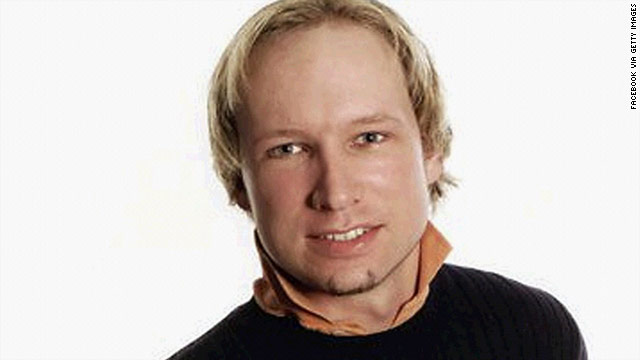
Anders Behring Breivik emailed his 1,500-page manifesto to far -right contacts across western Europe. Photograph: AFP/Getty Images
The man responsible for the mass killing in Norway emailed his 1,500-page document to 250 British contacts less than 90 minutes before he began his attack, according to a Belgian MP.
Anders Behring Breivik sent his manifesto to 1,003 email addresses at 2.09pm on Friday – less than an hour and a half before he detonated a bomb in Oslo.
According to Tanguy Veys MP for the rightwing anti-Muslim party Vlaams Belang, – and one of those who received the document – approximately a quarter of those on the email list were UK-based.
"I think the UK was the biggest group [of recipients]," he told the Guardian last night. "There were people from Italy, France Germany … but the UK was the biggest number."
Using the name Andrew Berwick, Breivik emailed his manifesto and a link to a YouTube video and addressed each recipient "Western Europe patriot" and wrote: "It is a gift to you … I ask you to distribute it to everyone you know."
It has been reported that Scotland Yard's domestic extremism unit, which is investigating Breivik's British links, has been sent a list of UK-based email addresses although the Met refused to confirm that.
Veys said he had not had any contact with Breivik and condemned his actions.
"Looking through this it seems very difficult to find a criteria for who he sent it to … it is very strange and I am cross I have been associated with him in any way."
The news of the emails came as anti-racism campaigners in the UK said they believed Breivik may have been in touch with activists from the far-right English Defence League as recently as March.
Searchlight, the anti-fascist magazine, said the 32-year-old used the pseudonym of a 12th-century Norwegian king who led one of the Crusades to communicate with people on an English Defence League forum.
In one posting, on 9 March, the author called on rightwing activists in the UK to "keep up the good work". The message said: "Hello. To you all good English men and women, just wanted to say that you're a blessing to all in Europe, in these dark times all of Europe are looking to you in such [sic] of inspiration, courage and even hope that we might turn this evil trend with islamisation all across our continent. Well, just wanted to say keep up the good work it's good to see others that care about their country and heritage. All the best to you all. Sigurd."
Breivik boasted about his links to the UK far-right group in his manifesto. He also wrote that he was given the codename "Sigurd (the Crusader)" at a founding meeting of a group called the Knights Templar Europe in London in 2002. There is no confirmation that the author is Breivik. Sigurd is a common name in Norway.
In other messages, "Sigurd" says he attended a football ground in the UK and expressed his admiration for the EDL.
"I've seen with my own eyes what has happened to england, i was in bradford some years ago, me and a friend walked down to the football stadium of bradford, real 'nice' neighborhood, same thing in the suburbs of london. well thinking about taking a little trip over the sea and join you in a demo. would be nice with a norwegian flag alongside with union jack or the english flag, that is if a norwegian would be welcome offcourse?"
In another message, he goes on to discuss the situation in Norway.
"The biggest problem in Norway is that there is no real free press, there is a left-wing angle on all the political topics so most people are going around like idiots. And offcourse with our norwegian labour party beeing in power for most of the last 50 years dont help. but i i think there is an awakening now at least i hope so."
In his manifesto, Breivik repeatedly refers to the EDL, stating at one point: "I used to have more than 600 EDL members as Facebook friends and have spoken with tens of EDL members and leaders."
"In fact, I was one of the individuals who supplied them with processed ideological material (including rhetorical strategies) in the very beginning."
"There also appears to be a growing dispute among some figures associated with the EDL over who Breivik's "mentor" Richard may be. In his manifesto, the Norwegian said he met "Richard" at the Knights Templar meeting in 2002 and says the pair became "close."
The EDL – which has staged a series of street demonstrations, many of which have turned violent, denies any links to Breivik and has condemned the killings, stating it is a peaceful organisation that rejects all forms of extremism.
Last night the EDL said in an emailed statement that it was "not aware of any contact between Breivik and EDL leadership … of anyone using the name Sigurd and the forum".
"You must realise anyone on the EDL Forum or EDL Facebook can join and make up any name that they may choose."
Since the killings there have been unconfirmed reports that Breivik attended EDL demonstrations in the UK last year – possibly in London and Newcastle
Suspect admired bloggers who believe Europe is drowning in Muslims
Norway attacks suspect Anders Behring Breivik frequented websites that see the modern world as a "clash of civilizations".
By Tim Lister, CNN July 27, 2011 -- Updated 0631 GMT (1431 HKT)
(CNN) -- Andres Behring Breivik was a prolific blogger and visitor to online sites that reaffirmed his worldview.
Breivik's taste in online conversation shows a compulsive interest in websites that see the modern world in terms of a "clash of civilizations," where Christian values are supposedly under siege in the face of an Islamic onslaught.
But rarely if ever does he seem to have advocated a violent response to what he saw as the Islamization of Europe, even as he planned a massacre for years.
The head of Norway's intelligence police, Janne Kristiansen, told a Norwegian newspaper Monday that Breivik had "deliberately desisted from violent exhortations on the net. He has more or less been a moderate, and has neither been part of any extremist network."
The blogs and websites Breivik enthused about were pro-American and pro-Israel, extremely hostile to Islam and despairing that the European political elite would ever see the error of its liberal multicultural outlook.
One such site is Gates of Vienna, whose banner reads: "At the siege of Vienna in 1683 Islam seemed poised to overrun Christian Europe. We are in a new phase of a very old war."
Breivik regularly applauded a writer who goes by the name of Fjordman on the site, one of whose contributions, from 2007, reads: "When the Swedish welfare state collapses, the immigrants who lose their payments will have to go somewhere. Denmark will probably be fairly successful at keeping them out. A lot of them will migrate to Norway, some will move to Germany and the Netherlands, and some will probably end up in Eastern Europe."
Breivik also praised Fjordman's book, "Defeating Eurabia," describing it as "the perfect Christmas gift for family and friends."
The book contends that Europe is being overrun by Muslims -- and that its governing class is complicit in this surrender. "According to some, one out of three babies born in France is a Muslim," Fjordman writes.
"Hundreds of Muslim ghettos already de facto follow sharia, not French law. Some believe France will quietly become a Muslim country, while others predict a civil war in the near future."
Fjordman has never advocated violence and has condemned Breivik's actions, posting on Gates of Vienna: "Any person doing such a thing is a monster. He murdered dozens of people in cold blood and injured countless others, mentally or physically."
Efforts by CNN to identify Fjordman have been unsuccessful.
Breivik was a prolific contributor to a Norwegian site, Document.no, in 2009 and 2010, purportedly posting such comments as: "Can you name ONE country where multiculturalism is successful where Islam is involved?" and "Today's Protestant church is a joke. Priests in jeans who march for Palestine and churches that look like minimalist shopping centers."
Other websites and blogs he followed include Jihad Watch, Brussels Journal, TheReligionofPeace and Atlas Shrugs. ReligionofPeace describes Islam as a "rigid political and cultural system with a mandate to conquer and govern the lives of others via necessary force."
Breivik points to a piece written by Pamela Geller in Atlas Shrugs in July 2009. "The Muslims have taken to rampaging, destroying and setting alight the streets of France. The media has abetted the fifth column with cowardly silence," she writes.
Geller has been prominent in opposition to the building of a mosque near Ground Zero in New York.
She notes there is just one reference to her in Breivik's purported 1,500-page manifesto, and ridicules the notion that she could have influenced his behavior.
"Anders Behring Breivik is responsible for his actions," she writes. But she adds: "If anyone incited him to violence, it was Islamic supremacists. If anything incited him to violence, it was the Euro-Med policy," a reference to immigration to Europe from North Africa.
Geller also complains, in a posting Tuesday, about "More expected grotesque exploitation and opportunism from Muslim Brotherhood groups in America" of the Oslo attack.
But to her long-time adversary Jeffrey Goldberg at the Atlantic magazine, Geller and others of like mind clearly influenced Breivik: "Free speech means free speech. But she should be aware now that violent people look to her for guidance, and she should write with that in mind."
On his blog Sultan Knish, Daniel Greenfield says that "trying to apply rational standards to Breivik is futile. Like many killers he was of above average intelligence, but below average sanity. Remove the politics, and Breivik fits the profile of most spree killers. He was angry at society, a loner ..."
Another conservative blogger, Mark Steyn, agrees. In a blog entitled "Islamophobia and Mass Murder" for the National Review Online, he argues that attaching the far-right tag to Breivik is pointless.
"This man Breivik may think he's making history and bestriding the geopolitical currents and the clash of civilizations, but in the end he went and shot up his neighbors. Why let his self-aggrandizing bury the reality?" Steyn wrote Monday.
But Greenfield insists Breivik's attacks did have a cause: "The Oslo killings are another item on the ledger of the high cost of Islam. The explosive rage on both sides fueled by a social instability created by aggressive immigration with no thought to its impact on the country as a whole. It was Breivik who spent nine years planning and carrying out the attacks, but it was the political authorities who had created a scenario that made it possible."
One of Breivik's entries on Document.no compliments the far-right English Defence League. "The tactics of the EDL is now out to 'entice' an overreaction from Jihad Youth / Extreme-Marxists -something they have succeeded several times already," he writes.
The EDL has also condemned Breivik -- saying that "Anyone who expresses any extremist beliefs of any kind, be it white supremacist, Christian fundamentalist or Islamic extremists, they all get banned from the (Facebook) site." But its leader Tommy Robinson echoed Greenfield and Geller in a BBC interview, saying: "There are British people that are greatly concerned about the threat Islam that is having on our nation ... There needs to be a platform given to people so they can have their frustrations heard."
Mark Steyn fears the platform for debate will actually shrink as a result of Breivik's rampage. "Free societies can survive the occasional Breivik," he wrote in a post Monday for the National Review Online. "If Norway responds to this as the Left appears to wish, by shriveling even further the bounds of public discourse, freedom will have a tougher time."
Bomb and terror suspect Anders Behring Breivik leaves the courthouse in a police car in Oslo Monday.
By Magnus Ranstorp, Special to CNN July 26, 2011 -- Updated 1240 GMT (2040 HKT)
Editor's note: Magnus Ranstorp is research director of the Center for Asymmetric Threat Studies at the Swedish National Defence College. He is a member of World Economic Forum Global Agenda Council on Terrorism for 2011-2012 and he testified before the 9/11 Commission in 2003.
(CNN) -- To borrow the title of Sebastian Junger's book, a "perfect storm" helped lead to the extremist thinking of Norway massacre suspect Anders Behring Breivik.
Globalization, extremist websites propagating the theory of Eurabia -- the colonization and Islamization of Europe -- and role-playing games all blend into one conspiratorial outlook that captures how Breivik views the world, how he defines his enemies, the fantasy world he sought to re-create in the real world and his narcissistic view of his role in the "resistance struggle" and the legacy he would leave behind.
I've read the purported 1,500-page manifesto of Breivik for hours on end to get an insight into the man suspected of staging Friday's terrorist attacks that claimed 76 lives. The picture that emerges is rather more complex and disturbing than I initially thought.
Breivik carefully constructs a "stormy," threatening and "globalized" world that he blames for bringing refugees and foreigners into Norway and the West. It is striking how he lacked the skills to critically question his sources of information for veracity and to filter and relate facts, arguments and interpretations.
He represents the exception rather than the norm in right-wing extremist circles. Traditionally, right-wing extremism has been disorganized and impulsive, and it has often been manifested through localized hate crimes against immigrants. These sporadic acts, often committed by educational underachievers, can usually be contained and managed by police and security services.
Breivik was the polar opposite. His nine-year preparation for creating the lengthy manifesto and the violent action that he argues for and documents in minute detail contradicts our traditional view. He argues against impulsive acts of harassing foreign immigrants in favor of spectacular, well-prepared attacks.
Having only a high school degree, he claims he has self-studied for more than 16,500 hours, the equivalent of several college and graduate degrees.
The second half of the purported manifesto is a DIY-manual of how to conceal and prepare an underground terrorist cell -- almost entirely derived from open sources. It is striking how he has utilized those sources to conduct surveillance on potential targets, to protect his operational tradecraft and potential recruits against detection and to organize into so-called armed resistance groups. Of particular concern is his discussion of how to target installations such as nuclear facilities and to stage spectacular attacks.
The goal is of course to create an "awakening" of the masses -- a war between the West and the Muslim world. He believes in shock-and-awe terrorist tactics. And he knows how to utilize psychological warfare in pursuit of his goals.
Ending multiculturalism and expelling foreign influences are key goals in his vision. Yet it is remarkable how Breivik's worldview mirrors that of his principal enemies -- the jihadists' own discourse: the role of martyrs in igniting widespread support; and the struggle where the glorious past is projected onto a long-ranging promising future.
Ironically and inadvertently, Breivik copies the blueprint of do-it-yourself terrorism campaigns and the themes of "resistance" from al Qaeda-inspired sources. His DIY section is an indirect copy of the jihadist revolutionary theoretician Abu Musab al-Suri.
Besides the mind-numbing detail about weapons systems and operational art, the manifesto provides a unique insight into the mindset of a right-wing extremist and the thought processes involved in conducting a terrorist operation. Few other documents exist providing such insight into a disturbed mind.
It is evident that he has thought through every aspect of igniting the fires to generate new followers and bolster the cause. Simultaneously he is in command of the marketing aspect and of his persona as he tries to pre-empt journalists' questions.
Toward the end of the manifesto he has a lengthy Q&A dissecting every conceivable aspect of his personal background and why he acted. He is in command of his image. This is macabre theatre, and he is the central character whose mission and personal legacy is everything.
Rarely before have we been able to get into the head of an extremist in quite this way. Breivik even spells out what music he planned to listen to on his iPod as he carried out the shooting.
By providing such a detailed blueprint, Breivik has exposed his own psychological state and his weaknesses, which will provide guidance to police and government security forces seeking to prepare for and prevent future attacks.
The opinions expressed in this commentary are solely those of Magnus Ranstorp.
Manifesto suggests massacre suspect troubled, not insane, experts say
Several experts agreed that Anders Behring Breivik seems to have more in common with mass killers than with many typical extremists.
By Josh Levs, CNN July 26, 2011 -- Updated 2329 GMT (0729 HKT)
(CNN) -- Norwegian massacre suspect Anders Behring Breivik's purported 1,500-page manifesto paints a picture of a deliberative, driven killer -- not a rambling crazy person, criminologists said Tuesday.
Speaking to CNN after Breivik's attorney said his client "may be" insane, Brian Levin, a criminologist with California State University, San Bernardino, rejected the suggestion. Based on what is known at this point, "he's not crazy," Levin said; he is a "sociopath," but "not crazy."
Criminologist James Alan Fox of Northeastern University echoed those sentiments. "The behavior is crazy, but not necessarily the state of mind of the person committing it," he said. "Mass murderers rarely are psychotic. They know what they're doing. They don't hear voices in an empty room. They're mad, but (mad) in terms of bitter and resentful -- not how we often use 'mad' to describe mental illness," he said.
Both said a "crazy" person can be commonly understood as someone who cannot tell the difference between right and wrong and does not understand the nature and consequences of his actions.
Breivik, 32, has acknowledged carrying out a bombing and a shooting rampage Friday, a judge said Monday. Authorities say eight people were killed in the bombing of an Oslo building that houses Prime Minister Jens Stoltenberg's offices, and 68 were killed at a youth summer camp run by his ruling Labour Party. Breivik said the attacks were necessary to prevent the "colonization" of the country by Muslims, the judge said.
Experts -- who have not met Breivik but have examined materials purported to be from him -- had different takes Tuesday on whether the manifesto suggests he was motivated more by ideology or by a desire for infamy. But several agreed that he seems to have more in common with mass killers, from "Unabomber" Ted Kaczynski to Virginia Tech shooter Seung-Hui Cho, than with many terrorists and typical right-wing extremists.
"If you see this killer as only a terrorist, you might see him as exceptional," said Jack Levin, also a criminologist with Northeastern University. "If you see him also as a mass killer, he fits the mold."
Levin said Breivik's purported manifesto and the "Hollywood-type photos of himself" -- including one in which he is dressed in a wetsuit with a patch that reads "Marxist Hunter" and holding a high-powered rifle -- suggest a "personal pathology, the need to be a celebrity, to achieve worldwide infamy may have been the real motive for this crime," more than an effort to cause terror among a specific population.
Cho, who killed 33 people at Virginia Tech in 2007, also had a manifesto and took photos and a video of himself, Levin said.
Fox, Jack Levin's colleague at Northeastern, had a similar view. "I think this is more about vanity than insanity ... and in fact more self-promotion than promoting any particular ideology," he said.
"The posed photographs, video, and of course the manifesto -- it seems to be all about him. And when you consider his background, (he was) fairly unsuccessful, which is something you find commonly among mass murderers. They see, through their crimes, the opportunity to feel like a big shot."
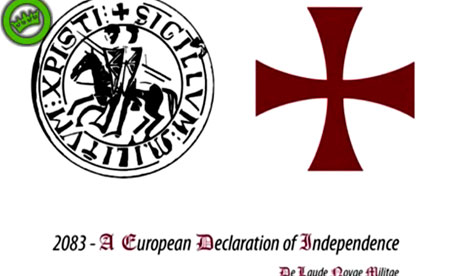
The manifesto vows that a "European civil war" will lead to the execution of "cultural Marxists" and the banishing of Muslims. At one point, the writer states that his "European Declaration of Independence" took him nine years to complete. The document contains a link to a video.
The writer identifies himself as Anders Behring Breivik.
CNN could not independently verify that Breivik wrote the document or posted the 12-minute video, and Norwegian authorities would not confirm that the man in their custody wrote the manifesto, saying it was part of their investigation.
Breivik says that he was in touch with two terror cells in Norway and in contact with other cells abroad, but that he acted alone in carrying out the attacks, his attorney said Tuesday.
Fox noted that "mass murders are typically well-planned executions."
Fox added that Breivik's apparent manifesto suggests similarities to U.S. domestic terrorist Timothy McVeigh, who killed 168 people in the 1995 bombing of a federal building in Oklahoma City, and to Kaczynski, who killed three people and wounded 23 others in a string of bombings from 1978 to 1995. The FBI dubbed him the "Unabomber" because of his early targets: universities and airlines.
"McVeigh had his own grudge against the government. And the Unabomber had his issues with technology. And in these cases and many more, they used murder as their means of filing a complaint," Fox said.
Magnus Ranstorp, research director of the Center for Asymmetric Threat Studies at the Swedish National Defence College, wrote in an editorial for CNN.com that Breivik "represents the exception rather than the norm in right-wing extremist circles.
"Traditionally, right-wing extremism has been disorganized and impulsive, and it has often been manifested through localized hate crimes against immigrants. ... Breivik was the polar opposite. His nine-year preparation for creating the lengthy manifesto and the violent action that he argues for and documents in minute detail contradicts our traditional view. He argues against impulsive acts of harassing foreign immigrants in favor of spectacular, well-prepared attacks."
Levin of California State University, San Bernardino, said Breivik is "much more deliberative" than people "like the impulsive neo-Nazi" who goes out and attacks people, and seems to be more similar to McVeigh, who planned his attack deliberately.
Levin said he believes ideology was probably Breivik's chief motivation -- and seeking personal benefit took a back seat.
"We're seeing the rise of the aspirational extremist," Levin said, describing someone who "perceives society as careening out of control off a cliff."
"This guy Breivik had a very tight ideological argument for what he was doing," the criminologist said.
Setbacks in Breivik's life certainly played a role as well, Levin said. "When people face a ruthlessness and some kind of personal setback and they've already been accustomed to an ideology that gives them comfort, they can ramp it up to violent forms of it."
Levin warned against writing off Breivik, with his "Islamophobic" writings, as a lone exception who does not reflect broader thinking around him. "While the violence was extreme, the actual sentiments are sentiments that are widely expressed in some form throughout the mainstream of Europe," he said.
Anders Behring Breivik had links to far-right EDL, says anti-racism group
EDL leader Stephen Lennon denies claims Anders Behring Breivik attended EDL demonstrations. Photograph: Ben Stansall/AFP/Getty Images
Searchlight wants English Defence League classified as extremist group amid claims of online discussions with Breivik
Matthew Taylor guardian.co.uk, Tuesday 26 July 2011 16.45 BST
Anti-racism campaigners believe they may have uncovered evidence that Anders Behring Breivik, the man who carried out the mass killings in Norway, was in touch with activists from the English Defence League as recently as March.
Searchlight said the 32-year-old used the pseudonym of a 12th-century Norwegian king to communicate with people on the EDL forum before retreating to a remote farm to prepare for last week's attacks.
In one posting, on 9 March, the author called on rightwing activists in the UK to "keep up the good work".
"Hello. To you all good English men and women, just wanted to say that you're a blessing to all in Europe, in these dark times all of Europe are looking to you in such [sic] of inspiration, courage and even hope that we might turn this evil trend with islamisation all across our continent. Well, just wanted to say keep up the good work it's good to see others that care about their country and heritage. All the best to you all. Sigurd"
Breivik boasted about his links to the UK far-right group in his 1,500-page manifesto, written in English under his Anglicised name, Andrew Berwick.
In the document, he says he was given the codename "Sigurd (the Crusader)" at a meeting of a group called the Knights Templar Europe in London in 2002. There is no confirmation that the author is Breivik. Sigurd is a common name in Norway.
In messages, "Sigurd" says he attended a football match in the UK and expresses his admiration for the EDL, adding that he would like join one of its demonstrations.
"i've seen with my own eyes what has happened to england, i was in bradford some years ago, me and a friend walked down to the football stadium of bradford, real 'nice' neighborhood, same thing in the suburbs of london. well thinking about taking a little trip over the sea and join you in a demo. would be nice with a norwegian flag alongside with union jack or the english flag, that is if a norwegian would be welcome offcourse?"
In another message, he goes on to discuss the situation in Norway.
"The biggest problem in Norway is that there is no real free press, there is a left-wing angle on all the political topics so most people are going around like idiots. And offcourse with our norwegian labour party beeing in power for most of the last 50 years dont help. but i i think there is an awakening now at least i hope so."
In his manifesto, Breivik repeatedly refers to the EDL, stating at one point: "I used to have more than 600 EDL members as Facebook friends and have spoken with tens of EDL members and leaders."
"In fact, I was one of the individuals who supplied them with processed ideological material (including rhetorical strategies) in the very beginning."
The EDL – which has staged a series of street demonstrations, many of which have turned violent, since it was formed two years ago – denies any links to Breivik and has condemned the killings, stating it is a peaceful organisation that rejects all forms of extremism.
There have also been claims that Breivik attended EDL demonstrations in London and Newcastle upon Tyne last year. One alleged EDL activist posted a comment online on Sunday stating: "[B]ar one or two doubt the rest of us ever met him, altho he did come over for one of our demo in 2010 … but what he did was wrong."
Another alleged EDL supporter suggested in a separate forum that she had come across Breivik in the UK. "OMG [Oh, my God] … HIM?! He wrote some books and did talks didn't he?"
Stephen Lennon, the leader of the EDL, told the BBC on Monday he had never met Breivik and added that he did not believe the Norwegian had attended any EDL demonstration. He also pointed out that at one point in his manifesto Breivik described the EDL as "naive fools" who believed in the democratic process.
Searchlight's editor, Nick Lowles, said there was now "clear evidence" of a direct link between Breivik and the English Defence League.
"The Home Office must now formally classify the EDL as an extremist organisation and allow the police to deploy the same manpower and resources to monitoring their activity as they would other extremist groups. It's also clear that the proposed EDL march in Tower Hamlets cannot be allowed to proceed."
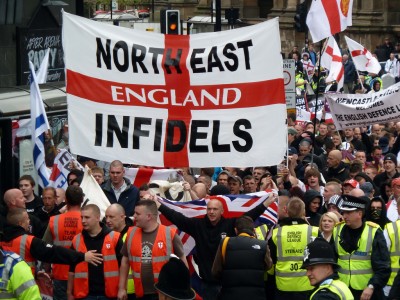
An English Defence League (EDL) demonstration in Newcastle, England, during 2010. Oslo attacks suspect Anders Behring Breivik claims to have links with the group. PHOTO: Wikipedia Commons
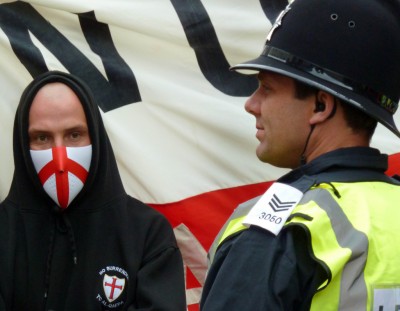
An English Defence League (EDL) activist at a demonstration in 2010. PHOTO: Wikipedia Commons
July 26, 2011
The international search for accomplices and supporters of the Oslo and Utøya attacks suspect Anders Behring Breivik has begun, as Norwegian police revealed that he had been on one of their lists as early as March. His links to British far right organizations and extremists have sparked an investigation in the country.
Breivik’s 1,500-page online manifesto, signed with the anglicized pseudonym “Andrew Berwick” and claiming to have been written in London, mentions a number of links to the far right in Britain. The suspected terrorist further claimed in his appearance in an Oslo court on Monday that there were two further “cells” in operation to which he was connected.
British links revealed
Breivik’s manifesto mentions a British mentor named “Richard,” who is yet to be identified but is believed to be named after the British king “Richard the Lionheart,” famed for his involvement in the Crusades. One British newspaper, The Daily Telegraph, claims to have found a blog written by someone calling himself “Lionheart” and authorities are now investigating.
The “Lionheart” blogger’s real name is Paul Rey, who claims to be a “founding father” and active participant in the English Defence League (EDL). The EDL has held a number of violent anti-Islamic demonstrations in the UK in recent years. In his manifesto, Breivik said, “I used to have more than 600 EDL members as Facebook friends and have spoken with EDL members and leaders.” He claims to be “one of the individuals who supplied them with processed ideological material (including rhetorical strategies) in the very beginning.” In other comments attributed to Breivik online, he states that a key strategy for “Christian conservatives” in Norway is to establish their own version of the EDL.
Breivik ‘participated in British demonstrations‘
The EDL have released a statement that reads, “we can categorically state that there has never been any official contact between him and the EDL.” Nonetheless, a number of EDL members have informed The Daily Telegraph that they have had contact with Breivik. He is believed to have been in London as part of a far-right solidarity demonstration when Dutch politician Geert Wilders visited Britain.
An EDL organizer, Daryl Hobson, told The Daily Telegraph that several members of the organization had met Breivik. A Facebook post from Hobson also claims that Breivik “did come over for one of our demo [sic] in 2010,” before going on to say that “what he did was wrong.” An anonymous member of the EDL also told the newspaper that they had met Breivik, suggesting that EDL members would be taken by an “extremely intelligent” man. “It’s like Hitler, people said he was hypnotic,” the source is quoted as saying. Another alleged EDL member, Katie Hedderick, posted on a message board about Breivik, stating “HIM?! He wrote some books and did talks didn’t he?”
The founder of the EDL, Stephen Lennon, told BBC news programme Newsnight on Monday night that “we’re against it [the Oslo attacks] but at the same time you cannot brush off millions of people who have concerns against Islam as lunatics.” Lennon has previous convictions for violence as part of scenes of football hooliganism. Another EDL leader, Tommy Robinson, is quoted by The New Yorker as saying, “we don’t want English lads blowing themselves up on our soil, but that will happen if they don’t give us a platform.”
‘Knights Templar’ and ‘Norwegian Defence League’
The order of the Knights Templar that Breivik claims to have been a member of, described as the “Knights Templar Europe,” was also apparently established in London in 2002. Breivik states that its aim is “to seize political and military control of western European countries and implement a cultural conservative political agenda.” In his manifesto, Breivik claims to be the youngest in the group and had been put in contact with them through a “Serbian crusader commander.” He also claimed that the group later held larger meetings in “Balticum.”
A source in the Norwegian Defence League (NDL) has now also confirmed to newspaper Aftenposten that Breivik was a member, and that he used the pseudonym “Sigurd Jorsalfar.” Breivik was apparently active in the organization’s foundation but became increasingly less involved because “he believed we [the NDL] were too kind.” The NDL arranged its first demonstration on April 9, when just nine followers showed up and a large counter-demonstration was held by anti-fascists. The source said that the group “completely and utterly” distances itself from the attacks.
Britain investigates
British Prime Minister David Cameron has promised to investigate links between Breivik and the EDL, confirming to a number of news outlets that he takes them “extremely seriously.”
A British police expert has already been dispatched to Oslo to assist the police in identifying Breivik’s international connections. Europol are also assisting the Norwegian police, making use of their continental database of known far right extremists.
Breivik was on police list
Meanwhile, the Norwegian Police Security Service (Politiets sikkerhetstjeneste, PST) confirmed on Monday that Breivik had come to their attention in March on a list of people who had bought products from a Polish firm selling chemicals. Breivik was reportedly checked but no further action was deemed necessary.
The PST’s director, Janne Kristiansen, told Norwegian Broadcasting (NRK) that his name was listed along with around 50 to 60 others “in connection with a currency check from an international customs project.” She added that the police “are not allowed without further grounds to put such names in our register, but we checked if we had anything else on the people on the list, if there was anyone that could be connected to other information we have, but we had absolutely nothing on Breivik.”
Kristiansen went on to say that following the attacks, the PST will not push for “methods or regulations where we will be able to keep surveillance over all people,” adding that “not even in the old East Germany, I believe, would one have been able to become aware of Breivik because he quite simply has not broken the law before.”
The PST has also said before that “lone wolves are something we cannot intercept in the kind of society we want to have.”
Geir Lippestad, the defence lawyer for Anders Behring Breivik Photo: AFP/GETTY IMAGES
Geir Lippestad is a personification of everything Anders Behring Breivik hates about Norway. He is also the killer's lawyer.
4:51PM BST 26 Jul 2011
Urbane, liberal and fluent in English, Mr Lippestad was shocked when he was contacted by police at home and told that Norway's most hated man has asked for his help.
For several hours he hesitated and discussed with friends and family whether to defend a man who only hours early had massacred 68 young people on a summer holiday island.
But in the end his civic instincts trumped his initial horror. "I believe that the legal system is very important in a democracy and someone has to do this job," he told reporters this afternoon.
There are two further twists to the relationship between killer and client. First, it was revealed Breivik had once rented an office close to where Mr Lippestad's firm is based.
They lawyer said he had never met Breivik before the killing but it's possible that the gunman knew who he was and singled him out long in advance.
Second, Mr Lippestad is also a prominent member of the ruling Labour Party, whose youth wing the terrorist targeted on Friday.
At one point he was deputy chair of the constituency party in Nordstrand, a borough of Oslo.
At his remand hearing, Breivik said the Labour Party had failed the Norway and left the country to be "colonised by Muslims."
But a clue to Breivik's choice may lie in Mr Lippestad's past: in 2002 he represented a neo-Nazi who murdered a mixed race teenager in Oslo.
The death of Benjamin Hermansen, whose mother was Norwegian and whose father was Ghanaian, sparked outrage in Norway and led to large marches against racism.
Michael Jackson even dedicated his number-one album Invincible to Benjamin's memory.
The case propelled Mr Lippestad to national attention as a man who believes that even the most brutal murderers deserve a fair trial.
Now the eyes of the world will be on him as he makes the case to defend Breivik's savagery.
Europe's Right-Wing Populists Find Allies in Israel
A woman in a headscarf walks past a campaign poster for the Freedom Party of Austria depicting party leader Heinz-Christian Strache.
By Charles Hawley 07/29/2011
Islamophobic parties in Europe have established a tight network, stretching from Italy to Finland. But recently, they have extended their feelers to Israeli conservatives, enjoying a warm reception from members of Prime Minister Benjamin Netanyahu's coalition. Some in Israel believe that the populists are Europe's future.
Part 2: Allied with the Settlers: Below
A woman in a headscarf walks past a campaign poster for the Freedom Party of Austria depicting party leader Heinz-Christian Strache.
Islamophobic parties in Europe have established a tight network, stretching from Italy to Finland. But recently, they have extended their feelers to Israeli conservatives, enjoying a warm reception from members of Prime Minister Benjamin Netanyahu's coalition. Some in Israel believe that the populists are Europe's future. Info
Anders Breivik's 1,500-page manifesto is nothing if not thorough. Pages and pages of text outline in excruciating detail the ideological underpinnings of his worldview -- one which led him to kill 76 people in two terrible attacks in Norway last week.
It is a document which has led many to question Breivik's sanity. But it has also, due to its myriad citations and significant borrowing from several anti-immigration, Islamophobic blogs, highlighted the deeply entwined network of right-wing populist groups and parties across Europe -- from the Front National in France to Vlaams Belang in Belgium to the Freedom Party of Austria (FPÖ).
But recently it has become clear that Europe's populist parties aren't merely content to establish a network on the Continent. They are also looking further east. And have begun establishing tight relations with several conservative politicians in Israel -- first and foremost with Ayoob Kara, a parliamentarian with Israeli Prime Minister Benjamin Netanyahu's Likud party who is also deputy minister for development of the Negev and Galilee districts.
The reason for the growing focus on Israel is not difficult to divine. "On the one hand," Strache told SPIEGEL ONLINE in a recent interview, "we are seeing great revolutions taking place in the Middle East. But one can't be totally sure that other interests aren't behind them and that, in the end, we might see Islamist theocracies surrounding Israel and in Europe's backyard."
In other words, in the battle against what right-wing populists see as the creeping Islamization of Europe, Israel is on the front line.
'More Sensitive to the Dangers'
Many in Israel see it the same way. Eliezer Cohen, known in Israel by his nickname "Cheetah," says that leftist parties in both Europe and Israel have lost their way. Cohen, a decorated Israeli air force colonel now in retirement, is a former member of the Knesset with Yisrael Beiteinu, the hardline nationalist party led by Foreign Minister Avigdor Lieberman that currently governs together in a coalition with Prime Minister Benjamin Netanyahu's Likud party.
"Right-wing politicians in Europe are more sensitive to the dangers facing Israel," Cohen, who gave a keynote address during Dutch right-wing leader Geert Wilders' visit to Berlin last October, told SPIEGEL ONLINE. "They are talking the exact same language as Likud and others on the Israeli right. I'm too old for bullshitting -- we hope the right wing wins out in Europe."
Kara sounds no different. "I am looking for ways to lessen the Islamic influence in the world," Kara told the Israeli daily Maariv in June. "I believe that is the true Nazism in this world. I am the partner of everyone who believes in the existence of this war."
At first glance, the European populists' relationship with Israel would hardly appear to be a marriage built on love. Many see the FPÖ as being just one tiny step away from classic neo-Nazi groups and the same holds true for their partners throughout Europe. While such parties insist that they are not anti-Semitic -- Strache claims that he takes a close look at populist parties' stances toward Israel and Jews before he enters into partnerships with them -- it is not difficult to find indications of extreme, anti-Zionist and anti-Semitic vitriol from within the populist party membership rolls.
Andreas Mölzer, for example, a member of the European Parliament for the FPÖ who has recently changed his tune to defend Strache's approaches to Israel, edits a weekly called Zur Zeit which is replete with attacks on Israel. Following its incursion into the Gaza Strip in late 2008, the paper accused Israel of acting in "the Talmudic spirit of annihilation" and that it was trying to "finally annihilate the open-air concentration camp of the Gaza Strip in the spirit of the Old Testament."
'Neo-Nazi Millionaire'
Indeed, when it comes to the FPÖ, observers of the party say the embrace of Israel, however far to the right it is taking place, is an insincere effort to establish foreign policy credibility. "The strategy is clearly that of normalizing itself, of becoming socially acceptable," Heribert Schiedel, an expert on the FPÖ with the Documentation Center of Austrian Resistance, a foundation which monitors right-wing extremism, wrote in an e-mail. "We presume that anti-Semitism remains a fundamental part of the party's ideology."
Many in Israel would tend to agree. And Kara was blasted in the Israeli press for a recent meeting in Berlin he held with Patrick Brinkmann, a German right-wing populist. "Deputy Minister Meets Neo-Nazi Millionaire," read a headline in the Israeli daily Yedioth Ahronoth earlier this month, noting that Brinkmann, while now insistent that he is not anti-Semitic, once had close ties with the right-wing extremist National Democratic Party of Germany (NPD). Following a visit to Vienna in December to meet with Strache, Vienna Jewish community leader Ariel Muzicant published an open letter in which he demanded that Netanyahu fire Kara.
The primary focus of the FPÖ's political message, however, is -- like that of populist parties from the True Finns in Finland to the Lega Nord in Italy -- one of extreme skepticism of Muslim immigration. The groups are opposed to the construction of minarets, convinced that Europe's future is threatened by high Muslim birth rates and certain that the Christian West must defend itself from Islam.
"For decades, politicians in Europe have ignored demographic developments and we are now in a situation where we have to warn that we are experiencing the Islamification of Europe," Strache says. "We don't want to become an Islamic society."
Geert Wilders, who hit the headlines in 2008 with his virulently anti-Muslim film "Fitna" in 2008, pioneered the European populist-Israeli connection that same year. He has been back to visit Israel several times since.
Part 2: Allied with the Settlers
Broader relations began in earnest late last year. Strache, together with Vlaams Belang party boss Filip Dewinter, Kent Ekeroth from the Swedish Democrats and René Stadtkewitz , who founded a German Islam-critical party called "Freedom" last October, traveled to Israel in December. The visit was quickly reciprocated with a trip by Kara and others to Vienna at the very end of December. Other exchanges, including Kara's visit with Brinkmann in July, have followed.
The partners that the European right-wing has sought out in Israel are, perhaps not surprisingly, well to the right of center. Kara himself, a member of the minority Druze religious community who enjoys close ties with Netanyahu, opposed the Israeli withdrawal from the Gaza Strip and is a loyal supporter of Jewish settlements in the West Bank. Gershon Mesika, a settler leader in the West Bank, received the populist delegation in December. Hillel Weiss and David Ha'ivri, both proponents of "neo-Zionism," a movement which holds the belief that it is impossible to live in peace with Arabs, traveled to Germany last April for a conference hosted by the small, German right-wing populist movement Pro-NRW.
Their hope is that a pan-European platform will begin to emerge that values Israel as an important bastion in resisting the advancing tide of Islam. And they think, with the populist right making electoral gains across Europe in recent years, the smart bet is on Strache and Co.
'Europeans Cannot Sleep'
"The reasonable right parties have their roots at home. The Germans in Germany, the Swedes in Sweden and so on," says David Lasar, a member of the Vienna city government for the FPÖ. "I think that Israel is also a country that says this is our homeland and we can't open the borders and let everyone in as happened in Europe. That is a reason that Israel today has more trust in the right-wing parties in Europe than in the left-wing parties."
Lasar himself is Jewish and is one of the key players in ongoing efforts to tighten relations between Israel and the Europeans. And his view on Israel is one which would seem to be at odds with his party's past positions on the Middle East. Whereas Lasar is skeptical of peace negotiations which would require Israel to give up East Jerusalem or to withdraw from the settlements, the FPÖ has traditionally been allied with Arab leaders such as Moammar Gadhafi and remained skeptical of America's hard-line position on Iran.
That, though, Strache made clear, is changing. "There are areas where we Europeans cannot sleep, where we can't remain silent," says Strache. "Israel is in danger of being destroyed. Were that to happen, it would also result in Europe losing its foundation for existence."
The Vienna-Tripoli Connection Austrian Right-Wing Populists in Libya for Mediation Effort
Libyan leader Moammar Gadhafi appears to be investigating multiple avenues for peace.
An emissary of the right-wing populist Austrian Freedom Party is currently in Libya at the invitation of Libyan leader Moammar Gadhafi. The relationship between the party and the dictator has a history.
By Charles Hawley 07/15/2011
The regime of Libyan dictator Moammar Gadhafi, it has become apparent in recent weeks, is eager for the bombs to stop falling. Kirsan N. Ilyumzhinov, president of the World Chess Federation, played a chess match with Gadhafi on a trip to Tripoli as part of a US-supported Russian effort to find a path to peace. France too has been in contact with Libyan emissaries, with Foreign Minister Alain Juppe saying on Tuesday that Gadhafi might be prepared to step down.
But perhaps the most bizarre feeler sent out by the Gadhafi regime extends to Vienna -- and the right-wing populist Austrian Freedom Party (FPÖ). In June, a senior official in Tripoli sent an invitation, which SPIEGEL ONLINE has seen, to FPÖ leader Heinz-Christian Strache , inviting him to the Libyan capital "to follow up closely the reality of what has been happening in my country Libya and the NATO's aggression." [ http://www.spiegel.de/international/europe/0,1518,774255,00.html ]
Weeks of e-mail traffic followed. And on Thursday, David Lasar, an FPÖ member of the Vienna city-state government, travelled to Tripoli at Strache's behest in an effort to prepare the way for an eventual mediation effort between Gadhafi and the rebels by the FPÖ leader himself. [ http://www.spiegel.de/international/world/0,1518,774594,00.html ]
'More Helpful than Larger Countries'
The party says it informed both NATO headquarters and embassies of alliance member states upon receipt of the invitation. Western embassies have also been notified of the trip, though the US Embassy in Vienna denies knowledge.
"Austria is a small country and has always been neutral," Lasar said prior to his trip. "Perhaps it could be more helpful than other, larger countries in efforts to find a peaceful solution to the ongoing conflict in Libya."
Still, he also said that he hadn't seen any anti-Gadhafi protesters in his travels and pointed to that as an indication that the NATO bombing campaign against the Gadhafi regime was unjust. That, he said, is what he was going to tell reporters he met in Libya.
The FPÖ, one of several right-wing populist parties gaining in popularity across Europe, is viewed with distaste by many for its strident opposition to Austria's Muslim immigrant population. The party is also deeply skeptical of the European Union and efforts to prop up the common currency. Many see the FPÖ and its right-wing allies across the Continent as being too close to the extreme right wing for comfort. [ http://www.spiegel.de/international/europe/0,1518,772875,00.html ]
But it is also no secret that Strache's party has long had close ties to the Gadhafi clan. Former FPÖ leader Jörg Haider became friendly with Gadhafi's second-oldest son, Saif al-Islam Gadhafi, when the Libyan was studying in Vienna in the 1990s. Haider visited Tripoli for the first time in 1999 and returned several times thereafter, getting to know Moammar Gadhafi in the process.
Relations with the Gadhafis
Following an internal party spat, Haider split off from the FPÖ in 2005 and founded the Alliance for the Future of Austria (BZÖ). And in 2008, the right-wing leader died in a car accident.
The two parties rejoined forces soon thereafter and the FPÖ, Strache said, has maintained relations with the Gadhafi clan. On his trip to Tripoli, Lasar hopes to meet with Saif Gadhafi, who had been seen as a potential successor to his father prior to the current rebellion. In June, the International Criminal Court issued an arrest warrant for both Saif Gadhafi and his father for crimes against humanity.
In a conversation with SPIEGEL ONLINE, Strache insisted that "we are not interested in pushing ourselves into the limelight. We have contacts in this region and we are happy to be of help."
But with his party neck and neck with Austria's center-left Social Democrats at the top of opinion polls, evidence of the FPÖ's ability to play a role on the international stage certainly wouldn't hurt ahead of 2013 general elections.
Furthermore, the party has something of a tradition of pushing for a role in mediating international conflicts, particularly in North Africa and the Middle East. In 2002, Haider made headlines by flying to Iraq for a controversial visit with dictator Saddam Hussein. In the same year, Haider founded the Austrian-Libyan Society (Österreichisch-Libysche Gesellschaft) in the hopes that it could contribute to the Middle East peace process. He also pushed his way into negotiations surrounding the 2007 release of five Bulgarian nurses who had been arrested in Libya years earlier.
Active in Syria
The FPÖ's mediation endeavors this year have not been limited to Lasar's trip to Tripoli. With pro-democracy protests in Syria having turned bloody in recent months, Strache and other FPÖ leaders have become active there too. In May, a group of opposition leaders travelled to Vienna at Strache's invitation. [ http://www.spiegel.de/international/world/0,1518,769618,00.html ]
Efforts at becoming involved in negotiations there are ongoing. "We are engaged in intensive discussions to see how we can be of use as mediators in Syria," Strache said.
Taxi drivers run from tear gas during clashes at the airport of Iraklion on the island of Crete, Greece, Monday ......... Aug. 1, 2011. (AP /Image Photo Services)
Associated Press Tuesday Aug. 2, 2011 6:14 AM ET
ATHENS, Greece — They descended by the hundreds -- black-shirted, bat-wielding youths chasing down dark-skinned immigrants through the streets of Athens and beating them senseless in an unprecedented show of force by Greece's far-right extremists.
In Greece, alarm is rising that the twin crises of financial meltdown and soaring illegal immigration are creating the conditions for a right-wing rise -- and the Norway massacre on Monday drove authorities to beef up security.
The move comes amid spiraling social unrest that has unleashed waves of rioting and vigilante thuggery on the streets of Athens. The U.N.'s refugee agency warns that some Athens neighborhoods have become zones where "fascist groups have established an odd lawless regime."
Greek police on Monday said they have increased security checks at Muslim prayer houses and other immigrant sites in response to the Norway shooting rampage that claimed 77 lives.
"There has been an increase in monitoring at these sites since the events occurred in Norway," said police spokesman Thanassis Kokkalakis.
Greece's fears are shared across Europe. Last week, EU counterterror officials held an emergency meeting in Brussels on ways to combat right-wing violence and rising Islamophobia, warning of a "major risk" of Norway copycats. The massacre by Anders Behring Breivik prompted continent-wide soul-searching about whether authorities have neglected the threat of right-wing extremists as they focus on jihadist terror.
Greece, however, may be particularly worrisome because of the intersection of extreme economic distress and rampant illegal immigration, which can create fertile ground for the rise of rightist movements. Immigrant scapegoating has been rife here as unemployment balloons amid economic catastrophe.
Even as Greece founders under mountains of debt, illegal immigrants have been streaming into the country across the Turkish border — turning Greece into the migrant world's gateway to Europe. Last year, Greece accounted for 90 percent of the bloc's detected illegal border crossings, compared to 75 percent in 2009.
The UNHCR and Muslim groups say hate crimes have risen sharply, although police do not have hard numbers.
The xenophobic rage exploded in May, when youths rampaged through a heavily immigrant neighborhood in broad daylight, knifing and beating foreigners. The attacks left at least 25 people hospitalized with stab wounds or severe beatings. Athens has since suffered a spate of hate attacks by far-rightists.
Last November, the leader of a neo-Nazi group won a seat on Athens' city council, with an unprecedented 5.3 percent of the vote.
The UNHCR warns of daily attacks by fascist groups in central Athens.
"There has been a dangerous escalation in phenomena of racist violence targeting indiscriminately aliens, based solely on their skin color or country of origin," the UNHCR wrote in a June report.
"In certain areas of Athens, cruel and criminal attacks are nearly a daily phenomenon staged by fascist groups that have established an odd lawless regime."
Immigrants testify to the growing atmosphere of hostility.
"I receive threats all the time," Naim Elgandour, the Egyptian-born head of the Muslim Association of Greece, said in an interview.
"Things have gotten much worse lately. It's an alarm bell from the rest for Europe," he said. "There may be 5,000 hardcore extremists in Athens, by they are gaining sympathy and tolerance by the day."
Elgandour said at least 10 makeshift mosques — basements and coffee shops converted by immigrants to use as prayer sites — have been damaged in firebomb and vandalism attacks in the past year.
Under the strain of fast-growing unemployment and new immigrant arrivals, once middle-class neighborhoods north of the center are turning into a rightist-ridden slums.
Police with machine guns guard intersections, white brothel lights line narrow back streets, and young men from violent far-right groups sit casually in squares, sipping cans of beer and hoping to intimidate immigrants.
Police spokesman Kokkalakis said violence by far-right groups has seen "periodical increases" but lacked numbers to point to a trend. But he said most cases of violence that appeared to have a "racial component" in Athens turned out to be the result of rivalry between criminal gangs.
Analysts argue that once-marginalized extremist groups are gaining a foothold in mainstream society for the first time, filling a perceived gap in law enforcement in crime-ridden neighborhoods, and benefiting from a surge in popular anger against the political establishment.
Since winning a seat on Athens City Council, Nikolaos Michaloliakos, head of the violent far-right group Golden Dawn, has tailored his recent rhetoric to the financial crisis.
"We are living in an enslaved country, financially and nationally," Michaloliakos, a 54-year-old mathematician, told supporters last month, giving a speech under a statue of Alexander the Great.
"We have a bankrupt economy and the thieving politicians responsible go unpunished," he said. "How long do they think they can keep lying and fooling the Greek people? Whether they like it or not, the hour of Golden Dawn and nationalist revolution is coming."
Aristotle Kallis, a professor of modern history at Lancaster University in Britain, studies European fascism. He argued that Greek extremists are losing the stigma of being associated with the 1967-74 far-right dictatorship and becoming more similar other European groups — sharing ideas and methods on the Internet.
"Since the 1990s, Greek nationalism has mutated quite substantially," Kallis wrote in an email to the AP, warning of a broader European rise in bigotry.
"We are ... becoming complacent about a wider, deep and dangerous prejudice against immigrants that is spreading well beyond the constituency of the conventional far-right."
Is this fair? Have the media ignored a gold-plated tale of bravery and heroism just because they don’t like the sexual orientation of the protagonists? I don’t know, obviously. But it’s not as though it’s just traditionally minded, conservative news organisations, who might be expected to have misgivings about homosexual marriage, which have not reported on Mrs Hansen and Mrs Dalen’s heroism. The Guardian and The Independent – and, indeed, the aforementioned New York Times – are all proudly liberal papers, but none seem to have covered it.
Of course, in the hours after the event, they would most likely have got their stories from newswires and local press, so it’s conceivable that – for whatever reason – those sources had their own biases. Maybe a lesbian couple doesn’t fit the mould of heroic rescuer that we in the media are used to, so the interview-hungry hacks at the scene gathered around burly, bearded Scandinavian men who more easily met their preconceptions. But I think it’s more likely that it’s just that, in the panicked days after the attacks, they just never happened to speak to a journalist. I can’t imagine many reporters ignoring their story if they met them; indeed (no great improvement though this might be) the lesbian “angle” might make it more appealing to a certain, more salacious brand of journalism. I may be wrong, I may be ignoring a deep-seated strain of homophobia that runs through the press of Europe and America alike, but in general I tend to assume cock-up rather than conspiracy [ http://en.wikipedia.org/wiki/Hanlon%27s_razor#Origins_and_similar_quotations ].
Whatever happened, whatever the reason, though, they deserve to be honoured. If I do have the great privilege of being the first person from a major national US or UK newspaper to mention them – which, by now, surely I can’t – then I am happy to say the following to the guys and girls at Talk About Equality: it did happen; Mrs Hansen and Mrs Dalen are heroes of the first order; and I am proud to write about them.
Two campers on the other side of the lake from the island of Utøya, where the Norwegian massacre happened [ http://www.guardian.co.uk/world/2011/jul/23/norway-attacks ], heard gunfire and screams while they were eating their supper. Without thought for their personal safety, they took their boat and crossed towards the firing. Bullets hit the boat, but they pulled the fleeing youngsters from the water and crossed back and forth repeatedly. It was not a very big boat, so it took four trips to save 40 teenagers who may otherwise have been shot, or drowned trying to escape. Without them, the massacre could have been considerably more bloody even than it was. So why have we hardly heard about them?
In the first place, Hege Dalen and Toril Hansen are women. A lot of the press like their tales of heroism to fit standard narratives, in which men protect and women nurture. In action films, women are mostly there so that the manly men can be rivals for their love, and to make sure that audiences never ever think that there is anything even the littlest bit gay about the boyish tussling for supremacy they enact while being heroic. Women are not, in these narratives, supposed to be competent: they don't drive well and they twist their ankles running away in unsuitable shoes.
In the second place, Dalen and Hansen are lesbians. In television narratives, the few heroines we are allowed to see are always heterosexual; even when they are allowed to be competent, and wear sensible action-adventure outfits, they always end up melting into some man's arms in the end. Mainstream culture does not like the idea of lesbians being people who would put themselves in danger to save teenagers, probably heterosexual teenagers, that they have never met. We are far more used to lesbian couples, in very special issue-driven episodes, being in danger, and having to be rescued themselves.
Third, they are a married couple and you can just imagine news editors in Washington worrying that, if they pushed the story, they would be accused of promoting "the gay agenda". American rightwing pundits that came close to saying [ http://www.guardian.co.uk/media/2011/jul/26/glenn-beck-norwegian-dead-hitler ] "well, we disapprove of Breivik's methods but you have to understand that there is something quite sinister about a summer camp of leftwing youth activists" was never going to be happy with lesbian heroism, and married lesbian heroes would just have made their heads explode.
It is a shame. We all need stories about people who put themselves in danger to save lives when bad things are happening; we all need to know that there are people out there who are not ideologically driven killers. In particular, gay teens need to be told not just that it gets better, but that they, personally, may one day get the chance to step up, be heroic and make it better.
Heinz-Christian Strache during an FPÖ party convention in Graz on June 18.
Alexander Jung and Bernhard Zand 08/17/2011
Right-wing populists in the Netherlands, Austria and Finland are stoking anger against people in debt-laden southern European countries. Experts say they are taking advantage of the debt crisis to gain popularity.
Calculated provocation is as close to Heinz-Christian Strache as the gel in his carefully groomed hair. Last week, the head of the Freedom Party of Austria (FPÖ) once again made use of this method with a bold analogy. Strache compared the purchase of government bonds by the European Central Bank to war financing. The FPÖ boss was obviously playing on the fact that Austria and Germany had paid for World War I largely with war bonds -- securities that were later worthless.
The euro rescue package was also nothing more than a mass compulsory purchase, Strache had railed: "Why do the Austrians, as well as the Germans or the Dutch, constantly have to pay for the bottomless pit of the southern European countries?"
Distrust towards states along the Mediterranean Sea is spreading, especially in the northern countries where stability has not been questioned by ratings agencies. The mood is being fueled by three right-wing populists who are targeting recession fears. Along with Strache, Timo Soini from the True Finns party and Dutchman Geert Wilders are trying to take advantage of the situation.
'We Work While They Drink Ouzo'
Anyone who cannot cope with the euro should withdraw from the currency union, vituperates Soini. His party managed 19 percent of the vote in April's election, after the debate over the bailout package for Portugal helped make the monetary union the top issue of the poll.
Some particularly cruel comments have emanated from right-wing populist Dutch politician Wilders. "We work while they eat souvlaki and drink ouzo," he said of the Greeks. Not a single cent would be seen again, the blond radical said, and the Greeks should be kicked out of the community.
Such sentiments are catching on. In recent years, the Dutch, Austrians and Finns have also undertaken efforts to make their economies more competitive. Some decided to avoid large wage increases, others to introduce more flexible working hours or to increase the retirement age. The countries are now doing relatively well and their people want to make no further sacrifices.
This means the mainstream parties can't afford to simply ignore the far-right. Instead they are adopting an increasingly harsh tone themselves.
Tasting Blood
In the future, no money would be sent abroad without first demanding security, Finnish Finance Minister Jutta Urpilainen recently promised. "Drastic action is the best medicine," her Dutch counterpart Jan Kees de Jager laid down as a new motto.
Hannes Androsch, 73, a former Austrian finance minister, fears that the right-wing populists like Strache, Wilders or Soini "could taste blood" over the euro crisis. "Europe's governments cannot just let this drift on," he warned. But astonishingly, the major donor countries set to carry the biggest burdens for other ailing EU economies have not produced similar figures.
"In Germany, there is a lack of personnel in the far-right scene," says Berlin political scientist Hans-Gerd Jaschke of the phenomenon. In addition, conservatives and liberals have incorporated populist approaches into their parties. And finally, the long shadow of National Socialism still hangs over the country, attaching a stigma to any right-wing populist ideology.
Even if Germany remains devoid of such influence, the debt crisis will still play a big role during the next election, Jaschke predicted. "The parties cannot get out of the way," he said.
Sen. Tom Coburn (R-Okla.) ripped his colleagues during a tour of northeast Oklahoma, calling them “career elitists,” “cowards” and said, “It’s just a good thing I can’t pack a gun on the Senate floor.”
Coburn’s gun-on-the- floor comment comes less than a month after Rep. Gabrielle Giffords (D-Ariz.) made a triumphant return to the Capitol and the House floor following her shooting in the head in January outside a Tucson supermarket.
At the time of the shooting, in which six people were killed, there were briefly calls for re-instituting the federal ban on high-capacity ammunition clips and beefing up protection for members of Congress. None of the proposals gained significant traction since.
Coburn’s remarks on Wednesday, reported by the Tulsa World, represent a tour de force of conservative thought. He said the nation’s health care system was better before Medicare existed, even as he noted that some people received poor care at the time and doctors often accepted baked goods or chickens in partial payment.
“You can’t tell me the system is better now than it was before Medicare,” he said.
He told a group at the Integris Mayes County Medical Center in Pryor, Okla.: “Show me where in the Constitution the federal government is responsible for your health care?”
Without specifying what he meant, Coburn said President Barack Obama has an “intent is to create dependency because it worked so well for him.”
The World’s caption below a photo of Coburn reads the understated: “Disagrees with Obama’s politics.”
“As an African-American male,” Coburn said, Obama received “tremendous advantage from a lot of these programs.” The programs were not identified in the World report.
Coburn, a friend of Obama’s from their shared time in the Senate, added that Congress is to blame for most of the nation’s problems.
“I don’t think presidents matter that much,” he said.
The chickens remark harkens to the 2010 Nevada GOP Senate primary, when then-front runner Sue Lowden proposed paying a health care barter system that would include paying physicians with chickens. Lowden lost the primary to Sharron Angle, who then lost the general election to Sen. Harry Reid.
Today on his radio show, Rush Limbaugh described a new Oreo that will have both chocolate and vanilla cream as a "biracial" cookie and said that "it isn't going to be long before it's going to be called the Or-Bam-eo or something like this." Limbaugh later called it the "Or-Bam-eo" himself.
Listen: IF you want to
LIMBAUGH: Kraft foods is going to launch a new Oreo. You ought to see -- that got Snerdly's attention. It's a Triple Double Oreo. Do you like Oreos, is that?
Well, it -- what it's going to be here, it's actually a biracial cookie. You've got three of the chocolate wafers, and then you've got the white vanilla cream -- the cream -- and then there's a chocolate cream. So you've got, you've got three -- the stuff, the thing that says Oreo on it, the wafer. And then you've got the white cream, then you've got another chocolate wafer, then you've got the chocolate cream, and then you've got the bottom wafer.
The Triple Double Oreo. You wait, it isn't going to be long before it's called the Or-Bam-eo, or something like this. Well, it's a biracial cookie, here. And this story is from the Chicago Tribune, and it's all about Kraft's juicing up its investment in the Oreo in recent years. Legitimate businesses.
Do I know you get Oreos and ice cream? Yeah, I know that. I don't -- I'm not a big ice cream fan, but I know that you can do that. I know that you can -- you know what? What I heard the other day, McDonald's? You know these -- what are they called? Rolos, these caramel things that come in a roll that you get? McDonald's is putting those in their soft ice cream or shakes or whatever. I saw that the other day. Yeah.
In the midst of all this talk of obesity. And, I mean, every time Michelle Obama goes out there and talks about healthful eating, the food industry responds with, "Oh, yeah? Take this." And Kraft comes up with the Or-Bam-eo, the triple double-dipper.