The mayhem continues in Iraq, with today at least 40 people dead, including five US soldiers in Diyala province as the meltdown of the failed US-led occupation continues.
Two suicide bombers detonated themselves after walking into a crowd of police officers in Hilla, south of Baghdad. The policemen were demonstrating outside the mayor‚s office to protest a government decision to disband their Special Forces unit.
In yet another horrible PR move (or attempt to raise sectarian tensions?) by the US military the head of Iraq‚s largest Sunni political party, Mohsen Abdul Hamid was detained from his home early this morning in western Baghdad. Of course his head was promptly bagged and his hands tied before he was taken away to be interrogated. His three sons were also detained with him. Stun bombs and bullets were said to be used during the raid, according to his wife.
It just so happens that his party, the Islamic Party, opposes the new US-backed security operation now engulfing Baghdad because they believe the security forces will disregard the rights of innocent Iraqis.
Later today he was released and the military admitted it made a mistake.
The military statement concerning the matter said, „Coalition forces regret any inconvenience and acknowledge (Abdul-Hamid‚s) cooperation in resolving this matter.‰
Abdul Hamid refused their apology in the Arab media, and stated that he was humiliated when US soldiers held their boots on his head for 20 minutes. It was also stated that he accused American soldiers of removing items from his home, including a computer. This is standard operating procedure with home raids-I can‚t tell you how many Iraqis I‚ve interviewed after their homes were raided who complained of money, jewelry and other belongings being looted by American soldiers. The Islamic Party released a statement after the release of Abdul Hamid which said, „The U.S. administration claims it is interested in drawing Sunnis into the political process but it seems that their way of doing so is by raids, arrests and violating human rights.‰
At least 740 Iraqis have been killed since the new „government‰ took power in late April, and with the ongoing operations sparking more attacks each day, it doesn‚t look like there is an end in sight. Keep in mind, the vast majority of the Iraqi security forces are either Shia or Kurdish battling against a primarily Sunni resistance (for now). It can easily be argued that we are witnessing a US-backed Iraqi government who is deliberating using its power to wage a civil war.
On that note, today Major General Ahmed al-Barazanchi, a Kurdish man who was the director of internal affairs of Kirkuk province died this morning after being shot yesterday.
My sources in Baghdad also said there have been fierce clashes today in the al-Amiriya district of Baghdad between resistance fighters and Iraqi and US soldiers. „Open gun battles in the streets,‰ as one friend told me, „And as soon as the Iraqi and US soldiers leave the area, the resistance takes it back over.‰
Keep in mind that all of this is against the backdrop of well over 50% unemployment, horrendous traffic jams, and an infrastructure in shambles that continues to degrade with next to no reconstruction occurring in Baghdad.
„Electricity shut offs drive us crazy in this hot summer,‰ one of my friends wrote me recently, „Even we can‚t read at night because of long hours of electricity cuts and because the outside generators can‚t withstand running these long hours and we have to turn these generators off for some time to cool them!‰
He continues, „Two years of occupation<sum>for God sake where is the rebuilding, where the hell are these billions donated to Iraq? Even not 1% improvement in services and electricity! They say again and again the terrorists are to blame and I would accept this, but why they do not protect these facilities? Do the American camps have cuts of electricity? No, no, and nobody will allow this to happen...but poor Iraqis, nobody would be sorry for them if they burn with the hell of summer, small kids and old men they get dehydrated because no electricity, no cold water, etc. Have you heard about the tea that is mixed with iron particles? It is real in our life. People have to make sure their tea is not mixed with iron by use of magnets.‰
He concluded his email with, „Things are getting worse day by day. Iraq has become a country not for its people, every day thoughts jump into the mind that sooner or later we have to leave this country, searching for another. And there is a saying, „your home is where you sleep safe,‰ but this is not true in Iraq anymore.‰
He sent me that email three days ago.
Yesterday the Iraqi government announced that it may decrease subsidies for fuel and electricity, despite a severe shortage of both in the country, according to the electricity minister who warned Iraqis to prepare for more blackouts this summer.
Ongoing fuel, electricity and drinking water shortages persist, and only 37% of Iraqis have a working sewage system.
As so many of my Iraqi friends continue to say, „This is the freedom and democracy that America has brought us.‰
Here’s a clue and it is right up your alley. In Turkey’s own words and probably at least one big reason Rice is trying to shove Turkey down the EU’s deep throat.
Someone thinks there is going to be more problems in your old neighborhood. But why not, the whole world is an armed camp; many of the inhabitants are now nuclear.
I would have guessed Turkey's membership would first impact the ME but it doesn't look like it according to the following.
-Am
It can be seen that the first impact of Turkey’s EU membership will be on the Balkans by restricting the ethnic tension in the region. Despite not being an EU member and its relatively limited economic and military capabilities, Turkey supported all NATO, US, and EU policies since 1990 and partook in the peace-making and peace-keeping operations by sending troops. It is a remarkable fact that Turkish security forces operating in the former Yugoslav republics are one of the most effective forces and are greeted warmly by the local populace.
Serbia is the one country that Turkey would have had problematic dealings. During the ethnic cleansing in Bosnia-Herzegovina and Kosovo following Yugoslavia’s disintegration, the story of Serbian militia attacking Moslems, addressing them as ‘Turks’ and using phrases such as “We evened the score with the Turks” is quite telling regarding the Serbs’ adherence to the past. http://www.turkishweekly.net/articles.php?id=41
The Black Sea's new geopolitics shows a new competition among great powers. With Russia in retreat, the United States, France and (more discretely) Germany are the new main external actors struggling for influence in the region. Economic interests and security enhancement are at stake in an energy-rich, strategically crucial area connecting the Balkans with the Caucasus and East-Central Europe with Turkey.
Another significant U.S. move was the nominee of Jack Dyer Crouch II, an advisor to U.S. Secretary of Defense Donald Rumsfeld, as American ambassador in Bucharest. In fact, Romania is considered to be a key state necessary to increase American influence in the region. On March 9, one day before Romanian president Basescu visited Washington, Bruce Jackson explained to the press that the Black Sea is already vital for European energy acquisition, and that it will be even more so in the future. E.U. countries import around 50 percent of their energy, and they are projected to import 70 percent of it in 2020. The Black Sea will be the vital link to transport the Caspian resources to the West.
Washington is therefore trying to increase its political influence in the region, hence controlling present and future European capabilities. #msg-6421713
Turkey's EU Membership's Possible Impacts on the Balkans Dr. Sedat Laciner
END OF ‘BALKANIZATION’?
In the Balkans, Greece is an EU member, while Croatia, Rumania, and Bulgaria are set to become members in a very near future. Greece has been working for a long time to play a significant role in the EU’s dealings with the Balkans. However, the bloody disintegration of Yugoslavia, along with the intermittent feeling of uneasiness has illustrated the shortcoming of the policies that were hitherto pursued. Unfortunately, the EU’s role in the Balkan tragedies cannot be neglected. The EU failed to appeal to expectations during the carnage reminiscent of genocide in Bosnia-Herzegovina. The clashes in Kosovo and the question of Macedonia acted as litmus tests for the EU’s policies towards the Balkans, with the EU unable to do much without the NATO and the US. When the EU attempted to do anything, it was usually too late or too little. It can be seen that the first impact of Turkey’s EU membership will be on the Balkans by restricting the ethnic tension in the region. Despite not being an EU member and its relatively limited economic and military capabilities, Turkey supported all NATO, US, and EU policies since 1990 and partook in the peace-making and peace-keeping operations by sending troops. It is a remarkable fact that Turkish security forces operating in the former Yugoslav republics are one of the most effective forces and are greeted warmly by the local populace. This owes mainly to fact that the Balkans were the Ottoman lands for the centuries, though now Turkey does not have any territorial claims in the region. Furthermore, Turkey’s another advantage in the region is that the Turkish minorities in the other Balkan states (about 2 million people) have not sought secession from the countries in which they lived during the hostilities, nor did they have taken sides in the conflicts. Once again, Balkan Moslems feel themselves close to Turkey. It is not a coincidence that Moslem Bosnians, Albanians, and Macedonians fled to Turkey during the wars in the former Yugoslavia. Following the Cold War, Albania looked upon Turkey as its strongest ally in the region. This owes to cultural and religious affinity and the existence of hundreds of thousands of Turkish citizens of Albanian origins as much as to the Ottoman legacy. The affinity was reciprocal and Turkish investors built important industrial and educational facilities in Albania. Other than the ethnic Turks and Moslems, Turkey’s relations with many of the region’s Christian peoples are also very intimate since the 1990s. Especially the relationship between Turkey and Bulgaria is friendlier than ever. In the same line, it can be said that relations with Rumania and Moldavia are perfectly harmonious. Especially with Turkey’s support for Rumania’s NATO membership and increasing investments by Turkish corporations fomented a kind of refreshing zephyr. The relationship between Macedonia and Turkey is almost at a stage of strategic partnership. Anticipating significant threats from the surrounding countries, Macedonia endeavors to develop its political and economic dealings with Turkey. Also, the Turkish minority in Macedonia has a special role in improving the relations. Serbia is the one country that Turkey would have had problematic dealings. During the ethnic cleansing in Bosnia-Herzegovina and Kosovo following Yugoslavia’s disintegration, the story of Serbian militia attacking Moslems, addressing them as ‘Turks’ and using phrases such as “We evened the score with the Turks” is quite telling regarding the Serbs’ adherence to the past. However, it can be said that a credible racial or hostile enmity towards Serbs did not materialize in Turkey. In contrast to other parts of the world, Turkish reaction was not towards the Serbs as a nation, but towards the atrocities committed. As a matter of fact, while Turkey led the international community in order to halt the tragedies in Bosnia and Kosovo, it was so careful in confronting the Serbian administration during the crises that Turkish public opinion was infuriated with its Foreign Ministry’s soft attitude. Turkey worked hard in lieu with Serbia for the conflict to come to an end and later strove to improve the commercial ties between the two countries. Another issue that facilitated a convergence in Turkish-Serbian relations was the transit passage of Turkish citizens working in Europe and Turkish transporters en route to Western Europe. As a result, even though some differences exist, Turkey does not pursue a policy of antagonism towards Serbia, on the contrary, seeks further reconciliation. Turkey’s role in the military operations conducted against Serbia was solely in the framework of the UN, the NATO, and the EU policies, invalidating any probability for animosity in the coming years. In comparative perspective, Greece is a Balkan country with which Turkey has had serious problems. Greece and Turkey nearly went to war on several occasions since the 1960s over the Cyprus, and territorial and airspace rights in the Aegean Sea that separates them. Greece, in line with the Ottoman past, perceives a permanent threat from the East. A part of the Ottoman Empire until the first-half of the 19th century, Greece has since increased its territories fivefold at the expense of Turkey following its independence. Following World War I, taking advantage of the invasion of the Ottoman Empire by Allied powers, in cooperation with them, Greece attacked and overtook significant portions of Western Anatolia, including İzmir, the second largest city at that time. Greeks had expressly stated that their aim was ‘Megali Idea’, the Grand Ideal for the seizure of all Anatolia. In a dramatic fashion, the Turkish War of Liberation ended this military venture with Greece soundly losing the war. Since this war, for over 80 years, a war has not taken place between Turkey and Greece. In other words, there is no sign to justify Greece’s ‘Grand Threat From the East’ thesis. In contrast, Greece extended its lands at the expense of Turkey fivefold since its birth and even attempted to seize all of Anatolia. It can be said that at the root of the problem lies the myths of the modern nation-state. Almost all nation-states, in order to secure their national unity, have a tendency to depict some part of the past in a gloomy way and to exaggerate hostilities for a while. Especially with the case of Greece, which encountered difficulty in creating its national unity during the initial states, this is an understandable phenomenon. As a matter of reality, the ‘Turkish threat’ has played a crucial role in achieving and strengthening Greek national identity. Another reason for Greek fears is the discrepancy between Greece and Turkey. Throughout history, Turkish population has been outstandingly higher than that of Greece. To a certain extent, this disparity still continues to this day. While Turkey has a population of 70 million, Greece has about 10 million. Having the largest army in the NATO, second to the US, the Turks, who are a ‘warring nation’, could occupy Greece at any moment, for the extremist Greeks. Some groups in Greece understand Turkey’s close proximity to Greece as a clear danger. Even though ethnic strife in Cyprus has worsened these fears in the past, there is a profound decline in these sentiments in the recent years. A form of détente has come about following the earthquakes in the two countries in the summer of 1999.[1] The earthquakes reminded Greece and Turkey of the same fate that they share in the face of natural disasters. But the real source of a détente between the two countries is laden in their relations with the EU. Working hard to enter the Euro monetary zone, the Greek government has attempted great reforms at home on the one hand, and on the other, eased tensions abroad. For one thing, this understanding does not eliminate Turkey as a source of threat. At the base of the new understanding lies the assumption that as Turkey moves closer to the EU, it will abide by international rules and institutions, thus refrain from committing unforeseen actions. Indeed, this holds true for both countries, not just Turkey. As EU members, the probability of a war between Turkey and Greece will be more miniscule than ever. Through the EU, the threat perceptions of the two countries will change, communication between the parties will increase, and cooperation for mutual security will be enhanced. As such, Greece has begun seriously supporting Turkey’s EU membership in recent years and has withdrawn some of its objections.[2] Thus, those countries resorting to the same pretexts as Greece have lost a base and Turkey-EU relations have attained a healthier standing. Those actors hiding behind Greece have been revealed and some have given up their objections. In this way, the hostility towards Turkey in Greek public opinion has declined, causing sentiments of mistrust to plummet. The greatest impact of Turkish-Greek convergence on EU foreign policy will be on the Eastern Mediterranean. As parties in the same bloc, Greece and Turkey will constitute the power center of the region and as such, regional problems will be solved more effectively. At any rate, the two countries are NATO members. But the EU is a more advanced organization and can facilitate convergence between the two countries more easily. The closer association between Greece and Turkey and the EU’s contribution has yielded its fruits starting with Cyprus. Turkey’s full membership will enhance these contributions. An area that is a focus of convergence other than Cyprus is energy. At first, steps have been taken to integrate the two countries’ electrical infrastructure. Consideration is being given to link Caucasian energy sources to Europe through a proposed Turkey-Greece pipeline. The real contribution of Turkish-Greek convergence for the EU will be in integrating the Balkans to the Union. Almost all countries of the region aim EU membership and a significant number of them will become EU members. Especially the cases of Bulgaria and Rumania have priority. It might be thought that given these two countries’ East Bloc past, they might experience some hardship with the integration process. Events accompanying Turkey’s membership process will further strengthen Turkish and Greek involvement in the region and hasten regional cooperation and integration. This will naturally ease the burden on the EU. So far, as convergence with the EU has increased, so did mutual investments in the mentioned countries. In the same fashion, the region’s countries tackle their problems, both external and internal, with greater simplicity as they associate more closely with the EU. The case of minority rights is the most striking among these. Bulgarian Turks, who were under the threat of forced assimilation during the 1980s, enjoy extensive political and economic rights today. In parallel, there are signs of improvement for Greeks living in Turkey and Turks living in Greece. While the Orthodox Theological Seminary in Istanbul is given a green light to reopen for education, the increased ties between the Greek government and the Turks of Western Thrace is also noteworthy. Another effect of Turkey’s accession to the EU and the EU’s enlargement towards the Balkans would be the dissolution of irredentist fantasies for good. All countries have their own extremists who dream of a greater country, even an empire. Megali Idea in Greece, Turanism in Turkey, Greater Bulgaria in Bulgaria are all just a few of the examples. But the sympathizers of such fantasies will significantly dwindle as the said countries integrate under the EU framework. Since the lands they intend to extend will indeed be extended with EU membership, these marginal groups will cease to exist as important political actors. As these examples reveal, with Turkey’s EU membership, in the Balkans, 1- Intra-regional integration will be strengthened, 2- The region’s integration with the EU will be hastened, 3- The solution of bilateral problems will be simpler, 4- Having solved their problems, the countries of the region will be able to cross a significant divide in solving their common problems, 5- Especially Turkish-Greek cooperation will act as a locomotive in the solution of ethnic and political conflicts in the region, 6- Progress in democratization, human rights, and minority rights will speed up, 7- Adventurous and irredentist currents will be enervated, 8- Balkan states will construct their national identity not through hostility towards their neighbors, but by more constructive means. As a result, with the burgeoning of all these factors, the expression ‘Balkanization’ could be history. In the history of the Balkans, this end is extremely near. Historian Bernard Lewis says “In the Balkans, Ottoman Government brought unity and security in the place of previous conflict and disorder.’[3] The Balkans, for the centuries, enjoyed stability under the Ottoman years.[4] However, the Western imperial powers in the 19th century, aiming to save their Christian ‘brother nations’ from the so-called ‘Ottoman yoke’, had encouraged the ethnic uprisings in the Ottoman Balkans, and it is unfortunate that this Western involvement in the region caused Balkanization, and the region has been in ethnic clashes, bloody riots and instability after the Ottomans until the present days. Ironically the great European powers ceased the Ottoman contribution to the region in the 19th century, and now the same European powers can help to back the Turks to bring security and stability in order to put an end to the Balkanization of the region. Sedat Laçiner: IR lecturer and Director of the ISRO, Ankara-based think tank. slaciner@comu.edu.tr or slaciner@usak.org.uk
[1] Andrew Purbis, ‘Détente in the Aegean’, Time, 7 February 2000; Kinzer, Stephen, ‘Earthquakes Help Warm Greek - Turkish Relations’, The New York Times, September 13, 1999; Niels Kadritzke, ‘Greece’s Earthquake Diplomacy’, Le Monde Diplomatique, English Edition, June 2000.
[2] Greek Prime Minister Costas Karamanlis declared officially the Greek support many times despite of a strong resistance from the extremely nationalist groups: “I confirmed the support of the Greek government and me personally for Turkey’s course towards Europe and Mr. Erdogan’s reform program”. (Helena Smith, ‘Greece to Back Turkey’s EU Bid’, The Guardian, 8 May 2004). Similarly Greece welcomed the EU Commisson’s ‘pro-Turkish’ report on Turkey’s EU bid in October 2004 while many groups in other EU countries protested the Commission’s opinion: ‘Greece Welcomes EU Report on Turkey’s Membership Bid’, AFP, 6 October 2004; ‘As a Greek, I Support Turkey’s EU Bid’, Zaman Online, 23 November 2004.
[3] Bernard Lewis, From Babel to Dragons, Interpreting the Middle East, (New York: Oxford University Press, 2004), p. 118.
[4] For the Ottoman years in the Balkans see: Justin McCarthy, The Ottoman Peoples and the End of the Empire, (Arnold Publishers: 2001); Halil İnalcık, The Middle East & The Balkans Under The Ottoman Empire: Essays on Economy & Society, (Indiana: Indiana University, Turkish Studies, 1993); Stanford J. Shaw, History of the Ottoman Empire and Modern Turkey, Volume I, Empire of the Gazis: The Rise and The Decline of The Ottoman Empire, 1280-1808, (London: Cambridge University Press, 1976). 2005-01-02 08:11:25
Is this normal to you, does Serbia really want to spend its days with the EU and NATO?
-Am
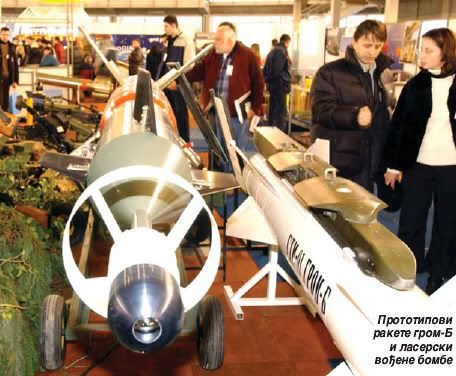
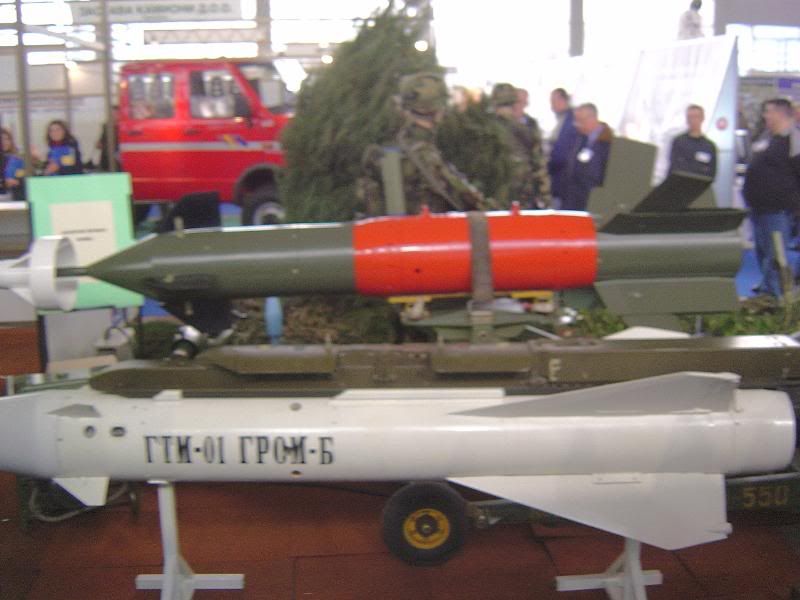
12 May 2005 - A television (TV)-guided air-to-surface missile and a laser-guided bomb (LGB) have been developed by Serbia and Montenegro.
The TV-guided missile is based on the earlier GROM ('Thunder' in Serbian), a radio-command guided weapon developed during the 1980s and 1990s. This was based on the Russian Kh-23 (AS-7 'Kerry') command-guided missile, which was already in service with the Yugoslav Air Force.
According to one source, the TV-guided GROM-B was developed by the VTI (Vojno-Tehnicki Institut) during the late 1990s, while another dates the project to 1996. The designation 'GROM-2' has also been reported for this variant, but since examples of the earlier command-guided version have been seen with the marking 'GROM-02', this reported alternative designation for the new TV-guided weapon may be incorrect.
The nose-mounted TV seeker is based on that of the AGM-65B Maverick air-to-surface missile, which had been sold to the former Yugoslavia. During the 1991 war with Croatia, the Yugoslav Air Force retrofitted its SOKO G-4 Super Galeb aircraft with AGM-65B Mavericks.
One source told JMR that the new seeker is better than the US original and incorporates "a modern CCD camera with higher resolution, digital data processing, etc". Identified only as a "TV unit for missile guidance", the seeker was first shown at the 'Partners 2004' exhibition. GROM-B uses the same aircraft interface as the AGM-65B, so it can be carried by all aircraft wired for the US missile.
The LVB-250F (Laserski Vodjena Bomba, 250 kg, Fugasna [Laser Guided Bomb, 250 kg, high- explosive]) was recently developed by the VTI, but according to one source exists only as a prototype. Like the GROM-B, it was first shown publicly at 'Partners 2005', but its actuator section and the housing for the seeker were exhibited a year earlier at 'Partners 2004'.
The payload of the LVB-250F is the locally produced FAB-250 'iron' bomb. This exists in two versions - the M79 low-drag general-purpose bomb designed for attacking a range of non-hardened targets such as industrial facilities, buildings, railway complexes, personnel and material, and the M72, a relatively high-drag fragmentation bomb designed for use as an anti-personnel and anti- material weapon.


 Market Data
  Markets


 AI
AI