Ailing UN climate talks jolted by record surge in greenhouse gases
Lord Stern talks of 'wake-up call' for governments meeting in Bonn next week with no sign of an agreement to succeed Kyoto
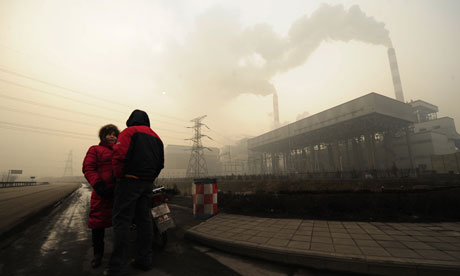
A coal-powered power plant in the notoriously polluted city of Linfen in Shanxi province. China is focusing on carbon emissions in its next five-year plan.
Fiona Harvey 29 May 2011 22.00 BST
The record leap in global greenhouse gas emissions last year has thrown the spotlight on the world's only concerted attempt to stem the tide of global warming – the United Nations climate negotiations.
Next week, governments will convene in Bonn, Germany, for the latest round of more than 20 years of tortuous talks, aimed at forging a binding international agreement on climate change which so far has eluded them.
Little is expected of the meeting, a staging post on the road to a bigger conference in Durban, South Africa, in December. But the data from the International Energy Agency (IEA) should shock even the most jaded of negotiators.
"I hope these estimates provide a wake-up call to governments," said Lord Stern, a London School of Economics professor and author of the landmark review on the economics of climate change. "Progress in international discussions since the modest successes [at the last UN meeting] in Cancún last December has been slow."
Tom Burke, founding director of green thinktank E3G and a veteran environmental campaigner, is even more forthright. "Be frightened – be very frightened," he said. "This rise in emissions underlines the urgency [of tackling climate change]. The politicians had better come back on this very fast, or we are all in trouble."
The contrast between the snail's pace of negotiations and the rapid rise in emissions catalogued by the International Energy Agency could scarcely be more marked. The Bonn and Durban meetings are widely expected to produce only a few clarifications of countries' emissions targets – already deemed inadequate by campaigners – and some detailed wording of the rules on issues such as forestry and carbon trading.
Yet the jump in carbon dioxide emissions comes less than 18 months after the climate change summit at Copenhagen, which was billed as the most important international meeting since the second world war but produced only a partial agreement and failed to set out a path to a binding treaty.
Another small step was taken at Cancún, when emissions-cutting targets were firmed up and financial commitments from rich to poor fleshed out, though the cash has yet to hit the streets.
"This is clearly an incremental process," said Chris Huhne, the energy and climate change secretary. "But the steps forward at Cancún showed that the UN framework convention on climate change is capable of progress."
According to the IEA, the problem the UN process is seeking to address is growing faster than anyone predicted. If emissions this year rise at the same pace as last year, the world will exceed 32 gigatonnes of Co2 in energy-related emissions alone in a single year. This is the level the IEA had expected emissions to reach by 2020, indicating that the growth of CO2 emissions has been much quicker than expected.
Unless these rises can be turned to reductions within a few years, the world will soon be well beyond what scientists say is the limit of safety.
Stern, chair of the Grantham research institute on climate change and the environment at the LSE, said: "If we are to give ourselves a 50% chance of avoiding a warming of more than 2C, and radically cut the risk of a 4 degrees rise, global annual emissions will need to peak within the next 10 years and then fall steadily, at least halving by 2050."
Even the worst economic recession in 80 years failed to make a lasting dent in emissions. "The global downturn bought us only a very temporary and now vanishing breathing space and the need for significant cuts in emissions remains urgent," Stern added. "The window of opportunity to meet the 2 degrees target is closing, and further delay risks closing it altogether. The challenge is not simply to meet the targets agreed at Cancún but to raise our ambition from there."
While warnings grow louder, analysts say politicians are turning off. Fatih Birol, chief economist at the IEA, said governments have lost interest. "The significance of climate change in international policy debate is much less pronounced than it was a few years ago," he said. "It's difficult to say that the wind is blowing in the right direction."
This gloomy assessment was borne out at last week's summit of the G8 group of leading industrialised nations in Deauville, a two-hour train ride from the IEA's offices in Paris, where hopes that world leaders would discuss climate issues were dashed. Russia, Japan and Canada reportedly told the meeting they would refuse to join a second round of carbon cuts under the Kyoto protocol. Greenpeace accused leaders of "gambling with our future".
Some participants remain optimistic. "The key success criteria [in Bonn and Durban] are whether we can start to deliver the Cancún agreements, as well as make progress on the difficult political issues not resolved there, such as the legal form [of any future agreement] and the level of ambition of emission reduction pledges," said Huhne.
At Bonn, a sticking point is whether there will be a second phase to the Kyoto protocol, the 1997 pact in which developed countries agreed to cut their emissions by about 5% by 2012. While the EU is on track to meet its commitments, other countries are not and some – including the US, which opposes Kyoto – would prefer to discuss a replacement. Developing countries refuse to countenance this, insisting Kyoto must continue as the prerequisite for continuing talks.
To an outside observer, this argument over the legal status of a 1997 agreement that has never been enforced, has been rejected by the US and that puts no obligations on the world's biggest emitter and second biggest economy, China, may seem arcane. But this debate has been the bread-and-butter of the UN talks.
Since Copenhagen, some countries have suggested another approach may work better – agreement among key countries that would bypass objectors, for instance, or a "bottom-up" approach where countries invest in renewable energy to cut emissions. All such attempts have been rejected by developing nations and green groups, who say only an international treaty will deliver accountability.
Huhne believes the UN negotiations can still deliver. "The UK has no intention of letting up in its efforts to get a legally binding agreement," he said.
Britain's adoption of ambitious carbon targets for the mid-2020s, as well as pushing the EU to take a tougher line on emissions, "shows we are serious about meeting the climate challenge, not just arguing for it."
There are signs of progress among emerging economies. Stern said. "China is now really focused on this issue [of emissions] via its five-year plan published in March, covering 2011-2015, and the country hopes to learn enough in the next five years to exceed and perhaps tighten its Cancún target for 2020."
Stern says the key to progress is to see tackling emissions as an economic growth opportunity, rather than a curb. "All countries, particularly in the rich world, should now be taking still stronger action to tackle climate change and to embark on the transition to low-carbon economic growth. This will be a new energy-industrial revolution and full of creativity and innovation and great benefits beyond simply cutting the risks from climate change. We can see its beginnings – it is time to accelerate."
Climate change demands we re-engineer the world economy now
To break the link between growth and carbon emissions, we must adopt a top-down approach of binding climate goals
The latest data from the IEA reveals a near-perfect correlation between global GDP and carbon emissions
Damian Carrington 29 May 2011
As an alarm call, the surge in emissions revealed by the International Energy Association is deafening. After the banking crisis of 2008, the cooling of the global economy had appeared to have given our wheezing, warming world pause for breath.
As GDP went into reverse, so did energy use and the pumping of planet-heating gases into the atmosphere. Attempts to agree global action went into reverse at the same time, despite the 120 heads of state who burned the midnight oil in Copenhagen in 2009.
But while the global economy has roared back to life, the UN's negotiations remain on life support, and with little hope of recovery.
Two truths emerge from this mismatch. First, the link between economic growth and carbon dioxide must be broken. The world's economy runs on energy, and while most of that power continues to comes from coal, oil and gas, global GDP and carbon emissions will be bound together in lockstep. The latest data show a near perfect correlation, and that shows how little impact, in a worldwide context, renewable and nuclear power is making.
Second, the rich industrialised world and the poor developing world must align their hopes and fears: they inhabit the same planet. All nations are united in understanding that unchecked climate change poses a grave threat in every part of the world.
Citizens in London, New York and Tokyo have grown rich from a century or more of fossil-fuelled industrialisation. They have the most wealth to lose and are, with notable exceptions, the keenest to cut carbon fast. But for those in Delhi, Rio and Beijing, where economic growth surges onwards, the improvement of living standards, from electricity to education, is even more pressing than reducing emissions.
Bridging that global gap between rich and poor requires a major transfer of wealth. That money, spent on low-carbon development, would fund the clean emergence of the developing world from deprivation. Put starkly, it is nothing less than using the engine of the world economy, energy, to tackle the world's poverty. It could be done by agreeing binding, global goals for cash and carbon: a top-down approach. But that would require unprecedented political leadership. Can the heating-up of the global economy thaw the diplomatic freeze at the UN talks and reignite the urgency needed?
If not, a bottom-up route is all that remains. In this scenario, each government sets its own national goals and the people of the world hope they all add up to something short of calamity.
The siren sounded by the IEA data is loud and clear. The world's economy is expanding again and belching out more carbon. The benign climate we have known since the dawn of civilisation looks about to blow. We are going to have to start re-engineering the global economy right now.
If not, we will be forced into the even more daunting task of trying to re-engineer the Earth.
New figures show we are still hurtling towards dangerous climate change - at a time when policymakers are running out of ideas
Editorial Monday 30 May 2011
Sometimes a quotation really does say it all. As chief economist of the International Energy Agency, Fatih Birol is not given to overstatement – so his comment in our paper today that the latest figures on greenhouse gas emissions are "the worst news" should be taken seriously. It is not just that the statistics showing another record leap in carbon output – 30.6 gigatonnes of CO2 over 2010 – to make the highest annual total in history are grim. They also come at a point when the old centrist certainties about how to tackle climate change are palpably out of date, and yet no new ideas have come along as replacement.
Over the past half-decade, three global-warming orthodoxies have pertained: the first diplomatic, the second economic, and the third industrial. The diplomatic orthodoxy was this: the best way to negotiate reductions in carbon emissions was the UN. That was the fairest forum, which allowed poorer, smaller countries a platform alongside the old economic behemoths. It could be effective, too: the 1989 Montreal protocol to phase out the use of CFCs and other ozone-harming substances had been described by former UN secretary general Kofi Annan as "perhaps the single most successful international agreement". Even the Kyoto treaty could be seen as a success, if you squinted hard enough. But then came Copenhagen in 2009, which was a flop. More negotiations take place at Durban this December, and already the British and the Americans are warning observers not to get their hopes up.
Economically, the optimists argued that the great recession of 2008-09 would give governments and industrialists a vital breathing space. A contracting world economy would naturally reduce carbon emissions, meantime, public and private sectors could strike a green new deal that would begin a shift towards low-carbon growth. Today's figures give the lie to all that: the link between GDP growth and greenhouse gases remains overwhelming. True, the distribution may have shifted eastwards since the Kyoto protocol – but that is partly because the west increasingly imports its manufactured goods. Finally, industrially, the great bet was that rich countries would wean themselves off fossil fuels and on to a mix of nuclear and renewables. Yet Fukushima has prompted Germany, Italy and Switzerland to mothball their nuclear power projects.
Today's figures, then, show a world still hurtling towards dangerous climate change – at a time when policymakers are out of solutions for slowing this process. "A nice utopia" is how Mr Birol describes the hope of keeping a rise in global temperatures below 2C. And if he thinks that, we should all be alarmed.
It is a bleak and bleary outlook when industry, politicians and so many of the public appear to believe that 89% of scientists and 99% of climatologists are wrong on human induced global warming.
Sails slowly appearing over the horizon helped to convince those that believed in a flat earth way back when, what will it take to convince global warming deniers tomorrow?


 Market Data
  Markets


 AI
AI