U.S.Dollar Index Time For Consolidation To Make Way For An Extended Move
U.S.Dollar Index Time For Consolidation To Make Way For An Extended Move
Technical observations of RossClark@shaw.ca
Bob Hoye Institutional Advisors posted May 11, 2005 ChartWorks PUBLISHED May 9th BY INSTITUTIONAL ADVISORS
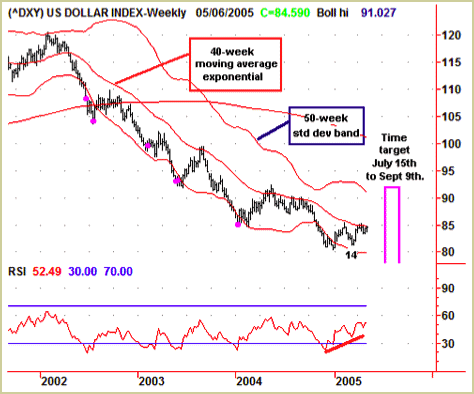
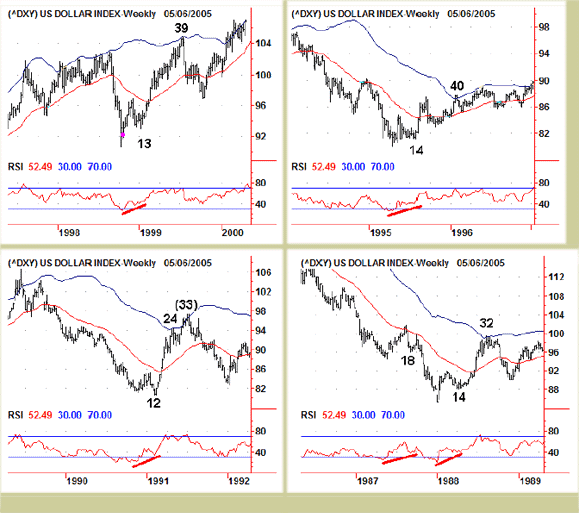
The US Dollar Index is now at an important crossroad. In December the Index generated downside exhaustion followed by a reversal in momentum and an excellent rally into February 8th (85.44). From there the market was anticipated to make a test of support and needed to hold above 80.90 in order to maintain the basing pattern. The test came fourteen weeks after the bottom in the RSI(14) and produced a higher low in the RSI. This is the common pattern seen at four important US Dollar bottoms (1999, 1995, 1991 & 1988) and one failed bottom (1987).
The subsequent rally to 85.32 tested the February 8th high and the 40-week exponential moving average. As of this week prices are back at important resistance one again. If prices have upside follow through from this level we can target the 50-week standard deviation band as a likely objective as seen at the four previous bottoms. The band currently sits at 91.02. From a timing perspective, the overall rally from the low in the RSI on December 3rd can be expected to reach the band after 32 to 40 weeks (July 15th to September 9th). A failure here and violation of 83.35 would result in a resumption of the bear market with a similar targeted time window for the next interim low.
The labels identify the number of weeks from the low RSI reading to the tested low followed by the significant high at the standard deviation band.
* Since the December low, a lengthy uptrend for the dollar has been possible. Current technical conditions suggest that this is about to extend. * This does not change our long term bullish outlook on gold and gold shares. * This will perplex orthodox goldbugs, but we remain optimistic about their ability to learn how gold works during the long post-bubble contractions. * This can be accomplished the hard way through experience in real time or the easy way by reviewing the history of financial markets.


 Market Data
  Markets


 AI
AI