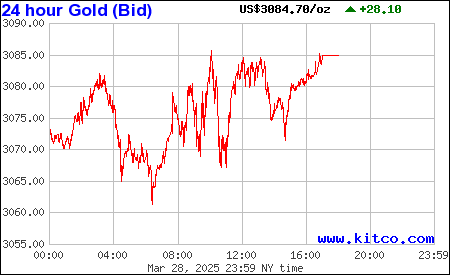
Gold production is decreasing due to few great Gold mine discoveryes. Witwatersrand played a big rule in gold offer since 1970 and people investing in Gold should observe the whole around this metal. I have seen predictions of Gold falling back to USD 300/oz (speculation) and I have also seen predictions for Gold reaching USD 9000/oz considering industrial consumption and mining? supply. Gold Mining production is around 2500 ton/year and demand around 3800 ton/ year. Take your own conclusions. The United States holds the largest gold reserve in the world. With 8,133.5 tonnes, (241, 207, 076 oz) the US gold holdings are worth approximately $337.67 billion. This massive gold reserve would have to increase 40 times just to cover the debt !! That’s $56,000 a once. But the us already defaulted on? its gold reserves back in 1971. So whatever the us has or doesnt have in gold isnt being sold. Roosevelt already defaulted on gold back in 1933. Nixon defaulted on foreign creditors in 1971. Assuming the us still has gold, how much dollars must the us print in order to turn 300 billion dollars worth of gold into 14 trillion? For the full 2 hours dvd watch here:
Gold & SILVER prices "You have not seen anything yet": says Pastor Lindsey Williams the plan by the global elite to sabotage the dollar, destroy the economy and America by 2012.
Silver will go to $100/oz: Lindsey Williams Saturday, March 19, 2011 11:16
Gold & SILVER prices "You have not seen anything yet": says Pastor Lindsey Williams the plan by the global elite to sabotage the dollar, destroy the economy and America by 2012. For the next 10 years silver will be like 2 steps forward 1 step back. But will probably be more like 5 forward 2 back. Their may be one big dip & many chickens will flap & sell, only to regret & see it shoot beyond imagination. You have to look at the? industrial & technical revolution & the global economic crisis. After doing my research I don't give a dam if silver goes down, as eventual fiat currency is going to 0, it's a possible small loss or loose everything, whats the fuss.
Silver Bull Run : Lindsey Williams
James Turk Gold 8000 Hyperinflation a sure thing Tuesday, March 15, 2011 11:19
"11:11 am by Ian Lyall The company owns the producing Blanket gold mine in Zimbabwe, some very exciting exploration targets nearby and the Nama copper project in Zambia's copper-belt. Caledonia Mining (LON:CMCL, TSE:CAL) is rated a buy up to 16 pence a share by UK broker Collins Stewart, which initiated coverage on the Zimbabwe gold play today.
A bullish assessment of the company’s prospects by analyst John McGloin immediately piqued interest in the stock, which rose 0.7 pence to 8.7 pence a share in afternoon London deals.
The company owns the producing Blanket gold mine in Zimbabwe, some very exciting exploration targets nearby and the Nama copper project in Zambia's copper-belt.
McGloin points out the potential of Nama is significant if, as suspected, part of the licence area contains a possible extension to the world-class Konkolo North project.
“This exploration upside comes for free at the current price,” the analyst adds.
Caledonia's Blanket mine is in the Gwanda greenstone belt, and was acquired from Kinross in 2006 (before that it was owned by Falconbridge).
Output was approximately 18,000 ounces last year rising to a target of 40,000 ounces of the precious metal for this year.
With cash costs falling and on target to go below US$550 an ounce this year, the current management, led by Stefan Hayden, is sweating the assets more efficiently than the mine’s two previous owners.
Gold recoveries have improved markedly from around 80 per cent on acquisition to the present sustained gold recovery level of 92 per cent. Now management’s ambition is to further increase Blanket’s output – to a target of around 100,000 ounces by 2015.
Before it can do this it needs to increase its reserves and resources, which at the current production rate of 40,000 ounces per year gives Blanket at least a 13-year mine life.
It is currently sinking one new shaft and rehabilitating three others on two of its highly prospective brown-field satellite zones – GG, which is seven kilometres from Blanket’s metallurgical plant, and the Mascot Project Area, which is 42 kilometres away.
Caledonia also isn’t ignoring the potential of the Blanket Mine footprint itself.
It is developing the 22-Level Haulage, which is essentially a horizontal tunnel 750m below surface that will provide access for further exploration of the up-dip and down-dip extensions of the mine’s known main ore bodies above and below this depth.
This is a much faster and cheaper approach to exploration than drilling all the way from surface.
The 22-Level Haulage itself will then be over 3 kilometres long and will provide immediate mining access to these resources from the recently upgraded number four shaft and automated ore loading system.
Blanket has already installed substantial excess capacity in its crushing, milling and CIL circuits, which can handle 2,400, 1,800 and 3,800 tonnes per day respectively. Daily throughput at a production rate of 40,000 ounces of gold per annum is roughly equivalent to a plant throughput of 1,000 tonnes per day. This means that Blanket can immediately treat 80 per cent more additional ore with little or no requirement for new investment in the processing plant.
The only increased costs would be the mining, transport and consumable costs related to the additional tonnage, and the result would be a significant decrease in the cost per gold ounce produced as the fixed costs are amortised over the increased production.
This busy round of resource development activity will produce an updated 43-101 reserves and resource statement by mid-2011 with a further updated reserve and resource statement a year later.
Hayden has set aside US$4 million for exploration this year and early next.
If Zimbabwean iIndigenisation rules are enforced, under the existing legislation, Caledonia would be obliged to sell a 51 per cent shareholding to black Zimbabweans over the next four to five years.
Caledonia had been hoping for a compromise deal, which seems unlikely ahead of the general election later this year as the issue of indigenisation in the mining sector has turned into a political football.
Finally Nama consists of four large scale, long term, contiguous mining licences covering more than 800 square kilometres in one of the world's premier locations for conventional copper-belt type mineralisation.
As mentioned earlier one of those mining licence areas borders onto the world class Konkola copper property being developed jointly by Brazilian giant Vale and African Rainbow Minerals, the South African mining company currently capitalised at around US$4billion.
They are currently investing a massive US$400 million in Konkola and expect to be in production by 2013.
Caledonia’s immediate plans are more modest by comparison. It is initially drilling four holes, each about 800m deep, on its Konkola East Target at a cost of just over US$1 million.
Subject to the drilling results and board approval, further drilling this year will either be focused on defining this target to a 43-101 compliant stage.
That, or an initial programme of holes may be drilled on its second copper belt target, Kafwira, which lies about 20 kilometres northwest of the Konkola East target.
The drilling programme has just started, and the initial results are expected this summer.
Should the drilling yield encouragingly positive results, then management wants to pull the trigger on a much more ambitious drilling programme.
Collins Stewart’s DCF valuation also shows that Caledonia is currently trading at a 30 per cent discount to the net present value of the Blanket Mine (based on a 10 per cent discount rate), when similar projects tend to be valued at 1.5 times NPV.
“Exploration success has the potential to expand the group’s resources, with Nama having the potential to be a share price driver,” McGloin concludes."
Great and I am looking forward to 10 times that and also I did sign up for the Sweden trip if we hit $1.20 That would be awesome. Great microcap4' info, please Sir, tell us more about it?
The drilling program at the Nama base metals project in Zambia commenced in March 2011 to identify typical copper-belt type mineralization.
Drilling of the first of four holes at the Konkola East target area commenced in early March 2011 and the results of this program are expected to be received in mid-2011.
Note. At the Nama Project in Zambia, the 2010 work program focused on metallurgical issues, the design considerations of specialized plant and equipment while the exploration program focused on completing and updating an evaluation of all the known cobalt/copper anomalies.
Field work and desk studies in 2010 were also undertaken on the Ore Shale horizon which hosts the typical Copperbelt type mineralisation.
The presence of Ore Shale is known from previous shallow drilling to extend into the Nama licenses for a distance of about four kilometres from its eastern boundary.
The neighbouring Konkola and Konnoco Mines have both reportedly defined substantial copper resources on their properties.
Exploration activities by Caledonia at Nama during 2010 resulted in the definition of two resource target areas ("Konkola East" and "Kafwira") characterized as belonging to the Ore Shale-hosted copper-cobalt style of mineralization.
These targets will be investigated further during the 2011 exploration field season, including a drilling program of diamond drill-holes to confirm the existence of Copperbelt stratigraphy within the two target areas.
Drilling of the first of four holes at the Konkola East target area commenced in early March 2011 and the results of this program are expected to be received in mid-2011.
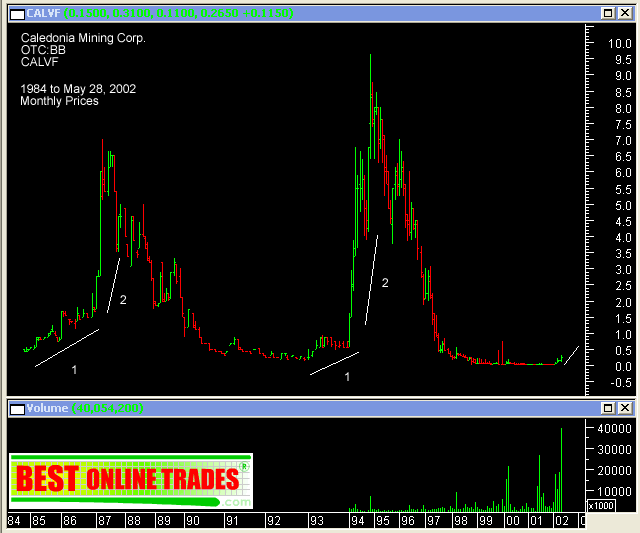
FOR CALEDONIA MINING, CAN THE PAST PREDICT THE FUTURE?
IF SO, GET READY FOR LIFT OFF VERY SOON
MUST SEE CHART: MOST IMPORTANT CALEDONIA CHART I HAVE EVER PRODUCED:
Caledonia Mining First Quarter 2011 Results May 18, 2011 (Marketwire Canada) -- TORONTO, ONTARIO --
Caledonia Mining Corporation - ("Caledonia" or the "Corporation") (TSX:CAL)(OTCBB:CALVF) (AIM:CMCL) is pleased to announce its first quarter 2011 operating and financial results.
The financial results below are reported in Canadian dollars, except where otherwise stated.
Highlights:
Gold production increased by 17% to 7,322 ounces compared to 6,235 ounces in the fourth quarter 2010 (Q1 2010: 3,129 ounces). Gold production in April 2011 was 2,737 ounces.
Average cash cost per ounce of gold produced decreased by 18% to US$648 compared to the fourth quarter 2010 (Q1 2010: US$807).
Average achieved price per ounce of gold was US$1,397 (Q1 2010: US$1,107).
Gross Profit for the quarter (i.e. before depreciation, amortization and administrative expenses) nearly doubled to $5,248,000 compared to $2,815,000 in the fourth quarter 2010 (Q1 2010: $449,000).
At March 31, 2011 the Corporation had net cash and cash equivalents of $1,406,000 (December 31, 2010: $398,000).
During the quarter Caledonia made considerable progress in removing the remaining constraints to Blanket achieving the targeted annual production rate.
The 2011 drilling program commenced in March 2011 at the Konkola West area of the Nama base metals project in Zambia.
Commenting on the results, Stefan Hayden, President and CEO, said: "I am very pleased to report a strong first quarter performance for 2011. The increased production coupled with the continued strength in the gold price and a reduction in Blanket's cash cost resulted in a substantial improvement in Caledonia's profitability and cash generation.
"We have made significant progress during the current quarter to address the remaining constraints which, once solved, should enable us to reach our target of 10,000 ounces per quarter.
A new ore pass was raise-bored and commissioned on May 13, 2011. The commissioning of the complete standby generating system commenced on May 16, 2011 and is expected to be completed by the end of May, after which Blanket will be able to maintain full operations during any interruption to the normal power supply.
I am confident that Blanket will achieve its targeted quarterly production from the third quarter of 2011.
"The drilling program at the Nama base metals project in Zambia commenced in March 2011 to identify typical copper-belt type mineralization.
This drilling program is expected to be completed by the third quarter 2011.


 Market Data
  Markets


 AI
AI