ZHUHAI, China—China is ramping up production of unmanned aerial vehicles in an apparent bid to catch up with the U.S. and Israel in developing technology that is considered the future of military aviation.
Western defense officials and experts were surprised to see more than 25 different Chinese models of the unmanned aircraft, known as UAVs, on display at this week's Zhuhai air show in this southern Chinese city. It was a record number for a country that unveiled its first concept UAVs at the same air show only four years ago, and put a handful on display at the last one in 2008.
The apparent progress in UAVs is a stark sign of China's ambition to upgrade its massive military as its global political and economic clout grows.
The U.S. and Israel are currently the world leaders in developing such pilotless drones, which have played a major role in the wars in Iraq and Afghanistan, and which analysts say could one day replace the fighter jet.
This year's models in Zhuhai included several designed to fire missiles, and one powered by a jet engine, meaning it could—in theory—fly faster than the propeller-powered Predator and Reaper drones that the U.S. has used in Iraq, Afghanistan and Pakistan. [crt_airshow] The Wall Street Journal
The jet-powered WJ600, for reconnaissance and attacks.
Exhibitors didn't give precise details of which Chinese drones were fully operational, although one confirmed that the People's Liberation Army, or PLA, had deployed at least two propeller-powered reconnaissance UAVs, which featured in last year's 60th National Day parade.
But the large number of UAVs on display illustrates clearly that China is investing considerable time and money to develop drone technology, and is actively promoting its products on the international market.
That has implications for China's external and domestic security, as well as for many other countries, including Iran, that have sought in vain to acquire drones either for military purposes or for police surveillance and antiterrorist operations.
It is of particular concern to the U.S. and Israel, whose drones are unrivalled in the world today, and could worry China's neighbors, many of which have territorial disputes with China in the East and South China seas.
China's apparent progress is likely to spur others, especially India and Japan, to accelerate their own UAV development or acquisition programs.
U.S. anxiety about China's UAVs were highlighted in a report released Wednesday by the U.S.-China Economic and Security Review Commission, which was formed by Congress in 2000 to assess the national security implications of trade and economic relations with China.
"The PLA Air Force has deployed several types of unmanned aerial vehicles for both reconnaissance and combat purposes," the report said. "In addition, China is developing a variety of medium- and high-altitude long-endurance unmanned vehicles, which when deployed, will expand the PLA Air Force's 'options for long-range reconnaissance and strike,' " it said, citing an earlier Pentagon report.
Military and aviation experts said China's drones are still probably several years behind U.S. and Israeli models, noting that many countries have tried and failed to develop their own UAVs. But they also said that China is catching up fast in other areas of civil and military aviation technology, thanks in large part to technology transferred by foreign aerospace companies in Chinese joint ventures.
They suggested, too, that China had been helped by Israel, which sold China antiradar drones in the 1990s—to the fury of the Pentagon, which has since blocked the Israelis from providing upgrades.
The Chinese drone of greatest potential concern to the U.S. is the one with several missiles and a jet engine—called the WJ600—which was displayed by China Aerospace Science & Industry Corp., or Casic, one of China's top weapons makers.
Casic officials declined to comment, but a video and a two-dimensional display by the company showed Chinese forces using the WJ600 to help attack what appeared to be a U.S. aircraft carrier steaming toward an island off China's coast that many visitors assumed to be Taiwan. ~~~~~~~~~~~~~~~~~~~~~~~~~~~~~~~~~~~~~~~~~~~~~~~~~~~~~~~~~~~~~~~~~~~~~~~~~~~~~~~~~~~~~~~~~~~~~~~~~~~~~ The Buzz on China's Drones
Still behind the U.S. and Israel, China is starting to catch up:
* Jet Drone: The WJ600 from China Aerospace Science & Industry Corp. has several missiles and a jet engine and is the Chinese drone of greatest potential concern to the U.S. * Drone in Space? China Aerospace Science & Technology Corp., one of the main contractors in China's space program, displayed an attack drone, complete with air-to-ground missiles. * Largest Drone: ASN Technology's ASN-229A Reconnaissance and Precise Attack UAV, the largest drone at the show, carries air-to ground missiles and uses a satellite link to find targets over a radius of 2,000 kilometers 1,250 miles. * Avian Drone: The ASN-211, a model under development, is about the size of a large duck and has flapping wings. It is designed for reconnaissance behind enemy lines.
—WSJ research ~~~~~~~~~~~~~~~~~~~~~~~~~~~~~~~~~~~~~~~~~~~~~~~~~~~~~~~~~~~~~~~~~~~~~~~~~~~~~~~~~~~~~~~~~~~~~~~~~~~~~ Another company that displayed an attack drone, complete with air-to-ground missiles, was China Aerospace Science & Technology Corp., one of the main contractors in China's space program.
The company showing the most UAVs, with 10, was ASN Technology Group, which claims to control 90% of China's domestic market. ASN officials said two of those are already being used by the PLA but neither was designed to carry weapons.
However, their display also included a model of the largest UAV at the show, the ASN-229A Reconnaissance and Precise Attack UAV, which is designed to carry air-to ground missiles, and to use a satellite link to locate and attack targets over a radius of 2,000 kilometers.
Company officials said that and the other ASN models were all in production, but not yet all on the market, and most could be used for military operations as well as civilian ones such as monitoring electricity pylons and oil and gas pipelines.
One model under development was the ASN-211, which is about the size of a large duck and has flapping wings. It is designed primarily for carrying out reconnaissance behind enemy lines.
"I can't tell you which models we have sold overseas, as that's secret, but of course we're interested in exporting them," said one of the company officials. "That's why we're displaying them here."
Released Chinese dissident barred from speaking out against Communist Party mark mackinnon BEIJING— Globe and Mail Update Published Sunday, Jun. 26, 2011 8:41AM EDT Last updated Sunday, Jun. 26, 2011 9:19PM EDT
Among China’s small but brave community of government critics, the silence is deafening.
Hu Jia, a previously indomitable human rights activist, became the latest prominent dissident to be released from detention only to be barred from speaking out against the ruling Communist Party, which has become increasingly intolerant of dissent in recent months.
The Communist Party now appears to have secured the silence of some of its most prominent critics through this fall's annual meeting of its Central Committee and next spring's National People's Congress, a period that will see a sensitive transition at the very top, with the current Politburo headed by President Hu Jintao and Premier Wen Jiabao giving way to a new generation of leaders headed by current Vice-President Xi Jinping.
The 37-year-old Mr. Hu, who three years ago won the European Union’s Sakharov Prize for Freedom of Thought, and who was believed to have been a finalist several times for the Nobel Peace Prize, arrived home early Sunday after completing a 3½-year sentence for “inciting subversion.” He was initially arrested shortly after testifying to the European Parliament in 2007 about the human-rights situation in China, during which he criticized the decision to award the 2008 Summer Olympics to Beijing.
“Sleepless night,” Mr. Hu’s wife, Zeng Jinyan, posted in Chinese Sunday on her Twitter account. “Hu Jia arrived home at 2:30 in the morning. [He’s] safe, very happy. Needs to rest for a while. Thanks, everyone.”
Ms. Zeng, herself a well-known blogger, later told the Reuters news agency that she and her husband did not want to give interviews at this stage, as it “might cause problems.” In a previous Twitter posting, she said her husband would be deprived of his political rights for one year following his release and would not be able to speak to media.
Dozens of policemen were deployed around the couple’s Beijing residence, preventing reporters from approaching.
Such coerced silence of critics of the ruling Communist Party has become routine recently. Last week, dissident artist Ai Weiwei was released after 80 days in a secret detention centre, on the condition that he not speak to reporters or use his Twitter account for one year. Four associates of Mr. Ai’s were also freed with the same restrictions.
Similarly, Chen Guangcheng, a blind human-rights lawyer and friend of Mr. Hu’s, was released last year after four years in prison but has been kept under unacknowledged house arrest in his village in Shandong province. Mr. Chen has also been prevented from speaking to media – journalists who tried to visit were chased away by thugs – though he has managed to smuggle out videos highlighting his ordeal.
Meanwhile, Liu Xia, the wife of jailed Nobel Peace Prize winner Liu Xiaobo, has been held incommunicado since her husband won the award last fall. Mr. Liu still has more than nine years remaining on his own 11-year subversion sentence, which is tied to his role in drafting a pro-democracy manifesto known as Charter 08.
In a statement, Amnesty International said at least 130 activists “have been detained, forcibly disappeared, harassed and imprisoned within their homes since February,” when Beijing was spooked by mysterious online calls for Chinese to stage a “jasmine revolution” like those that toppled authoritarian regimes in the Middle East. Many of those who were detained have gone conspicuously quiet since being freed.
Ms. Zeng said she was already experiencing escalating police harassment in advance of her husband’s release. She said she was pressured into leaving the couple’s Beijing home for the southern city of Shenzhen, only to be forced out of that apartment as well. Ms. Zeng eventually left the couple’s 3 ½-year-old daughter with friends and relatives so that she wouldn’t have to live under house arrest and surveillance like her parents.
Mr. Hu got his start in environmental activism while studying information engineering at the Beijing College of Economics (now Capital University of Economics and Business). After graduating, he joined a newly formed non-governmental organization, the Beijing Aizhixing Institute, which provides support to HIV/AIDS sufferers. Later, he took on other causes, including the rights of political prisoners, and became one of the most prominent critics of the Communist Party living inside China.
When he was awarded the 2008 Sasskharov Prize at a ceremony in Strasbourg, France, the jailed Mr. Hu was represented by an empty chair, just as Mr. Liu’s award was placed on an empty chair during last year’s Nobel Peace Prize ceremony in Oslo.
Revolt Begins Like Others, but Its End Is Less Certain
Agence France-Presse — Getty Images
Relatives carried a picture of Xue Jinbo, who died in police custody after villagers chose him to negotiate a solution to a land deal in Wukan, China.
By MICHAEL WINES Published: December 16, 2011
WUKAN, China — Each day begins with a morning rally in the banner-bedecked square, where village leaders address a packed crowd about their seizure of the village and plans for its future. Friday’s session was followed by a daylong mock funeral for a fallen comrade, whose body lies somewhere outside the village in government custody.
Follow @nytimesworld for international breaking news and headlines.
Agence France-Presse — Getty Images
Villagers tied white ribbons on their arms before heading to a makeshift funeral alter to pay their respects to Mr. Xue.
Agence France-Presse — Getty Images
A mourner at a rally and mock funeral for Mr. Xue on Friday. Relatives said his body was covered in bruises, his nose bloodied and his thumb broken.
The New York Times
A developer planned to buy 134 acres of land in Wukan.
It has been nearly a week since the 13,000 residents of this seacoast village, a warren of cramped alleys and courtyard homes, became so angry that their deeply resented officials — and even the police — fled rather than face them. Now, there is a striking vacuum of authority, and the villagers are not entirely sure what to make of their fleeting freedom.
“We will defend our farmland to the death!” a handmade banner proclaims, referring to a possible land deal they fear will strip them of almost all their farmland. “Is it a crime,” another muses, “to ask for the return of our land and for democracy and transparency?”
How long they will last is another matter. As the days pass, the cordons of police officers surrounding the village grow larger. Armored trucks and troop carriers have been reported nearby. On local television, a 24-hour channel denounces the villagers as “a handful of people” dedicated to sabotaging public order, with the names of protesters flashing on a blue screen, warning that they will be prosecuted. Many here fear this will all end badly. “The SWAT teams and the police here are acting like they’re crime organizations, not police forces,” said Chen Dequan, a 50-year-old farmer and fisherman. “The entire village is worried.”
The dispute that emptied Wukan of its government officials is, on its face, like hundreds — if not thousands — of others that inspire protests here each year: villagers who believe their land was taken illegally take to the streets when their concerns are ignored.
But the suspicious death of a well-liked villager, who was selected to negotiate on the citizens’ behalf, appears to have turned this long-simmering grievance into a last-straw standoff with the authorities.
The land deal inspiring the protests involved one of China’s largest property developers, a Hong-Kong listed company called Country Garden that prides itself on fast-paced construction in mostly suburban areas. Yang Huiyuan, described by analysts as the company’s chairwoman, is often listed as one of the richest women in China.
The company has faced controversy before. Xinhua, China’s official news agency, said this year that it had bought Anhui Province land to build a golf course in a deal that smacked of “the typical collusion of real estate business and local government.” The agency’s signed commentary said more than 10 government officials had been punished after that transaction and other cases of illegal purchases and use of land there.
Here in Wukan, many residents believed that the national government had not yet intervened to resolve matters simply because it had been misled by nefarious local officials to believe that all was well.
So far, however, it seems from inside this locked-down village that government leaders at all levels are flummoxed at their blue-moon, if temporary, loss of control.
Lin Zuluan, 67, a retired businessman who is now the village’s de facto leader, said that officials had approached him to negotiate an end to the protest, but that talks had gone nowhere, in part because the officials would not meet villagers’ demands to return all their land.
“I do have concerns” over the lack of progress, he said. “But I do believe this country is ruled by law, so I do believe the central government will do whatever it has to do to help us.”
In the meantime, life here goes on in an aura of unreality as much as uncertainty, a mixture of grief and optimism and somewhat willful ignorance of the hints of trouble at every police roadblock and on every news broadcast.
Inside the village, citizens hail foreign journalists as visiting saviors, bombarding them with endless cigarettes, bowls of rice-and-seafood porridge and free rides on the backs of scooters. The villagers bristle at the government’s suggestion that they are being financed by unnamed foreigners, but are convinced that only reporting outside the state-run press will bring word of their plight to leaders in Beijing.
Corruption accusations against Country Garden, the developer, go back for years. In 2007, the Southern Weekly newspaper alleged irregularities in a hotel construction contract awarded to the company by a district government in Zhangjiajie, in Hunan Province. The paper suggested that the government heavily discounted the project’s land cost because most of Country Garden’s payment was secretly diverted to a company in which two Country Garden officials had invested.
In a faxed statement Friday, Country Garden said both the other projects in Anhui and Hunan were wholly aboveboard. The firm said the Anhui deal was free of corruption and the Zhangjiajie contract was awarded through open, transparent bidding. Officials have contended that the money supposedly diverted was in fact spent for legitimate public purposes related to the project.
In Wukan, two people familiar with the Country Garden proposal said the company planned to buy at least 134 acres of land for villa homes and shopping centers here. About half of that land is controlled by Fengtian Livestock, a pig-raising firm that holds a 50-year lease issued by the government; the rest is apparently in villagers’ hands.
Chen Wenqing, the livestock firm’s owner, said Country Garden was negotiating directly with the local authorities last spring when the deal fell through over a difference on price. Country Garden said it had intended to build a project but has signed no agreements.
But Mr. Lin, the retired businessman, said villagers became angry in September when they saw construction work at the pig-farm site. Officials of Lufeng city, a district that controls Wukan, ordered the building stopped, he said, and asked villagers to select a committee of locals to settle the controversy.
Negotiations to return the land to villagers produced little, however. On Dec. 9, unidentified men abducted one of the negotiators, a 42-year-old leather worker named Xue Jinbo, and four other men from a local restaurant.
The other four soon turned up in nearby jails, accused of inciting villagers to subvert the government. Mr. Xue was seen only on the night of Dec. 11, when local government officials summoned relatives to view his body at a mortuary.
They said that he had died of a heart attack in a hospital and that medical records of his care would be provided.
But family members say officials confiscated their mobile telephones before allowing them into the funeral home, apparently to prevent them from taking photographs. Mr. Xue’s nose was caked with blood, his body was black with bruises and his left thumb was broken, apparently pulled backward to the breaking point, one of them, a nephew named Xue Ruiqiang, said on Friday in an interview.
Word of Mr. Xue’s death brought the villagers into the streets and sent members of the village committee that was involved in the land negotiations fleeing.
Mr. Xue’s 21-year-old daughter, Xue Jianwan, said before the service that her father “was a straightforward man who always stood up for people.”
“Mom said that if he hadn’t been such a straightforward person, he probably wouldn’t have ended up like this,” she added.
Shi Da contributed research from Wukan, and Mia Li from Beijing. Sharon LaFraniere and Jonathan Ansfield contributed reporting from Beijing.
Gagkye Drubpa Kyab detained in Serthar county, part of Sichuan province, as authorities crack down on dissent
Associated Press guardian.co.uk, Sunday 19 February 2012 07.11 GMT
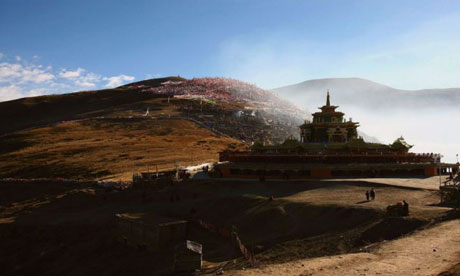
A monastery in Serthar county, Sichuan province, where Chinese authorities have been cracking down on dissent after protests by Tibetans. Photograph: Getty Images
Chinese police have detained a Tibetan writer in a western county where there have been anti-government protests, an overseas Tibetan news service has reported, as China's .. http://www.guardian.co.uk/world/china .. crackdown against persisting unrest spreads.
More than 20 police officers took Gangkye Drubpa Kyab from his home in Serthar county's main town on Wednesday night and he had not been released, the Norway-based Voice of Tibet .. http://www.guardian.co.uk/world/tibet .. reported on Saturday. The story, which cited a Tibetan politician living in exile, said that when Drubpa Kyab's wife asked for a warrant, police told her they wanted to talk with him.
Police and government officials in Serthar and in Ganzi, the Sichuan province prefecture that administers Serthar, either could not be reached by telephone on Sunday or said they had not heard about the case.
Tibetans and the Chinese government in the region have been engaging in a cycle of protest .. http://www.guardian.co.uk/world/protest .. and repression that erupted into violent unrest in recent weeks. More than 20 Tibetans have separately set themselves on fire to protest against controls on Buddhist monasteries and other repressive measures over the past year.
In response security forces have further tightened controls and increased arrests. US-based Human Rights Watch said last week that Chinese authorities had detained hundreds of Tibetans who recently returned from trips to India to attend sermons by the Dalai Lama, their exiled spiritual leader.
In Serthar, also known as Seda, Tibetan protesters clashed with security forces last month, leaving at least two Tibetans dead. The government said the protesters had attacked a police station. It was not known whether Drubpa Kyab was involved in the protests.
A Tibetan writer called Woeser living in Beijing said on her much-read blog that she was familiar with the 33-year-old Drubpa Kyab's writings. She said he was a Serthar native and had been a teacher and writer there for the past 10 years.
He would be at least the second cultural figure detained in the latest wave of arrests, following the reported arrest two weeks ago of Dawa Dorje, described as a civil servant and advocate for promoting traditional Tibetan music and culture
In a 1988 interview with Hong Kong's Liberation Monthly (now known as Open Magazine), Liu was asked what it would take for China to realize a true historical transformation. He replied:
[It would take] 300 years of colonialism. In 100 years of colonialism, Hong Kong has changed to what we see today. With China being so big, of course it would require 300 years as a colony for it to be able to transform into how Hong Kong is today. I have my doubts as to whether 300 years would be enough."
Liu admitted in 2006 that the response was extemporaneous, although he did not intend to take it back, as it represented "an extreme expression of his longheld belief." The quote was nonetheless used against him. He has commented, "Even today [in 2006], radical patriotic 'angry youth' still frequently use these words to paint me with 'treason'."
Known for his pro-West stance, Liu once stated in an interview: "Modernization means whole-sale westernization, choosing a human life is choosing Western way of life. Difference between Western and Chinese governing system is humane vs in-humane, there's no middle ground... Westernization is not a choice of a nation, but a choice for the human race" .. http://en.wikipedia.org/wiki/Liu_Xiaobo
China's ethnic tinderbox
Officially, China is made up of 56 nationalities ..
An ethnic Uigur man sits outside shuttered shops in Urumqi
View Photo Gallery — Tibetans in India protest Chinese president’s visit:?Tibetan exiles in India hold demonstrations against China during a visit by Chinese President Hu Jintao to New Delhi.
By Simon Denyer, Published: April 2 .. 492 Comments
DHARMSALA, India — He walked three times around the rural monastery he had attended as a small child, cycled into town and had a simple vegetarian meal with a friend. Then 22-year-old Lobsang Jamyang excused himself to go to the bathroom.
Inside, he doused himself with gasoline. When he emerged, he was already in flames.
Jamyang then ran a few yards to the intersection at the center of the eastern Tibetan town of Ngaba, faced its huge main Kirti monastery and shouted slogans calling for Tibetan independence from China and for the return of the Dalai Lama, the region’s exiled religious leader.
In the tense and heavily militarized town, police first kicked him and beat him with clubs spiked with nails before dousing the flames, according to witness reports compiled by refugee groups here in the Indian hill town of Dharmsala.
Jamyang was one of more than 33 Tibetans who have set themselves on fire .. http://www.savetibet.org/resource-center/maps-data-fact-sheets/self-immolation-fact-sheet#top .. in a recent wave of copycat acts of resistance against Chinese rule. The self-immolations are a reaction to what many Tibetans see as a systematic attempt to destroy their culture, silence their voices and erase their identity — a Chinese crackdown that has dramatically intensified since protests swept across the region in 2008.
Before he died, Jamyang had given the friend he lunched with three messages, said a close friend. One was that Tibetans in his village should work harder to preserve their language against the onslaught of Mandarin; the second was that a couple in his village who had recently divorced should reunite.
“The third message was that Tibetans should be very strong to face China, that Tibetans should not be cowards and should not remain silent,” said the friend, who fled his homeland for Dharmsala but remains in touch with local people. Today, Dharmsala is home to thousands of Tibetans, grouped around the Dalai Lama, who fled Tibet in 1959 as an uprising there was ruthlessly crushed.
In the spring of 2008, as the Beijing Olympics approached, Tibet was once again engulfed in protests and riots in which hundreds were killed and thousands were arrested. The response has been brutal, human rights groups say.
A program to resettle Tibet’s nomads into apartments or cinder-block houses and fence off their vast grasslands has gathered pace, the replacement of Tibetan by Chinese as a medium of instruction in schools has been expanded, and government control over Tibet’s Buddhist monasteries, .. http://www.hrw.org/news/2012/03/16/china-tibetan-monasteries-placed-under-direct-rule .. the center of religious and cultural life, has been tightened.
Yet the crackdown seems to have fueled a renewed sense of Tibetan national identity, according to refugees who have fled the region recently for Dharmsala and those like teacher Kelsang Nyima, who returned to his Tibetan village in the Chinese province of Qinghai this year to visit relatives.
“When I left Tibet in 1998, there was not that much conversation about Tibetan nationalism, although some people talked of the return of His Holiness the Dalai Lama,” he said. “This time I can strongly feel the growing sense of nationalism among Tibetans. It is a huge change.”
pg 2
Once a week, all across this vast Himalayan plateau, Tibetans wear traditional dress, speak only in Tibetan and avoid shops run by Han Chinese, a protest known as “White Wednesday.”
Scores of writers, intellectuals and artists were arrested in 2008 for overtly political work, but in a powerful resurgence of Tibetan culture, others have doggedly continued. Their messages of freedom and yearning for the return of the Dalai Lama are concealed in subtle metaphors that escape the wrath of Chinese officials.
Others yearn for a more overt expression of their feelings, an expression that has been closed off by China.
The monks’ statement
In February 2009, a young monk called Tapey from the Kirti monastery, among the most influential in the east of the Tibetan region, set himself alight carrying a homemade Tibetan flag and a picture of the Dalai Lama. He was fatally shot by police.
The monastery, in the Chinese province of Sichuan, had been under growing official scrutiny since 1997, its monks subject to intense sessions of “patriotic reeducation” and those deemed insufficiently enthusiastic thrown out of the order, said Lobsang Yeshi, a monk who has since fled to India but has remained in contact with his old friends.
“The three main monasteries in [the Tibetan capital] Lhasa were the center of Tibetan Buddhism, but now they are more or less for tourists,” he said. “But Kirti monastery is one of the few large monasteries that is still struggling to some extent. The Chinese see it as a threat to their control, and they are trying to eliminate it.”
The monks were divided on how to respond. The older ones, who had lived through the Cultural Revolution, when the monasteries of Tibet were largely destroyed and emptied, “who knew what the Chinese were capable of,” argued for cooperation, said Yeshi, while the younger ones urged resistance.
The 2008 protests effectively ended the debate. Yeshi said that at least 30 people lost their lives in Ngaba, and many monks were detained for their role in the uprising. When a second self-immolation followed in March 2011, the Chinese response was dramatic.
The monastery was sealed off and 300 monks were arrested. Villagers surrounding the monastery in an attempt to protect its occupants were beaten and carried off by the truckload. The teachers and two friends of the monk who set himself afire were sentenced to a decade or more in jail for homicide.
Today, the town feels like a military camp, sealed off by soldiers, barricades and barbed wire on every block, said 26-year-old nomadic herdsman Sugney Kyab, who arrived in Dharmsala this month after a harrowing escape over the Himalayas.
“When we hear about the immolations we feel very helpless, all we can do is cry,” he said. “We have no voice, we can’t even make a phone call, it is so suffocating.”
Kyab and other refugees said the immolators had become heroes to Tibetans, their acts “a clear expression that we can no longer live under Chinese rule.”
pg 3
It is also, say increasing numbers of young Tibetan refugees, a sign of the failure of the Dalai Lama’s “middle way,” a two-decade-long attempt to conciliate the Chinese and negotiate with them, an avoidance of any talk of independence in favor of a vaguely defined call for autonomy within China.
Exiles’ anguished appeals
China’s response to the self-immolations has been to blame the Dalai Lama, with one state-run Web site recently accusing him .. http://news.xinhuanet.com/english/indepth/2012-03/24/c_131487143_4.htm .. of wanting to impose “Nazi” racial policies inside Tibet and build a “?‘Berlin Wall’ of ethnic segregation and confrontation.”
The middle way, it said, was strikingly “similar to the Holocaust committed by Hitler on the Jewish.”
The Dalai Lama has said that he does not condone the immolations, but he has largely removed himself from the debate since he retired from politics last year in favor of a democratically elected exiled administration headed by Lobsang Sangay, a former Harvard professor.
With Sangay reduced to seemingly impotent appeals to Tibetans not to take such “drastic” actions, the exile community in Dharmsala, which did so much to keep Tibet in the public eye during the dark years of China’s Cultural Revolution, has been reduced to the role of anguished spectator as Tibetans inside their homeland take up the mantle of resistance.
Jamyang, who came from a desperately poor nomadic family, became a monk at age 5, but at 10 he left to attend a Tibetan school. Just five years later, with his family facing financial problems, he was forced to leave.
His friend remembered him as someone who loved lying in the grass and playing as his family’s sheep and yak grazed.
“That was very funny to me when I reflect on his life,” the friend said.
But if Jamyang was passionate about Tibet’s rolling grasslands, over the years he also became passionate about politics, joining an association in his village trying to preserve the Tibetan language, a move that earned him trouble with the authorities.
In 2008, when the protests erupted, he warned his brothers that he was going to do something unique.
“His brothers took it as if he was just boasting,” the friend said. “But what I would like to mention is that he is very passionate about whatever he does.
Taktshang, which is the most famous of the monasteries in all of Bhutan, is located on a 3,120 meter cliff and is more than 700 meters above the Paro valley. The name of this beautiful monastery was derived from the story of Padmasambhava, who was said to have flown to the monastery on the back of a tiger. http://investorshub.advfn.com/boards/read_msg.aspx?message_id=39889168