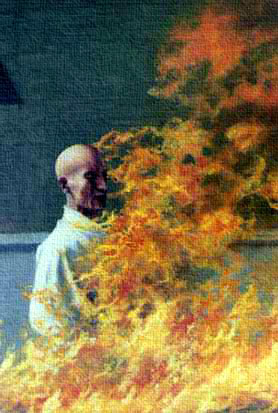
Quang Duc, the first Vietnamese monk to self-immolate, in July, 1963. This image is from a painting of the famous news photograph.
The orange-robed monks and the grey-robed nuns appeared to be part of a quiet protest as they walked slowly down Phan-Dinh-Phung Street in Saigon on a hot June afternoon. Heading the procession was an automobile filled with monks. At the intersection of Phan-Dinh-Phung and Le-Van-Duyet streets the priests got out of the car and lifted the hood. It appeared that they were having engine trouble. The procession parted around the car as if to move on, but instead the monks and nuns formed a surrounding circle seven and eight deep. Slowly they began to intone the deep, mournful, resonant rhythm of a sutra. The priests in the auto walked to the center of the circle and seventy-three-year-old Thich Quang-Duc sat in the lotus position, a classic Buddhist meditation pose. Nuns began to weep, their sobs breaking the measure of the chant. A monk removed a five-gallon can of gasoline from the car and poured it over Quang-Duc, who sat calmly in silence as the gasoline soaked his robes and wet the asphalt in a small dark pool. Then Thich Quang-Duc, his Buddhist prayer beads in his right hand, opened a box of matches and struck one. Instantly he was engulfed in a whoosh of flame and heavy black smoke that partially obscured him from view. The chanting stopped. The smoke rose and, as the fierce flames brightened, Quang-Duc's face, his shaven skull and his robes grizzled, then blackened. Amidst the devouring flames his body remained fixed in meditation.
.......To me, Mohamed Bouazizi and ONLY because I have NOT read any different .. that He took his life due to the inability to make ANYTHING right for his family, himself or his country, sorta of like - no way out - ..in physical life. His Death symbolizes to me the beginning of a whole NEW BETTER WORLD for all the people in Tunisia..
At Cairo square, protesters sow seeds of new Egypt
SARAH EL DEEB AP foreign, Tuesday February 1 2011
Associated Press= CAIRO (AP) — A 16-year-old Egyptian, Ahmed Sami, choked back tears as he explained why he and his father joined tens of thousands of protesters Monday in central Cairo to demand the ouster of President Hosni Mubarak.
"I want to live in a democracy, in social justice. I want to choose my parliament," he said. Flush with idealism, he added that any Egyptian, including himself, should have the chance to run for president.
Up until a week ago, when the largest protests ever challenging Mubarak's 30-year rule began, Mubarak had been widely expected to try to pass power to his son, Gamal, in a continuation of his autocratic rule
After the protests brought a change of government, Mubarak's first appointment of a vice-president who could succeed him, and promises of reforms, there was cautious hope at downtown Tahrir (Liberation) Square, the focal point of protests. Those in the crowd greeted each other with "Mabruk" — Arabic for congratulations.
Fear was fading, and the constant chanting was accompanied by the beat of Arabic hand drums that helped create a more festive atmosphere.
But there was also frustration that they have not yet achieved the one goal that unites the men, women, young, old, poor, middle class, secular and religious demonstrators: Mubarak's departure.
The determination to see their efforts bear fruit was palpable.
Some protesters carried pictures of Mubarak with a Hitler-style, clipped mustache.
As military helicopters buzzed overhead almost constantly throughout the day, those on the ground formed a human chain to spell out the word "Go" in Arabic for the benefit of the crews above. Others painted their message in large, black and white Arabic letters on the pavement: "Leave, coward. We're not leaving the square."
Still others shouted angrily at the skies: "Down, down, Hosni Mubarak."
The protesters haven't left Tahrir Square since Friday, maintaining a round-the-clock vigil undisturbed by the soldiers and tanks that ring the giant traffic circle and barricade every entry point.
The square had been the site of fierce clashes up until Friday, with police trying to drive out protesters with tear gas, water cannons, rubber bullets and beatings. But since the government ordered the military into the streets Friday night and the police vanished, the protests have been peaceful and the army has not intervened.
Animosity toward the police is on display in the square.
Police cars charred in Friday's riots have become garbage dumps, filled with black bags of trash. One has a handwritten sign that says simply: "I hate you."
Farida Jawad, a 43-year-old Arabic teacher and translator whose 3-year-old son, Jalil, slept in a friend's arms, expressed the hope of many in the crowd.
"I brought my son to make him a witness to the day that his life became better than ours," she said.
The demonstrators dismissed the news Monday that Mubarak had appointed the rest of his new Cabinet after sacking the old one two days earlier. As far as the protesters are concerned, anyone linked to Mubarak is tainted.
The square looks more like a protest camp every day. Up to 1,500 demonstrators have remained overnight for the last few nights. There are a few tents in a grassy, muddy plaza in the middle of the traffic circle, one named "Pensione of Freedom." Bags of food were stored near the cluster of tents while activists and a popular fast-food restaurant chain passed out free sandwiches and water.
There was even a lone entrepreneur who managed to get past the tanks with his scooter and a box full of little plastic containers of kosheri — Egypt's popular street food mixture of macaroni, lentils, tomato sauce and fried onions.
Protesters collected garbage in the square in this polluted city where care for the environment comes very low on the priority list.
One point of pride for the protesters is that they are creating a microcosm of the society they would like to live in — one that is free and clean, where women are not sexually harassed and where people help each other.
"I feel a difference in the people," said Nora Serag-Eldin, 27. "This is new."
And the word was spreading quickly across the square of calls for a million-strong march on Tuesday. People were calling their friends to urge everyone to show up and another large demonstration was being organized for Friday.
With Internet and text messaging cut off in Egypt for the fourth day, telephone calls and word of mouth were the main tools for publicizing new protest plans.
As far as fashion statements, the biggest thing on Tahrir Square was sticking red and blue bullet casings, each with a metal tip stamped "Made in U.S.A.," on all fingers on one hand.
"These are the bullets of the Interior Ministry," said Gamal Hussein, 54, holding up his hand. Police are under the command of the Interior Ministry.
Some protesters on the square had their heads and hands bandaged from clashes last week. One man with an eye patch said he was in danger of losing his eye after he was shot Friday with a rubber bullet.
Most protesters were young, and some brought babies and young children, encouraged by the lack of clashes on Saturday and Sunday. Also, many businesses remain shut, giving people time to demonstrate.
When the call to prayer rang out from mosques, one corner of the noisy square fell quiet as hundreds of men prostrated in prayer. As they finished, a few shouted "Allahu Akbar" — God is great.
As a government-imposed curfew went into force ahead of a fourth night, an hour earlier at 3 p.m., the soldiers surrounding the square did nothing to enforce it.
........Why EVERYONE in the WORLD is not BEHIND these Beautiful people and childrens dreams is simply beyond me! Why do WE want to keep a torturer and a liar and a crook as a head of any country ? .. oh I forgot .. We do that HERE.


 Market Data
  Markets


 AI
AI