Rectifying the case for beaming Lunar solar power by Sam Dinkin Monday, April 11, 2005
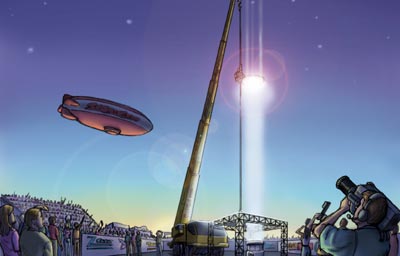
“The beam source is a 10 kWatt Xenon search-light (80 cm beam diameter, about 25% efficient), which should yield a climber power budget of about 500 watts.” — 2005 Beam Power Challenge
NASA’s support for a prize competition to develop power beaming technologies, ostensibly for a space elevator, could also prove useful to Lunar solar power development. (credit: Spaceward Foundation)
Power beaming is an excellent way to send power into space. Rather than carting heavy power generation equipment and fuel, all of the mass can stay on the ground. The reference case for Earth to space elevators now utilizes power beaming. Power beaming can also be used to reduce the weight thrown to the Moon to begin scouting, pioneering, and settling. While important to make the cost of the administration’s Vision for Space Exploration reasonable and perhaps someday making space elevators feasible, the biggest value of power beaming may be beaming back to Earth after the Moon is industrialized.
An investment in Lunar industry can produce cell after cell that will have a very long life in the optimal conditions for electronics on the Moon. By producing vast farms of solar cells, power can be gathered without any clouds or atmosphere to get in the way. If the solar photovoltaic power cells are built out of Lunar materials, a small industrial base on the Moon can lead to enough power to export by radar beam back to the Earth. Lunar solar power (LSP) is a low pollution, low operating cost, high capacity power generation technology.
There are substantial questions that need to be answered regarding cultural, legal, financial, and political challenges before the more modest engineering challenges can be embarked upon. Dr. David Criswell advocates LSP as a panacea for global poverty, petroleum wars, pollution, US growth, Social Security, Medicaid, interplanetary travel, and colonization. Is it the real deal, or is it being thoughtlessly oversold like orbital solar, helium-3, and hydrogen? Criswell’s frontal assault on the academy has been going on for decades. Even as the economics and technology gets steadily validated through other projects, we are further from LSP now than we were in 1968.
Criswell is certainly too much of a Pollyanna (Webster’s 10th: a person characterized by irrepressible optimism and a tendency to find good in everything) to be a very good advocate for his case. I am probably too controversial to do it. Anyone else want to have a go?
As a commercial proposition, saying with a straight face you want to start a blue sky endeavor (black sky?) that will cost $400-500 billion to achieve breakeven will have commercial investors wondering why they took the meeting. If a space transportation startup cannot raise $1 billion (see “The ‘signal-to-noise ratio’ in financing new space startups”, The Space Review, February 28, 2005), then why would a power company be able to raise $400–500 billion?
For the United States Congress, this would be a major strategic undertaking. However, if we spread the cost over fifteen years, spending would be only $30 billion a year. As a percent of GDP it is only 0.3%, a bare two percent of the federal budget or about twice what we are spending on NASA today. After that, we would have an asset that is self-sustaining worth trillions of dollars to the world economy.
That level of investment of a one-time investment of 4–5% of US GDP would be a commitment on the order of the Apollo Project, the Manhattan Project, the Louisiana Purchase, the War on Terror, the War on Poverty, the War on Drugs, the invasion of Iraq, the tax cut, the prescription drug benefit, the student loan program, the residential mortgage program, and the list goes on.
Most of the early investment will be mirroring the administration’s Vision for Space Exploration (VSE) anyway, at least for most of the first $20 billion or so. The first expensive elements will be to establish sufficient Lunar infrastructure to embark on Lunar construction of a demonstration system.
Lunar solar is a boring, simple technology. Solar cells have been powering houses in sunny spots and call boxes for decades on Earth. As a solid-state technology, it is uniquely suited to the harsh Lunar environment. Radiation, heat, and cold are no big deal to a hunk of silicon. Broadcast radar power has been successfully demonstrated. If the engineering case for LSP is so simple, compelling, and boring as to be unbelievably easy if it can be validated, the main challenges associated with adoption and deployment are cultural, legal, financial, and political.
Validating the case
There is not too much mass represented by a solar cell. Almost all of the mass is taken up by silicon, which is plentiful on the Moon. The energy to refine the silicon is also plentiful. Thus the case for LSP is very robust to changes in the cost of transport. Even at ten times Criswell’s assumed cost to Earth orbit of $500/kilogram, building out the Moon would assure that the cost of energy never rises higher than it is today. That is a pretty good assurance. And once there is $500 billion a year or more in commerce on the Moon, it would be reasonable to assume there would be sufficient traffic for lower cost heavy lift to be affordable and fully utilized, making the low-cost case of Lunar development govern.
Obtaining the frequencies for broadcast could be a pricey proposition especially if band clearance is rushed. Clearing all the existing users from the primary frequency and the harmonics will be a tricky endeavor. Being right in the sweet spot of communication, it could cost another $100 billion to clear the relevant spectrum bands. Technically, it can be easily validated that power can be broadcast, and then rectified. The regulatory issue of obtaining the requisite frequencies and moving the existing users to other parts of the spectrum may be much more time consuming. Done over a decade like analog TV, it might not be too disruptive. Advocates should start figuring out the answer early so the frequency will be available when the broadcast antennae start sprouting on the Moon. If band clearance (possibly on the harmonics) is incomplete, perhaps geographic separation would be a substitute. Even without broadcasts near population centers, due to the difficulty of band clearance and interference with consumer electronics, power beaming economics would be affected little. It would be a shame not to put copper wire to better use, but we’ve already got it deployed in case we still have to ship power from outlying areas to population centers once it hits Earth. Even so, the frequency band plan may be the most critical item.
One benefit that cannot be banked on (at least not without intervention or a complete turnover of the capital stock) is reduction of carbon pollution. Cost of coal is about nil. It is between $10–40/ton delivered. That generates about 25 million BTU, which converts into about 7,300 kWt-h or about 2,400 kWe-h. That puts it right around $0.01/kWe-h. If the cost of Lunar solar generated electricity dropped to that, coal would still be burned in about half the plants in America if we discount operating and maintenance costs. Since there is nothing really to do with coal if we don’t burn it, the price of coal would drop if we stop. The prices would drop to microprices.
It is reasonable to expect that few new coal, nuclear or gas plants would be built if Lunar solar starts offering electricity at $0.01, but that would entail a huge drop in the cost of carbon and uranium. It might still be profitable to operate rather than close them after the capital is written off. The only way to stop the burning of coal in existing plants is to impose a tax or outlaw it. We can do either of those things without Lunar solar power.
Oil is a similar deal. There are still very-low-cost oil fields to work, especially in the Middle East. If the cost of electricity dropped to $0.01/kWe-h due to market saturation of solar, oil would likely drop precipitously until burning it became competitive since petrochemicals demand would take years to reach the same level of demand as burning oil as fuel for heating or transportation. There would be many expensive wells that would be capped. There would be few, if any, new wells drilled, but oil would continue to flow and be burned for years following such a price drop. Again, a steep carbon tax would be required to eliminate it.
Even if electricity is $0.01/kWe-h, that does not make the capital turnover to electric and hydrogen cars much less expensive, especially considering the drop in the price of oil if the transition usage drop gets ahead of the carbon electricity generation plant capital depreciation. Which do you think depreciates faster, cars or big steam boilers?
The math of industrial transition economics is not flattering to LSP. The total cost of the LSP would have to compete against the marginal cost of burning the carbon in order to make a profit.
Building the capability
To think like the DoD, it might pay to research the problem and work out long-lead-time items, then slow down the deployment to keep the skills relevant and keep people thinking about the problem. It would only ramp up if there loomed an imminent crisis. LSP would be a strategic option, but there would be co-development with the Vision for Space Exploration to keep initial outlays low. The outlays would remain low until the economics became compelling. Prices of LSP would have to drop enough to undercut the marginal price of coal and oil, the world become rich or unhappy enough to phase out carbon and uranium, or we just outgrow terrestrial capacity for energy production, even with all carbon and uranium generators going full throttle.
For those of you who think the crisis is imminent now, buy oil company stocks—you’ll get rich when the price hits infinity. (See “Review: Out of Gas”, The Space Review, September 27, 2004)
Like those who continually herald the end of Moore’s Law, energy worrywarts never have their fears confirmed by the energy industry, which stays a few steps ahead of our growing energy appetite. I really have no idea whether it will be breeder reactors, oil sand, or coal gasification and carbon sequestration that power our streetlights in 100–200 years. It will probably be as alien as electricity is to candles, town gas, and whale oil. Maybe the things that will move on streets will look as different as cars do to horses. However, I do know there is a lot of money to be made solving the energy problem. Capitalism heals itself. If I wave a $100 bill in the air, I might find it easier to get a cab in New York City. The world is waving trillions of dollars to the people who figure out the energy solutions of the next generation.
If we have 100 GWe of installed capacity on the Moon in 2020 producing power at today’s costs, that would be a huge boon since the market is predicting prices are likely to rise. If the price of oil rises five percent per year between now and then, it will be double the price now. Oil prices are expected to rise according to the interest rate. The reason is that oil producers would keep their oil in the ground if the price were sure to rise faster than the interest rate. They would furiously pump now if not. The only price path that is consistent with this dynamic is one where prices rise according to the interest rate.
If LSP represents a small part of worldwide demand, it will do little to decrease electricity prices on Earth, but will result in impressive profitability. I think the “having the cake” of profits is a good waypoint on the way to “eating it too” and dropping the price of electricity to nearly nothing. Furthermore, as Dr. Criswell puts it, “If 100 GWe of LSP can be built then much more can also be built. The factory process and the initial commercial scale delivery are the key steps. After that, production can be ramped up very quickly.”
Cultural challenge
LSP poses the biggest direct challenge, ironically, to those who say they do not want to use uranium or foreign carbon. Earth’s clean power sources such as hydro, wind, terrestrial solar, and biomass take large amounts of land area and are not cost-competitive with carbon or uranium at strategically relevant quantities. It is a comfortable ideology of victimization to complain that corporations and governments are spoiling the world. Where would it leave activists if the greatest perceived ills of corporate activity were gone?
The cognitive dissonance about collective sacrifice would be gone. We would not have to waste $0.02 worth of time to recycle $0.012 worth of aluminum any more (that’s five seconds to someone earning $15/hr to save 14.9 grams per can at $800/ton). We would not have to sacrifice horsepower on our cars to be clean any more. We would not have to turn out the lights. We would not have to turn off the faucet.
With cheap, plentiful, pollution-free electric power, carbon could be retired as a power source that has been in use since the first human tamed fire to burn wood for cooking. Uranium could be obsoleted for commercial power 63 years after it was deployed.
There would still be plenty to be mad about. There would be enough power to go around amongst all the poor, but it wouldn’t. Just as there is enough food to go around now, but it doesn’t.
Space would need to be weaponized. Otherwise we would have a multi-trillion dollar installation and not protect it. Such negligent stewardship does not need much analysis to be reduced to absurdity.
We would have to reënvision ourselves as a two-world species. No more zero-population-growth sacrifice. No more shibboleths about resource wars because there is not enough resources to go around.
The generation that will grow up starting in 2040 will see that all substance can be shaped as we see fit. That “conservation” is an empty concept. The depression and energy crisis-era cultural dogmas will be permanently put behind us. The attention cost of thinking about turning off the light is more expensive than leaving it on because people will pay you piece rate for your attention and electricity will be so cheap. We can move on to colonizing the solar system doing more with more. We would no longer pay lip service to shoehorning ourselves into the Earth by doing less with less.
I am not talking about the poor when I say do more with more. There will be the same ratio of poor to rich as there has always been even as the poor become more wealthy in an absolute sense. The poverty line keeps moving up every so often so our standards for poverty are really relative, not absolute. There is nothing wrong with that, but to say we are going to eliminate poverty is nonsense. That would be like making everyone above average in height by use of growth hormones. It may work in Lake Woebegone, but not on Earth.
Legal challenge
I am not optimistic that there will be much in the way of development prior to the adoption of property rights. There is the appearance of a catch-22 in the Outer Space Treaty. No signers can claim the Moon without withdrawing from the Treaty. So if no one can claim the Moon, how can property rights occur? The UN draws its authority from its member nations. Scholars say if nations have no sovereignty, people can’t claim property either. Perhaps Lunar property rights will burst on the scene with an announcement of a coalition of the willing to colonize the Moon.
There are challenges for LSP in the ITU, the UN, the US, and the EU that make the adoption of Galileo look like child’s play in comparison. It is certainly tempting to withdraw from the Outer Space Treaty and claim the Moon. But in addition to making a lot of unhappy satellite owners, imagine how China would feel if the US claimed the Moon when it won’t even let some people exclusively claim land where they live and govern. If the world is lucky, they will join the development.
Financial and political
$400–500 billion is a hard sum to get out of Congress, even in $30 billion chunks. It may not be so difficult in 15 years time. In 1994, the USAF looked at a number of scenarios for the world back in their Spacecast 2020 excercise. They predicted that the economy would be twice as big in 2020. Taking a point and a growth rate from the CIA World Factbook, their prediction is not too far off the best we can do today.
There will probably be a trillionaire by 2020. If world GDP is $100 trillion by then, its assets, if fully monetized at 5% interest rate, would be worth $2 quadrillion. That trillionaire would likely not want to put all his eggs in one basket. There might not be a lot of other good places to invest any more. It’s hard to say. Many developments could occur to make the financials for LSP look much better such as space solar, Lunar tourism, orbital tourism, and space elevators. These industries have substantial overlap with what is required for cheap LSP. However, prior to necessity, LSP will require government seed money.
Politics is particularly fickle. Trying to explain why LSP is better than helium-3 mining or converting to a hydrogen economy requires physics and economics knowledge that is two levels removed from most legislators. The political class mostly does not associate with the scientific and economics academics (and this issue would require both at once). And if they did, the academics do not have the vocabulary to communicate the issue. Much will depend on resonance with the national mood. Who picks the movies that will be hits? Getting a hit major policy initiative is a lot like getting a hit patent, hit movie or hit song. There are some promoters that can do it well, but few that can do it for sure. And those great lobbyists and statesmen who occasionally reshape public opinion will have their own agenda to push. Therefore it is likely to be a long fight before LSP is funded even by a rich planet.
LSP starts with a heavy handicap. There are a gaggle more of well-funded fuel industries that would be threatened if LSP came to fruition such as carbon, uranium, and deuterium. When there is diffuse benefit and concentrated harm, a policy initiative has a particularly rough time to gain friends in the face of such persistent enemies.
Final thoughts
So perhaps it is wise that NASA should disguise its love of LSP and its technology development of it in innocuous, ancillary research. A Centennial Challenge ostensibly for space elevator climbers is a plausible cover story for a space beam broadcast trial that would go a long way to retiring the risks of developing LSP. NASA should continue to research solar panels on satellites, Lunar development for Mars practice, in situ resource utilization for hydroponics and other off point projects. By doing so, it may yet deploy LSP decades before a frontal attack ever could.
Sam Dinkin of Austin, Texas is a regular columnist at The Space Review. He can be reached at (888) 434-6546 and thespacereview@dinkin.com.


 Market Data
  Markets


 AI
AI