Ukrainian Foreign Minister Borys Tarasuyk said he and his Georgian counterpart, Salome Zurabishvili, will travel to Kyrgyzstan to help officials restore stability.
Both the Ukrainian and Georgian governments were put into power by Bush. These are not true democracies as they are answerable to Bush. Here we see the two whores scurrying off to Kyrgyzstan.
Excuse me, I think I am going to hurl.
-Am
Wednesday March 30, 2005 4:31 PM
AP Photo MOSB103
By KADYR TOKTOGULOV
Associated Press Writer
BISHKEK, Kyrgyzstan (AP) - A prominent foe of ousted President Askar Akayev offered renewed security guarantees Wednesday if he returned home from his refuge in Russia, and the U.S. ambassador extended a hand to the new leadership of Kyrgyzstan.
Akayev, who fled this ex-Soviet republic March 24 after protesters stormed the presidential headquarters, hinted in a Russian television interview Tuesday that he might be willing to resign if he received proper guarantees. But he said he would only trust them from new parliament speaker Omurbek Tekebayev.
``We guarantee Akayev his personal security, the security of his property and free movement,'' former opposition leader Felix Kulov said.
The new Kyrgyz authorities are eager to secure Akayev's resignation, seeing it as an essential step to restore a sense of order and legitimacy to the nation's politics.
But interim leader Kurmanbek Bakiyev said it was too early for Akayev to return.
``At this moment, Akayev's return would not be right because I am concerned about the security situation,'' Bakiyev said on a televised call-in show.
Akayev told Russia's state-run Channel One TV that he might be willing to step down to help ensure legitimacy for Kyrgyzstan's next elected leader. But he insisted he was still Kyrgyzstan's legitimate leader.
Asked whether he was prepared to resign, Akayev replied: ``Of course, of course - if I am given the relevant guarantees and if it is in full accordance with the current legislation.''
But Akayev said he lacked confidence in the guarantees already given by Kulov and Bakiyev, and saw the parliament as ``the only legitimate authority.''
Akayev fled when opposition supporters stormed government headquarters to protest disputed parliamentary elections in February and March. The opposition said the votes were rigged to fill the 75-member parliament with pro-Akayev lawmakers, who it feared would extend Akayev's expiring term.
Kyrgyzstan became the third former Soviet republic in the past 18 months - after Georgia and Ukraine - where the opposition was swept to power after mass protests against long-entrenched leaders.
U.S. Ambassador Stephen Young met with Tekebayev and pledged American help to the Kyrgyz as they try to bring prosperity and real democracy to this nation of 5 million people.
``We are ready to work actively and in a friendly way with the parliament and others in the leadership in the cause of a stable, thriving and democratic Kyrgyzstan,'' Young said in Russian after the talks.
Ukrainian Foreign Minister Borys Tarasuyk said he and his Georgian counterpart, Salome Zurabishvili, will travel to Kyrgyzstan to help officials restore stability.
Russian Foreign Minister Sergey Lavrov, meanwhile, again warned against outside interference in the political affairs of former Soviet nations.
Russia has criticized Western countries and structures - including the Organization for Cooperation and Security in Europe - for what it says is meddling in the internal affairs of former Soviet countries. The OSCE had denounced Kyrgyzstan's parliamentary elections as flawed.
``Those who were trying to create problems inside Kyrgyzstan, destabilize the situation there, were referring to this OSCE assessment,'' Lavrov said in Moscow. ``I am sure that the organization itself didn't want that, and we are not accusing it of that. We are just saying that it is necessary to treat election assessments in a very responsible way.''
Kyrgyzstan hosts both U.S. and Russian military bases. It shares a border with China, has been a conduit for drugs and is a potential hotbed of Islamic extremism.
Looting and gunfire in the capital of Bishkek marred the opposition's victory last week. Kulov, named by Bakiyev to coordinate law enforcement agencies after the uprising, resigned Wednesday, saying order had been restored.
``The situation has stabilized,'' Kulov told lawmakers, according to the parliamentary press service. He also said that with the interim government fully in place, there was no need for his position.
Presidential elections have been set for June 26, but Kulov said that ``only after we get guarantees of Akayev's resignation can we start talking about elections.''
Kulov apparently has no direct say in when the elections would be held, but his position as one of Akayev's most prominent opponents gives his statements weight.
Meanwhile, lawmakers appealed to the Supreme Court and the Prosecutor General's Office on Wednesday to cancel a corruption conviction against Kulov.
Kulov, a former vice president and security chief, spent four years in prison on charges he said were politically motivated. He was released just hours after the seizure of the presidential administration building last week.
Political tensions and disorder were still apparent when the new legislature convened Wednesday for its first session as the undisputed parliament. The session first was delayed because many legislators showed up late. Then, four legislators walked out when a pro-Akayev lawmaker turned up to take his oath of office.
Background: In the same manner that Bush and previous U.S. administrations have used the Chechens as a prelude to dismantle Russia, Bush is using the Uighurs to break China into more manageable pieces. The China/Kyrgyzstan alliance has until now stood in his way.
China has already protested the establishment of a Uighur Government-in-Exile in Washington and Beijing has repeatedly made it clear that it will not tolerate any political interference from abroad, where pro-independence Uighur organizations exist. This means us. It would seem we are orchestrating a riot in the Xinjiang province of China. Kyrgyzstan is one of the countries that borders the Xinjiang region. #msg-4098311 #msg-5871359
Note China has a substantial presence in Kyrgyzstan.
According to the mutual agreement between ex-president Akaev and China, these rented zones will become loopholes for the Chinese to penetrate into all other territories of Kyrgyzstan. Officially China already rented 800 hectares on the southern shore of Issyk Kul Lake (some reports say they were allotted about 1,200 hectares).
Local people are not allowed in there. Chinese patrol is guarding this section and checkpoints are now being set up. Not too long ago the Chinese brutally beat a 22-year-old local resident Nurmat A., who attempted to graze his cattle on the land rented by the Chinese. The parents, who started a scandal, were intimidated by the police and were paid a little compensation.
In the spring of 2000 in Osha Province, Kyrgyzstan, agents of Uzbek secret services, freely operating on Kyrgyzstan’s soil, abducted someone named Bakhtiar K., ethnic Uigur, and brought him out of the country. Bakhtiar K. was suspected in cooperating with Islamic Movement of Uzbekistan (IMU). During the interrogations, which involved severe tortures, Uzbek agents found out that Bakhtiar K. was really working for Chinese intelligence services and his assignment was to collect information about anti-Chinese activities among underground Muslim organizations operating in Southern Kyrgyzstan. #msg-4806037
-Am
ETHNIC CONFLICT SIMMERS IN SOUTHERN KYRGYZSTAN
By Igor Rotar
Monday, June 20, 2005
Dzirgalbek Sourabaldiyev, a well-known businessman and a member of Kyrgyzstan's parliament, was assassinated in downtown Bishkek on June 10. The deputy was shot five or six times, and his driver was also injured. The Kyrgyz parliament convened an emergency session that same day. According to deputy Kubanichbek Isabekob, the assassination may have both political and commercial reasons behind it. Sourabaldiyev owned the Kudaibergen market, and he backed ousted president Askar Akayev during the March revolution. On the day that protesters seized the central government building, Sourabaldiyev deployed athletes armed with rocks against the protesters.
The murder is one of many indications that the current authorities are not in full control of the situation in Kyrgyzstan. Protesters still control the main entrance and two emergency entrances to the Supreme Court. The protestors have compiled their own access list and refuse to let at least ten judges enter the building. They are demanding the resignation of several key members of the Supreme Court, and they want the results of the February-March parliamentary elections revisited (Vecherny Bishkek, June 11).
In Narynsky district, in northern Kyrgyzstan, Nurlan Motuyev and several hundred of his supporters in the People's Patriotic Movement of Kyrgyzstan have seized the Kara-Keche coal mines, shutting down the operation and dismissing personnel. Motuyev wants to redistribute ownership, so that 70% of the company is owned by local residents and the other 30% by the state. The agitators say that they intend to take machinery away from the private companies that have been working at the mines. The Kara-Keche coal mines are the largest in Kyrgyzstan, and they produce approximately half of the country's coal output (fergana.ru, June 13).
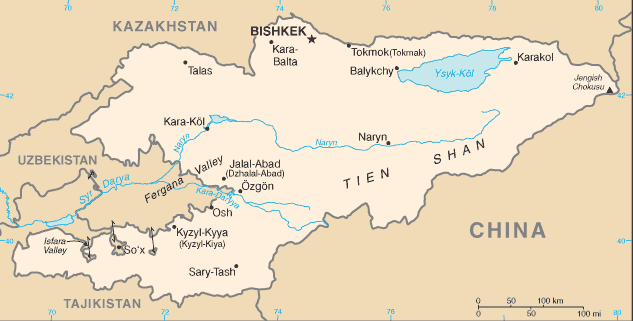
The weakness of the current authorities is most evident in southern Kyrgyzstan. On June 13, a shoot-out involving automatic rifles took place in central Osh (see EDM, June 14, 16). At almost the same time, residents of the Kyrgyz city Karasuu, home to the largest market in Central Asia, staged a protest against one of the owners of the market, Bayaman Erkinbayev. Traders accused the businessman of introducing an illegal surcharge for a stall at the market. The picketers shouted, "Bayaman, go away!" Because Erkinbayev is an ethnic Kyrgyz, whereas nearly all the residents of Karasuu are ethnic Uzbeks, the disturbances appear to have ethnic overtones (fergana.ru, June 13).
In the southern city of Jalalabad, a group of about 150 people are demanding the release of members of Adilbek Karimov's group, which carried out an assault on the municipal and district police departments in May 2003. The protestors are threatening self-immolation if Karimov is not released.
But Adilbek Karimov's case has nothing to do with politics. In May 2003 Karimov's gangsters attacked a police station in Jalalabad city, beat up the policemen on duty, and seized a large number of weapons. All of the perpetrators were quickly arrested.
As head of the gang, Karimov was sentenced to 25 years in jail. His relatives and associates believe he did not receive a fair trial under the Akayev regime and therefore the convictions should be overturned. Deputy Governor Zhanish Kurbanov met with the protestors, saying that no one had the right to simply release the prisoners. Rather, the case should be reviewed again according to legal procedure (kirgiz.info, June 10).
Southern Kyrgyzstan is a potentially explosive region. About one-third of the population is comprised of ethnic Uzbeks. So far, resident Uzbeks have generally stayed away from the Kyrgyz political revolution. Almost all the protesters who took part in the March disturbances in southern Kyrgyzstan were ethnic Kyrgyz. However, many poorly educated local Uzbeks suspect that the opposition is also driven by nationalism. According to the fergana.ru website, participants in the Jalalabad demonstration shouted insults against Uzbeks and Kyrgyz. The Uzbeks accused the Kyrgyz of destabilizing the situation in Kyrgyzstan, while the protesters blamed the Uzbeks for supporting the regime of President Akayev.
The mutual verbal accusations soon deteriorated into a brawl. According to witnesses, the special police units and police officers that were guarding the Jalalabad district administration building were in no hurry to intervene (Fergana.ru, March 6). Azimdzhon Askarov, a human-rights activist from the city of Bozor-Kurgan (an Uzbek-dominated district center approximately 30 kilometers west of Jalalabad, the district center of Southern Kyrgyzstan) told Jamestown, "After the March revolution one hears a lot of accusations that Uzbeks were loyal to the Akayev regime."
A representative on religious affairs in Osh district, Samsabek Zakirov, believes that the situation in Kyrgyzstan has become even more heated after the Andijan tragedy sent more Uzbeks into the region. "Even though there are about 500 people in the refugee camp, the true number of refugees is significantly higher, as most of them were put up by their relatives, and thus have not been registered by the authorities. The influx of refugees may aggravate the difficult socio-economic situation in southern Kyrgyzstan and potentially heighten the tension between local Kyrgyz and Uzbeks."


 Market Data
  Markets


 AI
AI