You were stating that Agri-Plas' order cost $25mill-- it was wrong as they are only looking to do 60tpd using a very different (total) process and feedstock. You got a reference for Green Envirotech and hastily miss-applied it to Agri-Plas.
Now you are generously giving a 90tpd for 25mill out of the blue...
Seriously, you are traveling down the wrong path:
This is what the "up to" $25 mill bond will do:
The process begins with Miller Compressing Co. in Milwaukee, which crushes the vehicles and will send the remnants by truck to the Sheboygan plant.
The material is separated using a process created by German company SiCon GmbH. About 23 percent of the material is plastic, 10 percent is non-tire rubber and 8 percent is various fibers. The rest cannot be used by Green Envirotech and goes to a landfill.
The plastics are then decontaminated using technology from Pennsylvania-based Thar Process Inc. The U.S. Environmental Protection Agency requires less than two parts per million of PCBs, and the Thar technology cleans the plastic to one-eighth of that limit.
About 60 percent of the plastic is polypropylene, which is mixed with an equal measure of virgin plastic and required additives before being sent to carmakers. This compounding process is done by a Belgian company called Ravago, which will install $7 million worth of equipment at the Sheboygan plant to be run by Green Envirotech's employees.
The remaining 40 percent of the plastic is mixed with the rubber and fiber into high-quality crude oil. That process was developed by Oregon-based Agilyx Corp.
Very, very, different from P2O -- perhaps you can compare the last piece if P2O will also do rubber and fiber. "Slurry" or "gel" comes with a process tag. That tag fits what Green Envirotech wants to do. Again, JBI appears to be boxed into low-hanging waste/scrap fruit. (BTW look what Green Envirotech is going to do with the previously comingled & contaminated polypropylene-- recycle it!)
Perhaps you should do more thorough research? Perhaps starting with SynCrude?
THOROLD, Ontario, Dec. 15, 2010 (GLOBE NEWSWIRE) -- Today, JBI, Inc. (JBI) (OTCQX:JBII) announces that it has entered into a formal Consent Order with the New York State Department of Environmental Conservation (DEC) Region 9, which will allow the Company to immediately run its Plastic2Oil process commercially and begin construction of an additional processor at its Niagara Falls, New York P2O facility.
JBII is now listed on the #1 Top Tier of the OTC: OTCQX
There is a surplus of Butane that is being compressed for use/Sale.
The Company has hired WithumSmith & Brown, an accounting firm rated in the top 30 in the U.S.:http://Withum.com .
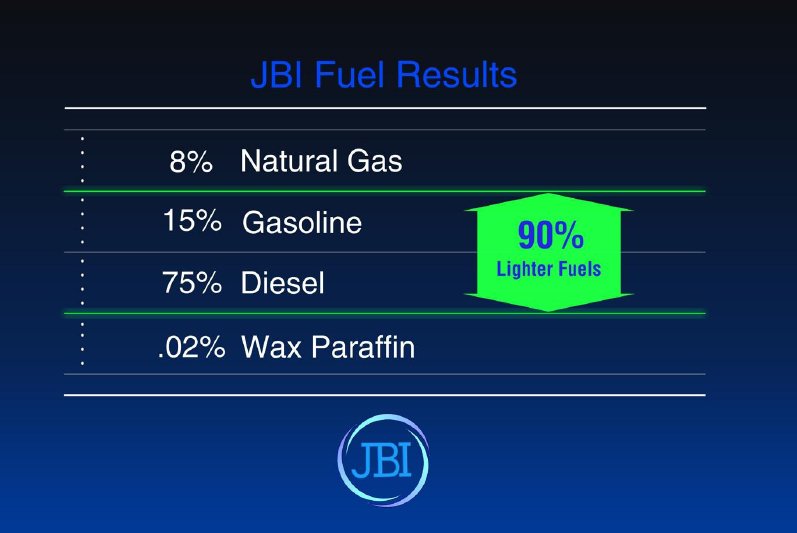
Fuel Output:
20 Ton Continuous Feed Production Machine Video:[/color]
JBII Plastic to Oil Video Presentation Part One:
JBII Plastic to Oil Video Presentation Part Two:
JBII Plastic to Oil Video Presentation Part Three:
JBII Plastic to Oil Video Presentation Part Four:
The AGM on 4-24-2010 was a huge success. 450+ Shareholders were in attendance to witness a very professional presentation about the company and her prospects for the future.
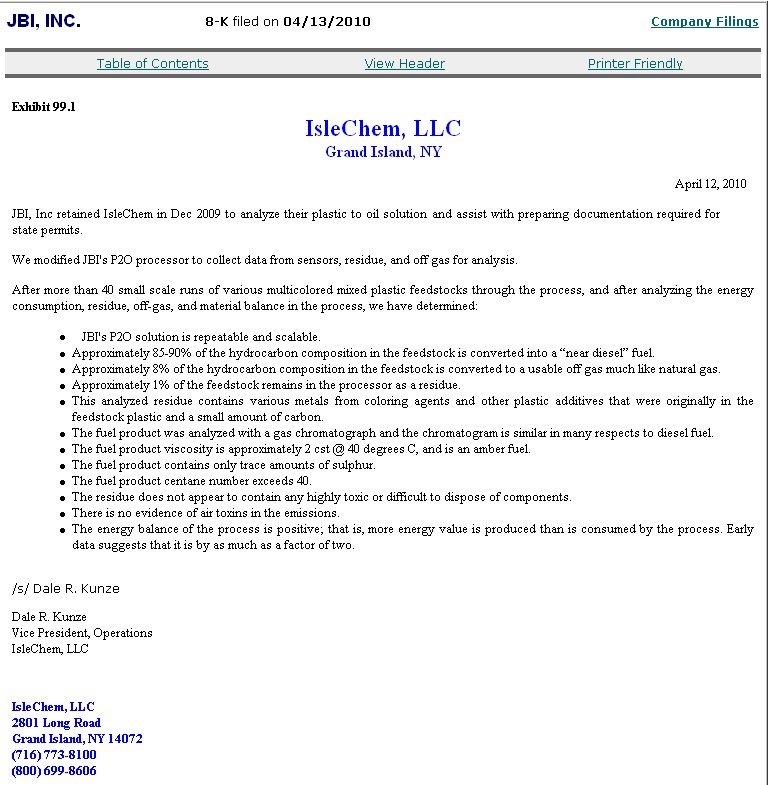
* JBI's P2O solution is repeatable and scalable. * Approximately 85-90% of the hydrocarbon composition in the feedstock is converted into a "near diesel" fuel. * Approximately 8% of the hydrocarbon composition in the feedstock is converted to a usable off gas much like natural gas. * Approximately 1% of the feedstock remains in the processor as a residue. * This analyzed residue contains various metals from coloring agents and other plastic additives that were originally in the feedstock plastic and a small amount of carbon. * The fuel product was analyzed with a gas chromatograph and the chromatogram is similar in many respects to diesel fuel. * The fuel product viscosity is approximately 2 cst @ 40 degrees C, and is an amber fuel. * The fuel product contains only trace amounts of sulphur. * The fuel product centane number exceeds 40. * The residue does not appear to contain any highly toxic or difficult to dispose of components. * There is no evidence of air toxins in the emissions. * The energy balance of the process is positive; that is, more energy value is produced than is consumed by the process. Early data suggests that it is by as much as a factor of two.
Independent Lab IsleChem ( http://IsleChem.com ) validation report on Plastic to Oil as specified by the company, has been released (See above) and has confirmed the P2O process works as predicted.
United Research Services ( URS: http://www.urscorp.com/ ), a Fortune 500 company has been hired: John Bordynuik: " to further validate the Plastic to Oil concept."


 Market Data
  Markets


 AI
AI