North Korea warns South against staging military drills
Pyongyang threatens to launch bigger attack on Yeonpyeong island if South Korea carries out further artillery exercises
Smoke rises from Yeonpyeong island, South Korea, after being hit by shells fired by the North last month.
Friday 17 December 2010 13.35 GMT
North Korea warned South Korea today that if it staged artillery drills on Yeonpyeong, the retaliation would be much stronger than last month's deadly attack on the island.
The North cautioned against similar drills before the shelling on 23 November, which killed four people, destroyed homes and revived fears of war on the peninsula.
South Korea plans to hold one-day, live-fire drills between tomorrow and Tuesday on Yeonpyeong, home to fishing communities and military bases. The island sits seven miles from the North. Seoul said the timing of the drills would depend on weather conditions and other factors and, despite the threats from the North, the exercises would go ahead as planned.
The North claims nearby waters and considers such drills an infringement of its territory. The assault last month was the first by Pyongyang to target a civilian area since the end of the 1950-53 war.
The shelling provoked anger and shock in the South, where TV screens and newspapers were filled with images of islanders fleeing their bombed-out, burning homes.
A senior North Korean military official said in comments published by the North's official Korean Central News Agency that if the South carried out further drills on Yeonpyeong "unpredictable self-defensive strikes will be made".
"The intensity and scope of the strike will be more serious than the [earlier shelling]," the official said in the notice sent to Seoul today.
Pyongyang said the planned drills were an attempt "to save the face of the South Korean military, which met a disgraceful fiasco" during last month's clash.
The South Korean president, Lee Myung-bak, has faced criticism that troops were unprepared for the strike on Yeonpyeong and reacted too slowly and weakly. He has since replaced his defence minister, Kim Tae-young, and pledged to increase the number of soldiers and weapons on islands along the Koreas' disputed western sea border.
Representatives of the US-led UN command, which oversaw the armistice that ended the Korean war, will observe the drills.
The war of words between the Koreas came as the governor of New Mexico arrived in Pyongyang today on an unofficial diplomatic mission to try to ease regional tensions.
Bill Richardson, an unofficial envoy to the North, said he wanted to visit the main nuclear complex and meet senior officials during his four-day trip, though details of his schedule were unclear. He said before the visit: "My objective is to see if we can reduce the tension in the Korean peninsula."
In Washington, the state department spokesman, PJ Crowley, said the South's artillery drills posed no threat to the North. "North Korea should not see these South Korean actions as a provocation," he said.
However General James Cartwright, vice chairman of the joint chiefs of staff, warned the exercises could trigger a chain reaction of firing and counter-firing. "What you don't want to have happen out of that is for us to lose control of the escalation. That's the concern."
Amid the rising tensions, US diplomats held meetings in the region. In Beijing, the US deputy secretary of state, James Steinberg, held private meetings with the Chinese state councillor, Dai Bingguo.
China's head of foreign policy returned last week from talks in Pyongyang with the North Korean leader, Kim Jong-il. China has come under renewed pressure to persuade North Korea, an ally, to change its behaviour.
Pyongyang is believed to be seeking exclusive talks with the US before returning to six-nation nuclear disarmament negotiations hosted by China, which will include South Korea, Japan, and Russia.
Crowley has warned North Korea must cease provocations, reduce tensions in the region, improve ties with South Korea and abandon its nuclear programme before any discussions can take place.
Japan identifies China as bigger military threat than Russia
Cabinet-approved guidelines in Tokyo call for new defence strategy focused on China and North Korea
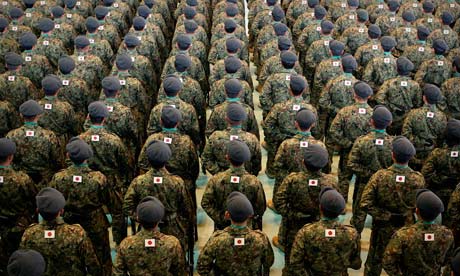
Japanese soldiers at a military display in Tokyo.
Friday 17 December 2010 16.57 GMT
Japan should refocus its defence strategy on the rise of China and not on the cold war threat of Russia, according to new guidelines announced today.
The guidelines, which were approved by the cabinet, also call for a stronger alliance with the US – Japan's biggest ally – and expanded security networks with partners such as South Korea and Australia.
Japan will acquire new submarines and fighter jets, upgrade its missile defence capabilities and make its ground forces more mobile so that they can quickly respond to emergencies in south-west Japan.
While Japan has forces for self-defence, its pacifist constitution, drafted by the US after Japan's defeat in the second world war, bar it from sending troops into combat overseas.
The guidelines paint China as a bigger threat than Russia and say Japan is shifting its defence emphasis from the northern island of Hokkaido to islands in the south, such as Okinawa, and territories claimed by both Tokyo and Beijing that have recently led to diplomatic tensions.
The defence minister, Toshimi Kitazawa, said the plan would help Japan adapt to a "new, complex security environment". China immediately described the guidelines as "irresponsible".
The Japan-US alliance remains "indispensable" to Japan's security, the statement said, calling for stronger co-operation between the Japanese and the 47,000 US armed forces based in the country.
But it also noted a relative decline of America's strength and rise of emerging countries such as China and India. Japan should pursue its own efforts to enhance missile defence capabilities to protect itself from threats from China and North Korea, it said.
"We still have lots of tanks and ground self-defence forces on Hokkaido and we need to shift to the south-western islands," a senior government official said on condition of anonymity before the official release of the guidelines. The official said the goal was to "modernise our defence posture from our cold war days".
Washington: The Pentagon is digging in on the Korean peninsula and increasing its commitment throughout the rest of the Pacific. That would seem to augur well for sales of F-35s to South Korea.
Defense Secretary Leon Panetta recently announced the United States' 28,000-man garrison in South Korea would be staying indefinitely. Washington and Seoul continue to hammer out a deal to sell the Air Force's Global Hawk unmanned intelligence, reconnaissance and surveillance aircraft to the Asian nation.
Could the next step be bringing in South Korea as the next partner in the F-35 Joint Strike Fighter program? The answer should be a resounding yes, according to one defense analyst and consultant.
The United States is already shifting focus to the Pacific to counter regional threats from China and North Korea. America will look to regional powers like South Korea to help address those threats, defense consultant and former NSC staffer Robbin Laird says. (He is a member of AOL Defense's Board of Contributors.)
The Pentagon needs its partners in the Pacific to shift from their static and defensive force posture to one that's more agile and flexible, Laird argues. A key part to that is getting the F-35 into their hands.
A South Korean-flagged fleet of F-35s would dramatically expand the country's options in responding to increased aggression from Pyongyang and Beijing. The JSF would also ensure that American and South Korean forces will be able to coordinate air operations if tensions flare up in the region.
A JSF deal could also put South Korea in the driver's seat of a growing regional effort to push back against China and North Korea.
The move won't end up being a "NATO in Asia," Mike Green, a defense analyst at the Center for Strategic and International Studies, told me earlier this month. But it shows that regional powers are warming up to the notion that Chinese aggression can only be checked with unified action. "Jointness is a capability," especially in light of the defense budget crunches facing Washington, he added.
To date, Australia and Singapore are the only JSF partners in the Pacific region. Australia is a member of the original nine partner nations including the United States. Singapore joined the program as "security cooperation partner" and is not a full-fledged member of the JSF consortium in 2003.
The F-35’s Air-to-Air Capability Controversy Oct 12, 2008 16:28 EDT
F-35A test flight
The $300 billion, multi-national F-35 Joint Strike Fighter program is the largest single military program in history. It’s also reaching a critical nexus. In order to keep costs under control and justify the industrial ramp up underway, participating countries need to sign order agreements within the next year or so. The problem is that the F-35 is not a proven fighter design, with a demonstrated baseline of performance in service. It is a developmental aircraft in the early days of its test program, which is scheduled to continue until 2013 or even 2014.
As one might expect, this status makes the F-35 a controversial long-term bet in many of the program’s member countries....


 Market Data
  Markets


 AI
AI