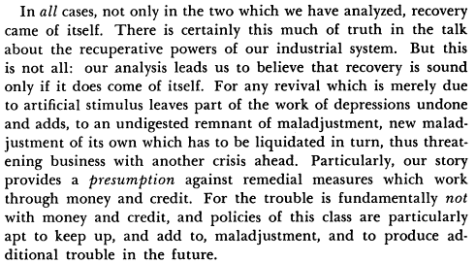
There’s a famous passage in Schumpeter’s writings during the Great Depression, in which he lays out the extreme liquidationist position, arguing not just against the use of fiscal policy to fight unemployment but even against monetary policy, lest it get in the way of the “work of depressions”. That passage has been held up by many people as an example of the wrong-headedness that prevailed at the time. Here it is:
But here we are, in 2010 — and something very much like that position is being forcefully advocated by Wolfgang Schauble, the government of China, Narayanan Kocherlakota, and Sarah Palin.
What do the government of China, the government of Germany and the Republican Party have in common? They’re all trying to bully the Federal Reserve into calling off its efforts to create jobs. And the motives of all three are highly suspect.
It’s not as if the Fed is doing anything radical. It’s true that the Fed normally conducts monetary policy by buying short-term U.S. government debt, whereas now, under the unhelpful name of “quantitative easing,” it’s buying longer-term debt. (Buying more short-term debt is pointless because the interest rate on that debt is near zero.) But Ben Bernanke, the Fed chairman, had it right when he protested that this is “just monetary policy.” The Fed is trying to reduce interest rates, as it always does when unemployment is high and inflation is low.
And inflation is indeed low. Core inflation — a measure that excludes volatile food and energy prices, and is widely considered a better gauge of underlying trends than the headline number — is running at just 0.6 percent, the lowest level ever recorded. Meanwhile, unemployment is almost 10 percent, and long-term unemployment is worse than it has been since the Great Depression.
So the case for Fed action is overwhelming. In fact, the main concern reasonable people have about the Fed’s plans — a concern that I share — is that they are likely to prove too weak, too ineffective.
But there are reasonable people — and then there’s the China-Germany-G.O.P. axis of depression.
It’s no mystery why China and Germany are on the warpath against the Fed. Both nations are accustomed to running huge trade surpluses. But for some countries to run trade surpluses, others must run trade deficits — and, for years, that has meant us. The Fed’s expansionary policies, however, have the side effect of somewhat weakening the dollar, making U.S. goods more competitive, and paving the way for a smaller U.S. deficit. And the Chinese and Germans don’t want to see that happen.
For the Chinese government, by the way, attacking the Fed has the additional benefit of shifting attention away from its own currency manipulation, which keeps China’s currency artificially weak — precisely the sin China falsely accuses America of committing.
But why are Republicans joining in this attack?
Mr. Bernanke and his colleagues seem stunned to find themselves in the cross hairs. They thought they were acting in the spirit of none other than Milton Friedman, who blamed the Fed for not acting more forcefully during the Great Depression — and who, in 1998, called on the Bank of Japan to “buy government bonds on the open market,” exactly what the Fed is now doing.
Republicans, however, will have none of it, raising objections that range from the odd to the incoherent.
The odd: on Monday, a somewhat strange group of Republican figures — who knew that William Kristol was an expert on monetary policy? — released an open letter to the Fed warning that its policies “risk currency debasement and inflation.” These concerns were echoed in a letter the top four Republicans in Congress sent Mr. Bernanke on Wednesday. Neither letter explained why we should fear inflation when the reality is that inflation keeps hitting record lows.
And about dollar debasement: leaving aside the fact that a weaker dollar actually helps U.S. manufacturing, where were these people during the previous administration? The dollar slid steadily through most of the Bush years, a decline that dwarfs the recent downtick. Why weren’t there similar letters demanding that Alan Greenspan, the Fed chairman at the time, tighten policy?
Meanwhile, the incoherent: Two Republicans, Mike Pence in the House and Bob Corker in the Senate, have called on the Fed to abandon all efforts to achieve full employment and focus solely on price stability. Why? Because unemployment remains so high. No, I don’t understand the logic either.
So what’s really motivating the G.O.P. attack on the Fed? Mr. Bernanke and his colleagues were clearly caught by surprise, but the budget expert Stan Collender predicted it all. Back in August, he warned Mr. Bernanke that “with Republican policy makers seeing economic hardship as the path to election glory,” they would be “opposed to any actions taken by the Federal Reserve that would make the economy better.” In short, their real fear is not that Fed actions will be harmful, it is that they might succeed.
Hence the axis of depression. No doubt some of Mr. Bernanke’s critics are motivated by sincere intellectual conviction, but the core reason for the attack on the Fed is self-interest, pure and simple. China and Germany want America to stay uncompetitive; Republicans want the economy to stay weak as long as there’s a Democrat in the White House.
And if Mr. Bernanke gives in to their bullying, they may all get their wish.
Bernanke Presses China on Imbalances, Echoing Obama
Ben Bernanke, chairman of the Federal Reserve Board, spoke at the European Central Banking conference in Frankfurt, Friday.
November 18, 2010
Ben S. Bernanke, the Federal Reserve chairman, argued Friday that currency undervaluation by China and other emerging markets was at the root of “persistent imbalances” in trade that “represent a growing financial and economic risk.”
Mr. Bernanke, in a speech at a European Central Bank conference in Frankfurt, warned that a “two-speed global recovery,” with the richest countries lagging behind fast-growing emerging markets like China and India, was hampering the cooperation the worldwide recovery needs, echoing a main point the Obama administration made — with limited success — when leaders of the Group of 20 economic powers gathered last week in South Korea.
Not only the United States is suffering from undervalued currencies, Mr. Bernanke said. Emerging countries with flexible exchange rates, like Brazil, are “carrying a double burden,” he said. They suffer disproportionately from the imbalances created by export countries with undervalued currencies. “It isn’t just advanced vs. emerging” countries, Mr. Bernanke said, said during the panel discussion led by Jean-Claude Trichet, president of the European Central Bank.
For the last two weeks, the Fed has been criticized for its Nov. 3 decision to inject $600 billion into the banking system through next June, resuming an effort to lower long-term interest rates.
Those attacks continued Thursday. Speakers at a conference in Washington, organized by the libertarian Cato Institute, warned that the Fed’s monetary policy could lead to asset-price bubbles like the housing boom that crashed in 2007.
Defending the policies Friday before an audience of central bankers and economists in Frankfurt, Mr. Bernanke said “there is considerable evidence” that securities purchases by the Fed have achieved their goal of raising asset prices. “We don’t want to overpromise,” he said during a question-and-answer session. “The effects are moderate — meaningful, but moderate.”
The mood of the conference was amiable, but there was a hint of tension when Agustín Carstens, governor of the Bank of Mexico, asked what the United States would do to reduce its trade deficit. “Deficit countries have to do their part,” Mr. Bernanke conceded. He said that the United States needs to further raise its savings rate and cut government borrowing. He added that a cheaper dollar will not be enough. “It would be difficult for exchange rates by themselves to restore balance,” he said.
Mr. Bernanke’s speech argued that unemployment in the United States is at “unacceptable” levels, and gingerly waded into the fiscal policy debate roiling Washington.
“In general terms, a fiscal program that combines near-term measures to enhance growth and strong, confidence-inducing steps to reduce longer-term structural deficits would be an important complement to the policies of the Federal Reserve,” Mr. Bernanke said.
He did not, however, express a view on extending the Bush-era tax cuts, the most contentious fiscal policy choice facing the White House and the lame-duck Congress.
Even so, by defending the Fed’s actions, calling for global rebalancing and hinting that more fiscal stimulus might be needed, Mr. Bernanke’s remarks amount to an endorsement of crucial elements of President Obama’s economic approach.
But that endorsement, in turn, could further stoke criticism by Congressional Republicans, who say the Fed is defying voters’ skepticism about large-scale government intervention in the economy and setting the stage for inflation later, and by foreign officials, who fear the Fed is trying to weaken the dollar to make American exports more competitive.
Mr. Bernanke, a Republican economist who was first appointed by George W. Bush, reiterated his argument that the Fed felt compelled to act because inflation is so low (about half of the Fed’s target of roughly 2 percent) and unemployment so high (stuck at nearly 10 percent for the last 18 months or so).
“In sum, on its current economic trajectory the United States runs the risk of seeing millions of workers unemployed or underemployed for many years,” he will say. “As a society, we should find that outcome unacceptable.”
Mr. Bernanke said that the Fed’s first, $1.7 trillion round of asset purchases, which lasted from December 2008 to last March, helped stabilize the economy. By resuming the purchases, the Fed “seeks to support the economic recovery, promote a faster pace of job creation and reduce the risk of a further decline in inflation that would prove damaging to the recovery.”
(In the speech he also argued that “quantitative easing,” the term markets have used to describe the bond-buying strategy, was an “inappropriate” phrase because it usually referred to policies that aim to change the quantity of bank reserves, rather than affect interest rates, as the Fed is trying to do.)
The text includes indirect responses to domestic and overseas critics. He also argued that the Fed “remains unwaveringly committed to price stability” and that buttressing growth was “the best way to continue to deliver the strong economic fundamentals that underpin the value of the dollar.”
The speech addresses the anxieties of Brazil, Thailand and other emerging economies, which fear that a surge of foreign capital will drive up prices and interest rates.
If exchange rates were allowed to move freely, Mr. Bernanke argued, emerging markets would raise interest rates — and allow their currencies to appreciate — even as advanced economies like the United States maintained expansionary monetary policies. That would curb the emerging markets’ trade surpluses and shift demand toward domestic consumption and away from export-led growth.
Instead, Mr. Bernanke said, currency undervaluation in big surplus economies has led to unbalanced growth and “uneven burdens of adjustment.”
Since “the ultimate purpose of economic growth is to deliver higher living standards at home,” the speech stated, surplus countries should satisfy domestic needs instead of focusing mainly on exports.
Without naming China explicitly, Mr. Bernanke warned that its “pursuit of export-led growth cannot ultimately succeed if the implications of that strategy for global growth and stability are not taken into account.”
Before Mr. Bernanke departed for Frankfurt, other Fed officials rallied to the central bank’s defense.
In a speech at Case Western Reserve University, Sandra Pianalto, president of the Federal Reserve Bank of Cleveland, defended the asset purchases, saying that the recovery had been “exceptionally gradual ” and that she did not expect unemployment to fall below 8 percent before 2013.
Even so, she tried to reassure inflation-fearing skeptics, saying: “The main variable the Federal Reserve can control over time is the price level. Ensuring price stability is our job.”
At a speech in Chicago, Narayana R. Kocherlakota, president of the Minneapolis Fed, also defended quantitative easing.
He said that in normal times, if the Fed let banks create more money, that could spur inflation. But, he said, that “this basic logic isn’t valid in current circumstances” because banks were sitting on nearly $1 trillion in excess reserves held at the Fed.
“This means that they are not using a lot of their existing licenses to create money,” he said. “Q.E. gives them $600 billion of new licenses to create money, but I do not see why they would suddenly start to use the new ones if they weren’t using the old ones.”
Still, he said the effects of the Fed’s new policy “are likely to be relatively modest.”
In a speech today in Frankfurt, the Federal Reserve chairman, Ben S. Bernanke, brought out the big (rhetorical) guns. He:
In a speech today in Frankfurt, the Federal Reserve chairman, Ben S. Bernanke, brought out the big (rhetorical) guns. He:
1. chastised China’s currency policy (“The exchange rate adjustment is incomplete, in part, because the authorities in some emerging market economies have intervened in foreign exchange markets to prevent or slow the appreciation of their currencies.”)
2. said, in no uncertain terms, that Congress should step up to the plate and start doing its part to boost growth (“a fiscal program that combines near-term measures to enhance growth with strong, confidence-inducing steps to reduce longer-term structural deficits would be an important complement to the policies of the Federal Reserve”)
3. called for a “rebalancing” of growth rates around the global economy
4. said the potential outlook for America’s job market should be considered “unacceptable” (“on its current economic trajectory the United States runs the risk of seeing millions of workers unemployed or underemployed for many years. As a society, we should find that outcome unacceptable”)
At least in tone, if not necessarily entirely in substance, this seemed to be a departure from what we’ve historically heard from Fed chairmen, usually at pains to avoid the political fray.
“Today’s speech by Bernanke was far removed from the subtle, circumspect language traditionally employed by monetary policy makers in discussing the choices of foreign officials,” wrote Dana Saporta, an economics director at Credit Suisse, in a note to clients. “It highlights the ‘unconventional’ nature of not just U.S. monetary policy operations, but of Federal Reserve rhetoric, as well.”


 Market Data
  Markets