A Chilean police officer embraces a relative of trapped miners after it was announced that a drill reached the underground cave where miners are at the San Jose Mine near Copiapo, Chile, on Oct. 9. Officials have announced that the drill trying to reach the 33 trapped miners has reached them after more than two months of efforts, prompting cheers, tears, and the ringing of bells by families in the tent camp outside the mine.
In this image released by the government of Chile, rescue workers stand next to a colleague who is inside a capsule after performing a dry run test for the eventual rescue of the 33 miners trapped at the San Jose mine, near Copiapo, Chile, on Oct. 11.
A rescue worker is inside a rescue capsule while performing a dry run test for the eventual rescue of the 33 miners trapped at the San Jose mine near Copiapo, Chile, on Oct. 11.
Members of the rescue team watch as the capsule descends into the shaft on one of the final tests before using it to lift the 33 miners to safety, in Copiapo, Chile, on Oct. 11. Rescuers will start evacuating 33 trapped miners late on Tuesday and have successfully tested a capsule to hoist them to the surface to end their two-month ordeal, officials said on Monday.
Relatives of trapped miners prepare to board a bus at the the San Jose mine near Copiapo, Chile, on Oct. 9. Officials announced that the drill trying to reach the 33 trapped miners reached them Saturday after more than two months of efforts. The miners have been trapped since the mine collapsed on Aug. 5.
Elizabeth Segovia (r.) holds her daughter, Esperanza Ticona, the first baby of trapped miner Ariel Ticona, at the camp where relatives wait for the rescue of trapped miners outside the San Jose mine near Copiapo, Chile, on Oct. 9. Esperanza was born while her father was trapped in the mine.
Workers operate the T-130 drill during the final push to reach the 33 trapped miners at the San Jose mine near Copiapo, Chile, on Oct. 9.
Workers and other officials cheer as the T-130 drill reaches the 622 meter (2,041 feet) below the surface point after 33 days of drilling to reach the trapped miners on Oct. 9 at the San Jose mine near Copiapo, Chile.
Maria Segovia, sister of Dario Segovia who is among the 33 miners trapped inside the San Jose mine, celebrates with members of the rescue team as the Schramm T-130 rig that drilled a rescue shaft is driven away from the site in Copiapo, Chile, on Oct. 11. Rescuers will start evacuating 33 trapped miners late on Tuesday and have successfully tested a capsule to hoist them to the surface to end their two-month ordeal, officials said on Monday.
Workers lower steel pipes to encase part of the escape shaft as efforts continue to free the 33 trapped miners at the San Jose mine near Copiapo, Chile, on Oct. 10.
Workers assemble machinery to be used in the rescue operation for 33 trapped miners in the San Jose mine near Copiapo, Chile, on Oct. 11. Rescuers on Monday finished reinforcing the hole drilled to bring 33 trapped miners to safety and sent a rescue capsule nearly all the way to where the men are trapped. The miners became trapped when the gold and copper mine collapsed on Aug. 5 and are expected to be rescued starting late Tuesday.
Chilean policemen prepare a barrier to keep journalists from crossing the road where emergency vehicles will pass, as the operation to rescue the 33 trapped miners is being prepared at the San Jose mine in Copiapo, Chile, on Oct. 12.
Chile's Health Minister Jaime Manalich inspects clothing that will be given to the miners after they are rescued and evacuated as Dr. Paola Neumann, health director for the Atacama region, looks on at a hospital in Copiapo, Chile, on Oct. 11.
By FRANK BAJAK and VIVIAN SEQUERA, Associated Press Writers Frank Bajak And Vivian Sequera, Associated Press Writers – 45 mins ago
SAN JOSE MINE, Chile – The miners who spent 69 agonizing days deep under the Chilean earth were hoisted one by one to freedom Wednesday, their rescue moving with remarkable speed while their countrymen erupted in cheers and the world watched transfixed.
Beginning at midnight and sometimes as quickly as once every 40 minutes, the men climbed into a slender cage nearly a half-mile underground and made a smooth ascent into fresh air. By early afternoon, more than half the men — 17 of 33 — had been rescued.
In a meticulously planned operation, they were monitored by video on the way up for any sign of panic. They had oxygen masks, dark glasses to protect their eyes from unfamiliar daylight and sweaters for the jarring climate change, subterranean swelter to the chillier air above.
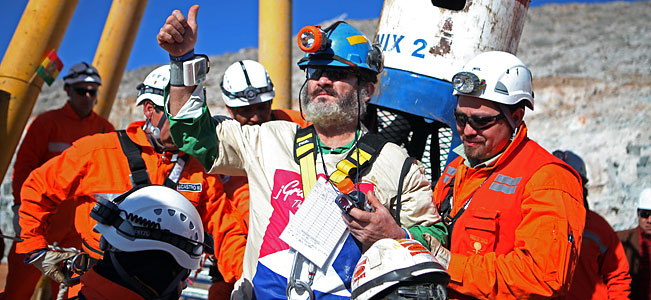
They emerged looking healthier than many had expected and even clean-shaven, and at least one, Mario Sepulveda, the second to taste freedom, bounded out and thrust a fist upward like a prizefighter.
"I think I had extraordinary luck. I was with God and with the devil. And I reached out for God," he said as he awaited the air force helicopter ride to a nearby hospital where all the miners were to spend 48 hours under medical observation.
The operation moved past the halfway point with the rescue of the 17th miner, a 56-year-old electrician named Omar Reygadas who helped organized life underground. His fourth great-grandchild was born a month after the men were sealed into the mine's lower reaches by an Aug. 5 collapse of 700,000 tons of rock.
As it traveled down and up, down and up, the rescue capsule was not rotating as much inside the 2,041-foot escape shaft as officials expected, allowing for faster trips, and officials said the operation could be complete by sunrise Thursday, if not sooner.
AP/Hugo Infante, Chilean government
The anxiety that had accompanied the careful final days of preparation broke at 12:11 a.m., with the first rescue — Florencio Avalos, who emerged from the missile-like chamber and smiled broadly after his half-mile journey. He hugged his sobbing 7-year-old son and wife and then President Sebastian Pinera, who has been deeply involved in an effort that had become a matter of national pride.
Avalos was followed an hour later by the most ebullient of the group, Sepulveda, whose shouts were heard even before the capsule peeked above the surface. He hugged his wife and handed out souvenir rocks from the mine to laughing rescuers.
No one in recorded history has survived as long trapped underground as the 33 men. For the first 17 days, no one even knew whether they were alive. In the weeks that followed, the world was captivated by their endurance and unity.
Health Minister Jaime Manalich told a news conference after eight miners were rescued that all of them were in good health, and none has required any special medication, not even the diabetic among them.
Chile exploded in joy and relief at the first, breakthrough rescue just after midnight in the coastal Atacama desert.
In the capital, Santiago, a cacophony of car horns sounded. In the nearby regional capital of Copiapo, from which 24 of the miners hail, the mayor canceled school so parents and children could "watch the rescue in the warmth of the home."
News channels from North America to Europe and the Middle East carried live coverage. Pope Benedict XVI said in Spanish that he "continues with hope to entrust to God's goodness" the fate of the men. Iran's state English-language Press TV followed events live until President Mahmoud Ahmadinejad touched down in Lebanon on his first state visit there.
The images beamed worldwide were extraordinary: Grainy footage from beneath the earth showed each miner climbing into the 13-foot-tall capsule, then disappearing upward through an opening. Then a camera showed the pod steadily rising through the dark, smooth-walled tunnel.
After the fifth miner made his ascent — 19-year-old Jimmy Sanchez, the youngest and the father of a months-old baby — the rescuers paused to lubricate the spring-loaded wheels that gave the capsule a smooth ride through the shaft, then resumed the rescues.
The ninth, Mario Gomez, who at 63 is the oldest miner, dropped to his knees after he emerged, bowed his head in prayer and clutched the Chilean flag. His wife, Liliane Ramirez, pulled him up from the ground and embraced him.
Gomez is most experienced of the group, first entering a mine shaft to labor at age 12, and suffers from silicosis, a lung disease common to miners. He has been on antibiotics and bronchial inflammation medicine. Manalich said Gomez came up with a special oxygen mask.
The lone foreigner among the miners, Carlos Mamani of Bolivia, was visited at a nearby clinic by Pinera and Bolivian President Evo Morales. The miner could be heard telling the Chilean president how nice it was to breathe fresh air and see the stars.
Most of the men emerged clean-shaven. Crews had lowered packages dubbed "palomas," Spanish for carrier pigeons, to get food and medicine to the men during their weeks underground, and in the days before rescue they were sent razors and shaving cream.
The entire rescue operation was meticulously choreographed, with no expense spared in bringing in topflight drillers and equipment — and boring three separate holes into the copper and gold mine.
Mining is Chile's lifeblood, providing 40 percent of state earnings, and Pinera put his mining minister and the operations chief of state-owned Codelco, the country's biggest company, in charge of the rescue.
It went so well that its managers abandoned what a legion of journalists had deemed an ultraconservative plan for restricting images of the rescue. A huge Chilean flag that was to obscure the hole from view was moved aside so the hundreds of cameras perched on a hill above could record images that state TV also fed live.
That included the surreal moment when the capsule dropped for the first time into the chamber, where the bare-chested miners, most stripped down to shorts because of the underground heat, mobbed the rescuer who emerged to serve as their guide to freedom.
"This rescue operation has been so marvelous, so clean, so emotional that there was no reason not to allow the eyes of the world — which have been watching this operation so closely — to see it," a beaming Pinera told a news conference after Avalos was brought to the surface.
Avalos, the 31-year-old second-in-command of the miners, was chosen to be first out because he was in the best condition. When the capsule came out of the manhole-sized opening, Avalos stepped out as bystanders cheered, clapped and broke into a chant of the country's name — "Chi! Chi! Chi! Le! Le! Le!"
The next three men out, including Mamani of Bolivia, followed because they were deemed the fittest of body and mind. The 10 to follow included miners with health problems such as high blood pressure, diabetes and skin ulcers.
The operation started just before midnight, when a Codelco rescuer made the sign of the cross and was lowered to the trapped men. A navy paramedic went down after Avalos came up — a surprise improvisation as officials had said the two would go down to oversee the miners' ascent before the first went up.
The last miner was slated to be shift foreman Luis Urzua, whose leadership was credited with helping the men endure the first two and a half weeks without outside contact. The men made 48 hours' worth of rations last before rescuers reached them with a narrow bore hole to send down more food.
Janette Marin, sister-in-law of miner Dario Segovia, said the order of rescue didn't matter.
"This won't be a success unless they all get out," she said.
Chilean officials played down the risks of the rescue.
Panic attacks during the ascent, they said, were the biggest concern. The miners were not sedated — they needed to be alert in case something went awry. Manalich said rescuers could accelerate the capsule to its maximum speed of 3 meters per second if necessary.
Rescue coordinator Andre Sougarett told The Associated Press beforehand that the worst technical problem would be the possibility that "a rock could fall" and jam the capsule in the shaft.
But Davitt McAteer, who directed the U.S. Mine Safety and Health Administration during the Clinton administration, said there were many risks: A miner could get claustrophobic and somehow jam the capsule, the cable could get hung up, or the rig that pulls the cable could overheat.
"You can be good and you can be lucky. And they've been good and lucky," McAteer told the AP just before the operation commenced. "Knock on wood that this luck holds out for the next 33 hours."
The CEO of the Austrian company that made the capsule's winch and pulley system said there was no danger of the motor overheating because the winch was not working under maximum capacity.
Mining Minister Laurence Golborne, whose management of the crisis has made him a media star in Chile, insisted all risks had been considered.
"There is no need to try to start guessing what could go wrong. We have done that job," Golborne said. "We have hundreds of different contingencies."
McAteer said he gave "very high marks" to the Chileans for creating lowered expectations by saying that it might take until Christmas to rescue the men — and then consistently delivering results ahead of schedule.
"Second, they have had very few technical problems," he said.
Three rescue capsules were built by Chilean navy engineers, named Phoenix for the mythical bird that rises from ashes and painted in the white, blue and red of the national flag. Only one has been used in the rescue.
The miners' vital signs were closely monitored throughout the ride. They were given a high-calorie liquid diet donated by NASA, designed to prevent nausea from any rotation of the capsule as it travels through curves in the 28-inch-diameter escape hole.
Engineers inserted steel piping at the top of the shaft, which is angled 11 degrees off vertical before plunging like a waterfall.
Drillers had to curve the shaft to pass through "virgin" rock, narrowly avoiding collapsed areas and underground open spaces in the overexploited mine, which had operated since 1885.
At the regional hospital in Copiapo, two floors were prepared for the miners to be evaluated.
U.S. President Barack Obama praised rescuers, including a team from Center Rock Inc. of Berlin, Pa., that built and managed the piston-driven hammers that pounded open the hole.
Chile has promised that its care of the miners won't end for six months at least — not until they can be sure that each miner has readjusted.
Psychiatrists and other experts in surviving extreme situations predict their lives will be anything but normal.
Since Aug. 22, when a narrow bore hole broke through to their refuge and the miners stunned the world with a note, scrawled in red ink, disclosing their survival, their families have been exposed in ways they never imagined.
Miners had to describe their physical and mental health in detail with teams of doctors and psychologists. In some cases, when both wives and lovers claimed the same man, everyone involved had to face the consequences.
As trying as their time underground has been, the miners now face challenges so bewildering that no amount of coaching can fully prepare them. Rejoining a world intensely curious about their ordeal, they have been invited to presidential palaces, take all-expenses-paid vacations and appear on countless TV shows.
Book and movie deals are pending, along with job offers. Previously unimaginable riches await a simple signature for those with savvy.
Sepulveda's performance exiting from the shaft appeared to confirm what many Chileans thought when they saw his engaging performances in videos sent up from below — that he could have a future as a TV personality.
But he tried to quash the idea as he spoke to viewers of Chile's state television channel while sitting with his wife and children shortly after his rescue.
"The only thing I'll ask of you is that you don't treat me as an artist or a journalist, but as a miner," he said. "I was born a miner and I'll die a miner."
Associated Press writers Michael Warren and Eva Vergara contributed to this report.
(This version CORRECTS New approach. Corrects spelling of Gomez's wife. Updates with 17th rescue and operation past halfway. Updates photos, video and audio. Multimedia: An interactive including timeline and bios of trapped miners available at _international/chile_mine_collapse. AP Video.)


 Market Data
  Markets


 AI
AI