Form 10-Q for JBI, INC.
13-Aug-2010
Quarterly Report
Item 2. Management's Discussion and Analysis of Financial Condition and Results of Operations.
JBI, Inc. ("JBI" or the "Company") was originally incorporated on April 20, 2006 in the State of Nevada as 310 Holdings Inc. ("310"). 310 had no significant activity from inception through March 2009. In April 2009, John Bordynuik purchased 63% of the issued and outstanding shares of 310, and was subsequently appointed President and CEO of the Company.
During 2009, JBI acquired three revenue sources, and began researching opportunities for continued expansion and development.
During June, 2009, the Company purchased certain assets of John Bordynuik, Inc. ("Data"), a Delaware corporation. The assets acquired from Data included custom tape drives, computer hardware, servers, and a mobile data recovery container to read and transfer data from computer tapes.
During August 2009, the Company purchased 100% of the outstanding shares of Javaco, Inc. ("Javaco"). Javaco distributes over 100 lines of equipment including fiber optic transmitters and radio frequency connectors used in the telecommunications industry.
During September, 2009, the Company purchased 100% of the membership interests of Pak-It, LLC ("Pak-It"). Pak-It manufactures cleaning chemicals, and owns a patent that allows for delivery of condensed cleaning chemicals in water soluble film, most often currently used in industrial cleaning operations. All U.S. Home Depots are cleaned using Pak-It products.
In the first half of 2009, the Company began developing its Plastic2Oil technology using a laboratory model. Results of the desk-top unit were used to build a 1-ton processor to test the scalability of the process. Output from the test unit was ASTM certified. The Company procured and began installing a 20 metric-ton ("20T") processor in late 2009 at its facility in Niagara Falls, New York. The Company engaged IsleChem, a state certified laboratory, in December 2009 to provide chemical, analytical and process engineering. Together with IsleChem, the Company has assembled and tested its 20T processor. Extensive data has been gathered and modifications have been made to the process to reach a steady state configuration.
The Company currently owns five P2O processing machines including the original desk-top unit, a 1-ton unit which will continue to be used for research and development purposes as needed, a 20T processor located at the Company's Niagara Falls location, as well as component parts that have been procured to assemble two additional production size processors. The Company believes that these machines are capable of converting waste plastic to oil through a process using a chemical catalyst. The currently operating machine is a 20 metric-ton processor intended for commercial use. The Company intends to assemble more of these machines, which it will own and manage itself, or license to commercial operators in the United States, Canada and elsewhere. Through a joint venture with a third party, the Company plans to install machines intended for international use on ships that will travel overseas. The machines have undergone extensive testing to determine whether, among other things, they satisfy air quality standards enforced by the New York Department of Environmental Conservation ("DEC"). To date, test results indicate that the machines comply with these standards. The Company is operating its 20T processor to gather data for a DEC air permit to allow full commercial production.
During 2010 the Company has formed a number of new companies and entered into agreements with third parties. They are:
? On December 22, 2009, the Company and Rick Heddle agreed to a Joint Venture whereby Heddle Marine Service, Inc. will retrofit ships with P2O processors. The Company is now finalizing a JV Agreement for production of its first P2O ship with Heddle. JBI anticipates contracting with various countries to convert their plastic waste into oil.
? Also in December, JBI has signed a Letter of Intent for the establishment of an Area Development Agreement (ADA) for 45 P2O sites in the State of Florida with AS PTO, LLC, an entity controlled by Al Sousa of Largo, Florida. Both Heddle and Sousa have strong management capabilities and are expected to be essential to the scaling up of a nationwide P2O launch. These agreements are pending full commercial production of our first 20T P2O processor.
? During February, 2010, the Company formed two Nevada corporations as wholly owned subsidiaries: Plastic2Oil Land, Inc., and Plastic2Oil Marine, Inc. to operate Plastic2Oil ("P2O") operations on land and sea, respectively. The Company hopes to begin commercial operations of converting waste plastic to oil in the third quarter of 2010.
? The Company entered into its first Area Development Agreement with AS PTO, LLC to promote licensing and P2O operations in Florida using a combination of Joint Ventures (JV's) and Company owned sites.
? In February 2010, Plastic 2 Oil of Clearwater 1, LLC (a Delaware LLC) was formed as a joint venture and a licensing agreement was executed with members Plastic2Oil Land, Inc., AS PTO, LLC and ES Resources, LLC. During February, 2010, the Company formed a wholly owned New York corporation, JBI RE #1, Inc. to secure an industrial building in Niagara Falls, NY. This building houses the Company's 20T processor which is intended to be the first commercial operation of the P2O entities.
? During February, 2010, the Company formed a wholly-owned Ontario corporation, JBI (Canada), Inc., to produce, market and sell the Pak-It? products in Canada.
? During February, 2010, the Company formed a wholly owned Ontario corporation, JBI RE One, Inc., to purchase an industrial building in Thorold, Ontario.
? In May, 2010 the Company formed a wholly-owned New York limited liability company, Plastic2Oil of NY #1, LLC, to operate the P2O operations and R&D functions at the Niagara Falls, NY facility.
? On June 21, 2010 the Company entered into an agreement with Mark Peikin to provide Investor Relations services in exchange for shares of the Company's restricted stock.
On May 19, 2010, the Company executed an Employment Agreement with CEO John Bordynuik which takes effect upon issuance of an air permit for the Company's P2O processor. The agreement provides for minimum annual compensation as well as the issuance of stock options contingent upon the achievement of certain milestones, none of which have been met as of August 13, 2010.
Products and Competition
The data migration business faces competition from industry specialists who may seek to develop 7 & 9 track computer-reading technologies to gain access to data that has not been recoverable to date.
Javaco operates in a very competitive environment in the distribution of fiber optic transmitters and RF connectors. Competition in Mexico and South America can come from local and international suppliers of similar technologies and products. As Javaco adds new lines of products, it faces new risks and competition associated with diversifying its product offerings.
Pak-It provides an innovative, technological approach to chemicals, both in terms of portion control solutions and product breadth that constantly seeks to improve quality and consistency.
Pak-It? uses patented technology to deliver liquid cleaner in a water soluble sachet. The products are fully biodegradable and much easier to ship than bulky liquid products. The user simply adds water to the container without measuring or cutting the Pak-It?. Large retailers (like Home Depot, Game Stop and Barnes and Noble) and many national building service contractors already using the product have documented significant cost savings from shipping, training, inventory controls and space utilization.
Pak-It also produces private label liquid cleaning supplies for a variety of well known companies, including a retail marine supply company and an international company that sells Pak-It's with its pressure washers. Pak-It also provides an operational focus on logistics that offers individual "kits" designed to meet specific cleaning requirements, delivered directly to each location, while remaining flexible toward meeting other customer needs.
The renewable energy sector and recycled products sectors are highly competitive. Plastic2Oil is in the process of commercializing its processor and catalyst technologies and there is risk associated with being a new entrant into the alternative energy sector. Profitability in the Plastic2Oil business will depend largely on the access to waste plastic feedstock where prices can fluctuate significantly. Plastic2Oil faces competition from other recycling solution products for access to feedstock in addition to facing competition from the traditional refined products industry. The Company's P2O operations are subject to the risk factors previously disclosed in our annual report on Form 10-K/A for the year ended December 31, 2009, filed with the SEC on July 9, 2010.
Plan of Operations
Overview
Management began executing its business plan in 2009 by acquiring three revenue generating sources in 2009 and concentrating R & D resources on scaling P2O for an anticipated launch in 2010. Detailed summaries of each acquisition and P2O are described in detail below.
Through recruiting efforts and these acquisitions, management believes that it has quickly assembled an experienced team of professionals that will allow the Company to grow both organically (within each subsidiary) and through synergistic acquisitions that have a demonstrated propensity towards being eco-friendly.
The Company believes that both private and public entities will see the environmental benefit, positive cost analysis, and potential savings from unnecessary disposal of waste plastic using Plastic2Oil, which will provide incentives for expansion of sites. By offering "green" products and continuing to use its proprietary technologies the Company hopes to create solutions to enormous problems. From Pak-It? products, where we save fuel by "not shipping water", to Plastic2Oil where we will create fuel from what is currently a costly plastics disposal problem, the Company believes it is well positioned for growth.
Significant Developments and Strategic Actions
On August 24, 2009, the Company acquired Javaco, Inc. ("Javaco"), for its know-how in world-wide communications and its business experience in Mexico and South America. Management hopes to utilize Javaco's expertise to launch Plastic2Oil sites in Mexico and South America and to develop a secure communications infrastructure between the Plastic2Oil sites and the Company. Javaco currently distributes over 100 lines of equipment from fiber optic transmitters to RF connectors. To further enhance business in the United States, new distribution lines are frequently being added, including a line of home theater and audio video products.
On September 30, 2009, the Company acquired Pak-It, LLC, a Florida limited liability company. Pak-It operates two business units: 1) a bulk chemical processing, mixing, and packaging facility, and 2) a patented delivery system that packages condensed cleaners in small water-soluble packages. Since acquiring Pak-It, the Company has spent over $500k to upgrade the manufacturing facility and equipment to automate the production process and increase capacity. In 2010, Pak-It has hired four new salespeople to manage the existing customer accounts as well as expand national accounts and distribution channels.
On July 30, 2010 Pak-It launched a new retail product line called Drop ShotTM. The advertising campaign was managed by Western Creative and includes 60-second and 120-second commercials as well as an online store, www.buydropshot.com. The product launch began with a special TV offer available for phone or online orders only. The DropShot Cleaning kit includes the following products: the DropShot Glass and Hard Surface Cleaner, All-Purpose Citrus Cleaner, Multi-Surface Heavy-Duty Grease Cutter, and the Autumn Fresh Odor Eliminator. When buying the special introductory offer, customers will receive two refills for each cleaner - a total of 12 cleaners for $19.95.
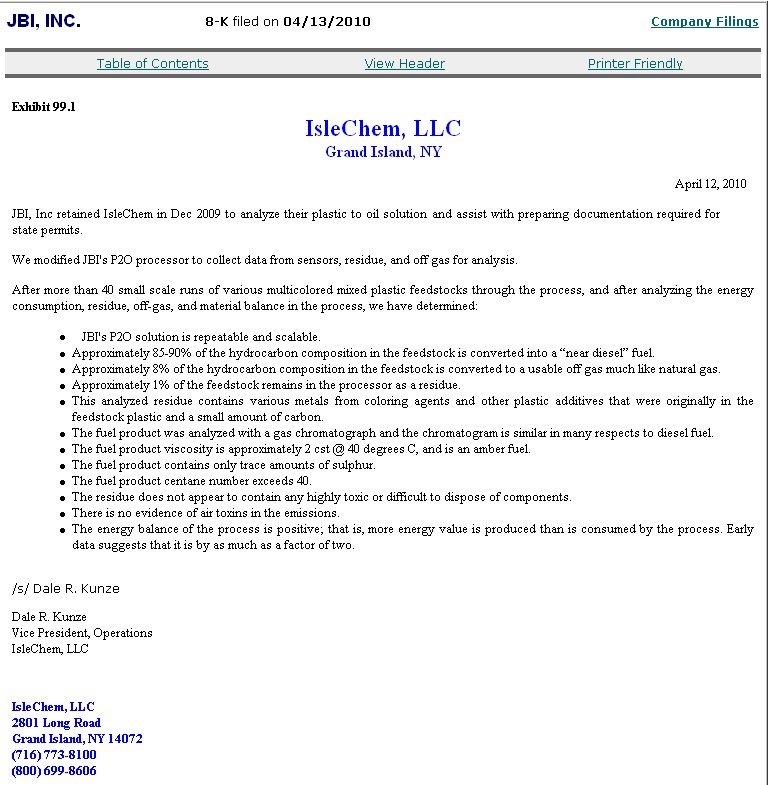
The Company is currently focused on making its Plastic2Oil technology commercially available. To assist in the process development, IsleChem was engaged by the Company on December 9, 2009 to verify the Company's Plastic2Oil process. During 40 runs of tests, IsleChem was able to isolate the conditions that allowed the process to run optimally and provide engineering support to gather data to apply for a New York state DEC air permit. IsleChem verified our Plastic2Oil process is scalable and repeatable.
In 2010, the Company assembled its 20T Plastic2Oil processor at its P2O factory in Niagara Falls, NY. The Company purchased a shredder and granulator to preprocess bulk plastic. A complete automation system with 63 sensors was installed on the Plastic2Oil processor for control, data logging, and management. The processor was run to gather operational steady state data for a stack test. Oxygen sensors supplied by a major US sensor manufacturer failed when exposed to the process over time and delayed our permit application process. A number of oxygen sensors were tested until a suitable replacement was found. Sensors on the processor are now functioning properly.
A minor by-product of the process is an off-gas much like natural gas. The process consumes much less off-gas to operate than is generated when operating at maximum capacity. Further testing at high processing rates proved that all the off-gas could not be burned (temporarily for a stack test) in the process furnace. Flaring the excess off-gas is common in the oil and gas industry but is not environmentally friendly, would waste the fuel value, and would require a separate permit. To avoid flaring the excess gas, the Company purchased a gas compression system to buffer and regulate the off-gas to 1) resell or 2) to cold start the process. The gas compression system and mobile storage tanks were installed on the Company's 20T Plastic2Oil processor in June 2010.
In July and August 2010, we have been able to run our processor in steady-state. We require a NY DEC simple air permit to enable us to run our Plastic2Oil process in full commercial production. To acquire an air permit we must have a stack test that is conducted by a third party (in our case CRA) and supervised by the NY DEC.
In July 2010, the Company scheduled a tentative date in August for an air permit test for its first production P2O processor. The configuration of the processor is in working condition and has allowed the stack test to be scheduled, contingent upon the availability of testing and regulatory attendees. The Company intends to operate the processor in full commercial capacity upon receipt of the air permit.
During the second quarter of 2010, the Company worked to upgrade its 1 million litre (250,000 gallons) fuel blending site to current standards. Equipment was fully tested and parts were replaced as required. The site was also completely repainted. The fuel testing lab at our blending site was equipped with analyzers that will allow the company to test both diesel and gasoline for commercial and retail sale. Several employees attended an independent training program to become certified operators.
The bulk fuel blending site enables the Company to
1. Store fuel from our P2O processors.
2. Blend additives (if required) to bring our fuel to a standard that permits the wholesale/commercial/retail sale of our fuel.
3. In-house testing of blended fuel without the cost and delays of using external laboratories.
4. Distribute our fuel to commercial and retail customers.
5. Load four tanker trucks simultaneously through our bottom-loading rack.
6. Unload tanker trucks through a separate unloading rack.
7. Inject butane or ethanol consistent with industry practices.
8. Flexibility to blend fuels including: gasoline, diesel, kerosene, furnace oil, and specialty fuels.
By acquiring the bulk fuel blending site, JBI is not dependent on 3rd party fuel refining, processing, testing, sales, and distribution. The site will service local JBI processors and enables the Company to maximize the sale price of the output by selling further down the value chain. The output from the process can still be sold to refineries at market rates.
JBI continues to maintain its data recovery and migration business through the use of its tape drives. It currently has a mobile data container that can be deployed to transfer data onsite for customers with highly sensitive data. It acquired tape drives, servers, and the mobile data container through the acquisition of certain assets from John Bordynuik, Inc. The Company has a large backlog of tapes to be migrated and is seeking strategic partnerships with international companies that will allow the Company to realize tape revenues faster, thereby decreasing the backlog. The data recovery business was not a priority in the first half of 2010 because the Company's focus was directed toward developing Plastic2Oil, but revenues are anticipated to increase in the third quarter.
Results of Operations
Quarter ended June 30, 2010 compared to June 30, 2009
For the quarter year ended June 30, 2010, we generated $3,791,743 in revenues, and incurred a net loss of $2,071,340. We had no significant activity during the quarter ended June 30, 2009.
Year-to-date through June 30, 2010, the Company's revenues total $7,365,173 with a net loss totaling $5,367,949.
Revenue Sources
We derive revenues from the sale of bulk cleaning chemicals and patented cleaning solutions in water soluble sachets through our Pak-It subsidiary, which comprised $1,721,356 of total revenues during the quarter ended June 30, 2010.
Additionally, we derive revenues through Javaco through the sales and distribution of electronic components marketed in Mexico and Latin America, which comprised $2,059,522 of total revenues during the quarter ended June 30, 2010.
Finally, we generate sales through reading high volume legacy data computer tapes for large institutions and corporations. However, this unit has not produced significant revenues through the first half of 2010 due to the allocation of resources to our Plastic2Oil technology development. We do maintain contracts to perform these services and receive revenues on an irregular basis.
We expect that the commercial launch of Plastic2Oil will result in sales of the product produced by our commercial processor units. These products will include diesel fuel, gasoline, propane and butane.
Operating Expenses
The Company's operating expenses for 2010 have exceeded gross margin by $5,367,949, resulting in a net loss. Many of the expenses incurred in 2010 have been non-cash and/or non-recurring.
The Company's current run rate on recurring expenses is approximately $1,000,000 per quarter. This includes cost of salaries and selling, general and administrative expenses.
Year-to-date, stock compensation has been issued and expensed totaling $3,013,020, with $643,120 occurring in the second quarter. This non-cash expense will likely continue in future quarters but the amount will vary based on number of shares issued and the stock price on the date of issuance.
The Company has incurred many non-recurring expenses in preparation for the commercialization of its Plastic2Oil technology and the operation of its fuel blending site.
Approximately $24,000 was spent on one-time services for the blending site, including environmental, tank, pipeline and gasket repairs, corrosion system upgrades as well as general repairs and upgrades such as having the facility painted.
Relating to Plastic2Oil, the Company has invested around $28,000 in security equipment, $14,000 in fencing around the property, $2,000 for a guard building, $4,000 for engineering support relating to the off-gas and sensors, $25,000 for chemical engineering and $10,000 for general engineering relating to the processor.
Additional expenditures include approximately $23,000 toward new software to centralize accounting and reporting for all of the Company's operating units. The Company paid approximately $65,000 to host the Annual Shareholders' Meeting in April in Niagara Falls.
The Company incurred auditing and accounting fees of approximately $178,000 and legal fees of $132,000 during the second quarter.
Stock-Based Compensation
The Company periodically issues shares of common stock for services rendered or for financing costs. Such shares are valued based on the market price on the transaction date.
The Company plans to adopt a formal plan which addresses all forms of share-based payment awards, including shares issued under employee stock purchase plans, stock options, restricted stock and stock appreciation rights. No such plan had been adopted as of August 13, 2010.
LIQUIDITY AND CAPITAL RESOURCES
As of June 30, 2010, we had $1,945,594 cash on hand. The Company is developing a cash plan to help manage future expenditures.
During the quarter the Company purchased property and equipment of $819,360 principally relating to development of the P2O processor and to upgrade the fuel blending site, bringing the total investment in property and equipment to $1,475,478 year-to-date. Some specific investments include approximately $130,000 for the fuel blending site and $25,000 for equipment relating to the site as well as approximately $140,000 for parts and equipment relating to P2O, including the off-gas compression system, a shredder and a granulator. During the quarter the Company paid approximately $100,000 toward the purchase of a new corporate office building located in Thorold, Ontario. The purchase price of the building was $369,769 at an interest rate of 7%. The vendor took back the mortgage on the building, which is denominated in Canadian dollars and will fluctuate based on the exchange rate in effect. The Company expects to continue to make significant investments in property and equipment in the future.
While the Company has experienced a cumulative operating loss, a significant portion of the expenses incurred this year have related to non-cash items such as the issuance of stock compensation totaling $3,013,020. The Company expects that its current cash balance will sustain operations until an air permit for its first production Plastic2Oil processor is obtained, resulting in a new revenue stream from the sale of the output from the process. While the Company does not currently have sufficient cash for the next 12 months, in the event that cash is needed before a permit is obtained, the Company has a good current ratio and access to short and long-term borrowings. Additionally, the Company is taking steps to minimize expenses and reduce operating costs.
Historically, we have funded our operations through financing activities consisting primarily of private placements of debt and equity securities with existing shareholders and outside investors. Our principal use of funds has been for capital expenditures and general corporate expenses.
We expect to rely upon funds raised from private placements, as well as future equity and debt offerings to implement our growth plan and meet our liquidity needs going forward. Management believes that our Company's cash will be sufficient to meet our working capital requirements for the next twelve month period at which point further funding will be necessary. However, we cannot assure you that such financing will be available to us on favorable terms, or at all.
Forward-Looking Statements
This Form 10-Q Report and the Company's other communications and statements may contain "forward-looking statements," including statements about the Company's beliefs, plans, objectives, goals, expectations, estimates, projections and intentions. These statements are subject to significant risks and uncertainties and are subject to change based on various factors, many of which are beyond the Company's control. The words "may," "could," "should," "would," "believe," "anticipate," "estimate," "expect," "intend," "plan," "target," "goal," and similar expressions are intended to identify forward-looking statements. All forward-looking statements, by their nature, are subject to risks and uncertainties. The Company's actual future results may differ materially from those set forth in its forward-looking statements. For information concerning these factors and related matters, see Item 2, "Management's Discussion and Analysis of Financial Condition and Results of Operations," in this Report, and the following sections of the Company's Annual Report on Form 10-K for the year ended December 31, 2009: (a) "Risk Factors" in Part I, and (b) "Management's Discussion and Analysis of Financial Condition and Results of Operations" in Part II. However, other factors besides those referenced could adversely affect the Company's results, and you should not consider any such list of factors to be a complete set of all potential risks or uncertainties. Any forward-looking statements made by the Company herein speak as of the date of this Report. The Company does not undertake to update any forward-looking statement, except as required by law.
Critical Accounting Policies, Estimates and Assumptions
The Company believes the following discussion addresses its most critical accounting policies, which are those that are most important to the portrayal of the financial condition and results of operations and require management's most difficult, subjective, or complex judgments, often as a result of the need to make estimates about the effect of matters that are inherently uncertain. Accounting policies, in addition to the critical accounting policies referenced below, are presented in Note 2 to the Company's Consolidated Financial Statements included in the Company's Annual Report on Form 10-K for the year ended December 31, 2009, "Summary of Accounting Policies."
Estimates
The preparation of financial statements in conformity with U. S. generally accepted accounting principles requires management to make estimates and assumptions that affect the reported amounts of assets and liabilities and disclosure of contingent assets and liabilities at the date of the financial statements and the reported amounts of revenues and expenses during the reporting period. The most significant estimates relate to Goodwill, the value of assets and liabilities acquired, valuation of inventory, and the allowance for uncollectible accounts receivable. These estimates may be adjusted as more current information becomes available, and any adjustment could be significant.
Inventories
Inventories, which consist primarily of electrical components and chemicals, are stated at the lower of cost or market. The Company uses the first-in, first-out (FIFO) method of determining cost.
Property and Equipment
Property and Equipment are recorded at cost. Depreciation is provided using the
straight-line method over the estimated useful lives of the various classes of
assets as follows:
Leasehold improvements lesser of useful life or term of the lease
Machinery and office equipment 5-7 years
Vehicles 5 years


 Market Data
  Markets







 AI
AI


