For generations, Philippine politics have been dominated by powerful family dynasties using violence and fear to rule.
But after 57 civilians were killed in the election-related Maguindanao massacre in November 2009, the government has been forced to act.
Gloria Macapagal-Arroyo, the president of the Philippines, has launched a special commission to disband the country's 132 private armies.
But the commission has received widespread scepticism. Critics say that to tackle private armies, the whole structure of Philippine politics has to change.
Meanwhile, around 10,000 men form private armies across the Philippines.
Some are more heavily armed than conventional guerilla armies, and have helped maintain a political system built on clan loyalties and patronage.
With national political leaders relying on them for support and votes, local politicians have operated with impunity, dealing with rivals through the barrel of a gun rather than an election box.
Maguindanao massacre trial could take ‘55,000 years’ By Philip C. Tubeza Philippine Daily Inquirer
2:45 am | Wednesday, November 23rd, 2011
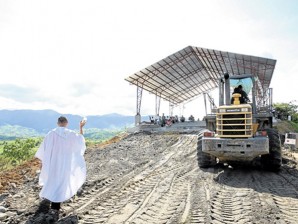
IN MEMORIAM Catholic priest Fr. Robert Reyes blesses the ground where some of the 57 massacre victims were found on Nov. 23, 2009, at Ampatuan town in Maguindanao province. JEOFFREY MAITEM/INQUIRER MINDANAO
The day-to-day legal clashes in court may have become more intense and personal but there’s still no end in sight in the trial of close to 200 defendants in connection with the Maguindanao massacre case.
To speed up hearings, private prosecutor Harry Roque has recommended trimming the number of defendants from 196 to just 35 to focus on those who were primarily responsible for the planning and killing two years ago of 57 people, mostly media workers.
He said the other defendants could be charged with lesser offenses. “At the rate we are going, it could take us at least 20 years to finish this,” Roque said.
At present, there are 196 defendants, each of whom are facing 57 cases. “That’s 11,172 cases. And international studies say that it takes five years to try a single case in the Philippines. So that’s 55,000 years,” Roque said.
He said that not everyone responsible was charged with war crimes after World War II. “Let’s just focus on the primary accused . . . the Ampatuan family and those who actually pulled the trigger,” he added.
On the eve of the second anniversary of the massacre, Amnesty International lamented the “very slow wheels of justice.” The London-based group pressed the government to ensure “effective remedy” for the victims and their families, and to “break the continuing impunity.”
A Catholic bishop dared the government to apply to the case the same speed it demonstrated in pursuing criminal charges against former President Gloria Macapagal-Arroyo.
“If they were able to have a speedy resolution on Arroyo’s case overnight, they can also do it with the case involving the Maguindanao massacre,” Cotabato Auxiliary Bishop Jose Colin Bagaforo said over Church-run Radio Veritas.
Not forgotten
Deputy presidential spokesperson Abigail Valte assured the public that the Aquino administration had not forgotten about the case and that it hoped that it would be resolved under its watch.
Valte said that when the President last spoke with the relatives of the massacre victims he told them that the government would extend them assistance and that “we will not forget what happened.”
The Maguindanao massacre on Nov. 23, 2009, left 57 people dead, including 32 media workers, in what is considered to be the worst election-related violence in the country’s history. The remains of the 58th victim, a media worker, have yet to be found.
It was also the single incident anywhere around the world with the biggest number of media practitioners being killed, international press organizations pointed out.
The media workers were part of a convoy traveling with the wife of Esmael Mangudadatu who was going to file her husband’s certificate of candidacy. Mangudadatu’s wife was accompanied by women relatives and friends. They were all killed. Six other civilians who happened to be passing by were also killed.
Many at large
Two years after the gruesome murders, not even half of the alleged perpetrators are in jail. Out of the 196 suspects, only 93 have so far been captured by the authorities.
Prosecutors have given to the police the names of around 20 prominent suspects out of the 103 people who are still at large but there is still “no word as to what happened to them.”
Of the 93 detained, 29 have yet to be arraigned, including Zaldy Ampatuan, former governor of the Autonomous Region in Muslim Mindanao.
Moreover, 50 of the 64 accused who have been arraigned such as primary suspect former Mayor Andal “Datu Unsay” Ampatuan Jr. have asked the court to allow them to post bail. Presiding Judge Jocelyn Solis Reyes has yet to rule on their petitions as the court is still hearing arguments.
“Last year, we were delayed for seven or eight months until September because they asked the judge to inhibit herself. We could have presented at least 20 witnesses during that time,” said private prosecutor Nena Santos, a lawyer of the Mangudadatus.
The prosecution has so far presented 72 witnesses out of the “not less than 300 witnesses” it intends to present.
18 years
The defense team expects the trial to last 18 years before the judge could finally come out with a ruling, said a defense lawyer, who declined to be identified. He himself is planning to present at least 325 witnesses for his client.
“The Maguindanao massacre case is nothing to sneeze at,” the lawyer said, adding that the public should refrain from pre-judging the case since the defense has not presented its witnesses.
He also pointed out that the 72 witnesses the prosecution had presented were not all for the criminal cases because they included the private complainants testifying on the civil aspect of the case.
In recent weeks, defense lawyers have tried to push for the court to hold actual hearings on Mondays to expedite the cases even if only the private complainants are presented.
3 hearings a week
The court practically holds three hearings a week—motions are heard on Mondays in Quezon City while the actual trial is conducted at Camp Bagong Diwa in Bicutan, Taguig City, on Wednesdays and Thursdays.
Judge Reyes initially favored the proposal after private prosecutor Prima Quimsayas, who represents families of some of the slain media workers, said she could present her clients.
“Monday is open. The court can accommodate the parties should they decide to present private complainants or other incidents,” Reyes said.
However, state prosecutors balked at the defense motion, saying that they would be hard-pressed to hold three days of hearings every week.
“(Quimsayas’) proposal was made on the understanding that other private prosecutors would agree but they have not,” State Prosecutor Peter Medalle told the court.
Other prosecutors say they would be hard-pressed to present witnesses three times a week as they would have to be flown from Mindanao and briefed before they can be presented in court.
State prosecutors also pointed out that they were handling other criminal cases besides the Maguindanao massacre case.
Amend rules
Santos said prosecutors were hoping that witnesses, who had testified and were cross-examined by some of the defense lawyers, would no longer be recalled to be reexamined again by other defense lawyers. However, this would entail amending court rules.
“Our target is to finish presenting the prosecution’s evidence in three years but that depends on the cross examination. We don’t control cross and there are many defense lawyers repeating questions already asked during their own cross,” she said.
Roque went further and said the Supreme Court should look into amending the Rules of Court to allow the lawyers of prominent defendants to present their witnesses once the prosecution wraps up its presentation in a particular case.
“I think we can do this in Unsay’s case and have a ruling in two years. Otherwise, we are not getting anywhere… even if we hold daily hearings,” Roque said.
Bogged down
“We’re bogged down in cross-examination and the witnesses will be recalled all over again,” he added.
Santos said that at least, after the original panel of prosecutors in the case were replaced in April, the prosecution team has been faster in preparing its witnesses.
Judge Reyes has been freed from handling other cases after the Supreme Court this year appointed two pairing judges to assist her—one to handle more than 220 criminal cases and another to try around 200 civil cases.
However, while these cases have been assigned to other judges, their paperwork is still handled by Reyes’ court staff.
The case file of the Maguindanao massacre has reached 38 volumes of pleadings and orders, with documents filed almost everyday. With reports from TJ Burgonio, Jocelyn R. Uy, Christine O. Avendaño and Julie M. Aurelio
We Also Recommend:
Chief Justice says he thought of resigning DoJ exec explains why Aquino gov’t wants Corona out An unwitting advocate of HIV prevention Rain in parts of Mindanao due to tropical depression in region–Pagasa De Lima warns SC: Aquino to reclaim court for the people
Recent Stories:
Palace takes nonpartisan stand in case of Quezon ally 66-year-old bridge shut down; traffic mess expected In the Know: Mujiv Hataman Wayward fireworks hurt 17 in UP Diliman NBI chief goes on leave as kidnap probe set Cops eye politics in two shooting incidents DPWH starts seawall repairs Marikina City council okays P1.5-B budget Buyers urged to check labels on toys before purchase Robredo: Gov’t won’t question SC’s decision on 16 cities
Complete stories on our Digital Edition newsstand for tablets, netbooks and mobile phones; 14-issue free trial. About to step out? Get breaking alerts on your mobile.phone. Text ON INQ BREAKING to 4467, for Globe, Smart and Sun subscribers in the Philippines.
which is two downstream from the one this is in reply to. The one between looks into private armies in the Philippines.
The snail-like pace of justice exemplified above sparked a recall along these lines .. excerpt among many ..
* Now my friends, I am opposed to the system of society in which we live today, not because I lack the natural equipment to do for myself, but because I am not satisfied to make myself comfortable knowing that there are thousands of my fellow men who suffer for the barest necessities of life. We were taught under the old ethic that man's business on this earth was to look out for himself. That was the ethic of the jungle; the ethic of the wild beast. Take care of yourself, no matter what may become of your fellow man. Thousands of years ago the question was asked: "Am I my brother's keeper?" That question has never yet been answered in a way that is satisfactory to civilized society.
Yes, I am my brother's keeper. I am under a moral obligation to him that is inspired, not by any maudlin sentimentality, but by the higher duty I owe to myself. What would you think of me if I were capable of seating myself at a table and gorging myself with food and saw about me the children of my fellow beings starving to death? ** Eugene V. Debs in The Issue, a speech delivered at Girard, Kansas (23 May 1908)
* Where justice is denied, where poverty is enforced, where ignorance prevails, and where any one class is made to feel that society is an organized conspiracy to oppress, rob and degrade them, neither persons nor property will be safe. ** Frederick Douglass Speech on the twenty-fourth anniversary of Emancipation in the District of Columbia, Washington, D.C. (April 1886)
* Social equality and economic protection of the individual appeared to me always as the important communal aims of the state. Although I am a typical loner in daily life, my consciousness of belonging to the invisible community of those who strive for truth, beauty, and justice has preserved me from feeling isolated. ** Albert Einstein, in "My Credo", a speech to the German League of Human Rights, Berlin (Autumn 1932), as published in Einstein: A Life in Science (1994) by Michael White and John Gribbin, p. 262
* A just city should favour justice and the just, hate tyranny and injustice, and give them both their just desserts. ** al-Farabi, quoted and translated by Gibb, H. et al. (eds.) (1991) 'Mazalim' in The Dictionary of Islam vol. IV Leiden: Brill
* The wheels of justice turn slowly, but grind exceedingly fine. ** Traditional proverb, appeared in various forms over the millenia. Traditionally refers to gods or (later) Christian God rather than justice. Early recorded form of sentiment by Euripides circa 405 BCE The Bacchae, line 882, translated as: *** Slow but sure moves the might of the gods ** Earliest printed version is Sextus Empiricus Against Professors (perhaps specifically Against the Grammarians) I.xiii.287,[1][3][4] who quotes it as an existing Greek adage and gives a Latin form: *** ??e ???? ?????s?µ????, ?????s? de ?????,
..... Est mola tarda dei, verum molit illa minutim ..... The mills of the gods are late to grind, but they grind small.
** Other versions given in Plutarch (Moralia)
** Earliest English version is recorded by George Herbert, (died 1633, published 1640):
*** Gods Mill grinds slow, but sure.
..... 1640 George Herbert Outlandish Proverbs no. 747[5]
** Most quoted English version is due to Longfellow, 1845, who wrote (first line is most quoted, and appears to be origin of “exceedingly”):[2]
** Though the mills of God grind slowly, yet they grind exceeding small; / Though with patience he stands waiting, with exactness grinds he all.
..... 1845, “Retribution,” in The Belfry of Bruges and Other Poems, collected in 1870 Longfellow Poems (1960 edition) 331
*** This is a literal translation of a German version by Friedrich von Logau in 1654 Deutscher Sinngedichte drei Tausend (klein is “small”) **** Gottes Mühlen mahlen langsam, mahlen aber trefflich klein / Ob aus Langmut er sich säumet, bringt mit Schärf' er alles ein many more .. http://en.wikiquote.org/wiki/Justice
Please excuse if i stuffed up the *s. It's early for many, yet dastardly late for me.
Oops, almost forgot there are many links in the wikiquotes. :) Enjoy.
Zamboanga is the sixth largest city in the Philippines, and a vital hub for the economy of the south. For the past five days, it has been more or less shut down by a confrontation between the army and a group of insurgents from the Moro National Liberation Front (MNLF).
Yet the MNLF, the group that started its armed campaign against the central government back in the early 1970s, was also the first to make peace, in 1996.
After that, its leader, Nur Misuari, was the governor of an autonomous region for five years. So why did his followers land in Zamboanga, heavily armed, and then take over several districts of the city?
The Misuari issue
The insurgents, numbering around 180, are believed to be led by Habier Malik, a veteran MNLF commander who has been involved in many other armed attacks in the past, including a similar one in Zamboanga 12 years ago.
He is known to be a loyal supporter of Nur Misuari, but according to the government the MNLF leader has denied authorising this latest operation.
For their part, the MNLF gunmen in Zamboanga have said they are fighting for an independent state, not the autonomy the government is negotiating with the larger MILF insurgent group.
The Philippine military still believe Nur Misuari is responsible, and the authorities are considering laying criminal charges against him, although his exact whereabouts are unknown.
The current whereabouts of Nur Misuari (centre) are uncertain
The MNLF's strongholds are in the Sulu archipelago, a sprawling stretch of islands south-west of Zamboanga, where the government's authority is weak, so finding him would be difficult.
This all has striking echoes of the situation 12 years ago. Back then Nur Misuari had announced that he was taking up arms against the government again, after he was ousted as chairman of the MNLF and it split into rival factions.
In November 2001, his men attacked military bases on the island of Jolo. After that, clashes in Zamboanga between the military and some of his forces, who had been allowed to remain there under the 1996 deal, ended with the MNLF taking all of the inhabitants of a nearby neighbourhood hostage, and marching them, roped together, through the streets of the city, until they were allowed to leave.
'Sense of entitlement'
Nur Misuari fled to Malaysia, from where he was extradited back to the Philippines and charged with rebellion. He was eventually released, and the charges dropped seven years later.
At the heart of this particular fight - among several armed conflicts in the southern Philippines - is Nur Misuari's "sense of entitlement", as the government describes it, and his steady marginalisation from the wider peace process.
The Muslims of the south call themselves the Moro people, and they have been rebelling against the central government for centuries.
During the 1970s, Nur Misuari established himself as the pre-eminent leader of the MNLF, and was recognised as the Moro representative by the 57-member Organisation of the Islamic Conference, which has played a prominent role in trying to end the conflict.
The first serious blow to Misuari's authority was the split in 1978, which led to the establishment of the MILF, based on the main island of Mindanao rather than in the Sulu archipelago.
[hidden inside .. Philippine government peace negotiator Marvic Leonen, right, and Moro Islamic Liberation Front chief negotiator Mohagher Iqbal, left, shake hands as they exchange signed documents of their tentative peace agreement following a formal signing ceremony at Malacanang Palace in Manila, Philippines as Malaysian peace broker Dato Tengko Abdul Ghafar, centre, and others, second row from left, MILF Chair Al Haj Murad, Malaysian Prime Minister Najib Razak, Philippine President Benigno Aquino, and Government peace negotiator Teresita Deles look on and applaud ]
The government and the MILF agreed on a ceasefire last year
The MILF refused to negotiate with the government, so then-President Fidel Ramos turned to Nur Misuari to negotiate the landmark 1996 agreement, creating the Autonomous Region in Muslim Mindanao (ARMM), which was intended to be a pre-cursor to a more permanent autonomy deal.
But five years later the deal had soured, with Nur Misuari facing widespread criticism over poor leadership and corruption. His supporters blamed the government for failing to give sufficient assistance and funding to run the impoverished and war-damaged ARMM.
Nonetheless he was voted out of the MNLF chairman's seat. The movement is now divided into three main factions, although much of its armed wing remains loyal to Misuari.
Territorial fighting
The situation is complicated by the presence of so many other armed groups and warlords in this region.
There is the militant Islamic group Abu Sayyaf, notorious for kidnapping and murder, and partly comprised of disaffected MNLF fighters. There is the Bangsamoro Islamic Freedom Fighters group, which split from the MILF during its negotiations with the government. There are also so-called "lost commandos" - fighters who are not members of any group, but may join battles for either profit or principle.
Villagers in the areas affected by the current fighting have fled to safety
So long as the peace talks remained stalled, as they did for most of the past decade, the various groups operated on their own turf, and the army did little to disturb the status quo.
The exception was Abu Sayyaf, which was hit hard in an operation supported by the US military because of its links to al-Qaeda.
But last year the government and the MILF announced a breakthrough in their talks, and signed a ceasefire. In recent months they have made progress in negotiating power and revenue-sharing.
Government officials have made it clear in their comments that they no longer regard Nur Misuari as a negotiating partner. The MILF is a larger group, and has been the tougher opponent in recent years. The hope is clearly that if the peace deal holds, most of the MNLF factions will want to jump on board to make sure they get their share of the benefits.
Nur Misuari has responded with growing indignation, accusing the government of betraying the agreement it signed back in 1996. But even when he dramatically declared an independent Bangsamoro state last month, he promised he would pursue it through peaceful means.
The government will have to decide now whether he authorised the attack on Zamboanga, and what they do with him. None of the other MNLF factions has supported him; he appears isolated.
But excluding him altogether may prove counterproductive, if it reignites the conflict just as a lasting peace seems within reach.
~~~~~~ .. to make it easier to find where in the Philippines is ..
"Almost 10 months after the Maguindanao massacre that killed at least 57 people, the trial finally started with a former house helper of the Ampatuans the first to take the witness stand." ..
.. no .. am not suggesting there is any connection, no idea just now about that .. i just wasn't sure exactly where either place was .. :)
====
Philippine helicopters fire rockets at Muslim rebels in Zamboanga siege
Nuno Correia Nuno Correia·190 videos Published on Sep 16, 2013
Philippine military helicopters on Monday fired rockets at Muslim rebels who were holed up in areas of a major city on the southern island of Mindanao.
The rebels have been holding scores of people hostage in Zamboanga City for the past week in a crisis that authorities estimate has left as many as 61 people dead and more than 150 wounded.
No truce: Army, Islamic militants fight on in Philippines
Intense exchanges of gunfire continued to take place Monday as military officials said they were trying to tighten the noose around rebel-held areas.
Two MG-520 attack helicopters from the Philippine Air Force fired rockets at rebel positions over a roughly 20 minute period in the early afternoon, the official Philippine News Agency reported, citing military officials.
The recent violence has largely paralyzed Zamboanga, a usually bustling trading hub on the southwestern tip of Mindanao, and displaced more than 60,000 people.
The crisis has increased fears of instability in a region where the central government is pursuing a new peace plan after decades of unrest.
President Benigno Aquino III and other top Philippine officials are overseeing the response in Zamboanga, a mainly Christian city. The Philippine armed forces are carrying out an operation to try to "constrict" the rebels, who came ashore last Monday, said military spokesman Lt. Col. Ramon Zagala.
He described the operation as "delicate," as the troops try to avoid harming hostages and any other civilians caught in the parts of Zamboanga where the rebels are holed up.
The rebels now hold one third of the territory they had last week, before the military began its effort to squeeze their positions last Friday, Zagala said. The armed forces switched to a more offensive approach after the rebels fired mortars into civilian areas, he said.
More than 100 hostages
Military officials say they believe that slightly more than 100 rebels remain active in Zamboanga and that they are still holding more than 100 people as a human shield.
Some hostages and other civilians trapped in the rebel-held zone have managed to flee during outbursts of fighting over the past week.
Security forces estimate that they have killed 51 rebels, although only 21 bodies have been recovered. A further 48 rebels have been captured and nine have been wounded, Zagala said.
The violence has killed six members of the Philippine security forces and four civilians, he said. The number of people estimated to have been wounded, including rebels, stands at 157.
The unrest in Zamboanga has closed schools and businesses. Hundreds of houses of houses have caught fire during the fighting. Authorities have accused the rebels of deliberately starting the fires.
The rebels are a faction of the Moro National Liberation Front (MNLF), a separatist movement founded in 1971 by Nur Misuari with the aim of establishing an autonomous region for Muslims in the mainly Catholic Philippines. The MNLF signed a peace deal with the central government in Manila in 1996, but some of its members have broken away to continue a violent campaign.
Last month, Misuari issued a "declaration of independence" for the Moro nation -- referring to Mindanao's indigenous Muslim population -- after complaining that the MNLF had been left out of a recent wealth-sharing agreement with another insurgent group, the Moro Islamic Liberation Front, which has fought for decades to set up an independent Islamic state on resource-rich Mindanao.


 Market Data
  Markets


 AI
AI