Abbas wants negotiations with Israelis, but not with Netanyahu
Ahead of Netanyahu-Obama meeting, PA leader warns Israeli journalists that growing number of Palestinians want to abandon two-state solution.
By Aluf Benn and Akiva Eldar .. 01.07.10
RAMALLAH - Palestinian Authority President Mahmoud Abbas Wednesday launched a direct appeal to the Israeli public to coincide with the upcoming meeting between Prime Minister Benjamin Netanyahu and U.S. President Barack Obama.
Palestinian President Mahmoud Abbas at the White House in Washington on June 9, 2010. Photo by: AP
The Palestinian leader launched his "popular peace campaign" to explain the PA's positions to Israelis. His aim is to win Israelis' trust and enlist their support for a peace settlement based on the 1967 borders (with minor changes and land swaps. )
At a meeting with six Israeli journalists in his Ramallah office on Wednesday, Abbas spent an hour patiently answering questions, including one about the doubts he expressed over the scope of the Holocaust in his doctoral thesis.
He invited the guests to dine with him and shared his impressions of the World Cup games, as well as anecdotes from meetings with Israeli leaders and Obama. After about three hours, Abbas urged the journalists, "don't let me lose hope."
Abbas said his family was pressing him to retire from politics due to his age (75 ) and reiterated his pledge not to run in the next presidential election. He warned that in view of the difficulties in the peace process, growing numbers of Palestinians are calling for abandoning the two-state solution in favor of a one-state solution.
Abbas said that former Israeli foreign minister Abba Eban was right when he said the Palestinians never missed an opportunity to miss an opportunity. "To this day, I regret our rejection of the Partition Plan in 1947," he said.
Insert: history excerpt in reply, for anyone interested .. :)
"Now I tell you Israelis - don't miss the opportunity the Arab League has offered you with its peace initiative."
Though that plan requires Israel to withdraw from all the territories it conquered in 1967, Abbas said he was confident Syria would not sabotage a deal to end the Israeli-Palestinian conflict, even if it does not advance the negotiations with Syria (which insists on a complete withdrawal from the Golan Heights ).
Abbas said he would not sign a reconciliation agreement with Hamas unless it adopts the Arab peace initiative and the principles incorporated in the road map peace plan.
Abbas, who was in high spirits, joked with the Israeli guests and had photos taken with each of them. He told many anecdotes about his smoking habits. Between one cigarette and another, he disclosed that opposition leader Tzipi Livni used to smoke cigarillos and that he had smoked in Obama's company.
He spoke proudly about joint receptions that Jewish and Palestinian community leaders in South America had hosted for him. He said that Yasser Abed Rabbo, who is in charge of the PA's television channel, had invited Netanyahu for an interview but received no response.
The PA intends to invite President Shimon Peres to a large peace rally in Jericho, he added.
Abbas said that despite the absence of direct negotiations with Israel, he has repeatedly offered to resume the work of the joint committee to prevent incitement, which was established 12 years ago after Netanyahu consented to it at the Wye summit. But even to this, Abbas said, Israel has not responded.
Responding to the claim that the doctoral thesis he wrote in 1982 for Lumumba University in Moscow had expressed doubts about whether six million Jews really perished in the Holocaust, Abbas said he saw the Holocaust as a crime against humanity, and had meant only that he lacked the tools to determine whether six, five or seven million Jews died in it. As far as he is concerned, he added, the murder of even one innocent person is a crime against the world. Abbas said he has instructed his ambassadors in Poland and Russia to take part in Holocaust memorial days.
Abbas expressed support for a deal with Hamas to free kidnapped soldier Gilad Shalit, but said the agreement must not just release Hamas prisoners. Rather, it must free all the thousands of Palestinians imprisoned in Israel.
He said Netanyahu recently received a Palestinian proposal to deploy an international force in the territories, under NATO or UN auspices, as part of a final-status deal establishing a Palestinian state in the West Bank, Gaza and East Jerusalem. The proposal was given to Netanyahu by American envoy George Mitchell in the context of the PLO's positions on borders and security arrangements.
Abbas said the plan he proposed was examined by the U.S. National Security Advisor, James Jones, in his previous role as special envoy to the region, and has also been accepted by the Arab states.
He was responding to Netanyahu's statement that it is impossible to discuss borders before reaching an understanding about security arrangements.
Abbas said the positions on borders that he gave to Netanyahu were based on the agreements he reached in talks with former prime minister Ehud Olmert. These agreements, he said, were as follows: The border would be based on the June 4, 1967 lines in both Gaza and the West Bank, including East Jerusalem, the northern part of the Dead Sea, the Jordan Valley and the no-man's land near Latrun, but would include border adjustments and land swaps on a 1:1 scale.
Abbas said he and Olmert had "exchanged maps" on the basis of these principles, with the Americans' knowledge and approval.
Consensus forming in Washington that Israeli government is abusing support with policies seen to be risking US lives
Monday 5 July 2010
There are questions that rarely get asked in Washington. For years, the mantra that America's intimate alliance with Israel was as good for the US as it was the Jewish state went largely unchallenged by politicians aware of the cost of anything but unwavering support.
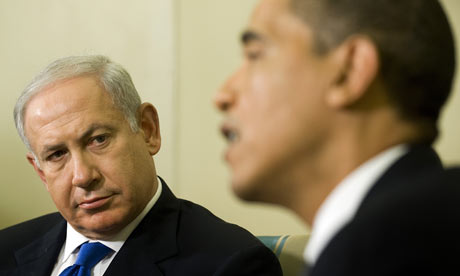
But swirling in the background when Binyamin Netanyahu, the Israeli prime minister, arrives in Washington tomorrow to patch up relations with the White House will be a question rarely voiced until recently: is Israel - or, at the very least, its current government - endangering US security and American troops?
Netanyahu would prefer to be seen as an indispensable ally in confronting Islamist terror. But his insistence on building Jewish settlements in East Jerusalem, which is causing a deep rift with Washington, is seen as evidence of a lack of serious interest in the establishment of a viable Palestinian state. That in turn is seen as fuelling hostility towards the US in other parts of the Middle East and beyond, because America is perceived as Israel's shield.
In recent months Barack Obama has said that resolving the Israeli-Palestinian conflict was a "vital national security interest of the United States". His vice-president, Joe Biden, has confronted Netanyahu in private and told the Israeli leader that Israel's policies are endangering US troops in Iraq and Afghanistan. Senior figures in the American military, including General David Petraeus who has commanded US forces in both wars, have identified Israel's continued occupation of Palestinian land as an obstacle to resolving those conflicts.
More recently, Israel's assault on ships attempting to break the Gaza blockade has compromised relations with Turkey, an important American strategic ally.
A former director of intelligence assessment for the US defence secretary, last month caused waves with a paper called Israel as a Strategic Liability? In it, Anthony Cordesman, who has written extensively on the Middle East, noted a shift in thinking at the White House, the US state department and, perhaps crucially, the Pentagon over the impact of Washington's long-unquestioning support for Israeli policies even those that have undermined the prospects for peace with the Palestinians.
He wrote that the US will not abandon Israel because it has a moral commitment to ensure the continued survival of the Jewish state. "At the same time, the depth of America's moral commitment does not justify or excuse actions by an Israeli government that unnecessarily make Israel a strategic liability when it should remain an asset. It does not mean that the United States should extend support to an Israeli government when that government fails to credibly pursue peace with its neighbours.
"It is time Israel realised that it has obligations to the United States, as well as the United States to Israel, and that it become far more careful about the extent to which it test the limits of US patience and exploits the support of American Jews."
Cordesman told the Guardian that the Netanyahu government has maintained a "pattern of conduct" that has pushed the balance toward Israel being more of a liability than an asset.
"This Israeli government pushed the margin too far," he said. "Gaza was one case in point, the issue of construction in Jerusalem, the lack of willingness to react in ways that serve Israel's interests as well as ours in moving forward to at least pursue a peace process more actively."
It was a point made forcefully by Biden to Netanyahu in March after the Israelis humiliated the American during a visit to Jerusalem by announcing the construction of 1,600 more Jewish homes in the city's occupied east.
The Israeli newspaper Yedioth Ahronoth reported that at a meeting between the two men, Biden angrily accused Israel's prime minister of jeopardising US soldiers by continuing to tighten the Jewish state's grip on Jerusalem.
"This is starting to get dangerous for us. What you're doing here undermines the security of our troops who are fighting in Iraq, Afghanistan and Pakistan. That endangers us and it endangers regional peace," Biden told Netanyahu.
Obama's chief political adviser, David Axelrod, said the settlement construction plans "seemed calculated to undermine" efforts to get fresh peace talks off the ground and that "it is important for our own security that we move forward and resolve this very difficult issue".
Netanyahu sought to head off the issue when he spoke to pro-Israeli lobbyists in Washington earlier this year. "For decades, Israel served as a bulwark against Soviet expansionism. Today it is helping America stem the tide of militant Islam. Israel shares with America everything we know about fighting a new kind of enemy," he said. "We share intelligence. We co-operate in countless other ways that I am not at liberty to divulge. This co-operation is important for Israel and is helping save American lives."
But that argument is less persuasive to the Americans now. Last month, Israel's ambassador to the US, Michael Oren, said the Jewish state had suffered a "tectonic rift" with America. "There is no crisis in Israel-US relations because in a crisis there are ups and downs," he told Israeli diplomats in Jerusalem. "Relations are in the state of a tectonic rift in which continents are drifting apart."
Oren said that assessments of Israeli policy at the White House have moved away from the historic and ideological underpinnings of earlier administrations in favour of a cold calculation.
Cordesman said it is too early to tell whether Netanyahu has fully grasped that while there will be no change in the fundamental security guarantees the US gives Israel, "the days of the blank cheque are over".
He added: "I think it is clear there is more thought on how to deal with Gaza, how to deal with the underlying humanitarian issues, less creating kinds of pressures which frankly, from the viewpoint of an outside observer, have tended to push Hamas not toward an accommodation but toward a harder line while creating of all things an extremist challenge to Hamas. But until you see the end result, some comments and some token actions don't tell you there's been a significant shift."


 Market Data
  Markets


 AI
AI