“Those countries with serious fiscal challenges need to accelerate the pace of consolidation,” it added. “We welcome the recent announcements by some countries to reduce their deficits in 2010 and strengthen their fiscal frameworks and institutions”.
These words were in marked contrast to the G20’s previous communiqué from late April, which called for fiscal support to “be maintained until the recovery is firmly driven by the private sector and becomes more entrenched”.
It’s basically incredible that this is happening with unemployment in the euro area still rising, and only slight labor market progress in the US.
But don’t we need to worry about government debt? Yes — but slashing spending while the economy is still deeply depressed is both an extremely costly and quite ineffective way to reduce future debt. Costly, because it depresses the economy further; ineffective, because by depressing the economy, fiscal contraction now reduces tax receipts. A rough estimate right now is that cutting spending by 1 percent of GDP raises the unemployment rate by .75 percent compared with what it would otherwise be, yet reduces future debt by less than 0.5 percent of GDP.
The right thing, overwhelmingly, is to do things that will reduce spending and/or raise revenue after the economy has recovered — specifically, wait until after the economy is strong enough that monetary policy can offset the contractionary effects of fiscal austerity. But no: the deficit hawks want their cuts while unemployment rates are still at near-record highs and monetary policy is still hard up against the zero bound.
But what about Greece and all that? Look, right now sovereign debt problems are taking place in countries with a very specific problem: they’re part of the euro zone, AND they’re badly overvalued thanks to huge capital inflows in the good years; as a result they’re facing years of grinding deflation. Counties not in that situation are not facing any pressure from the markets for immediate cuts; as of this morning, 10-year bonds were yielding 3.51 in Britain, 3.21 in the US, 1.27 in Japan.
Yet the conventional wisdom now is that these countries must nonetheless cut — not because the markets are currently demanding it, not because it will make any noticeable difference to their long-run fiscal prospects, but because we think that the markets might demand it (even though they shouldn’t) sometime in the future.
I was having an interesting email exchange with a smart person this morning which, in the interest of killing two birds with one stone, I've decided to turn into a post. My correspondent wondered why there was an international move to neo-Hooverism considering the differences in cultures between the various European countries and the US. I replied with a somewhat glib and facile response about disaster capitalism and Pete Peterson, and he pressed for a reason why the rest of the world is on the same bandwagon, especially considering their more generous history with the welfare state. (He also mentioned that Tim Geithner was surprisingly Keynesian at the G20.)
After thinking about it for a bit, I’m not sure the same phenomenon we see here isn’t happening internationally. It’s an article of faith among financial elites across the planet that the welfare state is an abomination and this is a global opportunity to end it. Each culture will deal with it slightly differently --- riots in Greece, marches in France, blog posts in America. But in the end, the result, short of revolution, will be similar everywhere --- the post-war welfare state will be weakened or destroyed. The left is barely relevant anywhere anymore and they simply do not fear any kind of serious populist uprising. I’m not suggesting conspiracy. I think it’s more of a natural result of ideological capture.
I just saw this exchange on CNN between Ali Velshi and some hedge fund manager. They were discussing whether Europe’s woes could come to America:
Hedge fund manager: It all comes down to debt --- if you believe that you can solve the problems that are anchored in debt with more debt… At the end of the day America’s debt to GDP ratio is exactly like Greece. And anytime we have an issue like today’s jobs report, what is the answer? More government, more government spending. Which is going to keep pushing that deficit higher.
Velshi: Hold on hold on hold on. What are you talking about? When you have a jobs report like this week’s there’s got to be more government spending. Where did you hear that from? We’ve been discussing it endlessly and that’s not been anybody’s suggestion.
Velshi was the vociferous defender of government there, insisting that nobody in their right minds was talking about more government spending to create jobs. That’s the limit of our discussion. I know that this is braindead American TV, but I see little appetite to challenge that CW among elites anywhere.
As for Geithner at the G20, I’m guessing that at a minimum, they may see the efficacy of maintaining some flexibility. Their magical thinking hasn’t gotten them to where they hoped it would ---the market hasn’t “fixed itself” at least on terms that are politically sustainable --- and so perhaps they are seeing this as a long term challenge instead of a short term cyclical crisis. I don’t know. But aside from the inadequate stimulus, everything they have said up to now is in service of the hoary old Hooverite ideas about belt tightening and sacrifice even down to giddily announcing they are going to reform social security the "right way." The re-institution of Paygo, the deficit commission, the constant lip service to austerity has led to a validation of the erroneous idea that deficits are causing our economic problems and that government needs to hold back spending to fix them --- when the opposite is true.
I think it's easy to over think this. The world economy is unstable for myriad reasons. But the reasons for insisting on austerity are fairly obvious. The question is whether or not people will see through this or not. Disaster capitalism depends upon the people being confused and stressed for its success. (In that sense, rioting in the streets may actually help them.) And all over the world right now, with the rapid change from globalization and resistance to modernity in general, there is a tremendous amount of social stress and cultural upheaval on top of this economic downturn. It's the perfect time to strike.
Angela Merkel's government threatened with collapse
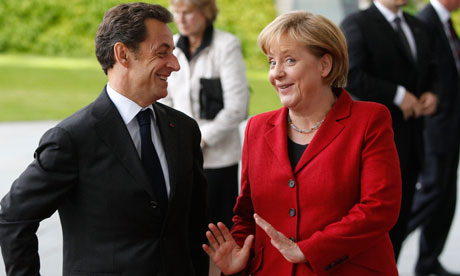
President Nicolas Sarkozy with Angela Merkel in Berlin.
Monday 14 June 2010 18.37 BST
German chancellor Angela Merkel's centre-right coalition government looked to be close to collapse today, weakened by a string of disagreements and intense infighting over austerity cuts, policy reform and the departure of senior conservatives.
Less than eight months after it took office, the government was given only a narrow chance of running to a full term by the majority of Germans, 53% of whom said in a poll they expected it to fall.
"Either we get things sorted out in Berlin, or it will soon be the end for the coalition," said Jorg-Uwe Hahn, head of the Hessen branch of the Free Democrats (FDP), the junior coalition allies of the Christian Democrat Union (CDU) and its Bavarian sister party, the CSU. Renate Künast, leader of the opposition Greens, said: "The phrase 'new elections' is in the head and the heart of anyone who is thinking in a politically responsible way."
Merkel called at the weekend for the government partners to bury the hatchet over their disagreements after a week when relations reached such a low that members of her government had variously referred to each other as "wild pigs" and "gherkin troops" (rank amateurs).
But much of the mistrust and anger is being directed at Merkel herself. This week's Spiegel magazine called her the Trummerfrau, a reference to German women who cleared away the rubble after second world war bombings. It painted a picture of a woman presiding over a government in ruins and used its title page to request the government in one word to "Aufhören!", or stop.
Criticised at home and abroad for mishandling the euro crisis, Merkel's latest political headache is the four-year €80bn (£67bn) austerity package passed last week in an attempt to reduce Germany's deficit. Many of Merkel's own CDU MPs fear a voter backlash after growing criticism that the cuts are socially imbalanced. Almost 80% believe the cuts to be socially unfair, while 67% want an increase in the top rate of tax, which Merkel has strongly resisted. Public anger at the package spilled over at the weekend when thousands of demonstrators took to the streets.
The package has also stoked the anger of Merkel's French counterpart, Nicolas Sarkozy, who has accused the Germans of creating an atmosphere that will stifle growth in Europe at a time when it should be stimulated. Sarkozy arrived in Berlin for talks with Merkel tonight – a meeting which the German leader cancelled at the last minute a week ago, adding to speculation that relations between the two politicians are at an all-time low.
The recent departure of CDU heavyweight Roland Koch, the state premier of Hessen, and the unexplained resignation of Horst Köhler, another CDU man, from the post of president have also left Merkel looking increasingly exposed. Two further ministers have covertly expressed their desire to quit Merkel's government, including its most popular politician, defence minister Karl-Theodor Guttenberg of the CDU, who has faced a backlash over his attempts to scrap compulsory military service, and Philip Rössler, the FDP health minister, whose efforts to reform the health system have been rejected by parts of the bickering government.
The chaos has led commentators to refer to Merkel's administration as a "constipated institution". Writing in the Süddeutsche Zeitung, commentator Daniel Brössler said: "Governments need to be steered, but the Merkel cabinet is no longer steering. It resembles a car where the only thing that's working is the brakes."
All eyes are now on June 30, when politicians will vote for Germany's new president – either the Merkel-backed candidate, Christian Wulff, state premier of Lower Saxony, or the opposition-backed, East German-born Protestant vicar and human rights activist Joachim Gauck. A growing number of FDP politicians are pledging to support the pastor, snubbing Merkel. If Merkel's candidate loses, the common consensus is that the chancellor's position would become untenable.
She would then be likely to face a vote of no confidence in parliament – an event that has happened three times since 1949 – which could ultimately lead to a switch in coalition partners, or more likely, new elections.
The last coalition government to collapse before completing its elected term was the Social Democrat-Green alliance under Gerhard Schröder, which collapsed in 2005.


 Market Data
  Markets


 AI
AI